Tag: trump foreign policy
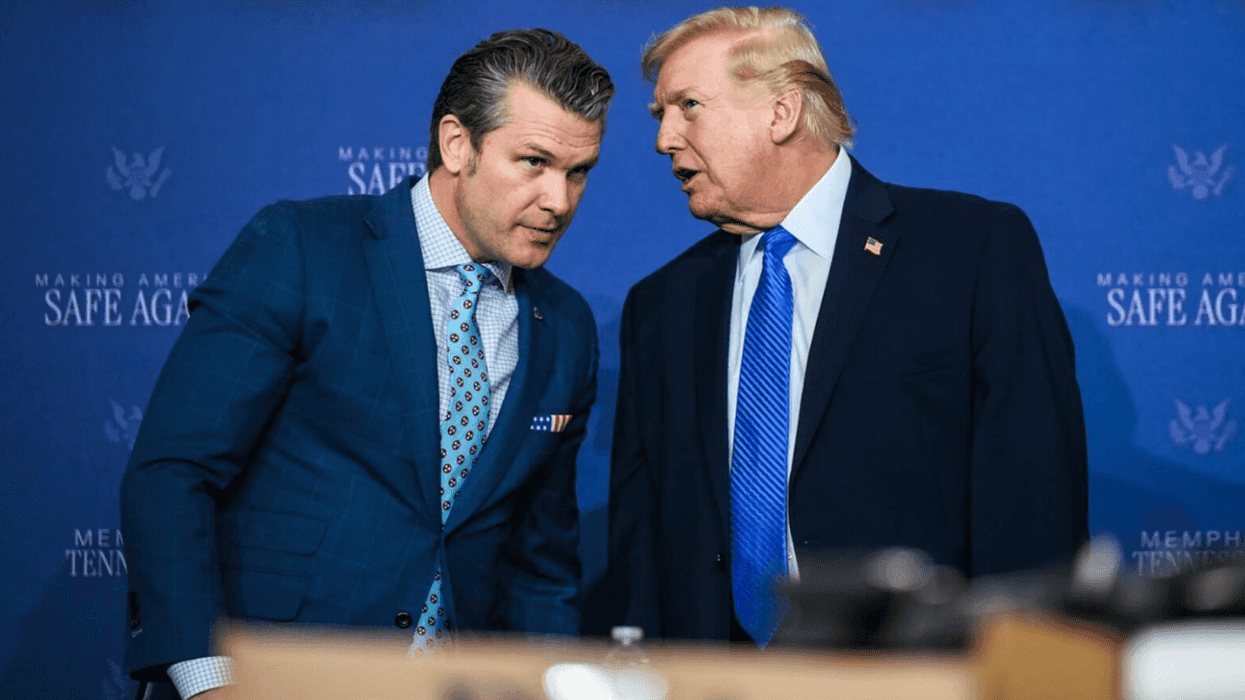
Trump and Hegseth

'Did North Korea Write That?' Trump Blasted For Remarks Praising Communist Regime

President Donald Trump's latest betrayal of a close foreign ally has drawn withering criticism from all corners, with a new piece from MS NOW likening his statement to the words of the infamous dictator he claims to be close with.

Over the weekend, Trump directed Defense Secretary Pete Hegseth via a Truth Social post to "substantially reduce" joint military exercises with South Korea, shortly before new ones were set to commence. He argued that participating in them would be seen as "totally inappropriate and hostile" to North Korea, the dictatorship that he claimed has been "unthreatening and respectful."

"Based on the fact that it is too late to cancel, I have instructed Secretary of War, Pete Hegseth, to substantially reduce the Joint Military Exercises," the post read.Despite the U.S. lacking any formal relations with North Korea, Trump has long insisted on trying to maintain a close relationship with its leader, Kim Jong-un, one of the many global dictators he has expressed a fondness for. He also implied in his post that the decision was a direct response to South Korea declining to aid in his war with Iran.

Writing for MS NOW on Tuesday morning, national security analyst Kevin Baron chastised Trump's statement, arguing that his "description of North Korea sounds like Kim Jong Un wrote it," and questioning why he is choosing to "be blindly trusting that North Korea’s murderous, prison-state regime has turned a page toward global peace."

"Did North Korea write that message?" Baron asked. "With no intelligence, data or proof provided to back up his assertion, Trump appears to be blindly trusting that North Korea’s murderous, prison-state regime has turned a page toward global peace. With that choice, Trump is unilaterally rejecting American intelligence threat assessments, military preparedness and history. He’s also getting nothing in return for it. That’s his prerogative as commander in chief."

Baron further questioned the wording of Trump's justification for the move, saying that it sounded as if he had only just learned that joint exercises with South Korea were about to take place. He also warned that this abrupt decision will carry a "substantial cost," in "dollars, diplomacy, readiness and morale."

"At best, Trump is playing with fire. At worst, he is willfully endangering American lives, interests and influence for the chance at saving money, based on nothing but a gut feeling," Baron continued.He concluded later: "Trump is always hunting for a bargain, but U.S. security is nothing to bargain with.

"America’s forward-deployed military presence and preparedness with allies including South Korea and Japan are what allow people to live in peace and prosperity there, so that we can do so here. It’s not charity. It’s not a gift. It’s a security umbrella. It’s a multibillion-dollar investment and insurance policy on American prosperity. And it’s the best leverage the world has to deter North Korea from doing something catastrophic. On Sunday, Kim got another unearned gift courtesy of the U.S. president: A free pass to never change."

Reprinted with permission from AlterNet

Iowa Dogfight: Trump's Ruinous Policies Shaking Up Ruby-Red State

Iowa Dogfight: Trump's Ruinous Policies Shaking Up Ruby-Red State

President Donald Trump’s policies have hurt farmers so badly, Republicans are getting nervous that they could flip the state in both its Senate and gubernatorial elections.

“Well, number one, this is Iowa and the tariffs are hitting them really hard. Before the tariffs, Donald Trump had a 52 percent approval rating in the state — still not super great for Iowa — but he is currently at 42 percent,” The Bulwark’s conservative founder and political expert Sarah Longwell wrote on Tuesday. “Farmers are losing money, even with the federal subsidies that are trying to offset the impact of the tariffs.”

She added that “soybean farmers are losing about $75 an acre. Trump's one big, beautiful bill kicked nearly 100,000 Iowans off their health insurance. And [Republican Gov. Kim] Reynolds is one of the most unpopular governors Iowa has seen in a while.” In addition to complaining that the school vouchers program requires students to go down to four days a week of schooling, many voters also believe that “the six-week abortion ban they enacted there in Iowa, which people think is too extreme. And then there's this issue of cancer water, which I had not heard about until I started focus grouping in Iowa — but essentially you've got a lot of chemicals going into the water, and a lot of people in Iowa say that they're experiencing incredibly high cancer rates.”

As a result of all these issues, “Cook Political Report currently rates this race as a toss-up. So that's interesting for Iowa — they've got a toss-up for governor. Democrats looking strong.” Reynolds is not running for reelection, but Democratic nominee State Auditor Rob Sand has focused on her unpopular record and is expected to tie his eventual Republican opponent to Reynolds’ governorship.

“Now let's move to the Senate,” Longwell wrote. “We also have an open Senate seat because [Sen.] Joni Ernst has decided not to run again. There's no Republican primary because Ashley Hinson, who is a sitting member of Congress — she's been there for three terms, she's a former state rep, and she was also a news anchor in the state — is the de facto Republican nominee. But the Democrats have kind of an interesting primary. There are two of them: Josh Turek, who I think is likely to win, and Zach Walls.”

She added, “Now, Josh Turek — if you don't know who he is or you haven't seen him — he's in a wheelchair. He has spina bifida, and his dad had exposure to Agent Orange in Vietnam. He's knocking on doors by pulling himself up step by step. He's also a four-time Paralympian and a two-time gold medalist.”

In April, The Economist/YouGov conducted a poll which found that farmers are overwhelmingly opposed to Trump’s tariffs and Iran war, as both policies have raised prices on farmers on important products like fertilizer and gasoline. Despite these concerns, farmers remain one of the most staunchly pro-Trump groups and refuse to abandon their support, instead hoping that he will provide them with economic relief.

“A recent Economist/YouGov poll suggests such troubles are now commonplace,” wrote The Economist on Monday, referring to farmers who struggle to make ends meet thanks to Trump’s policies. “27 percent of rural respondents said it would be ‘impossible’ to cover an unexpected $1,000 bill. It would be easy to blame Mr Trump for the downturn. After all, he campaigned on promises to bring down prices and revive the heartland. But rural America does not.”

The article continued, “The president’s favourability rating is higher among rural voters than among any other group in our survey. Most still think he is doing a good job. In interview after interview with The Economist, farmers said they trust the administration—but that they need help to recoup the losses its foreign policy is causing them.”

Reprinted with permission from Alternet


'One-Hit Wonder': Trump's Military Adventurism Is Sinking In Strait Of Hormuz

'One-Hit Wonder': Trump's Military Adventurism Is Sinking In Strait Of Hormuz

I’ve only time for a quick note, trying to put together some coherent thoughts on what’s going on with the war/econ nexus on which I’ve been focusing in recent days.

The right place to start is the oil price, which has been on a crazy ride and as I write, is well off its peak.

The gas price, however, hasn’t gotten the memo and is up to $3.54 today, up from $3.48 yesterday and $2.92 a month ago.

So, where do we go from here? Here’s the bottom line, as I see it. Warning: this requires understanding Trumpian psychology; do not try this at home.

Trump viewed the Maduro operation as pretty much perfection from his perspective. A literal one-night intervention of shock-and-awe to take out a bad guy, impeccably implemented by our armed forces. No spillover into markets, and, if anything, a play for more oil supply. Never mind that the original Venezuelan regime remains intact.

Iran isn’t that. Yes, there was the same decapitation of an enemy leader—and the same intact regime problem—but there’s this problem called the Strait of Hormuz (SoH). By shutting that down, leavened with attacks on other Gulf energy-providing states, Iran was able to hit us, and even more so Europe, in the wallets. All totally predictable, of course, but these folks don’t do that sort of planning.

When confronted with costs, Trump often backs off. That’s the root of the whole TACO [Trump Always Chickens Out] thing, but also the source of his gentle treatment of China, who used their almost absolute control of the refining of “rare earths”—key inputs into much of our tech and defense production—to back him down.

In this case, Iran is flexing its Strait of Hormuz control, and this raises the economic costs for the rest of the world and the political costs for the Trump admin and their Congressional allies. We can’t know which way this will bounce, but markets seem convinced that the admin is truly about done with this adventure.

If so, what a mess! Iran will have learned that, yes, the US/Israel coalition can hit hard (which they already knew), but at least the senior partner will back off if you shock the oil supply. They need not worry about regime change or even about dialing back of their nuke pursuits.

The provisional punchline is this: give a world-class army to an authoritarian leader who a) faces no constraints from Congress and is served by a bunch of yes-man lackeys and b) fully discounts the future, meaning doesn’t do the geopolitical chess exercise of weighing the many possible implications of his interventions, and he will deploy that army to do one-hit wonders. Take out a global bad guy, claim credit, move on to the next bad guy.

That “worked,” from his perspective, in Venezuela. It did not work in Iran.

Jared Bernstein is a former chair of the White House Council of Economic Advisers under President Joe Biden. He is a senior fellow at the Council on Budget and Policy Priorities. Please consider subscribing to his Substack.

Reprinted with permission from Econjared.

Shop our Store

Headlines

Editor's Blog

Trending

World