Tag: washington post
No, The Times Didn't 'Debunk' Post Report On Alleged War Crime In Missile Strike

No, The Times Didn't 'Debunk' Post Report On Alleged War Crime In Missile Strike

Right-wing commentators have seized upon a New York Times report on the U.S. military’s September 2 extrajudicial killing of 11 people on board a boat the Trump administration alleged was carrying drugs in the Caribbean, claiming that the article “DEBUNKED” a previous Washington Post report that triggered congressional scrutiny over potential war crimes. But the Times actually confirmed, rather than undermined, the Post’s account.

The Post reported Friday that according to its sources, Defense Secretary Pete Hegseth gave a spoken order “to kill everybody” on board the boat before the attack, and that after confirming that the first strike left two survivors, the Navy special operations commander overseeing the action, Adm. Frank Bradley, “ordered a second strike to comply with Hegseth’s instructions,” killing them. Lawmakers of both parties quickly vowed to aggressively scrutinize the attack, which legal experts argued would constitute, “at best, a war crime under federal law.”

Hegseth, in his prior career as co-host of Fox News’ Fox & Friends Weekend, championed U.S. service members accused or convicted of war crimes. In one 2019 segment discussing a soldier charged over the extrajudicial killing of an Afghan man accused of making bombs for the Taliban, Hegseth said, “If he committed premeditated murder … then I did as well. What do you think you do in war?”

Top Trump administration officials over the weekend denounced the “fake news” Post’s “entire narrative” as “fabricated” with “NO FACTS.” But at Monday’s briefing, White House press secretary Karoline Leavitt effectively confirmed — and defended — the actions the Post had reported, including the second strike.

This confusion left President Donald Trump’s most zealous propagandists with few clear pathways to defend the administration’s actions. But after the Times published its own account of the attack on Monday, “plenty of conservatives are now declaring this case closed,” as Politico reported. Indeed, right-wing commentators have claimed that the Times “quietly DEBUNKED” the Post’s “hoax hit piece,” which they said has been exposed as “a genuinely vile slander of both Hegseth and Bradley.”

“Disgrace to journalism that [Post reporters] @AlexHortonTX and @nakashimae got so many details of this story wrong just to smear @PeteHegseth,” posted RedState's R.C. Maxwell, a member of the new Pentagon press corps composed of MAGA shills.

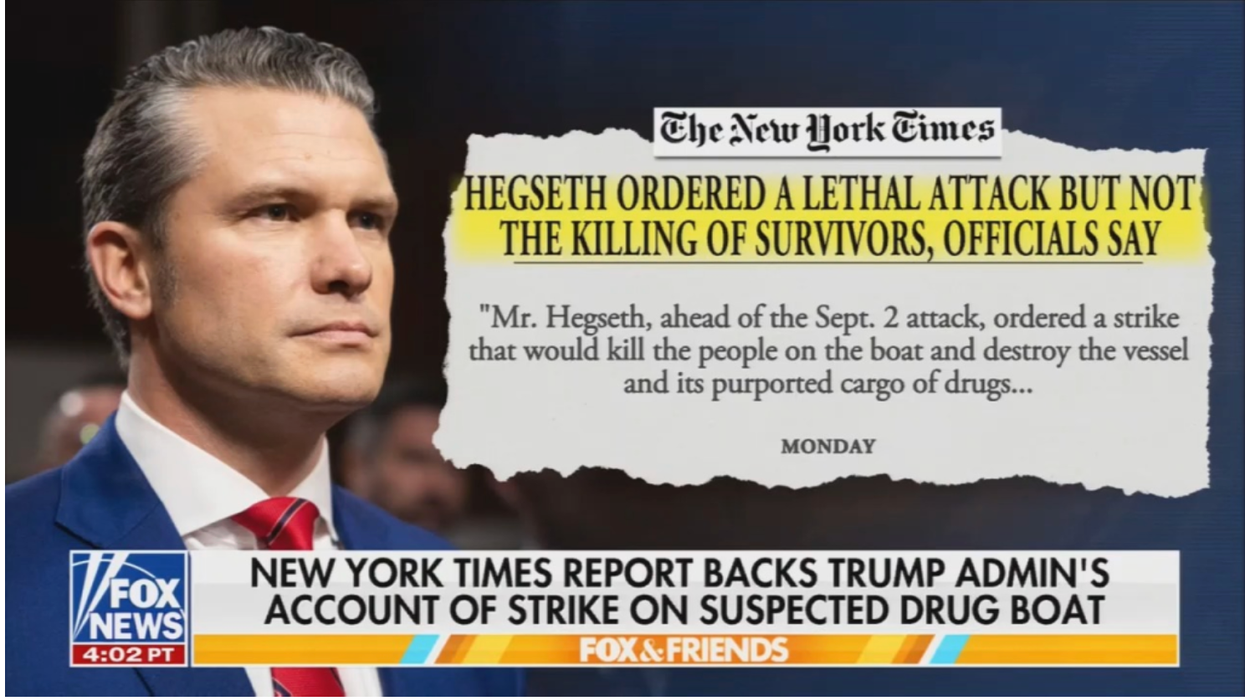
Fox News, Hegseth’s former employer, had devoted 53 minutes of airtime to the story across the four days from Friday through Monday. The bulk of that coverage came from purported “news side” shows; Jesse Watters was the only prime-time host to address the story, while the defense secretary’s old program ignored it altogether. Coverage picked up on Tuesday morning, however: Apparently armed with new marching orders at last, Fox & Friends finally found an angle and reported on how the “New York Times report backs Trump admin’s account of strike on suspected drug boat.”

In reality, the timeline of the September 2 attack laid out in the Times article matches the one provided by the Post.

First, after U.S. intelligence operatives determined that the boat was carrying drugs, Hegseth issued his order to destroy it and kill those onboard.

From The Washington Post:

The longer the U.S. surveillance aircraft followed the boat, the more confident intelligence analysts watching from command centers became that the 11 people on board were ferrying drugs.
Defense Secretary Pete Hegseth gave a spoken directive, according to two people with direct knowledge of the operation. “The order was to kill everybody,” one of them said.

From The New York Times:

According to five U.S. officials, who spoke separately and on the condition of anonymity to discuss a sensitive matter that is under investigation, Mr. Hegseth, ahead of the Sept. 2 attack, ordered a strike that would kill the people on the boat and destroy the vessel and its purported cargo of drugs.
...

In interviews on Monday, two U.S. officials — both of whom were supportive of the administration’s boat strikes — described a meeting before the attack at which Mr. Hegseth had briefed Special Operations Forces commanders on his execute order to engage the boat with lethal force.

Then, the Navy launched an initial strike, which left two survivors, who were killed after Bradley ordered further strikes.

From The Washington Post:

A missile screamed off the Trinidad coast, striking the vessel and igniting a blaze from bow to stern. For minutes, commanders watched the boat burning on a live drone feed. As the smoke cleared, they got a jolt: Two survivors were clinging to the smoldering wreck.
The Special Operations commander overseeing the Sept. 2 attack — the opening salvo in the Trump administration’s war on suspected drug traffickers in the Western Hemisphere — ordered a second strike to comply with Hegseth’s instructions, two people familiar with the matter said. The two men were blown apart in the water.

From The New York Times:

Admiral Bradley ordered the initial missile strike and then several follow-up strikes that killed the initial survivors and sank the disabled boat.

The Times account stresses that Hegseth’s “order was not a response to surveillance footage showing that at least two people on the boat survived the first blast,” and that the defense secretary “did not give any further orders” to Bradley following the first strike — but the Post’s account does not say otherwise.

It is unclear whether the Post’s reporting that Hegseth issued a “spoken directive” to kill those onboard the boat is describing something different from the Times’ reporting that Hegseth briefed commanders on his order to “engage the boat with lethal force.” But both agree that Bradley ordered a second U.S. strike which killed shipwrecked survivors.

That second strike, experts say, constitutes “at best” a textbook war crime (if you accept the administration’s dubious claims that this constitutes a lawful conflict in the first place; otherwise, both strikes are simply murder). Trump said Sunday he “wouldn’t have wanted … a second strike,” though Leavitt defended Bradley ordering one on Monday.

The right-wing complaints amount to hair-splitting over the exact extent of MAGA favorite Hegseth’s responsibility for the allegedly unlawful killings — and it's based on two reports that paint a consistent picture. Did Hegseth cause the second strike with his initial order, or did he merely watch Bradley order it in real time with no apparent qualms about it, then promote Bradley, give a speech urging military leaders to “untie the hands of our warfighters” to ensure “maximum lethality,” and then defend the attack and mock its critics?

Either way, the Times article doesn't vindicate him.

Reprinted with permission from Media Matters
The Media's Rich Owners Want Generations To Fight Each Other -- Not Classes

The Media's Rich Owners Want Generations To Fight Each Other -- Not Classes

The idea of generational warfare is pernicious tripe. It gets pushed endlessly in the media because rich people would rather see kids lashing out at their parents than at them. And since the rich own the media, we hear a lot about generational inequality. Jeff Bezos’ Washington Post gave us the latest effort at generational warmongering.

Just to give some basic facts that are not in dispute, the country is getting richer year by year. Using the projections from the Social Security Trustees, per capital income is projected to be 15.4 percent higher in 2035, 32.6 percent higher in 2045, and 54.3 percent higher in 2055, when virtually all the baby boomers will be dead.

Since the baby boomers are for the most part not going to be partaking in these higher levels of consumption, who do the generational warriors think will be getting this income? It’s worth mentioning that these could prove to be very conservative projections of income growth. If AI has anywhere near the impact its proponents are claiming, per capita income will grow by far more than the Social Security trustees are projecting.

Given the indisputable fact that the country is getting richer, how can there be a story where Gen Xers, Millennials, and Gen Zers will be poorer on average than baby boomers? There is a story where generations can do worse through time, but that would be a story of within-generation inequality, not between-generations inequality.

The problem is not greedy boomers, but rather ridiculously rich people like Elon Musk, Jeff Bezos, and Mark Zuckerberg hoarding the country’s wealth for their own use and the use of their heirs. People are less likely to see that story because these super-rich people are the ones who own the major media outlets and social media platforms, but that is reality.

Given these simple and undeniable facts, it is striking how often we see this generational inequality nonsense. As is the case with this Post piece, they often push outright lies to make their case. For example, this piece tells readers:

“’Baby boomers “entered the labor force during decades of strong economic growth, rising productivity and relatively high real wages,’ Mitchell said. They were in their prime earning and saving years during long bull markets, namely in the 1980s and ’90s, she said, as well as the economic recovery that followed the Great Recession.” ….

“And ‘particularly for middle-income workers, real wage gains since the 2000s have been modest, compared to the robust wage growth that boomers benefited from mid-career,’ Mitchell said.” [Prof. Olivia Mitchell, who teaches business economics and public policy at the University of Pennsylvania’s Wharton School.]

“Post-World War II, ‘you had this tremendous boom that many got to ride for a very long period of time,’ Ney said.” [Jeremy Ney, a professor at Columbia University’s business school.]

This turns reality on its head. As I wrote in a piece last month:

“There was in fact a golden age, but it predated the entry of most boomers into the labor market. The economy experienced a period of low unemployment and rapid real wage growth, which was widely shared, from 1947 to 1973. At the endpoint of this boom period, the oldest boomers were 27, and the youngest were 9.

“After 1973, the economy took a sharp turn for the worst. The most immediate cause was the Arab oil embargo, which sent oil prices soaring. The economy at that time was far more dependent on oil than is the case today. Soaring oil prices sent inflation higher, which prompted the Fed to bring on severe recessions, first in 74-75 and then again in 1980-82.

“The full story is more complicated and highly contested, but what happened to the economy is not. We had a period of far higher unemployment and stagnant real wage growth that lasted until the mid-1990s. The median real wage in 1996 was actually 4.4 percent lower than it had been in 1973.

“The average unemployment rate for people between the ages of 20-24 over the years 1973 to 1988 (when the last boomer hit 24) was 11.3 percent. By comparison, it averaged 7.2 percent over the last decade, although it has been rising rapidly in 2025.”

After stagnating for two decades, the median real wage has been rising modestly for the last three decades.

Finally, the piece includes this inadvertently damning comment for the argument it is trying to push on readers.

“’In 1940 there was a 90 percent chance that you were going to earn more than your parents. To somebody born today, it is just a coin flip,’ Ney said.”

Since average income has risen consistently over the last seventy years and is universally projected to continue to rise (barring a climate disaster), the only reason why most workers won’t earn more than their parents would be a further rise in inequality. In other words, more money going to people like Washington Post owner Jeff Bezos and less money going to ordinary workers.

If there is not a further increase in inequality, then most workers in ten or twenty years will be earning considerably more than do workers today. That is irrefutable logic, which apparently has no place in the Washington Post.

Dean Baker is a senior economist at the Center for Economic and Policy Research and the author of the 2016 book Rigged: How Globalization and the Rules of the Modern Economy Were Structured to Make the Rich Richer. Please consider subscribing to his Substack.

Reprinted with permission from Dean Baker.


Jeff Bezos

The Free Market Op-Ed That Bezos' Washington Post Rejected

The Jeff Bezos-owned Washington Post recently changed its policies on its op-ed page. It replaced most of its former editorial staff and announced a commitment to promoting the free market and free expression.

Many of us have laughed at these ostensible commitments. The Trump administration is probably the most anti-free market presidency this country has ever seen. A president constantly demanding shows of loyalty from private companies is antithetical to free market capitalism. The commitment to free expression also seems dubious in a country where talking honestly about this country’s past or present can be the basis for firing or even criminal charges.

Anyhow, I have often pointed out that many people who ostensibly believe in the free market are just fine with government-granted patent and copyright monopolies, government interventions that transfer trillions of dollars from the rest of us to those in a position to benefit from these monopolies. I joked that the Washington Post op-ed page probably would not be interested in a piece that argued for a free market, as opposed to these government monopolies.

A friend suggested that I write a piece along these lines and see if the Post would take it. I did and they didn’t:

Time for a Free Market in Prescription Drugs

Advocates of “free markets” usually focus on tariffs and government regulations, but they almost never look at the most costly regulations, patents and copyrights. Incredibly, most discussions turn reality on its head and treat these government-granted monopolies as being part of the free market. Powerful interests benefit from these monopolies, but political power does not change reality; patents and copyrights are massive government interventions into the free market.

These monopolies cause problems everywhere, but nowhere is the harm greater than with prescription drugs. The problem of high-priced prescription drugs is entirely an issue of patent monopolies. Drugs are almost always cheap to manufacture and distribute, the reason why some drugs sell for hundreds or even thousands of dollars per prescription, is that the government has granted a patent monopoly.

The patentholder can go to court to stop any competitors from producing the same drug. If their competitor persists, they will face huge penalties, possibly including jail time.

There is an enormous amount of money at stake with prescription drugs. We will spend over $700 billion this year on prescription drugs and other pharmaceutical products. If these drugs were all sold in a free market, without patent monopolies or related protections, they would likely cost less than one-fifth as much.

The difference of $560 billion comes to $4,400 per household annually. It’s more than the cost of the “Big Beautiful Bill.” It’s even more money than President Trump hopes to raise from his tariffs. It is real money by any standard.

But the money at stake is only part of the story. The huge profits drug companies can make from selling drugs at prices in the hundreds or thousands of dollars per prescription, that cost them $10 or $20 to produce, gives them enormous incentive to mislead doctors and the public about their safety and effectiveness.

The most extreme case of dishonest drug pushing was the opioid crisis. The major manufacturers paid out huge settlements over allegations that they deliberately provided misleading information about the addictiveness of the new generation of opioids.

While opioids are an extreme case, the problem of drug companies providing misleading information about their products is well known. Medical journals have long had to contend with ghost-authored articles, where doctors lend their names to pieces written by a person paid by a pharmaceutical company. Similarly, doctors have often taken payments to give talks at medical conferences praising a company’s drugs. With so much money at stake, there is no easy way around this problem.

Also, drug companies routinely game the system to find ways to extend their monopolies and keep out generic competition. And they spend hundreds of millions on campaign contributions and lobbying Congress to make their patents longer and stronger.

Patent monopolies do serve an obvious purpose. They give drug companies an incentive to conduct research and develop new drugs.

This would be a powerful argument for patents if they were the only way to provide this incentive. However, there are alternatives, most obviously just paying for the research upfront.

We already did this to a large extent. Before the cuts put in place by the Trump administration we were spending over $50 billion a year on biomedical research through the National Institutes of Health and other government agencies. Almost everyone familiar with the research considered this to be money very well spent.

While most of this funding went to support basic research, there is no reason that we could not triple or quadruple the funding to include downstream research. It could pay for the development and testing of new drugs, with all new drugs available to be produced as generics in a free market from the day they are approved by the Food and Drug Administration.

This would end the problem of high-priced drugs and also eliminate most of the incentive to mislead the public about the safety and effectiveness of drugs. This risk could be further reduced by requiring that all research be fully open source, with all new findings and test results available on the Internet as quickly as practical.

This sort of system of publicly supported research can be sliced and diced in a thousand different ways. Rather than having a single government agency dishing out the funds, there could be private companies, like our current drug companies, that would compete for long-term contracts (e.g. 10-20 years) to undertake research in different areas.

Dean Baker is an economist, author, and co-founder of the Center for Economic Policy and Research. His writing has appeared in many major publications, including The Atlantic, The Washington Post, and The Financial Times.

Reprinted with permission from Substack.

Trump's Corrupt Deal With Big Oil Comes To Fruition

Trump's Corrupt Deal With Big Oil Comes To Fruition

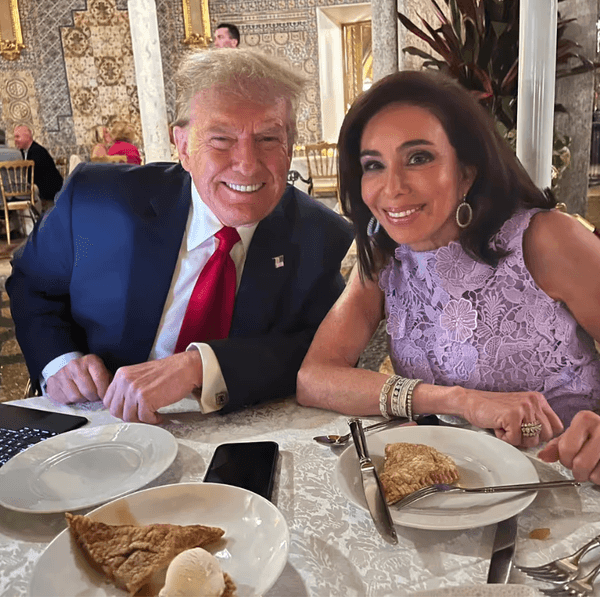
Last May, The Washington Post published an exclusive story on a dinner at Mar-a-Lago in which Donald Trump promised to reverse then-President Joe Biden's actions on climate change as he asked Big Oil executives to fundraise $1 billion for his presidential campaign, assuring that they would be getting a “deal” due to the “taxation and regulation they would avoid thanks to him.” Reportedly, oil and gas executives did make “significant contributions to the Trump campaign.”

Over a four-day period, MSNBC was the only major TV network to cover the story, which All In host Chris Hayes described as “a political quid pro quo.”

Now, two new stories emerged this week that give more context to the promised “deal” the oil and gas industry is getting under Trump’s second term. National TV networks should inform their audience about how Big Oil is benefitting under Trump.

Bloomberg reported on June 17 that the Senate version of Trump’s “One Big Beautiful Bill” now includes a tax break for the oil and gas industry “estimated to be worth more than $1 billion.”

The provision would allow energy companies subject to a 15% corporate alternative minimum tax to deduct certain drilling costs when calculating their taxable income. Companies including ConocoPhillips, Ovintiv Inc. and Civitas Resources, Inc. lobbied in favor of it.

The change was included in the legislation released Monday by Republicans on the Senate tax writing committee, which would slash tax credits for wind, solar, electric vehicles and hydrogen.

Other supporters of the measure, which wasn’t included in the House version of the bill, include the Domestic Energy Producers Alliance, founded by oil billionaire and Trump donor Harold Hamm.

The same legislation would repeal tax credits for the clean power industry, which would threaten more than 800,000 jobs and raise energy prices for consumers.

In fact, clean energy technologies constituted 93 percent of new power generation capacity added to the grid last year alone, and the climate provisions in the Inflation Reduction Act which Trump wants repealed, “have spurred the highest levels of factory construction in American history, with more than 400,000 new jobs announced across the country.”

Meanwhile, CNN reported on June 16 that “the Environmental Protection Agency has told staff overseeing the country’s industrialized Midwest — a region plagued by a legacy of pollution — to stop enforcing violations against fossil fuel companies.”

Four sources with knowledge of the situation at the EPA’s Region 5 office, which oversees six Midwestern states, told CNN that enforcement officials were informed that “there is a pause on oil and gas enforcement” at staff meetings.

“That is how our regional management is interpreting signals from the president,” the EPA enforcement staffer said.
Officers stopped being able to issue notices of violation or send information requests to fossil fuel companies suspected of polluting, the sources told CNN. A violation notice is a prerequisite for taking a company to court for alleged violations of environmental laws.

These instructions are on top of other administration efforts to radically reduce safeguards that protect Americans from fossil fuel-related pollution and open up more land for oil and gas drilling.

Earlier this month, for example, the EPA announced plans to eliminate Biden-era regulations limiting the amount of carbon emissions and other pollution released into the atmosphere by fossil fuel-fired power plants. CBS reported the rule the EPA seeks to revoke “is projected to reduce 1.38 billion metric tons of carbon dioxide from entering the atmosphere by 2047, as well as eliminate tens of thousands of tons of other harmful air pollutants that are dangerous to public health” — an amount of pollution “equivalent to driving more than 320 million gas-powered cars for a year, according to an EPA estimate.”

The new CNN report also notes:

An early snapshot of enforcement data from Trump’s start of his second term shows the overall number of EPA enforcement cases initiated or closed across sectors has dropped by 32% compared with the first three months of the Biden administration, according to publicly available EPA data analyzed for CNN by environmental watchdog Environmental Integrity Project. The same data shows nearly 60% fewer cases have been initiated or closed compared with the first three months of Trump’s first term.

Taken together, these reductions in taxes, regulations, and enforcement for the fossil fuel industry are essentially what Trump promised to deliver for Big Oil in exchange for backing his 2024 campaign.

At the time, The Atlantic’s David A. Graham described the proposition as “undeniably scandalous.” Now that these gifts to Big Oil are being delivered, TV networks should inform their audience about the dirty “deal” between Trump and Big Oil playing out at the expense of the booming clean energy industry, our health, and our climate.

Reprinted with permission from Media Matters.

Shop our Store

Headlines

Editor's Blog

Corona Virus

Trending

World