Tag: wealth tax
Elizabeth Warren

California's Tax On Billionaires May Work -- But There's A Better Solution

A coalition of unions and other progressive groups is trying to get an initiative on California’s ballot this fall which would impose a five percent tax on the wealth of the 200-250 billionaires living in the state. The tax would be retroactive, so it applies to billionaires who lived in the state as of January 1 of this year. The supporters estimate that it could raise $100 billion, almost 30 percent of the state’s annual budget, although the tax could be paid over five years.

Many people have asked me what I thought about the tax. I confess to originally being hesitant. I have no problem with hitting billionaires with a much higher tax bill than they now face. After all, they are the ones with the money.

The right likes to push the story that billionaires won’t have incentive to become ridiculously rich if we tax them more. I always found that absurd, but even taken seriously what would it mean? Will Elon Musk spend less money and effort bribing politicians to get government contracts and favorable regulatory treatment if we tax him too much?

But that aside, I do take seriously concerns about evasion and avoidance. Billionaires care a lot about their money, and they are prepared to go to great lengths to avoid having to surrender it to the government. There clearly is some point at which we get less tax revenue by raising rates, as a result of evasion and avoidance. And that point is lower at the state and local level than the national level, since it’s much easier for billionaires to move out of New York City or California than to leave the United States.

On this point, I was influenced by research by Joshua Rauh and Ryan Shyu showing that the state lost 60 percent of the revenue anticipated by California’s 2012 Proposition 30. This raised the marginal tax rate on people earning more than $1 million a year from 10.3 percent to 13.3 percent. This suggested to me that California was very close to this tipping point. (It got closer when Trump’s 2017 tax bill limited the deduction for state and local taxes on the federal taxes.)

Rauh works at the conservative Hoover Institute, so I naturally viewed the work with suspicion, but I could not see anything wrong with it. (If anyone can tell me where they messed up, I’m all ears.)

Anyhow, recognizing that avoidance and evasion are real, I have always been cautious about efforts to whack the rich with very large taxes. I am open to the California wealth tax because its structure seems to minimize this risk.

By making the date at which the wealth tax applies in the past, rich people cannot leave going forward. I was concerned about some billionaires fleeing when the tax was being discussed in the fall, and it seems some did, but at this point that’s water under the bridge.

To be clear, I’m absolutely certain that many of the people facing the tax will do everything they can to try to escape the tax, starting with defeating the initiative, and then tying it up in the courts as long as they can. With the ultimate decision likely to rest with the Republican Supreme Court, I’m not at all confident that the state will see the money, but we can’t preemptively surrender. At this point it seems worth going full speed ahead with the initiative.

The Longer Term: Let’s Not Have Billionaires

My bigger complaint with the effort to tax back some of the billionaires’ billions is that we should be more focused on not letting them be billionaires in the first place. There is an incredibly lazy view that we just have a market sitting there, which generates inequality, and then we need the government to step in to redistribute income.

More than a decade ago, Sen. Elizabeth Warren (D-MA), who I greatly admire, did a viral video that was dubbed “you didn’t build that.” The gist of it was that the success of rich people depended on a social and physical infrastructure that was paid for by the whole of society, not just the hard work and ingenuity of the person who happened to get rich.

This is very true. To be profitable, a factory needs the roads and ports to bring their materials in and ship their finished product out. It also needs a skilled workforce to be both on the factory floor and to handle business operations. No one can get rich by themselves.

Elizabeth Warren Doesn’t Go Far Enough

But this is only part of the story. In addition to the physical and social infrastructure, we have a massive set of rules that determine who gets to keep the goodies. I keep harping on government-granted patent and copyright monopolies, both because there is a huge amount of money at stake (easily over $1 trillion a year or $8k per household) and because they so obviously could be different.

We can make these monopolies shorter and weaker, allowing their holders to profit much less from them. Also, we can rely more on alternative mechanisms, like direct public funding of research, as we do currently with more than $50 billion a year in biomedical research at the National Institutes of Health. Many of today’s yacht-loving billionaires would still be working for a living with different rules on intellectual property.

Labor law is another obvious case where governments set the rules, and they could be structured in a way far more beneficial to workers. In the early post-World War II era it was widely recognized that large corporations with monopolistic power dominated the economy, but that was not necessarily seen as a bad thing, because their workers also benefited from higher wages. This was due to the fact that they were unionized and able to demand their share of the benefits from monopolistic power.

This is much less the case today because unions are far weaker. But that is not a natural outcome, the rules on labor-management relations were written to make workers weaker. There is no natural market in this story, the government writes the rules to make them more beneficial to one side or the other.

Just to give a few examples: the prohibition on secondary boycotts in the U.S. is a regulation that unambiguously weakens unions. A secondary boycott would mean Elon Musk’s suppliers could be struck over sending him steel, if he didn’t give the auto workers at Tesla a big pay hike.

The ban on union shops (“right-to-work”) in most states, where all the workers who benefit from a union pay their share of the union’s costs, is a government intervention against freedom of contract. This also weakens workers. Restrictions or outright bans on collective bargaining by gig workers is another example. In addition, there could be serious penalties for violating labor laws, as in millions of dollars in fines from real courts, rather than joke sanctions from the National Labor Relations Board.

None of this is “the market.” This is a story of government policy designed to give more money to the oligarchs.

The list goes on. Mark Zuckerberg, and now Larry Ellison, would be much poorer without Section 230, which protects their massive social media platforms from the same sort of liability for spreading lies that print and broadcast media face. Different bankruptcy laws, that made private equity firms liable for the debts of the companies they take over and then push into bankruptcy, would likely have prevented many of today’s billionaires, as would applying a sales tax on financial transactions similar to the sales tax people pay when they buy clothes or shoes.

This is the topic of my now dated book Rigged (it’s free). The point is that the market is infinitely malleable. We can structure it in a way that leads to far more equality or in ways that gives all the money to billionaires, as we have done in the last half century.

In that context, by all means we should try to find creative ways to tax back some of the wealth we have allowed them to accumulate, but it makes much more sense, and it’s much more efficient, not to structure the market in a way that gives them all the money in the first place.

Dean Baker is a senior economist at the Center for Economic and Policy Research and the author of the 2016 book Rigged: How Globalization and the Rules of the Modern Economy Were Structured to Make the Rich Richer. Please consider subscribing to his Substack.

Reprinted with permission from Dean Baker.
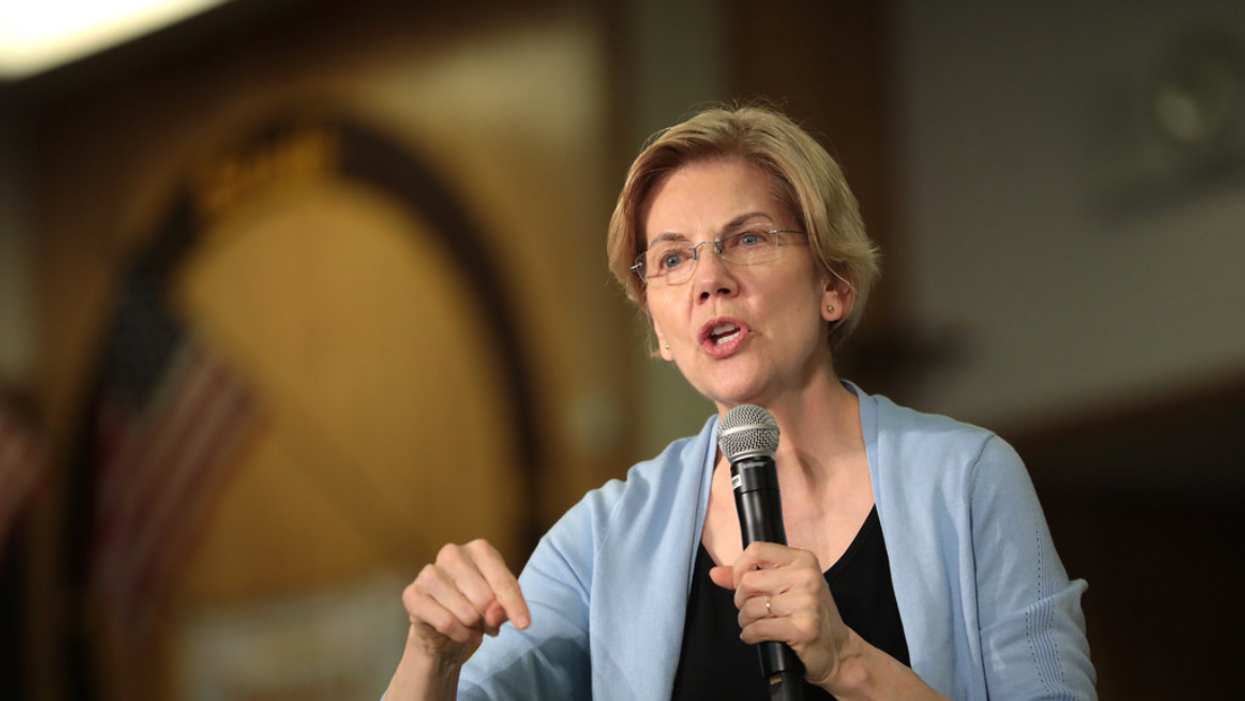
Proposed Tax On ‘Ultra-Millonaires’ Could Raise Trillions In Revenue

Proposed Tax On ‘Ultra-Millonaires’ Could Raise Trillions In Revenue

Reprinted with permission from American Independent

Three congressional Democrats unveiled a plan Monday to raise $3 trillion in new revenue over the next decade. By taxing only those worth more than $50 million, the proposal would not raise taxes on 99.95 percent of Americans.

Sen. Elizabeth Warren of Massachusetts, Rep. Pramila Jayapal of Washington, and Rep. Brendan Boyle of Pennsylvania introduced the Ultra-Millionaire Tax Act of 2021, which would establish a two percent annual tax on the net worth of those taxable assets of $50 million to $1 billion. Those worth more than $1 billion would pay a three percent annual tax.

"The hyper concentration of wealth among a tiny number of multimillionaires and billionaires is a crisis for American capitalism and the American Dream," Boyle said in a press release. "Wealth inequality is at its highest level since the Gilded Age. The wealth share of the richest 0.1 percent has nearly tripled since the late 1970s. It is time for the ultra-millionaires to pay their fair share so that critical government programs can be bolstered to help the everyday American."

The sponsors circulated an analysis by University of California, Berkeley, economics professors Emmanuel Saez and Gabriel Zucman that predicted the wealth tax would affect only 100,000 families and would raise $3 trillion in new federal revenue between 2023 and 2032.

The proposal comes as Republicans in Congress are making a big deal about the growing national debt they helped rack up and using the budget deficit as an excuse to oppose President Joe Biden's priorities, such as COVID-19 relief.

"For too long, Congress has maxed out America's credit card with no plan to pay off our debts. The disastrous impacts of this reckless spending and growing debt, like high inflation, will hurt low and fixed income families the most. We must do better," tweeted Florida Sen. Rick Scott on February 16.

"Eventually USA $28 Trillion debt bill becomes due," warned Rep. Mo Brooks of Alabama on Thursday. "Friday #Socialist #Democrat debt junkies to borrow & spend ANOTHER $2 Trillion."

This wealth tax could either offset some of those previous expenses or enable new spending without increasing the debt.

According to the Saez-Zucman analysis, the richest Americans would be asked to pay about 4.3 percent of their wealth each year on average, compared to an estimated 3.2 percemt in 2019.

A Data for Progress poll, taken in 11 states between July and September 2020, found widespread public support for the idea of a two percent wealth tax on those with a $50 million-plus net worth.

Among all voters surveyed, 62 percent preferred adopting the idea, compared to 26 percent who preferred the current system. Even in the deep-red state of Mississippi, voters preferred the wealth tax 55 percent to 30 percent.

The proposal comes as Republicans are trying to change their image as the party looking out for the very rich.

"The uniqueness of this party today is we're the workers' party, we're the American workers' party," claimed House Minority Leader Kevin McCarthy in a Feb. 8 Punchbowl News interview.

Sen. Ted Cruz of Texas tweeted Friday, "The Republican Party is not just the party of country clubs, the Republican Party is the party of steel workers, construction workers, pipeline workers, police officers, firefighters, waiters and waitresses." He also tweeted Friday, "The Republican Party is not the party of the country clubs, it's the party of hardworking, blue-collar men and women."

Still, not a single Republican lawmaker has co-sponsored the Ultra-Millionaire Tax Act so far.

In addition to the three lead sponsors, it is co-sponsored by Sens. Bernie Sanders (I-VT), Sheldon Whitehouse (D-RI), Jeff Merkley (D-OR), Kirsten Gillibrand (D-NY), Brian Schatz (D-HI), Ed Markey (D-MA), and Mazie Hirono (D-HI).

Published with permission of The American Independent Foundation.

Can America Afford To Underwrite Universal Child Care?

Can America Afford To Underwrite Universal Child Care?

Reprinted with permission from The American Prospect.

When Senator Elizabeth Warren issued a bold plan for universal child care last week, the question some people asked was the usual one: How will she pay for it? Warren has a good answer to that question, which I’ll come to. But there’s a second question that is actually more difficult: How will child care get the necessary public and media attention to make it a top priority?

In 2016, Hillary Clinton issued a proposal for universal access to child care that was similar to Warren’s, though not as extensive. Clinton called for federal subsidies to cap child care costs at 10 percent of family income, whereas Warren proposes to cap those costs at 7 percent. Like Warren today, Clinton wanted to build on existing locally run programs such as Head Start to make child care affordable for all families. And like Warren, Clinton also framed the program as serving the purposes of both economic growth and family well-being, as Katie Hamm and Sarah Jane Glynn of the Center for American Progress explained in a fall 2016 American Prospect article, “Putting Family Policy on the Governing Agenda.”

Some people writing this week about Warren’s proposal seem to have forgotten or to be unaware that the last Democratic presidential candidate wanted to move in the same direction. But if you never heard about that Clinton child-care proposal, it’s hardly your fault. Media coverage of all substantive policy issues was astonishingly limited in the 2016 presidential race. In a study in the Columbia Journalism Review, Duncan J. Watts and David M. Rothschild found that in just the six days after FBI Director James Comey announced the reopening of the agency’s email inquiry, The New York Times published as many cover stories about Clinton’s emails as it had published about all policy issues combined in the two months before the election.

The analog to coverage of Clinton’s emails may be coverage about Warren’s Native American ancestry. Still, the chances may be better this time for putting work-family issues at the center of public debate. The midterms saw an upsurge of political activism among women and a record number of women elected to Congress, and the race for the Democratic presidential nomination has not just one woman in the running but at least four who are in the top tier of candidates.

That’s not to say child care is exclusively a “women’s issue,” just that women in the public arena are more likely to make an issue of it. The changes in gender politics over the past several years could help elevate child care to the prominence it deserves. Let all the candidates, not just Warren, come up with proposals and debate child care the way Democratic candidates in recent elections have debated health-care reform.

Back to the financing: In a column on paying for a progressive agenda, Paul Krugman makes a useful distinction among three types of expenditures: investments that can be paid for through borrowing because they generate an economic return; benefit enhancements that can be paid for through higher taxes on the rich; and major system overhauls that involve such drastic changes in taxes and social arrangements that Democrats would be wise to put them off.

As an example of a major system overall, Krugman points to pure Medicare for All proposals that would replace employer-sponsored coverage with tax-financed public insurance. As he says in an understatement, that would be “a much heavier political lift” than the other two types of expenditures: “You don’t have to be a neoliberal tool to wonder whether major system overhaul should be part of the Democratic platform right now.”

That’s exactly my view of Medicare for All proposals, but that is not tantamount to saying Democrats should refrain from ambitious ideas. On the contrary, those other ambitious ideas—like universal child care—wouldn’t have a chance if Medicare for All, with its staggering fiscal demands, dominates Democratic priorities. As Krugman argues, Democrats have options that are both good policy and good politics for financing both big investments (such as many of the Green New Deal ideas) and benefit enhancements (such as universal child care). Those are the ideas that should be at the top of their agenda for 2020.

Warren calls for financing her Universal Child Care and Early Learning Act with the proceeds from the wealth tax that she proposed earlier—a tax of 2 percent on net worth for people with more than $50 million in assets and an additional 1 percent for those with more than $1 billion in assets. Public opinion surveys have shown strong support for the general idea of higher taxes on the rich and in particular for Warren’s wealth tax. I have some concerns about the wealth tax because of its vulnerability to a challenge in the Supreme Court, given the Court’s current right-wing majority. But I believe its aims could be achieved through changes in the income and estate taxes, where the legal foundations are firm.

In an economic analysis of Warren’s proposal, Mark Zandi and Sophia Koropeckyj of Moody’s Analytics find that the wealth tax would more than cover the cost of the child care plan, which they put at $70 billion annually, when taking into account its first-order economic effects in stimulating consumer spending and increasing labor participation. There are also longer-term benefits from improvements in early childhood learning; to use Krugman’s categories, the child-care proposal is both an investment and a benefit enhancement.

Of course, there’s a lot more that would need to be done to resolve the problems in child care. Warren’s proposal aims to improve the pay of child-care workers and the quality of child-care services, but it would take time and government involvement to build out the capacity to provide that high-quality care on a fully universal basis. An alternative approach presented last week by Matt Breunig calls for more direct government involvement on the supply side and free access to child care (under Warren’s proposal only families with incomes below twice the poverty level would get child care at no charge). Curiously enough, coming from the left, Breunig also criticizes Warren’s proposal for not including payments to parents who care for their children at home and for lacking adequate cost controls (and he may well be right about that).

These are exactly the kind of questions that ought to be front and center in the national debate on child care policy as the 2020 campaign unfolds. It’s time American politics gave young families the attention and help with child-care costs they need. This baby is long overdue.

At Last, Democrats Have Broken The Taboo On Raising Taxes

At Last, Democrats Have Broken The Taboo On Raising Taxes

Shop our Store

Headlines

Editor's Blog

Corona Virus

Trending

World