Tag: zohran mamdani
Zohran Mamdani

Mamdani Won Big -- So Why Aren't The Wealthy Fleeing New York City?

One of the silliest preelection narratives around the New York City mayoral race was the supposed fear that a victory by democratic socialist Zohran Mamdani would spark an exodus of the city’s wealthy elite.

Billionaire investor and all-around Trumpian asshole Bill Ackman was typical of the lot, crying on X this past summer that both businesses and wealthy people had “already started making arrangements for the exits.” Barstool Sports founder Dave Portnoy, another obnoxious MAGA bro, claimed he might move his company out of New York “because I hate the guy.” His grand plan? Move to New Jersey. Equally high-tax, equally liberal. So … yeah.

Grocery mogul John Catsimatidis, who runs the Gristedes and D’Agostino Supermarkets chains, also threatened a move to New Jersey.

“We may consider closing our supermarkets and selling the business,” the 76-year-old entrepreneur told The Free Press. “We have other businesses. Thank God, we have other businesses.”

And it wasn’t just right-wingers. NewYork’s Democratic Gov. Kathy Hochul fretted about a potential Mamdani win because “I don’t want to lose any more people to Palm Beach. We’ve lost enough.”

Experts have been rolling their eyes at these threats all along.

“There is tax-induced mobility. It’s not non-existent but it’s very small,” Quentin Parinello, a tax expert, told ABC News.In major cities like New York, people value the arts, business opportunities, and the ability to hire talent. ABC’s reporting includes several researchers making the same point: While the wealthy love to complain and posture, they rarely follow through.

“Movement of rich people on the basis of tax differentials is relatively small,” said Northwestern University professor Jeffrey Winters. “It’s very common for them to threaten to move. The risk is grossly overstated.”

Think of everyone who said they’d move to Canada if Donald Trump won the presidential race. Talking is always easier than acting.

Still, the New York Post—being the right-wing tabloid it is—keeps trying to manifest this fantasy.

“‘Mamdani effect’: Miami realtors report 166% spike in inquiries from wealthy NYC residents,” blared a recent headline. But even the story immediately contradicts itself: “Manhattan luxury contracts actually jumped 25% in November… a surge some brokers said shows ‘there is no Mamdani effect.’” The only sources in the Post story claiming otherwise are Miami real estate agents who make money convincing New Yorkers to relocate.

And since the Post didn’t bother providing raw numbers, that “166% spike” could literally mean inquiries went from three to eight. A phone call isn’t a move. Honestly, the number is almost certainly made up.As for real numbers?

“Sales of luxury homes in Manhattan jumped in November, countering fears that the election of Zohran Mamdani as mayor would drive out wealthy residents,” Bloomberg reported. Buyers signed contracts on 176 homes priced at $4 million or more, up 25 percent from the month prior. These included condos purchased for around $24 million each. Not exactly a market in retreat.

There’s an even more telling statistic: Luxury housing inventory is down.

“Inventory actually fell 16 percent in the luxury market from October 2024 to October 2025, indicating that there is no flood of New Yorkers selling their homes and leaving town,” reported USA Today. If the wealthy were running for the exits, inventory would be skyrocketing. Instead, it’s tightening.

Of course no one likes paying higher taxes. Even those of us who believe in a functional government don’t enjoy writing the check every year—we just see it as the cost of a society that works. So it’s natural for wealthy New Yorkers to gripe about an extra two percent tax on incomes over $1 million (which likely won’t happen anyway; Albany leaders seem uninterested in backing Mamdani’s campaign proposal).

But the reality is that New York City’s wealthy residents get a lot for what they pay. Another Bloomberg story features David Bahnsen, a Republican wealth manager who sits on the board of the conservative National Review. He despises the city’s liberal politics, calling them “contemptible.” And while he frets about potential tax increases, he isn’t going anywhere.Bahnsen openly acknowledges that New York gives him advantages he can’t get anywhere else—the clients, the talent, the nonstop drive of the place. What really hooks him, he says, is “the energy of the city, the ambition.” That spark doesn’t exist in the low-tax red-state enclaves conservatives claim are paradise. Certainly not in Florida.

And he’s not just staying—he’s thriving: morning jogs in Central Park, Broadway shows, dining out every night, walking 40,000 steps on a typical weekend, even working out of offices that are steps from the Museum of Modern Art. Sounds pretty good, actually.

And that’s really the dynamic at play: The wealthy stay because New York gives them a lifestyle they can’t replicate anywhere else. The city’s appeal isn’t just the museums, the theater, the restaurants, or the talent pool—though all of that matters. It’s the density of opportunity. It’s being in a place where the most ambitious people in the world cross paths every single day. Deals get made over coffee because everyone who is anyone is already there. Entire industries cluster on the same few blocks. For people with the freedom and means to take advantage of all that, the cost of living is simply baked into the price of admission.

For them, the taxes aren’t a deterrent because New York City delivers something tangible in return: world-class public amenities, a creative and economic ecosystem unmatched anywhere in the country, and an energy that makes even the most stubborn conservative wealth manager admit the city is worth it. As Bahnsen said—perhaps after skimming another anti-tax screed in the magazine he bankrolls—Central Park alone is “worth the cost of living in the city.”

And he’s right. Where else can you step out of a skyscraper, walk a few blocks, and be surrounded by 843 acres of urban wilderness, all maintained and accessible because New Yorkers collectively pay for it? And nothing Mamdani has proposed threatens any of that.But New York City’s price of admission isn’t the same for everyone. The amenities, energy, and opportunity that make New York irresistible to the wealthy don’t trickle down—they get walled off by the city’s staggering cost of housing, child care, transit, and daily life. If you can’t buy your way into the version of the Big Apple that’s thriving, you get squeezed into the version that isn’t. And eventually, you get pushed out entirely.

Northwestern University professor Winters highlights that point.

“We are worried about the outflow of the very wealthiest people… when in fact the biggest outflow of people is among those who can’t afford even the basics of staying there,” he warned.

The rich aren’t fleeing Mamdani’s New York. But the working class and the struggling middle class? They’ve been leaving for years because the price of admission keeps rising while their access to the city’s prosperity keeps shrinking.

That is the energy Mamdani tapped into. That’s what led to his resounding victory.

And that is New York City’s real challenge in the years ahead.

Going Nowhere, Or Learning To Ignore The Plutocrats Who Cried 'Commie!'

Going Nowhere, Or Learning To Ignore The Plutocrats Who Cried 'Commie!'


The reaction of plutocrats to the Zohran Mamdani campaign — histrionic freakout before the mayoral election, with promises to flee New York City if he won, followed by a big “never mind” when he did — can teach us a couple of things.


First, ignore billionaires when they threaten to take their marbles and go home. The big money always responds to threats of tax hikes, or even mere verbal criticism, by threatening to go all Ayn Rand and move to Galt’s Gulch. In reality, they won’t even move to Florida.

You may recall that a couple of years ago there was a lot of talk about how the financial industry was going to flee blue-state taxes and wokeness and move to Miami. And to be fair, some companies did move. Notably, Ken Griffin, a hedge-fund billionaire and a big Trump backer, made a splash when he did indeed move the global headquarters of Citadel and Citadel Securities from Chicago to Miami.

But the second headline above comes from a CNBC report on remarks from top commercial real estate executives, who see Mamdani having little impact on booming demand for offices in New York. This includes plans by Griffin to rent substantial space in a new building at 350 Park Avenue. “Ken is committed and will have more employees at 350 Park than in Miami,” said one executive.

Why won’t plutocrats flee New York? For one thing, they’re not stupid (although they were hoping that voters were.) Mamdani might — might — be able to raise their taxes a bit. But they don’t really believe that free buses and city-run grocery stores will turn one of America’s safest cities into a post-apocalyptic landscape. And New York will retain formidable advantages thanks to agglomeration economies — the advantages of locating a business where many other related businesses are concentrated.

As Bloomberg put it,

For workers in finance and a range of other industries, no technology has so far replaced New York’s longstanding specialty, the face-to-face chat. In-person meetings remain essential for sniffing out who you can trust, what deals might be brewing and which rumors to believe. And from Wall Street to the United Nations, nowhere pulls together more gossip and more elite decision-makers.

This isn’t just a New York strength. There was a West Coast analog to the hype about Miami becoming the new Wall Street: For a while there was a lot of chatter about Silicon Valley fleeing California’s taxes and regulations by decamping to Austin. But the Austin boom has fizzled as companies that moved there found that not being located in a giant tech hub put them at a disadvantage compared with their competitors.

New York also happens to be a great place to live if you can afford housing — which the wealthy can. The central city has much higher effective population density than any other city in America, which in turn supports a range of amenities — restaurants, shops, museums, shows and concerts, and more — that you can’t find anywhere else. This doesn’t matter to the ultrawealthy who use their wealth to wall themselves off in a private universe. But for the merely very, very rich, there’s no place like it. Bloomberg again:

For all the angst about New York City these days, it’s remarkable how well things are going. Broadway houses are fuller than ever. The subways are getting busier and safer. The population is rising again, and the city’s economy seems to have held up well this year as Wall Street pay soars and tax revenue comes in strong.

Now, New York isn’t such a great place to live if you aren’t very affluent. Why? The problem isn’t crime, which is historically low. Nor is it the large number of immigrants, who clearly make the city better in many ways. No, it’s all about affordability, especially the cost of housing.

Mamdani won his remarkable victory largely by promising to address affordability. Whether he can do much to improve it remains to be seen: A New York mayor has very limited power, and the obstacles to doing what needs to be done, above all building a lot more housing, are formidable.

But one problem Mamdani won’t face is a mass exodus of the people who yelled “Commie!” before the election. When will we learn not to take plutocratic whining seriously?

Paul Krugman is a Nobel Prize-winning economist and former professor at MIT and Princeton who now teaches at the City University of New York's Graduate Center. From 2000 to 2024, he wrote a column for The New York Times. Please consider subscribing to his Substack.

Reprinted with permission from Paul Krugman.

Elise Stefanik

Her Next Humiliation? Stefanik Announces Run For New York Governor

Republican Rep. Elise Stefanik announced on Friday that she is running to be governor of New York in 2026, attempting to reignite her political career after failing to become ambassador to the United Nations.

Stefanik, a diehard MAGA supporter of President Donald Trump, said in her announcement video that she wants to bring a “new generation of leadership to Albany” and assailed the current governor, Democrat Kathy Hochul, as “the worst governor in America.”

The Republican is coming off an embarrassing year after Trump first nominated her to be his U.N. ambassador. Fearing that her appointment would endanger the Republican Party’s razor-thin majority in the House, Trump ultimately pulled her nomination in March. He instead selected Mike Waltz, infamous for his role in the “Signalgate” leak scandal.

Stefanik hopes to succeed as a MAGA Republican in hostile territory, right after elections this week showed the Trump brand has once again become toxic to millions of voters.

To win the governorship in New York, Stefanik will have to make inroads in the Democratic stronghold of New York City, where Mayor-elect Zohran Mamdani just achieved a dominating victory on a progressive platform. Stefanik has positioned herself against Mamdani and during the campaign furthered bigoted and false allegations against him, labeling him a “terrorist sympathizer.”

The comments were in line with Stefanik’s previous embrace of racist rhetoric, including her promotion of the “great replacement” conspiracy theory. The idea, beloved by white supremacists, alleges that Latino migration to the United States is meant to replace white people.

While Hochul does not have the highest approval ratings, recent polling has not been in Stefanik’s favor. A September survey from Siena College of the possible matchup showed Hochul with a commanding 52 percent to 27 percent lead over the Trump acolyte.

The last time New York elected a Republican governor was over 30 years ago, when George Pataki defeated incumbent Mario Cuomo in 1994. The four governors who followed Pataki have all been Democrats.

New York is not fond of Trumpism. In the 2024 election, former Vice President Kamala Harris defeated Trump there by a 56 percent to 43 percent margin.

Stefanik may need a win after losing out on her U.N. job, but Albany may not be the way.

Reprinted with permission from Daily Kos
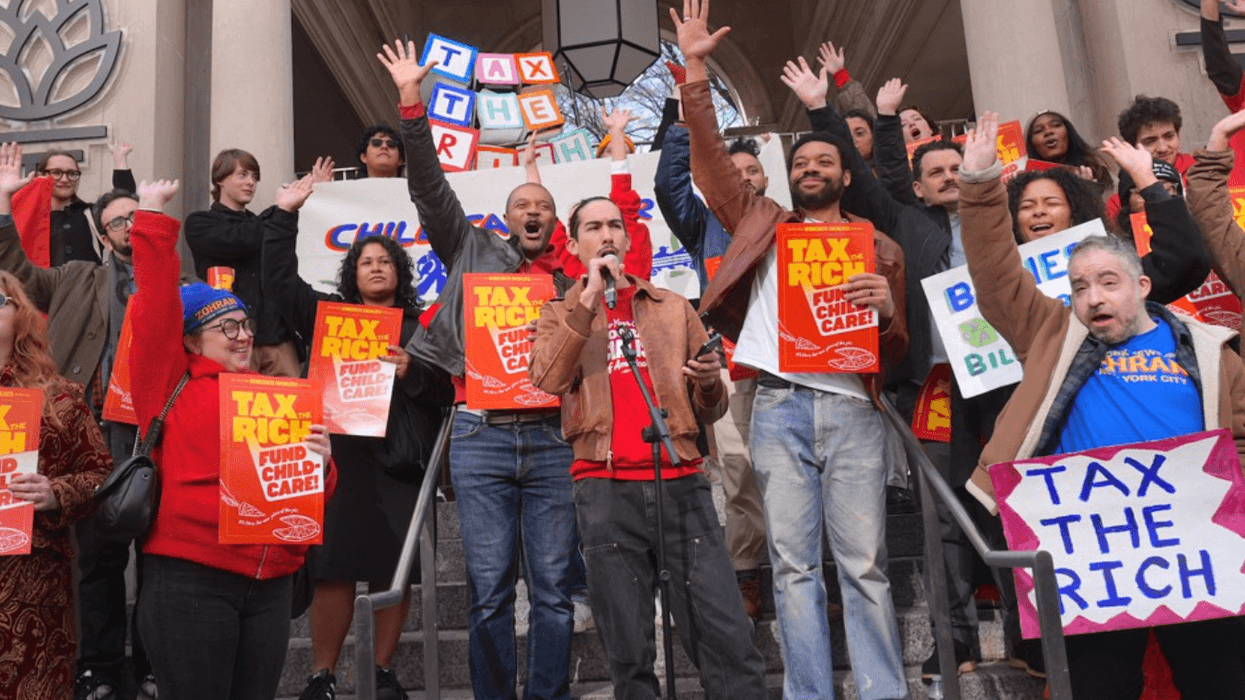
Defying Trump Threats, Mamdani Wins Historic Victory In New York Mayoral Race

Defying Trump Threats, Mamdani Wins Historic Victory In New York Mayoral Race

Democrat Zohran Mamdani, a 34-year-old democratic socialist, was projected by multiple news outlets to become New York City’s next mayor—an outcome that would have been unthinkable just a year ago.

He defeated disgraced former Gov. Andrew Cuomo, who ran as an independent after losing the Democratic nomination in June, and the GOP nominee, Curtis Sliwa, frequent New York candidate perhaps best known for his red beret and love of cats.

As of publication, Mamdani led with 50 percent of the vote to Cuomo’s 41 percent, with 75 percent of the expected vote counted, according to the Associated Press.

f the results hold, Mamdani’s victory would amount to a generational break from the city’s political establishment—and a humiliating defeat for Cuomo, the once-dominant governor who left office in disgrace and had been itching to claw his way back.

What started as a sleepy reelection bid for incumbent Mayor Eric Adams evolved into a full-blown political reckoning, reshaping the city’s political map and derailing Cuomo’s attempted comeback tour.

The path to this moment took a dramatic turn in late September, when Adams withdrew from the race amid plummeting approval ratings and ongoing scandals, including federal corruption probes. In late October, he endorsed Cuomo, hoping to persuade his small base of backers to support another scandal-plagued independent.

Yet Mamdani’s insurgent campaign didn’t falter. His message was steadfastly focused on the city’s cost-of-living crisis, with him proposing policies like rent freezes, higher taxes on the wealthy, free buses, and city-owned grocery stores. And clearly, it has resonated with voters. Despite facing millions in super PAC attacks as well as a well-funded establishment candidate, he built a devoted coalition of progressive activists, younger voters, and working-class New Yorkers.

By early voting, the race had become a clear test of which Democratic vision New Yorkers preferred. Cuomo leaned on the old-guard playbook, promising stability and toughness, while Mamdani ran as an insurgent pushing for big, structural changes.

Cuomo and his allies tried to frame Mamdani as untested and extreme, pointing to his pro-Palestinian activism and criticism of Israel. President Donald Trump and far-right billionaire Elon Musk also waded in, with both endorsing Cuomo on Monday.

Earlier this year, Trump falsely branded Mamdani a “communist,” and threatened to withhold federal funding if Mamdani enacted policies the president disagreed with. “Remember, he needs the money from me, as President, in order to fulfill all of his FAKE Communist promises,” Trump posted online in September. “He won’t be getting any of it.”

Right-wing news outlets also waged a war against Mamdani. Fox News aired segments suggesting he should be deported, while the New York Post churned out near-daily front page warnings of radical rule in City Hall. (Both outlets are owned by right-wing billionaire Rupert Murdoch.)

But the attacks seemed to only harden Mamdani’s base. His campaign mobilized a grassroots operation. Volunteers hit subway stations, organizers livestreamed rallies, and voters lined up at early-voting sites across the city—a wave of energy that recalled the campaign that propelled Alexandria Ocasio-Cortez to Congress seven years ago. Privately, Trump reportedly told allies he didn’t think Mamdani could be beaten, underestimating the candidate’s broad appeal.

Even as Mamdani’s rallies drew massive crowds, much of the Democratic establishment was hesitant to embrace him. House Minority Leader Hakeem Jeffries waited until late October to endorse him, while New York Sen. Kirsten Gillibrand and Senate Minority Leader Chuck Schumer never publicly supported his campaign. But that apparent caution strengthened Mamdani’s anti-establishment image, positioning him as the candidate of street-level energy and outsider momentum.

For months leading up to June’s Democratic primary, Cuomo led nearly every poll, but Mamdani closed the gap and won the party’s nomination, thanks to a surge of younger voters and working-class New Yorkers fed up with the status quo. By August, polls of the general election showed him overtaking both Cuomo and Sliwa as the Democratic base consolidated around their candidate.

Reprinted with permission from Daily Kos
Shop our Store

Headlines

Editor's Blog

Corona Virus

Trending

World