Tag: affordable care act
As Insurance Costs Surge, GOP No Longer Pretends To Support Universal Coverage

As Insurance Costs Surge, GOP No Longer Pretends To Support Universal Coverage

The Trump administration’s wrecking ball has succeeded in shattering one of the core beliefs of centrist health care reformers, which states: Incremental reforms will eventually lead the U.S. to the promised land of health insurance for all—something most advanced industrial nations achieved more than 75 years ago.

Even many Republicans once signed onto the gradualist approach to achieving the goal of universal coverage. In the early 1970s, President Richard Nixon proposed covering everyone through insurance industry-managed plans. In the 1990s, a Republican-controlled Congress authorized universal coverage for children. Even President Trump in 2017 vowed to replace Obama’s Affordable Care Act with a new plan that would provide “insurance for everyone.” Ultimately, he failed to either release a plan or repeal Obamacare.

But now, for the first time in its history, the U.S. is making a sharp U-turn on the long road to health care for all. The GOP not even pretending that universal coverage is a desirable national goal. It is deliberately raising the ranks of the uninsured.

The One Big Ugly (not Beautiful) Bill signed by the president last July will drive an estimated 17 million people from the insurance rolls by 2034, according to KFF. More than two-thirds of those losses will come from cuts to Medicaid. Half those cuts, which establish bureaucratic roadblocks for obtaining coverage, won’t be reversed even if the Democrats succeed in forcing concessions from the majority party during the shutdown negotiations, which are still underway as of this writing.

Thanks to legislation Democrats passed during Joe Biden’s administration, the national uninsured rate fell last year to 8 percent, which is within hailing distance of universal coverage (generally considered to be five percent or less). Some states are already below that threshold, which might have occurred nationally had not ten Republican-run states, including populous Texas (still 16.4 percent uninsured) and Florida (10.9 percent), refused to expand Medicaid to cover the working poor. That overall rate is certain to rise next year and for the rest of this decade. If no changes are made, it will soar into the mid-teens, nearly to the levels seen before the Affordable Care Act passed in 2010.

Universal coverage doesn’t guarantee Americans will enjoy better health. Nor does it ensure health care will be affordable. However, it is inconceivable that either of those goals can be achieved without universal coverage, which is a necessary, though not sufficient, condition for addressing the long-term health care cost crisis affecting most American households.

Step by step

The incrementalist strategy emerged in the wake of President Harry Truman’s failed attempt after World War II to implement a government-run, universal health insurance plan, similar to those adopted by many European countries. Opposition from the American Medical Association, labor unions with their newly negotiated employer-based plans, and a burgeoning health insurance industry doomed the bill.

But calls for universal coverage never ceased. A decade-and-a-half later, with the White House and Congress in Democratic hands after Lyndon B. Johnson’s 1964 landslide, the government created Medicare and Medicaid for the old, disabled, and poor. In 1997, after the Bill Clinton administration’s significant push for universal coverage failed, a Republican-led Congress included a separate plan for uninsured children in the Balanced Budget Act.

Then, in 2010, with Barack Obama in the White House and the country reeling from the Great Recession, a Democratic Congress passed the Affordable Care Act. It created a subsidized individual market for those without employer coverage; expanded Medicaid to include individuals and families earning up to 137 percent of the poverty level; and began experimenting with a host of delivery system reforms to hold down costs.

However, cost-saving measures cannot be effective unless everyone is in the insurance pool. Uninsured individuals often postpone necessary but non-emergency care. When they become so sick that they must seek care, they show up in emergency rooms, where care is the most expensive, and where their outcomes are usually worse because they waited too long. For their troubles, they are often saddled with unpaid debts.

More uninsured hurts everyone

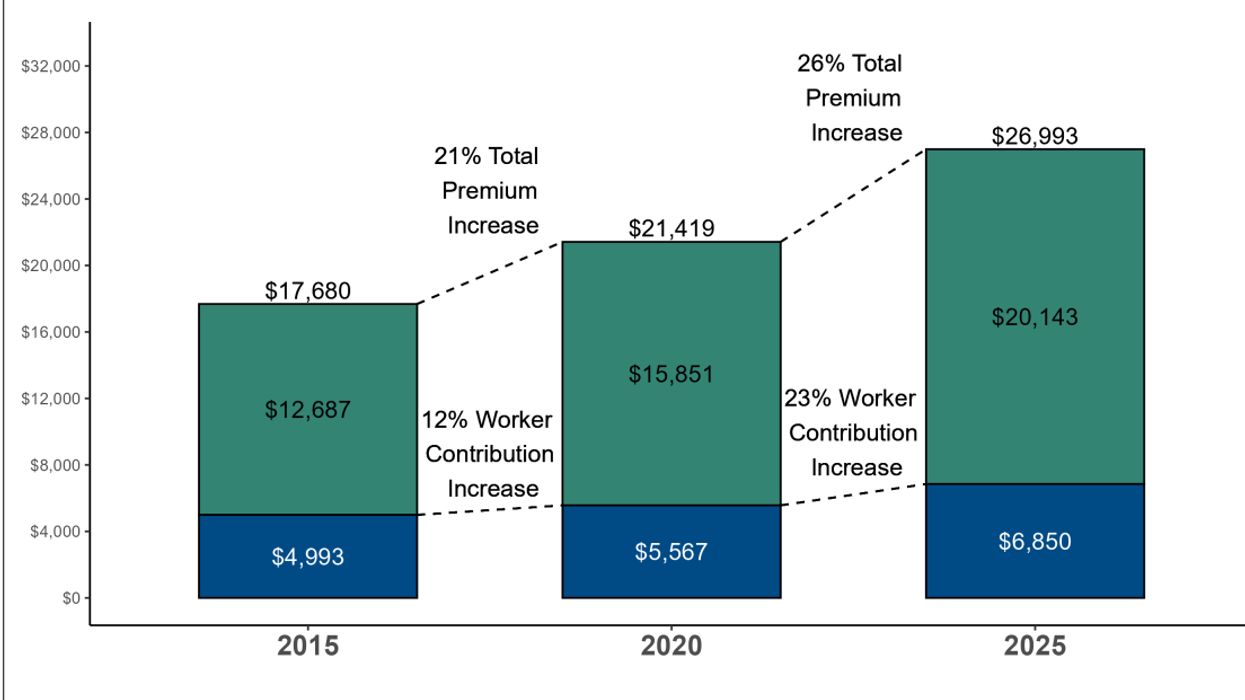
The dysfunction wrought by a growing pool of uninsured people affects everyone’s pocketbook. Providers and insurers use the uninsured’s unpaid bills as an excuse to pass along those expenses in the form of higher prices to the privately insured, who already pay 2 ½ times what Medicare recipients pay on average. This results in not just more expensive plans for employers (the median family plan cost a staggering $27,000 in 2025), but higher co-premiums, co-pays, and deductibles for their employees, whose share of the total cost of “employer-financed” care has hovered between 25 and 30 percent for decades. (I put scare quotes around “employer-financed” because employer contributions are a tax-deductible business expense that otherwise would go to workers as wages if it weren’t spent on benefits.)

Universal coverage doesn’t guarantee that health care will become more affordable for everyone. But it reduces the level of more expensive, uncompensated care in the system, which is necessary to lower prices for everyone, including private insurers and their employer customers. Universal coverage is a crucial prerequisite for achieving more affordable health care.

Yet now, under Trump and a supine Republican Congress, America is deliberately reducing the ranks of the insured. The process has already begun. Premiums for individual plans being sold on the exchanges for next year are soaring due to the expiration of enhanced subsidies, which will discourage many people from buying plans.

Though the bill’s new Medicaid work requirements were postponed until after the 2026 mid-term elections to hide their full effects from voters, states were given the green light to begin enforcing twice-annual recertification requirements. Many red states are already moving to do that, as well as cut their Medicaid spending in response to the cutbacks in federal support for the joint federal-state program. Millions of low-wage workers will start losing their Medicaid coverage next year, not because they aren’t working, but because they become frustrated by the paperwork requirements set up by hostile bureaucrats beholden to their Republican overlords.

Democrats on Capitol Hill are singularly focused on maintaining the enhanced subsidies and restoring the cuts in Medicaid financing. That means the work requirements and other bureaucratic roadblocks will remain because they can’t be addressed in a reconciliation bill. No matter how the shutdown is resolved, a sharp decline in both coverage and access is inevitable.

That will financially harm almost everyone covered by employer-sponsored plans. This year, those rates soared at twice the inflation rate on average, according to the annual KFF employer survey of just under 1,300 firms. Mercer, a leading benefits consulting firm, says rates will rise by a similar level next year. Plan structures will undoubtedly include higher co-payments, higher deductibles, and higher co-premiums for workers and their families.

No matter how the government shutdown is resolved, the health care affordability crisis, exacerbated by the historic GOP U-turn on universal coverage, will remain a salient issue during next year’s House and Senate campaigns. The only question is whether Democrats will be able to take advantage by offering a program that addresses voters’ number one concern when it comes to health care.

This story first appeared on the Washington Monthly website.

Merrill Goozner, the former editor of Modern Healthcare, writes about health care and politics at GoozNews.substack.com, where this column first appeared. Please consider subscribing to support his work.

Reprinted with permission from Gooz News

​Johnson Retreads His Unpopular, Previously Rejected 'Ideas' For Health Care Reform

​Johnson Retreads His Unpopular, Previously Rejected 'Ideas' For Health Care Reform

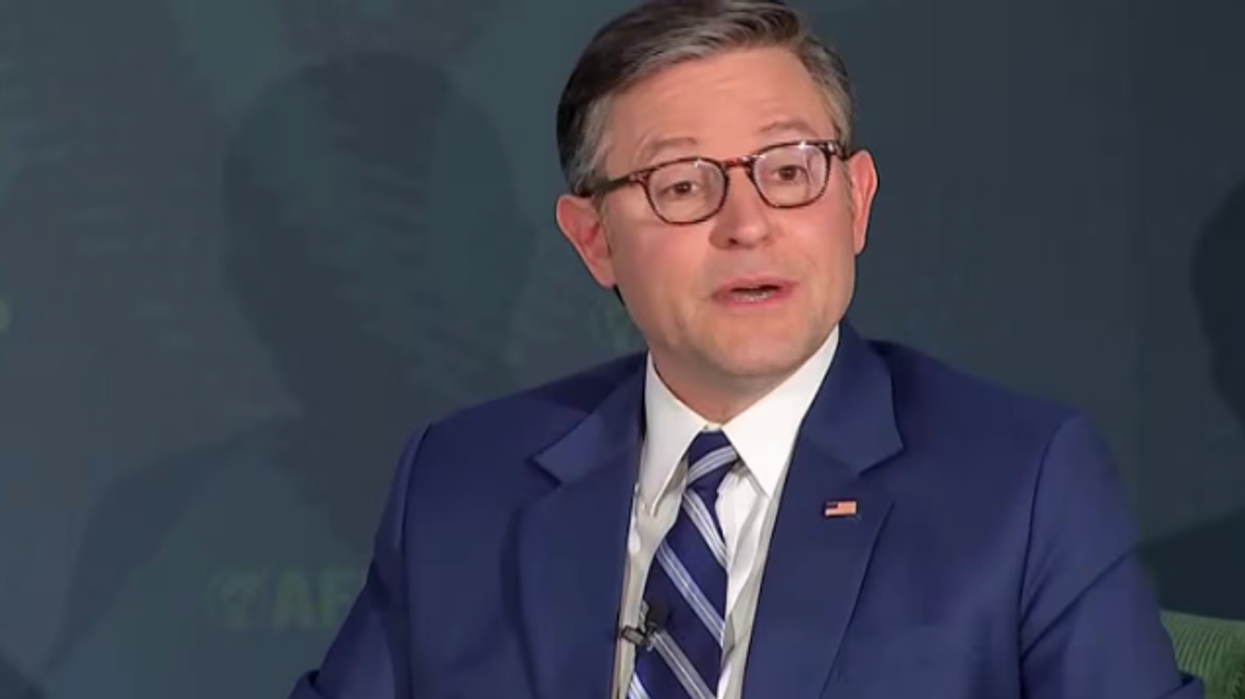
House Speaker Mike Johnson on Monday suggested that the "ideas" Republicans are kicking around for how to make health insurance more affordable is basically just the Obamacare-repeal plan that the GOP tried and failed to pass in 2017, during Donald Trump’s first term.

“When I say that the Republicans have been working on a fix for health care, we’ve been doing this for years,” Johnson said Monday at a news conference on Capitol Hill after he was asked how Republicans were planning on addressing the expiration of enhanced Affordable Care Act subsidies that, if not extended, will soon cause massive premium increases for millions of Americans.Johnson specifically pointed to the health care proposal he released when he was chair of the Republican Study Committee—a caucus of right-wing House Republicans.

"These ideas have been on paper for a long time," Johnson said. “There’s volumes of this stuff. Volumes of it.”

Of course, the reason they have been on paper but never passed is because the ideas in the RSC health care proposal are overwhelmingly unpopular.

The Center on Budget and Policy Priorities, a left-leaning think tank, reviewed a newer version of that RSC health care proposal found in the committee’s proposed budget. That review found the plan would weaken protections for preexisting conditions, cut the tax subsidies millions of Americans receive to make their ACA premiums lower, and "would slash $4.5 trillion in federal investment in Medicaid, Children’s Health Insurance Program (CHIP), and marketplace coverage"—all moves that would likely cause millions to lose their insurance.

“These proposals would create an environment where people with health conditions would pay higher premiums and out-of-pocket costs for less substantial coverage than is currently available,” the CBPP report says. “Given the increase in costs, more people would enroll in subpar plans that leave them exposed to high costs if they get sick.”

That sounds a whole lot like the Obamacare repeal that Republicans attempted to pass in 2017. That bill failed spectacularly amid public outcry because it would have kicked millions off their insurance and weakened protections to cover preexisting conditions.

In fact, the repeal effort was such an unpopular boondoggle that it helped to sink the GOP in the 2018 midterm elections.

If this is the plan Republicans will try to pass again, it’ll likely be an equally unpopular mess for the GOP.

Polling shows that the ACA is popular, with 64 percent of Americans viewing it favorably, according to a KFF tracking poll.

Republicans Push Skimpy, Unaffordable Health Coverage As Costs Keep Rising

Republicans Push Skimpy, Unaffordable Health Coverage As Costs Keep Rising

The median cost of employer-based health insurance this year leaped ahead at nearly twice the rate of the consumer price index, according to the annual Kaiser Family Foundation employer survey released yesterday. Sadly, workers are bearing a larger share of the increased burden through rapidly rising co-premiums.

The press coverage this morning of the closely followed survey emphasized the combined top-line increase of 5.5 percent for a family plan, which now stands at a staggering $26,993 a year or about the price of a new compact car. The cost of an employer-based individual plan rose at the slightly lower rate of 4.6 percent to $9,325 a year.

But a deeper dive into the numbers provides a better understanding of why people are so upset about rising health care costs. Employee co-premiums for a family plan (the amount deducted from paychecks) rose 7.6 percent on average to $6,850. The employer share went up only 4.8 percent. The net effect was a downward shift in the share paid by employers and a corresponding upward shift in the share paid by their employees, which was a half percentage point more or 25.4 percent of the total.

This increased burden on workers comes after an eight-year period when the employer share of premiums rose fairly steadily (with a few years off early in the pandemic). Companies offset some of those increases by funneling more of their workers into plans that raised their out-of-pocket expenses for deductibles and co-pays.

Depending on the plan type (HMO, PPO, high-deductible), the average deductible from employer-based family plans now ranges from $3,118 to $5,095 a year. Fully a third of workers and their families enrolled in high-deductible plans for 2025, up from 28 percent the previous year and the most ever.

Put the two together, and the median family (half pay more, half pay less) now pays anywhere from $9,968 to $11,945 a year for health care or close to $1,000 a month. Given the median household income in 2024 stood at $83,730, that translates into anywhere from 12 percent to 14 percent of a typical family’s income.

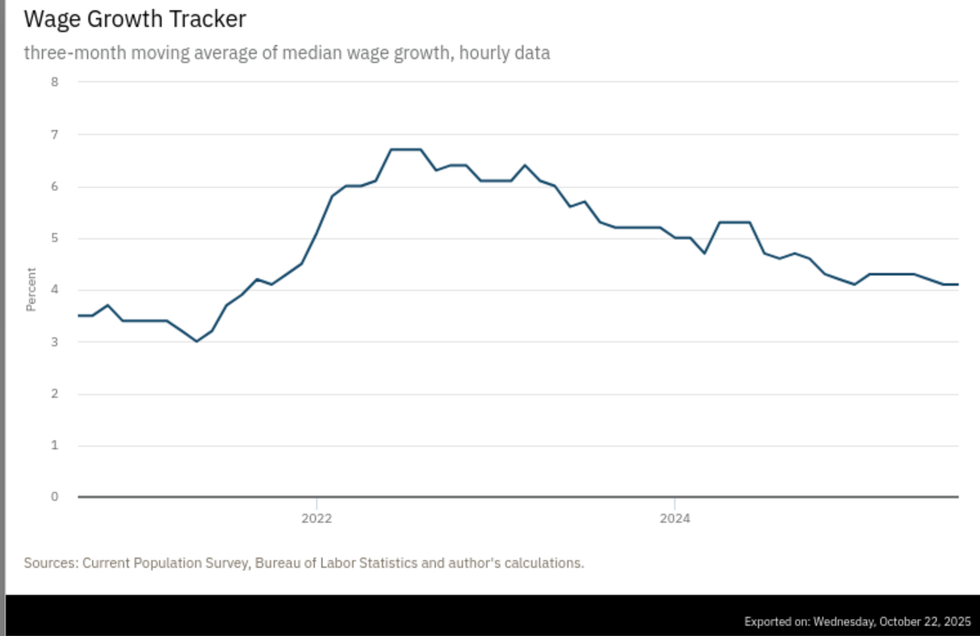
Things are about to get a lot worse. Next year’s premiums and co-premiums for employer-based plans, which cover an estimated 154 million people, are set to rise six percent to seven percent, according to a new survey by Mercer, a health care benefits consulting firm. If the split between employers and their employees remains the same, that will exceed wage increases by two to three percentage points. Wage increases have been trending down for the past three years, falling to just 4.1 percent this past August, the last month reported by the Bureau of Labor Statistics before the government shutdown.

Source: Atlanta Federal Reserve

No wonder health care costs now ranks as the second most important issue for inflation-weary Americans, just behind the deteriorating state of the overall economy. More than four in five of 1,300 adults surveyed in mid-October by the Associated Press and the NORC Center for Public Affairs said health care issues were extremely or very important to them personally. That was nine percentage points more than crime and 23 percentage points ahead of immigration — the next two biggest concerns.

The impact of ACA/Medicaid cuts on employer plans

The outlook for employer-based plans will also get a lot worse if Democrats fail to restore the Medicaid cuts and the enhanced subsidies for Affordable Care Act plans (which provides affordable insurance for tens of millions of low-wage workers, gig workers and sole proprietors). An estimated 7.3 million people who purchased subsidized exchange plans will drop ACA coverage, with more than half becoming uninsured, according to a Commonwealth Fund brief.

Many will look for cheaper, non-ACA compliant plans that don’t quality for listing on the exchanges because they provide skimpier benefits, are not required to provide free preventive care, can discriminate based on prior medical conditions, and often carry extremely high deductibles and co-pays. This summer, the Trump administration announced it wouldn’t enforce the rule approved by the Biden administration in mid-2024 that limited such plans to three months duration.

“Those who sell non-ACA plans … will absolutely see the coming open enrollment as an opportunity to push their plans as more affordable alternatives, without sharing full information with consumers about the limits of those plans,” said JoAnn Volk, a professor at Georgetown University’s Center on Health Insurance Reforms.

What happens when people who previously had Obamacare buy skimpy plans or become uninsured? They postpone care until their conditions require emergency room treatment — the most expensive place to obtain health care. When struck by serious illnesses like cancer, heart attacks and strokes, they often fail to pay their uncovered bills, or resort to Go Fund Me campaigns to pay off their high deductibles. Some will negotiate long-payoff periods and live the rest of their lives burdened by medical debt. Some will declare bankruptcy.

Hospitals and physicians, in turn, will raise their prices to cover the cost of uncompensated care, which will cause private insurance rates to rise even more. Rising prices, rising insurance premiums, and rising uninsured rates is an accurate description of what existed in the U.S. before passage of the ACA.

These health care economic fundamentals are of little interest to the modern-day Republican Party, which invariably includes some variation of bare-bones insurance as one of their answers to the affordability crisis. Early in the shutdown, they floated ideas like instituting new income caps on Obamacare subsidies, establishing minimum co-pays, and cutting off subsidies for new enrollees, none of which they would agree to negotiate until the government is reopened.

Then, last week, Politico reported they are also willing to beef up tax credits for investing in health savings accounts, which could be used to buy skimpy plans. Lower-income workers generally avoid HSAs since they can’t afford the voluntary deductions needed to fund them.

I can’t predict when or how the shutdown crisis will end. But I am pretty confident that I know what will happen to health care costs in the next few years given Republican control of Washington. They’re going up, up, and up.

Merrill Goozner, the former editor of Modern Healthcare, writes about health care and politics at GoozNews.substack.com, where this column first appeared. Please consider subscribing to support his work.

Reprinted with permission from Gooz News
Mike Johnson

Republicans Still Yearn To Kill Obamacare, But Fear 'Political Disaster' If They Do

The standoff over the federal shutdown has exposed deep fractures within the GOP, particularly around health care — a longstanding vulnerability for Republicans.

The New York Times highlighted in a report Sunday that while Democrats insist they will not support a spending deal without extending the expiring tax credits under the Affordable Care Act (ACA) that safeguard coverage for millions, Republicans are split between ideology and electoral reality.

On one end, hard-line conservatives still press to eliminate the ACA outright; on the other, pragmatists recognize that wiping it out without a credible replacement could inflict “a political disaster” on their party, per the report.

The shutdown has forced the GOP into a public tug-of-war over what to do with a law they largely oppose but cannot realistically undo without major risk.

House Speaker Mike Johnson (R-LA) insisted the dispute is not about health care, calling Democrats’ insistence on subsidies a “red herring” that distracts from the funding fight.

At the same time, top Republicans such as House Majority Leader Steve Scalise (R-LA) pledged to vote against extending the credits, arguing they would “bail out insurance companies,” even as many recipients live in GOP-held districts.

At least 14 House Republicans and several senators signaled they would support a renewal of the credits through 2027, recognizing what some advisers called “a potential political catastrophe for the G.O.P.” if coverage were lost.

The report noted that the broader dynamic reveals why the party remains stuck. Even though Republicans have long pledged to “repeal and replace” the ACA, they have repeatedly failed to articulate what “replace” means in practice. The 2017 Senate health care bill collapsed amid conservative-moderate splits, leaving GOP leaders without an alternative mapped out.

According to the report, Democrats "have forced the G.O.P. to wrestle publicly with its divisions about what to do with the health care law, which most Republicans revile but many recognize would be impossible to unravel without bringing political disaster to their party.”

Reprinted with permission from Alternet


Shop our Store

Headlines

Editor's Blog

Corona Virus

Trending

World