Tag: income inequality
As Health Insurance Premiums Spike, Inequality Worsens -- But There Is A Solution

As Health Insurance Premiums Spike, Inequality Worsens -- But There Is A Solution

It’s not just people with Obamacare plans who face huge premium spikes next year. Workers with employer-based plans, which cover nearly half of all Americans, are also getting hit with very large increases in their premiums.

The annual survey by Mercer, a major employer benefits consulting firm, found health benefit costs per employee are expected to rise 6.5% in 2026, which would be the highest increase since 2010. Total plan costs-per-employee will increase nine percent, which employers will partially offset by “raising deductibles and other cost-sharing provisions, which can lead to higher out-of-pocket costs for plan members when they seek care.”

One of those “other cost-sharing provisions” — the one that will hit everyone and not just those who get sick — are the co-premiums for their plans, which are taken each week or month out of their paychecks. Historically, employers pick up about 75 percent of the cost of family plans. So when the total costs goes up 6.5 percent, so does the 25 percent share paid by employees.

How much will that cost workers? According to the Kaiser Family Foundation annual survey of employer-based insurance, the average worker paid $6,850 for a family plan in 2025. A 6.5 percent increase in 2026 will sap paychecks by an average of $445. That’s nearly a one percent reduction in the median worker’s take-home pay.
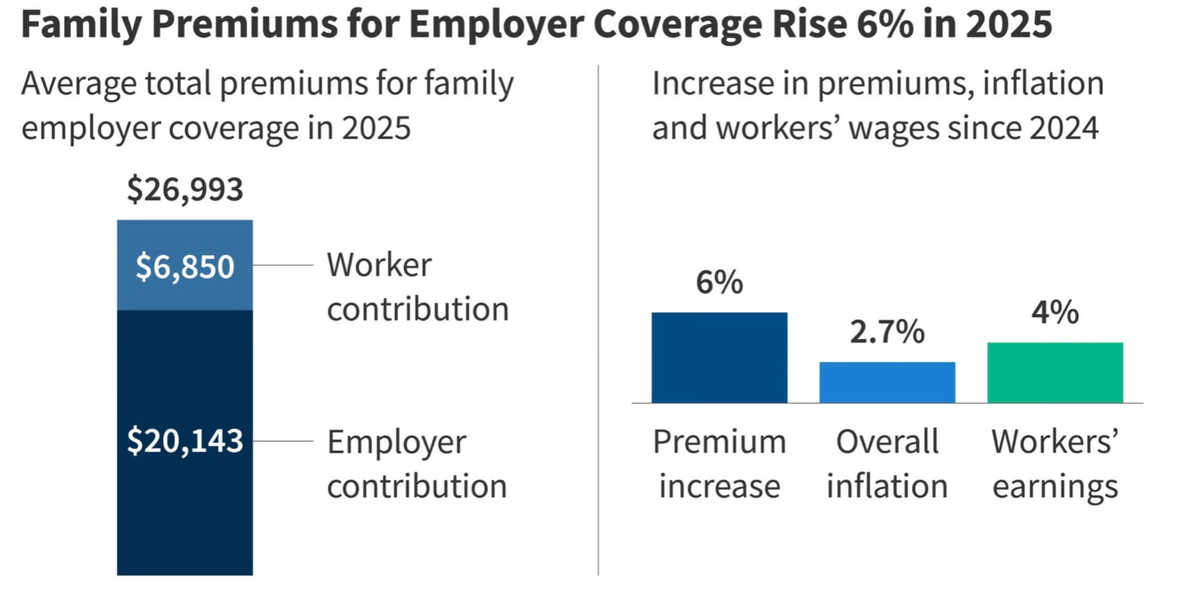

Source: Kaiser Family Foundation

This has gone on for the decades, and will continue as long as health care costs rise faster than wages. A study published in JAMA Network Open last year calculated lost earnings from the growth in health insurance premiums between 1988 to 2019 cost the average family over $125,000 in inflation-adjusted dollars, or nearly 5% of total earnings over the entire 32-year period.

Low-wage workers bear the brunt

But averages don’t tell the whole story. The income-sapping surge in co-premiums for health insurance hits low-income workers much harder than high-income workers because of the way employers structure their health insurance plans.

Most employers that offer health insurance to their employees provide three plan options. The most expensive is the preferred provider organization (PPO) plan. The middle-priced option is usually a health maintenance organization (HMO) plan, which places limits on provider choice. And then there is the high-deductible plan, which is the least expensive but can leave plan participants with huge and unaffordable bills when they get sick.

Not surprisingly, the lowest cost high-deductible option is most attractive to employers’ lowest-paid workers, who are desperate to hold down their upfront health care costs because they need the cash to pay other bills. Middle-income workers may opt for the HMOs, while upper income employees are the most likely to opt for the PPO plans. They can afford them, and they appreciate the ability to see any doctor they choose.

Most employers unwittingly exacerbate this class stratification in private health insurance. More than three-quarters of employers charge every employee, no matter what their income, the same co-premium within each plan option, according to a 2019 Bureau of Labor Statistics survey. Everyone who choose an HMO plan, for instance, faces the same co-premium. That means lower wage workers are paying a higher share of their income for health insurance compared to others who choose the same plan.

Time to graduate

There is a way to bring greater equity to employer-based health insurance. It is something more employers should consider given the growth in income inequality over the past half century.

They could adopt income-based co-premiums, which are sometimes called tiered co-premiums. In a tiered system, those with the lowest incomes pay lower co-premiums for any of the three choices, while those with higher incomes pay more for the same plans. Tiered co-premiums operate like a graduated income tax.

For example, Honolulu-based Alexander & Baldwin, a real estate firm, dropped its one-size-fits-all co-premium structure in 2023. It established three tiers for its more than 100 employees. A single worker in the lowest salary range paid $42 a month for an HMO plan; the middle salary range paid $67 a month for the same plan; and the highest paid workers paid $92 a month.

Universal tiering of co-premiums — something that could be mandated by federal regulation — will not address the burden placed on all Americans by rising health care costs, which this year are being driven by exorbitant hospital and drug prices, rapid uptake of weight-loss drugs, and soaring costs for imported medical products due to Trump’s tariffs. But it will bring equity when it comes to bearing the burden of those rising costs.

Merrill Goozner, the former editor of Modern Healthcare, writes about health care and politics at GoozNews.substack.com, where this column first appeared. Please consider subscribing to support his work.

Reprinted with permission from Gooz News

Jeff Bezos

Raising Corporate Taxes Makes Plutocrats Cry — But The People Cheer

Not only are the rich different from you and me; they're becoming more different than ever.

I'm not referring to mere millionaires but to the billionaire bunch. In the past year, while ordinary Americans have lost jobs, businesses, and homes due to the economic crash caused by the COVID-19 pandemic, America's 664 billionaires have found themselves nearly 40 percent richer than before the pandemic! These fortunate few collectively added more than a trillion dollars to their personal stashes of wealth in 2020. And practically all of them got so much richer by doing nothing : Their money made the extra money for them, because corporate stock prices zoomed even as regular people lost income.

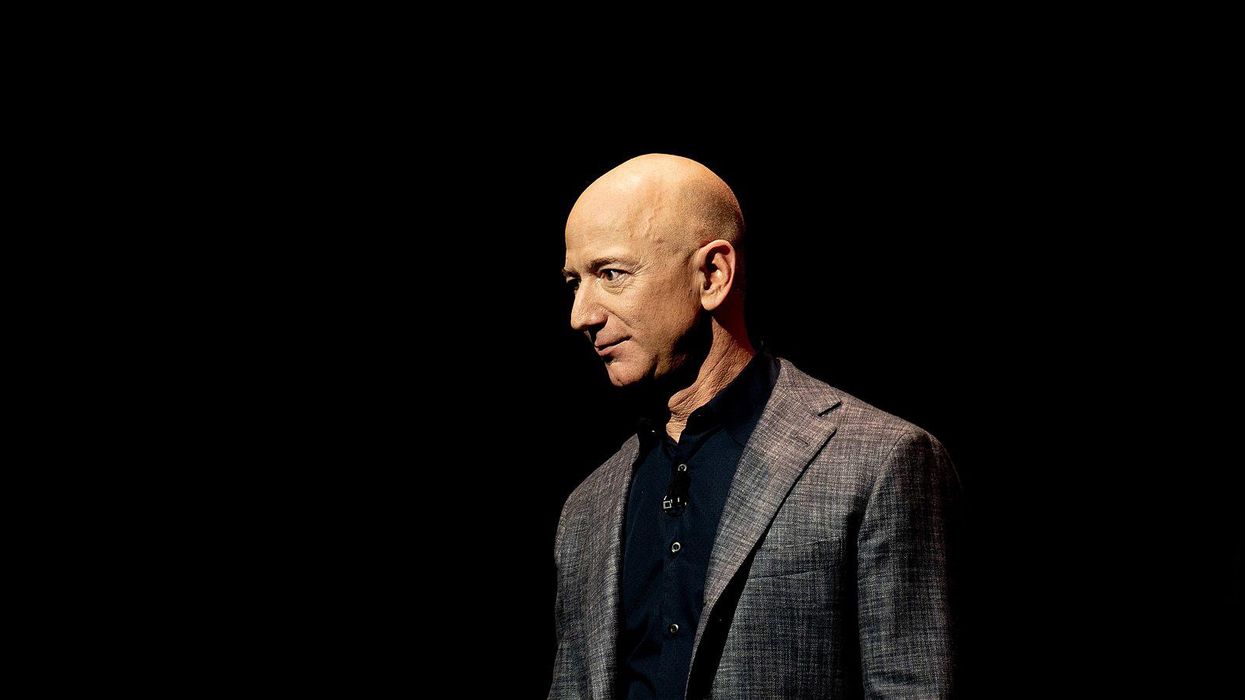
Take a peek at THE richest of these different ones: Jeff Bezos, the alpha-geek of Amazon. He hauled in an additional $75 billion last year (roughly $8.6 million an hour), giving him roughly $188 billion in total wealth. You can do a lot of good in our world with such riches ... or you can splurge on yourself.

Jeff splurged. He bought a boat — more accurately, an ocean-going ship, one of the largest sailing vessels ever built. More than one-and-a-third football fields long, the super-yacht apparently cost the diminutive mega-billionaire some half a billion bucks. But that is the price before Bezos' big boat goes anywhere: He'll reportedly pay some $60 million each year for operating expenses.

Plus, he had to buy a "support yacht" to sail along with his main boat. Why? Because the three sails on his 400-footer are so huge that a helicopter can't land on the deck, requiring an auxiliary yacht to provide a helipad.

See, the rich really are different. Where to park the helicopter while at sea is a problem you and I don't have to face.

According to mega-yacht sellers, the main draw of these ostentatious purchases is that they reinforce inequality, literally letting the rich float in leisure and luxury, oceans apart from even having to see hoi polloi like us.

"Outrageous," screeched the president of the U.S. Chamber of Commerce. "Archaic," moaned the president of the National Association of Manufacturers. "It doesn't feel fair," whimpered the chief executive of the giant Bechtel construction company.

The wailing by those who run corporate America is not for the plight of the great majority of workaday families who've seen their incomes stagnate and even plummet to zero during the past months of the coronavirus pandemic. Rather, this chorus of woe is arising from powerful plutocratic interests that have been enjoying windfall profits but now want us to feel sorry for them. Why? Because, they cry, that meanie in the White House, Joe Biden, intends to jack up their corporate tax rate up from 21 percent to 28 percent.

But wait. Didn't former President Trump and the GOP Congress slash the corporate share of our nation's upkeep nearly in half just four years ago, from 35 percent to 21 percent, shifting the burden to the middle class and poor? Yes. And didn't they promise that those cuts would create millions of new jobs and raise the incomes of the working class? Yes, again. Yet corporations got richer and working stiffs got shafted.

Still, here they come again, howling that raising corporate taxes would crash the stock market. Well, on the day Biden announced his plan, stock prices did fall ... by less than one percent. The next day, they bounced right back, and they're still booming.

Moreover, those are crocodile tears the rich are shedding, for they know that — as Biden himself makes clear — his proposed uptick in their tax share "is not going to affect their standard of living at all, not a little tiny bit." They'll still have their two or three big houses, private jets, and yachts. But with them paying just a bit more toward the Common Good, our country will be able to reinvest in society's physical and human infrastructure, making America stronger and fairer for all.

That's why there are broad and deep public majorities — even among Republicans — supporting Biden's infrastructure plan and an increase in corporate taxes to pay for it. For more information, go to AmericansForTaxFairness.org.

To find out more about Jim Hightower and read features by other Creators Syndicate writers and cartoonists, visit the Creators webpage at www.creators.com.

Study: Richest 0.00025 Percent Of Americans Own More Than Bottom 150 Million

Study: Richest 0.00025 Percent Of Americans Own More Than Bottom 150 Million

Reprinted with permission from Alternet.

As survey data continues to show that raising taxes on the wealthy is extremely popular among the U.S. public, new research by inequality expert and University of California, Berkeley economist Gabriel Zucman found that the richest 0.00025 percent of the American population now owns more wealth than the 150 million adults in the bottom 60 percent.

Zucman, who helped Sen. Elizabeth Warren (D-MA) develop her “Ultra-Millionaire Tax” proposal, observed in a working paper (pdf) that “U.S. wealth concentration seems to have returned to levels last seen during the Roaring Twenties.”

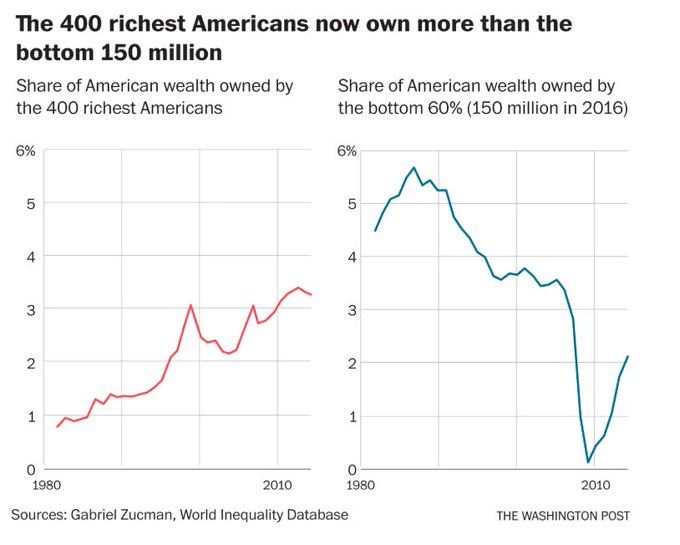
According to Zucman’s research, the richest 0.00025 percent—just 400 Americans—have seen their share of America’s national wealth triple since the 1980s, while the wealth of much of the U.S. population has stagnated or declined.

Steven Greenhouse@greenhousenyt

The 400 richest Americans have tripled their share of the nation’s wealth since the early 1980s and now own more of the country’s riches than the 150 million adults in the bottom 60% of the wealth distribution. https://www.washingtonpost.com/us-policy/2019/02/08/wealth-concentration-returning-levels-last-seen-during-roaring-twenties-according-new-research/?utm_term=.5ba7d345a34b 


As the Washington Post’s Christopher Ingraham noted in a breakdown of Zucman’s research, adults in the bottom 60 percent of the wealth distribution “saw their share of the nation’s wealth fall from 5.7 percent in 1987 to 2.1 percent in 2014.”

Consolidation of wealth at the very top, Ingraham observes, “is eroding security from families in the lower and middle classes, who rely on their small stores of wealth to finance their retirement and to smooth over economic shocks like the loss of a job. And it’s consolidating power in the hands of the nation’s billionaires, who are increasingly using their riches to purchase political influence.”

Zucman’s research comes as members of Congress and 2020 presidential candidates are pushing a variety of plans to begin reducing America’s staggering wealth and income inequality by raising taxes on those at the very top.

Warren,  who officially launched her 2020 presidential campaign on Saturday, has proposed an annual tax of two percent on assets over $50 million.

Last month, Sen. Bernie Sanders (I-VT)—who is reportedly close to announcing his 2020 candidacy—introduced the For the 99.8% Act, which would establish a 77 percent tax on all estates over $1 billion.

And Rep. Alexandria Ocasio-Cortez (D-NY) has suggested imposing a top marginal tax rate of 70 percent on those who make over $10 million.

Pointing to polling data showing that 76 percent of Americans believe the rich should pay more in taxes, Indivisible’s Chad Bolt concluded: “Raising taxes on the wealthy isn’t just good policy. It’s also good politics.”

Shop our Store

Headlines

Editor's Blog

Corona Virus

Trending

World