Tag: nuclear deal
Iran Negotiators Had Offered Trump A Better Nuclear Deal Than Obama Got

Iran Negotiators Had Offered Trump A Better Nuclear Deal Than Obama Got

Did you know that just hours before Donald Trump launched his illegal Middle East war that Iranian negotiators offered him a better deal on nuclear materials than Barack Obama’s administration negotiated in 2015?

The Iranians agreed to lower levels of enriching nuclear fuels, keeping them far below weapons grade, and other major concessions just so Trump could boast that he was a better negotiator than Obama.

From Trump’s point of view this could have been a major win, maybe even enough to make his name as the “peace president.”

From Tehran’s perspective it supported their claim that they would never build or use nuclear weapons because they are unholy.

What happened next provided Tehran with irrefutable proof that the American government is run by incompetents and liars who cannot be trusted.

After all, if you give the Trump administration what it says publicly it wants—verifiable guarantees that Iran will not build or have the capacity to build nuclear bombs—and the response is to kill your head of state what else would any rational, or even irrational, regime conclude?

Broken Promise

The illegal war on Iran violates Trump’s endless promises on the campaign trail that if returned to the White House he would guarantee no more “endless wars” in the Middle East or anywhere else.

Trump, campaigning to get back to the White House in 2023 and 2024, declared again and again that he would never go to war with Iran. The reason, he emphasized, was that he had superior and effective negotiating skills unlike, he said, Obama, Joe Biden and Kamala Harris.

Once again, the appallingly ignorant tyrant in the White House showed the “poor educated” MAGA who embrace him that they are fools, lacking the discernment to spot the devil in front of their faux Christian eyes.

The rest of us know that only Congress can declare war, making Trump’s attacks properly impeachable offenses. But only educated fools believe the Republican leadership on Capitol Hill will act to stop the madman from Queens.

Trump asserted that Biden, and later Harris, would bring us to “the brink of world War III.”

Indeed, in 2011 Trump declared that Obama would start a war with Iran because it was the only way he could win re-election in 2012.

Source Named

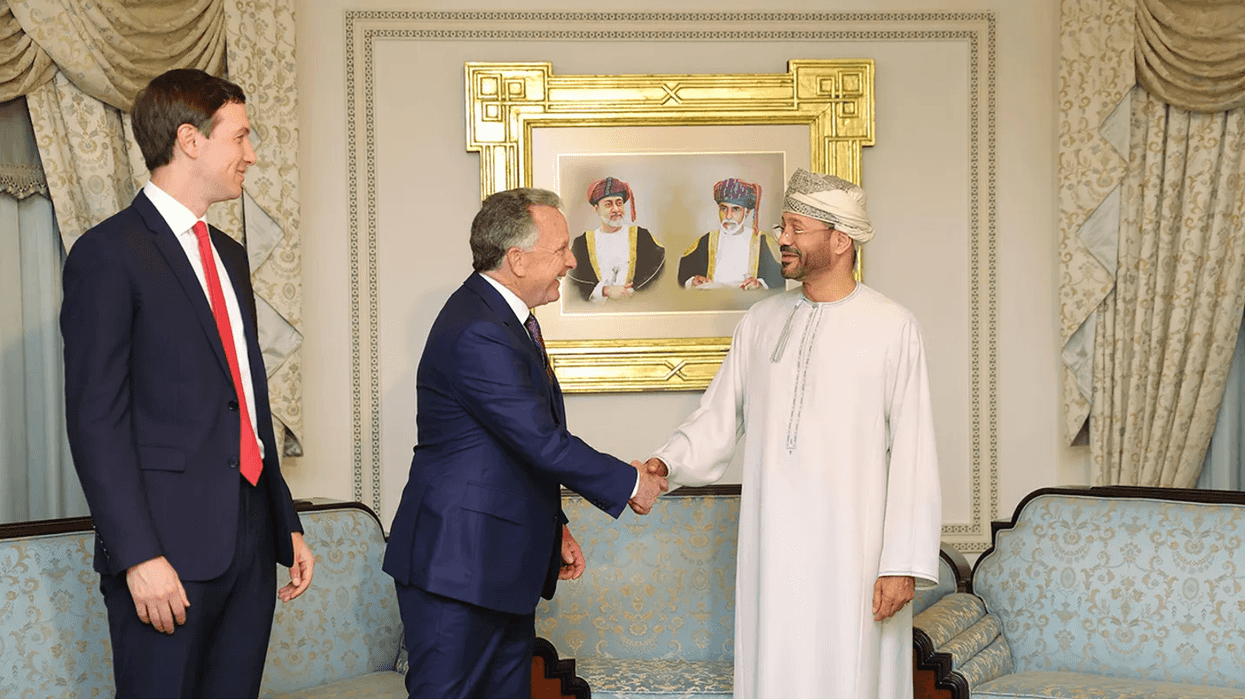
News that Iran offered Trump more than it gave Obama 11 years ago comes from the man who mediated indirect nuclear talks in Geneva between Tehran and Washington: the foreign minister of Oman, Sayyid Badr bin Hamad Al Busaidi.

Badr shuttled between the Iranian delegation in one room and another, occupied by Trump’s son-in-law, Jared Kushner, and Trump emissary Steve Witkoff with messages aimed at avoiding military action by the U.S. and Israel.

When the nuclear talks broke off Friday in Switzerland, Oman’s Foreign Minister Badr flew directly to Washington. There Badr gave interviews, informal and on camera, to David Rohde, a two-time Pulitzer Prize winner and my former colleague at the New York Times and later Reuters. Rohde, who spent seven months as a Taliban captive, has shown time and again how deeply and solidly he knows the Middle East. He now covers national security issues for MS Now.

Amateur Diplomats

Kushner and Witkoff are amateurs, both from real estate families with no formal training in diplomacy and no education in the centuries of mind-numbingly complex political, religious, and economic issues in the region from Egypt east to India that was largely controlled by the British in the 1800s and has been called “the Middle East” since at least 1902 (and by some since the 1850s).

Their public statements and official remarks make clear that Kushner and Witkoff aren’t equal to the best high school debaters in understanding geopolitical conflicts. Their track records in Gaza, Ukraine, and now Iran show why experience and education matter in diplomatic talks.

On Ukraine, they push a version of the Kremlin line, advancing the Trumpian credo that might makes right.

On Gaza, they talk to Israel and oil-rich Arabs—except for Palestinians, who are also Arab.

On Iran, they received valuable Iranian concessions, but didn’t persuade America’s conmander-in-chief to take the win and brag about what he got. Had Trump taken their offer, which include included allowing American oil companies to operate in Iran, it would have helped strengthen his oft-repeated 2016 claim that he would be the “peace president.”

Money Wasted

American taxpayers poured vast sums of money, especially since the end of World War II, into developing an extraordinarily sophisticated diplomatic corps that among other accomplishments got us past the Cold War without a nuclear exchange between Moscow and Washington. There’s plenty to criticize about our State Department, but the fact remains that diplomacy is always preferable, and cheaper, than war.

But from this seat-of-the-pants administration, run by amateurs and sycophants, many of them filled with hate, violence is embraced. Donald Trump has been public about how murderous desires since 1989 when he took out full page ads calling for the summary executions of five young men in a Central Park rape case. When evidence showed the five had been falsely accused—released after years in prison, the real perpetrator convicted— Trump doubled down on his call to murder the five.

Official violence is Trumpism in action, be it against American citizens shot to death or grabbed by ICE or an illegal Trump-directed war that on Saturday dropped a bomb on an Iranian school, killing more than 160 girls, teachers and staff.

We should remember that “ACTION IS CHARACTER,” as the great American novelist F. Scott Fitzgerald wrote in the manuscript for his final novel, The Last Tycoon.

Trump’s lifelong actions violating the law tell you exactly who he is.

Attacking civilians, as American servicemen did this weekend, is the Russian style of warfare, a style that dates at least to the era of the boyars, as Russian aristocrats were called in the old Czarist era. Under the modern Czar, Vladimir Putin, Russia has repeatedly launched missiles against Ukrainian hospitals, schools, and other civilian facilitates that no civilized nation, no democratic nation, should or would tolerate from its leaders.

But America, for more than a year, has been not a democracy but a de facto dictatorship run by a convicted career felon who falsely claims that our Constitution empowers him to “do anything I want.”

Indeed, the question on the line now is whether America is indeed a civilized society anymore or just a land of cowards who will tolerate any injustice, any cruelty, and indulge the murderous rage flows from the addled brain of Donald Trump.

Who are we, America?

Reprinted with permission from DCReport

David Cay Johnston, a former columnist for The National Memo, co-founded DCReport. He is a best-selling author, investigative journalist and former reporter for The New York Times, where he won a Pulitzer Prize in 2001. He teaches law and journalism at Rochester Institute of Technology.
The Art Of The Deal: Why Putin Needs One More Than Trump

The Art Of The Deal: Why Putin Needs One More Than Trump

MOSCOW (Reuters) – In his book, Art of the Deal, Donald Trump said the best deals were ones where both sides got something they wanted. His credo, applied to a potential U.S.-Russia deal, flags an awkward truth for Vladimir Putin: He wants more from Trump than vice versa.

As aides try to set up a first meeting between the two presidents, the mismatched nature of their respective wish lists gives Trump the edge, and means that a deal, if one is done, may be more limited and longer in the making than the Kremlin hopes.

“What the two countries can offer each another is strikingly different,” said Konstantin von Eggert, a commentator for TV Rain, a Moscow TV station sometimes critical of the Kremlin.

“The U.S. has a stronger hand. In biblical terms, the U.S. is the three kings bearing gold, while Russia is the shepherds with little apart from their good faith.”

Appetite for a deal in Moscow, where parliament applauded Trump’s election win, is palpable. The Kremlin blames Barack Obama for wrecking U.S.-Russia ties, which slid to a post-Cold War low on his watch, and with the economy struggling to emerge from two years of recession, craves a new start.

Trump’s intentions toward Moscow are harder to discern, but seem to be more about what he does not want — having Russia as a time-consuming geopolitical foe — than his so far vague desire to team up with the Kremlin to fight Islamic State.

Trump has hinted he may also push for a nuclear arms deal.

Putin’s wish list, by contrast, is detailed, long and the items on it, such as getting U.S. sanctions imposed over Moscow’s actions in Ukraine eased, are potentially significant for his own political future.

He is looking to be given a free hand in the post-Soviet space, which he regards as Russia’s back yard.

Specifically, he would like Trump to formally or tacitly recognize Crimea, annexed from Ukraine in 2014, as Russian territory, and pressure Kiev into implementing a deal over eastern Ukraine which many Ukrainians view as unpalatable.

The icing on the cake for him would be for Trump to back a Moscow-brokered Syrian peace deal allowing President Bashar al-Assad, a staunch Moscow ally, to stay in power for now, while crushing Islamic State and delivering regional autonomy.

For Putin, described in leaked U.S. diplomatic cables as an “alpha-dog,” the wider prize would be respect. In his eyes, a deal would confer legitimacy and show Russia was a great power.

But, like a couple where one side is more interested than the other, the expectational imbalance is starting to show.

Trump spoke by phone to five world leaders before talking to Putin on Jan. 28 as part of a bundle of calls. The White House readout of the Putin call was vague and four sentences long; the Kremlin’s was effusive and fifteen sentences long.

Nor does Trump seem to be in a rush to meet. Dmitry Peskov, Putin’s spokesman, said the two might only meet before a G20 summit due to take place in July.

Trump has good reason not to rush.

‘A HUGE BONUS’

With U.S. intelligence agencies accusing Moscow of having sponsored computer hacking to help Trump win office, a deal would hand fresh political ammunition to Trump’s opponents, who say he has long been too complimentary to the Russian leader.

A delay would have the added advantage of postponing a chorus of disapproval from foreign allies and Congress, where there is bipartisan determination to block sanctions relief.

For Putin though, in his 17th year of dominating the Russian political landscape, a deal, or even an early symbolic concession such as easing minor sanctions, matters.

Expected to contest a presidential election next year that could extend his time in the Kremlin to 2024, he needs sanctions relief to help lift the economy out of recession.

U.S. and EU financial sector sanctions have cut Russia’s access to Western capital markets and know-how, scared off foreign investors, and — coupled with low global oil prices — have exacerbated an economic crisis that has cut real incomes and fueled inflation, making life harder for millions.

Since Putin’s 2012 election, consumer prices have risen by 50 percent, while a fall in the value of the rouble against the dollar after the annexation of Crimea means average salaries fell by 36 percent from 2012-2016 in dollar terms.

Official data puts inflation at 5.4 percent, but consumers say the real figure is much higher, and fear of inflation regularly ranks among Russians’ greatest worries in surveys.

An easing of U.S. sanctions could spur more foreign investment, helping create a feel-good factor.

“It would be a huge bonus if it happened,” said Chris Weafer, senior partner at economic and political consultancy Macro-Advisory Ltd, who said he thought Putin wanted to put rebuilding the economy at the heart of his next term.

The economy matters to Putin because, in the absence of any more land grabs like Crimea, greater prosperity is one of the few levers he has to get voters to come out and support him.

With state TV affording him blanket and favorable coverage and with the liberal opposition still weak, few doubt Putin would genuinely win another presidential term if, as expected, he decided to run.

But for the win to be politically durable and for Putin to be able to confidently contemplate serving out another full six-year term, he would need to win big on a respectable turnout.

That, an election showed last year, is not a given.

Around 4 million fewer Russians voted for the pro-Putin United Russia party in a September parliamentary vote compared to 2011, the last time a similar election was held.

Although the economic benefits of a Trump deal might take a while to trickle down to voters, its symbolism could boost turnout, helping Putin prolong a system based on himself.

“It would be presented to the Russian people as a huge victory by Putin,” said von Eggert. “It would be described as a validation of his strategy to go to war in Ukraine regardless of the consequences and to turn the country into Fortress Russia.”

(Additional reporting by Andrey Ostroukh; Editing by Peter Graff)

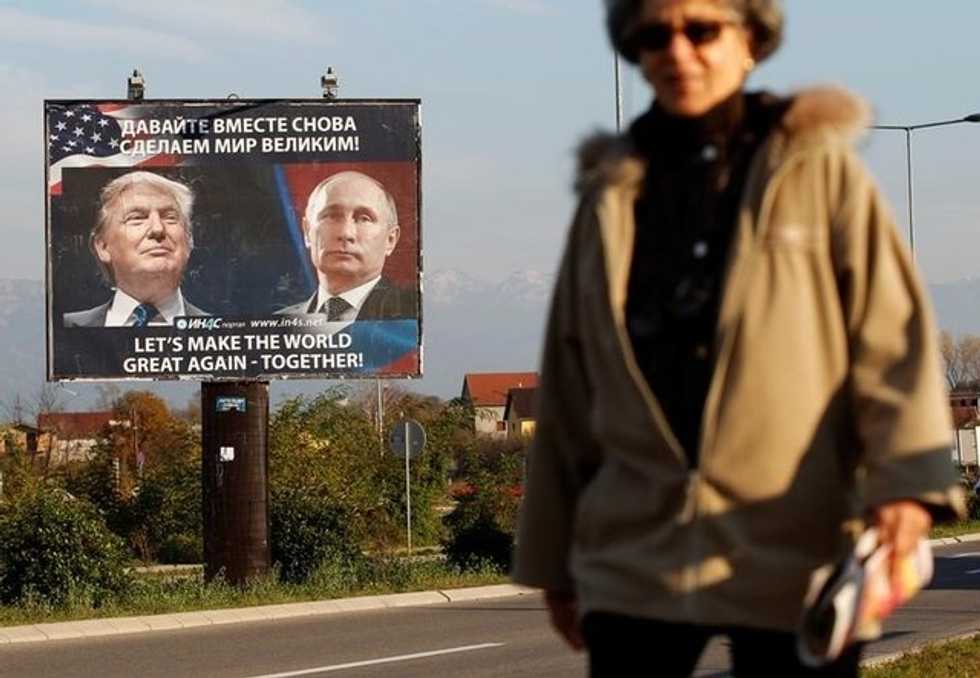
IMAGE: A woman passes a billboard showing a pictures of US president-elect Donald Trump and Russian President Vladimir Putin in Danilovgrad, Montenegro, November 16, 2016. REUTERS/Stevo Vasiljevic

As Improved US-Iran Relations Are Celebrated, Questions Loom About Road Ahead

As Improved US-Iran Relations Are Celebrated, Questions Loom About Road Ahead

By Tracy Wilkinson and Patrick J. McDonnell, Los Angeles Times (TNS)

WASHINGTON — Amid celebration of the milestone nuclear deal and the depature from Iran of three freed Americans, the Obama administration offered a reminder Sunday of the gulf that remains in the countries’ relations.

The U.S. placed new sanctions targeting 11 people or companies that work to advance Iran’s ballistic missile system, and President Barack Obama promised to “remain vigilant.”

That announcement came almost as an aside in an otherwise upbeat message but illustrated the continued strains in what is being hailed as a new relationship between enemies Iran and the United States.

Addressing their respective nations, Obama and his Iranian counterpart, Hassan Rouhani, praised the nuclear deal as a victory for tough diplomacy between two governments that just a short time ago were not on speaking terms.

Obama said the deal, fully implemented on Saturday, makes the world safer, allows Iran to join the world by lifting key sanctions, and is already providing sidebar dividends: the release of five Americans who were being held in Iranian jails and were “finally coming home.”

Three of them touched U.S. territory Sunday, at an American military base at Ramstein, Germany. The Swiss jet carrying Washington Post reporter Jason Rezaian and the others landed Sunday evening at the base, where the freed men will undergo medical checks.

Along with Rezaian, the other two were U.S. Marine veteran Amir Hekmati and Christian pastor Saeed Abedini. Also on board were Rezaian’s Iranian wife and his mother; locating them in Tehran on Saturday delayed the departure of the flight.

A fourth Iranian-American, Nosratollah Khosravi-Roodsari, about whom little is known, chose to stay in Iran, U.S. officials said, adding that it was his right to decide where to go. The fifth, student Matthew Trevithick, who was in Iran studying Farsi, left earlier.

With the exception of Trevithick, the prisoners were released in an exchange for seven Iranians who were jailed or facing trial in the U.S. They were charged with violating sanctions by attempting to illegally export prohibited items and will be granted clemency by Obama. They were on a much longer list the Iranians supplied but that was whittled down to include only those who hadn’t committed violent or terrorism-related crimes, U.S. officials said.

Obama said the nuclear deal, under which Iran has dismantled much of its nuclear arms capabilities and been rewarded by the easing of significant economic sanctions, serves as a reminder “of what we can achieve when we lead with strength and wisdom.”

And he told the Iranian people that they will be able to emerge from dark days of isolation. Iran will receive tens of billions of dollars in frozen assets as well as access to the international banking system and world markets for its oil and gas.

“We’ve now closed off every single path Iran had to building a (nuclear) bomb,” Obama said, speaking from the White House. “We’ve achieved this historic progress through diplomacy, without resorting to another war in the Middle East.”

In Tehran, before parliament, Rouhani lauded a “golden page” in the Islamic republic’s history that will be the beginning of economic recovery thanks to the injection of cash and trade.

“While we always remain ready to defend Iran, we bear the message of peace, stability and security for our region and the world,” he later tweeted.

Iranian officials are hopeful that the lifting of sanctions will help revive the nation’s economy, crippled by the sanctions in recent years, but the low price of oil means its immediate income will be lower than needed or expected.

Obama also announced the resolution of a long-standing claim Iran had brought in the Iran-U.S. Claims Tribunal in The Hague, the international court through which such demands were pursued.

Dating to shortly after the 1979 Islamic Revolution, Iran said it was owed $400 million for military equipment the deposed government was buying. In the resolution, the U.S. paid the $400 million plus $1.3 billion in interest, which was much less than what the Iranians had sought, Obama said.

Within the framework of the nuclear negotiations, a less hostile relationship developed between the U.S. and Iran following decades of acrimony, especially through the personal contacts of U.S. Secretary of State John F. Kerry and his Iranian counterpart, Javad Zarif. Many hope that can be translated into cooperation on other persistent conflicts in the region, such as the civil war in Syria.

American officials are also hopeful that the success of the nuclear deal will strengthen the hands of Rouhani and other likeminded moderate Iranians.

With Iran, the tone of its rhetoric “very much changed when Rouhani was elected,” an administration official said. “He had a mandate to engage the West on the nuclear issues.”

Yet it is clear that change comes slowly in Iran, and discord between the two countries remains deep.

On Sunday, hours after the nuclear deal, the Obama administration slapped new sanctions on Iran’s ballistic missile program in connection with alleged violations of United Nations resolutions last year. The sanctions had been prepared weeks ago but held up until the prisoners were freed.

The sanctions target “11 entities and individuals,” including a network based in the Middle East and China and another with suspected links to North Korea, as well as five Iranians who U.S. officials said had worked to secure ballistic weapon components for Iran.

“Iran’s ballistic missile program poses a significant threat to regional and global security, and it will continue to be subject to international sanctions,” Adam J. Szubin, Treasury’s undersecretary for terrorism and financial intelligence, said in a statement Sunday.

The sanctions include a freeze of any assets that these entities and individuals have in the U.S. financial system, as well as prohibitions on doing business with them.

The sanctions are separate from the sanctions against the nuclear program that were lifted this weekend. Iran launched ballistic missiles on two occasions last year in violation of the U.N. restrictions; Iran says it has a right to use the weapons.

Other U.S. sanctions that remain in place on Iran include those related to activities considered by Washington to be terrorism and violations of human rights. Obama and other U.S. officials insist they can revive other sanctions at any point if Iran is found to be in violation of nuclear restrictions or any other sanctionable activities.

In swapping the prisoners, the Obama administration has come under criticism among Republicans and others for appearing to exchange innocents for convicted criminals. But administration officials Sunday defended the swap, saying it was a one-time, unusual opportunity that they saw arise on the margins of the nuclear talks.

(Wilkinson reported from Washington and McDonnell from Beirut. Staff writer Don Lee in Washington contributed to this report.)

©2016 Los Angeles Times. Distributed by Tribune Content Agency, LLC.

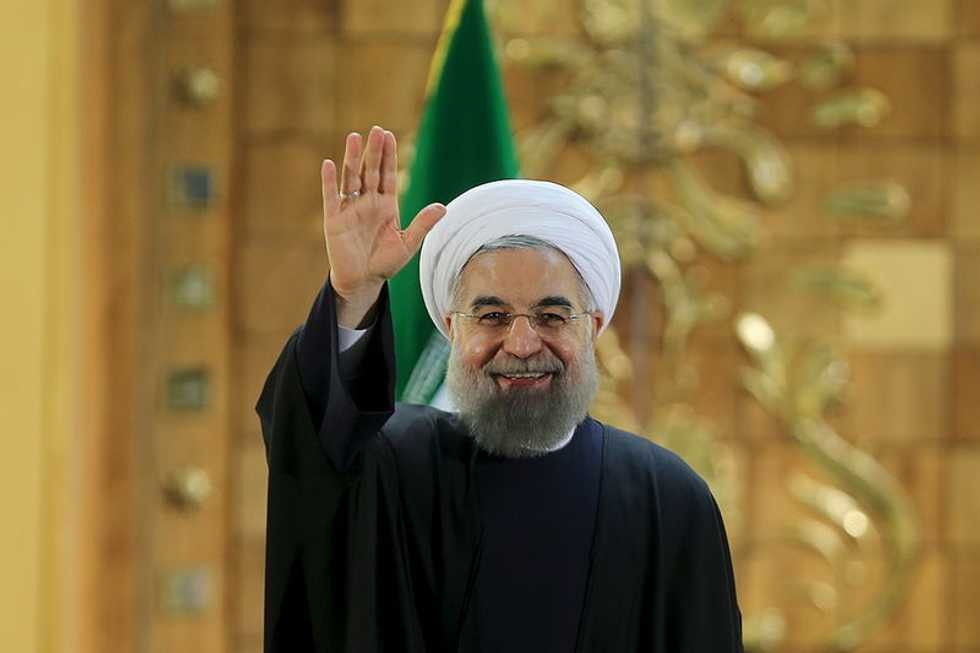
Photo: Iranian President Hassan Rouhani waves during a news conference in Tehran, Iran January 17, 2016. REUTERS/President.ir/Handout 

White House Shrugs Off Schumer’s Decision To Oppose Iran Deal

White House Shrugs Off Schumer’s Decision To Oppose Iran Deal

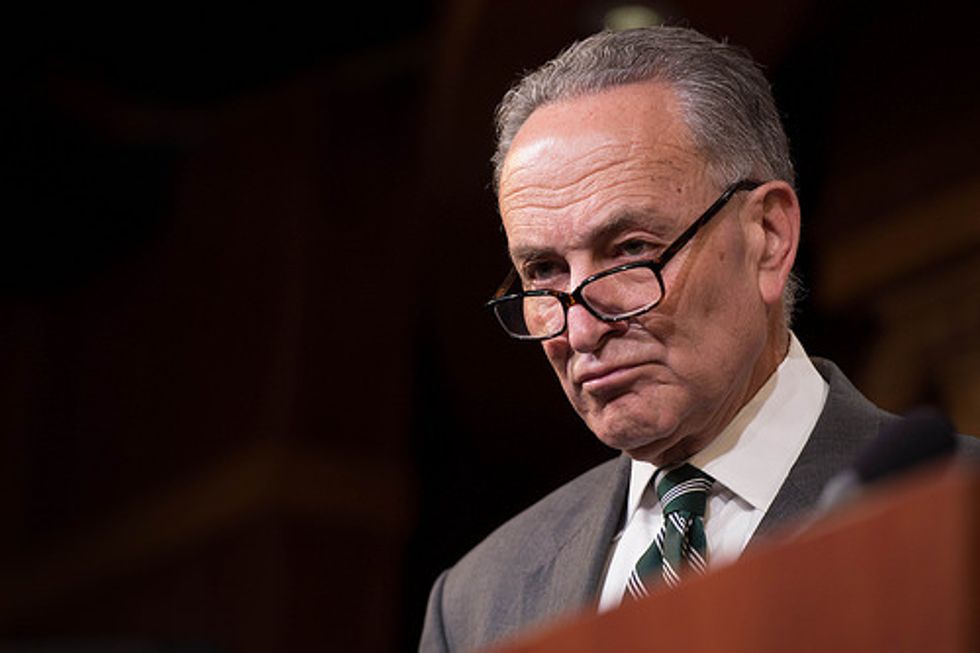
WASHINGTON (Reuters) — The decision by one of the top Democrats in the U.S. Senate to oppose the nuclear deal between Iran and world powers was “disappointing but not surprising,” White House spokesman Josh Earnest said on Friday.

President Barack Obama’s hopes of preserving the nuclear deal were dealt a blow on Thursday when New York’s Charles Schumer came out against it even as the White House tried to draw attention to other lawmakers who are backing the agreement.

Earnest told reporters that the Obama administration worked closely with Schumer to explain details of the deal even before it was signed in an effort to gain his support.

“Ultimately, it didn’t turn out that way. I don’t think anybody was surprised,” Earnest said.

Obama is struggling to gain congressional backing for the deal, which lawmakers must vote on by Sept. 17. Schumer’s rejection means the Obama administration may have to ramp up its lobbying efforts on Capitol Hill.

Twelve members of the U.S. Congress, seven members in the House of Representatives, and five in the Senate, have publicly come out in support of the agreement in recent days, showing Obama had made a persuasive case, Earnest said.

The administration is confident they can continue to build support before next month’s deadline, he added.

(Reporting by Lindsay Dunsmuir, Doina Chiacu and Jeff Mason; Editing by Susan Heavey)

Photo: Senate Democrats via Flickr

Shop our Store

Headlines

Editor's Blog

Corona Virus

Trending

World