Tag: retirement savings
Bessent and Lutnick with Trump in Oval Office

Bessent And Lutnick's Fantasy Stock Earnings Won't Finance Your Retirement

We all know how Trump likes to make up crazy numbers, which his lackeys then repeat. He has $18 trillion in foreign investment coming into the country. He won the 2020 election by millions of votes. He is lowering drug prices by 1500%.

We can usually just laugh these off as the ramblings of an old man suffering from dementia. But there is one crazy Trump number that it is important people know should not be taken seriously. This is the claim on stock returns that lackeys like Treasury Secretary Scott Bessent and Commerce Secretary Howard Lutnick tout when telling people how much money their new-born kid can get from their Trump accounts.

In their telling, the $1000 that the government is putting into the Trump accounts, starting this year, will grow to more than $590,000 when the kid reaches retirement age. If their families are able to put the full $5,000 allowed into the account, they will have more than $2.5 million when they reach retirement, and that assumes no further contributions. (They can put up to $5,000 a year into the account.)

That’s a serious chunk of money, even if we cut it by four to adjust for projected inflation over this period. It’s also serious nonsense. The problem is that there is no plausible story whereby the stock market can provide the 10 percent nominal return the Bessent-Lutnick gang is pushing. In their story, price-to-earnings ratios would have to go through the roof.
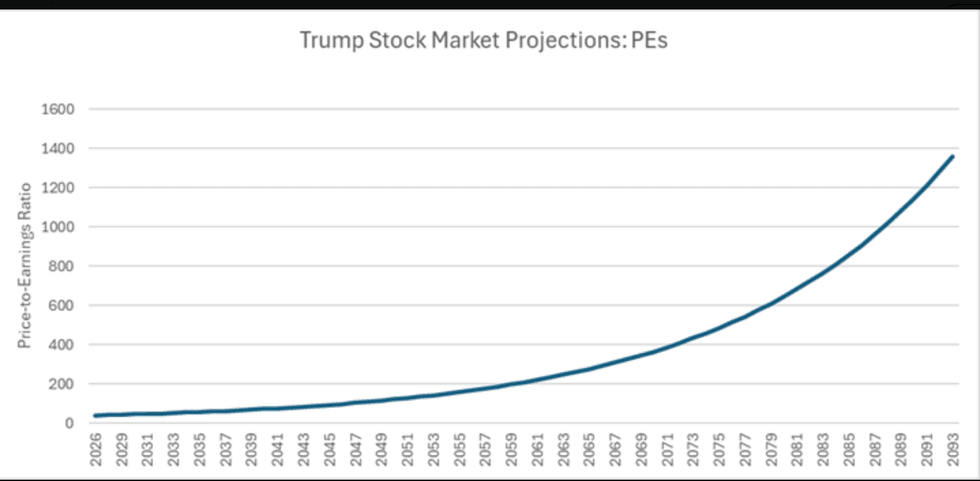
By 2093, when our newborn kid plans to cash out the fortune in their Trump account, their 10 percent compounded returns would imply a price-to-earnings ratio (PE) of almost 1400. The problem is that if the Trump accounts are growing at the rate of 10 percent a year, the economy and corporate profits are only growing at a bit less than 4.0 percent annually. This causes the PE to go through the roof.

This is not an old problem. Some of us have been trying to point this one out to arithmetic fans ever since the Social Security privatization debates of the 1990s. While the stock market has historically provided returns that were higher than the economy’s rate of growth, this was possible because the PE in the stock market has averaged around 14 to 1. It is currently close to 40 to 1.

The simplest way to calculate the real rate of return consistent with a stable PE is to simply take the reciprocal of the PE ratio. When the PE ratio is 14, the sustainable real rate of return is 7.1 percent percent. Adding in inflation that has averaged close to 3.0 percent, gets the 10.0 percent that we can see going back 100 years.

But with the current PE close to 40, this sort of rate of return is not possible unless the PE gets ever higher. The sustainable real rate of return would be just over 2.5 percent. Adding in projected inflation of 2.3 percent gets us to 4.8 percent, well below the Bessent-Lutnick promise.

The moral of this story is that, just as no one in their right mind would take health advice from RFK Jr., no one in their right mind should take financial advice from the Bessent-Lutnick gang. As the saying goes, do your own research.

Dean Baker is a senior economist at the Center for Economic and Policy Research and the author of the 2016 book Rigged: How Globalization and the Rules of the Modern Economy Were Structured to Make the Rich Richer. Please consider subscribing to his Substack.

Reprinted with permission from Dean Baker.

5 Reasons Your Nest Egg Could Be At Risk In 2016

5 Reasons Your Nest Egg Could Be At Risk In 2016

By Roger Wohlner, GOBankingRates.com (TNS)

Investing for retirement, or any other objective, always carries risk. There are potential risks specific to 2016 that retirement investors should be aware as the new year approaches. There are also potential risks in any year that you should watch out for, said to Mike Piper, personal finance author and founder of the Oblivious Investor blog.

Having a significant amount of your portfolio invested your employer’s stock can be a big risk. “While familiarity with the company may make it feel safe, it’s anything but,” Piper said. “Having both your job and your portfolio exposed to the same set of risks creates a very dangerous situation.”

Also, if your portfolio contains actively managed mutual funds (like non-index funds), make sure you have a solid understanding of how the fund managers are investing. “During every market downturn, there are a handful of actively managed funds that ‘blow up’ in a spectacular manner — declining much more than investors anticipated, because the investors didn’t have a good understanding of the degree and types of risks the fund managers were taking,” Piper said.

Adjusting your long-term asset allocation based upon potential market risks in 2016, or any other year, is generally a poor idea, Piper said. However, it’s also a good idea to be aware of trends and what they can mean for your money. Here are five reasons why your nest egg could be at risk in 2016:

—The bull market might end. The current bull market began on March 9, 2009, according to the S&P 500-stock index. Although there have been a few hiccups in 2015, and at a few other points during this run, this market is six years in. It’s the third-longest bull market in U.S. history, according to a report by Bespoke Investment Management.

The S&P 500-stock gained 1,329 points through the last week of November, since the lows of March 2009 — a bit over three times the average gain during a bull market. There’s no rule that bull markets must end at a particular point, but they don’t go on forever. Furthermore, stock market risk is always heightened as a bull market progresses.

—China’s economy affects ours. This summer, the stock market experienced steep losses and a high degree of volatility. A good deal of this was due to China’s economic troubles. In this interconnected world, what happens in the second-biggest economy has an impact on the U.S. economy and financial markets.

A slowdown in China’s consumer economy, and a devaluation in its currency, hit a number of large U.S. companies that do business in China. Among the major companies that felt the impact were Apple, Yum Brands, Caterpillar, Boeing and General Motors.

—International markets are uncertain. Beyond China, other international markets also have an impact on the U.S. Because a well-diversified portfolio includes international exposure, both in developed and emerging markets, changes in those markets would be reflected in those portfolios.

“The outlook for international markets — Europe, Asia, Latin America and emerging markets — continues to be unclear,” said financial adviser Cathy Curtis. “As most diversified portfolios have a percentage allocated to stocks in these regions, they could continue to be a drag on portfolios. However, to not hold an allocation to international and emerging stocks could hurt a portfolio when these economies do improve.”

It’s this uncertainty that is a big risk to U.S. stocks in the coming year, said to Russ Koesterich, global investment strategist for money manager BlackRock. “Emerging markets account for a growing percentage of global growth, and the recent slowdown in the emerging world isn’t limited to China, as data from Bloomberg demonstrate,” he wrote in a recent economic outlook. “Economies in Brazil and Russia are contracting, and most large emerging markets, with the possible exception of India, are slowing, according to the data.”

—Tragic events have an impact. The impact of terrorist attacks on our portfolios is secondary to the human toll. However, some sort of major attack would affect our financial markets and your retirement nest egg, at least in the short term.

“The Paris attacks emphasize how vulnerable the world is to terror,” Curtis said. “Markets don’t like uncertainty, and investors could decide to put their money in safer havens — cash or short-term bonds, gold. Diversified portfolios would be vulnerable to this shift.”

—Interest rates might increase. When the Federal Reserve didn’t raise interest rates at its last meeting, experts began speculating on whether it would do so by the end of the year. An interest-rate increase will affect holders of fixed-income mutual funds, exchange-traded funds and individual bonds. The price of a bond moves inversely with interest rates.

A statistic called duration, which Morningstar and other sources provide for fixed-income mutual funds, can illustrate this. The largest bond mutual fund with Vanguard Total Bond Market Index Investor Shares currently has a duration of 5.72 years, according to Morningstar. What this means is that a 1 percent increase in interest rates would result in a 5.72 percent decrease in the value of the underlying bonds held by the fund. If you hold a longer-duration bond fund, the impact will be greater.

Bond duration is an imperfect indicator, but it can give investors a good idea of the impact on the value of their bond fund if interest rates rise. The interest rate earned from the bonds in the fund will partially offset the impact of rising rates. Investors should keep the impact of their fund’s duration in mind and might consider shortening up on the length of their bond holdings.

There are risks to your retirement nest egg in 2016. However, one of the biggest risks is overthinking what can go wrong. That doesn’t mean you should ignore what’s going on in the financial markets and the economy, but trying to time the markets based upon these or any other risk factors is not the best strategy. Retirement investors should consider investing with an asset allocation based on when they need the money, risk tolerance and their investment goals.

GOBankingRates.com is a leading portal for personal finance news and features, offering visitors the latest information on everything from interest rates to strategies on saving money, managing a budget and getting out of debt.

© 2015 GOBankingRates.com, a ConsumerTrack web property. Distributed by Tribune Content Agency, LLC.

Photo: Pictures of Money via Flickr

More Than A Third Of Americans Have Saved Nothing For Retirement According To New Survey

More Than A Third Of Americans Have Saved Nothing For Retirement According To New Survey

By Becky Yerak, Chicago Tribune

More than a third of Americans have no retirement savings, and millennials feel more financially secure than other age groups despite being the least likely to have socked away any cash for their golden years, a new survey shows.

Bankrate.com, a publisher of personal finance content, found that on average 36 percent of Americans haven’t saved any money for retirement.

Generally, the older the age group, the more likely it is that they are saving.

More than two-thirds of 18-to 29-year-olds have saved nothing for retirement, while 14 percent of people 65 and older have put nothing aside for retirement, Bankrate.com found.

But despite their lack of retirement savings, millennials feel more financially secure and optimistic about their personal situations than other age groups.

The study was conducted on behalf of Bankrate.com by Princeton Survey Research Associates International. It did phone interviews with 1,003 U.S. adults, nearly evenly divided between land lines and cell phones. The survey was conducted in English and Spanish over four days earlier this month. The margin of error is plus or minus 3.5 percentage points.

Among people ages 30 to 49, a third have no retirement savings.

AFP Photo/Emmanuel Dunand

Interested in national news? Sign up for our daily email newsletter!

Shop our Store

Headlines

Editor's Blog

Corona Virus

Trending

World