Tag: theodore roosevelt
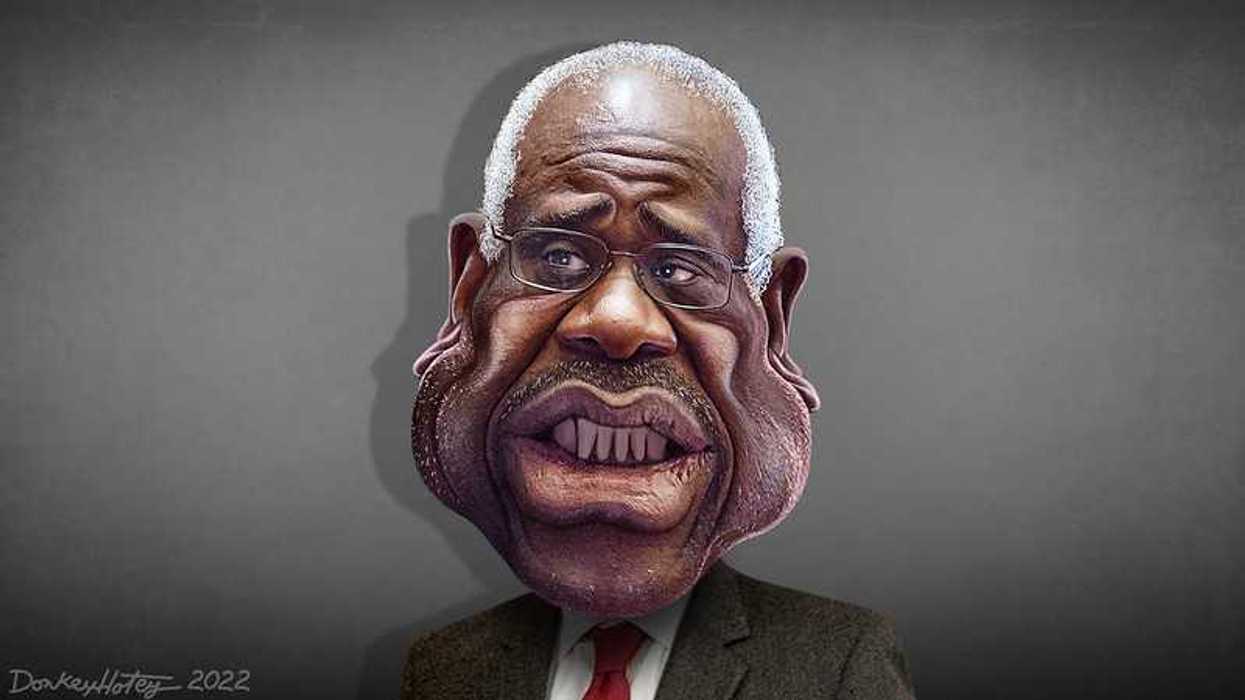
Justice Thomas Delivers 'Historically Illiterate' Speech Berating Progressives

Justice Thomas Delivers 'Historically Illiterate' Speech Berating Progressives

When Supreme Court Justice Thurgood Marshall announced his retirement in 1991 and President George H.W. Bush nominated Clarence Thomas, he wanted the seat to be held by another Black justice. Marshall was an historic figure: Appointed by President Lyndon B. Johnson in 1967, he was the first Black justice in the High Court's history.

But Thomas, now 77, was a major departure from Marshall in terms of judicial philosophy. While Marshall (who passed away in 1993) was decidedly liberal, Thomas is a far-right social conservative. And over the years, he had strong disagreements with not only the late liberal Justice Ruth Bader Ginsburg, but also, with retired libertarian/conservative Justice Anthony Kennedy.

Thomas looked back on U.S. history during a speech on Wednesday night, April 15, at the University of Texas-Austin Law School, arguing that progressive politics are incompatible with the Declaration of Independence. But The New Republic's Matt Ford, in an article published on April 17, argues that Thomas got history wrong in multiple ways.

Thomas told attendees, "As we meet today, it is unclear whether these principles will endure. At the beginning of the 20th Century, a new set of first principles of government was introduced into the American mainstream. The proponents of this new set of first principles, most prominently among them the 28th president, Woodrow Wilson, called it progressivism. Since Wilson's presidency, progressivism has made many inroads in our system of government and our way of life. It has coexisted uneasily with the principles of the Declaration. Because it is opposed to those principles, it is not possible for the two to coexist forever."

But according to Ford, Thomas' take on U.S. history is wildly inaccurate.

"Thomas is correct that progressivism was introduced around the turn of the 20th Century, that Woodrow Wilson was the 28th president, and that Wilson was a progressive," Ford explains. "The historical accuracy ends there. Presenting Wilson as the inventor of progressivism is historically illiterate, akin to saying that Joseph Stalin invented communism or that Ronald Reagan invented conservatism. In reality, the progressive era emerged in the 1890s from the corruption and excesses of the Gilded Age."

Ford continues, "A broad range of activists, journalists, legislators, and judges challenged the societal ills that had emerged from the nation's rapid industrialization…. I'm sure that Wilson would have liked to claim credit for inventing the progressive movement, but he was one figure in a much larger social and political ecosystem. Republicans and Democrats alike both supported the movement and its reforms, and the first president to embrace it was actually Theodore Roosevelt."

Ford argues that for Thomas, it is "rhetorically advantageous to make" Wilson "the standard-bearer of progressivism" because he "was perhaps the most racist person to hold the presidency between Andrew Johnson and Donald Trump."

"It allows certain conservative intellectuals to adopt the guise of anti-racism while simultaneously opposing the civil rights laws passed decades after Wilson died," Ford notes. "I bring all of this up not to defend Wilson himself, but to point out the importance of getting history correct."

Reprinted with permission from Alternet


Danziger Draws

Danziger Draws

Jeff Danziger lives in New York City. He is represented by CWS Syndicate and the Washington Post Writers Group. He is the recipient of the Herblock Prize and the Thomas Nast (Landau) Prize. He served in the US Army in Vietnam and was awarded the Bronze Star and the Air Medal. He has published eleven books of cartoons and one novel. Visit him at DanzigerCartoons.

Whatever Happened To Americans’ Sense of Humor?

Whatever Happened To Americans’ Sense of Humor?

You’d think there’d have been more laughs. Hard-fought political campaigns drenched in sweat and tears usually produce moments of levity. But Americans seem to have lost their sense of humor, becoming late-night angry, frustrated and sick with anxiety.

Mark Twain said: “The secret source of Humor itself is not joy but sorrow. There is no humor in heaven.” The problem is that Americans can’t agree on what to be sorrowful about. Many can’t even recognize as false the “facts” fueling their woes, so trapped are they in their alternate reality.

Political wit has traditionally provided sparks of light in the darkest of times.

Winston Churchill: “If Hitler invaded hell, I would make at least a favorable reference to the devil in the House of Commons.”

Abraham Lincoln during the Civil War: “I can make more generals, but horses cost money.”

Made today, such remarks would easily ignite demands for apologies from groups feeling insulted — or, in many cases, feigning umbrage for political effect. Often the demands follow failed attempts at wit, which is too bad. Efforts to lighten things need encouraging.

Theodore Roosevelt poked Grover Cleveland as “His Accidency.” And when George H.W. Bush persisted in likening his opponent Bill Clinton to Elvis Presley, Clinton responded, “I don’t think Bush would have liked Elvis very much, and that’s just another thing that’s wrong with him.”

Wit requires using words and ideas in quick, inventive and humorous ways. Donald Trump’s insults were mere stink bombs. And his alt-right chorus was a uniquely dimwitted bunch. The alt-right’s idea of funny is grossly worded memes tacked on obscene images. Yuk, yuk, yuck.

Trump did show some comedic promise at the Al Smith dinner, delivering some decent jokes written for him. Self-mockery is not in Trump’s natural repertory, but he got laughs complaining that everyone loved Michelle Obama’s speech but not his wife’s when she used the exact same (plagiarized) words.

But then his rudder broke off, as it so often did, and Trump veered into leaden attacks on that “corrupt” woman. Trump’s own idea of funny wasn’t funny, but it sometimes sounded that way because of his New York patter.

Bernie Sanders, though Jewish and from Brooklyn, revealed no sense of humor. Vermont must have beat it out of him.

That said, Calvin Coolidge of Putney, Vermont, fired off some of the presidency’s most sophisticated wisecracks.

At a White House briefing, “Silent Cal” gave one-word answers of “no” to a string of questions dealing with Prohibition, the World Court and the farm situation. As reporters were leaving the room, Coolidge called out, “And don’t quote me.”

Hillary Clinton, meanwhile, hasn’t said a single really funny thing on her own. (Perhaps someone can correct me on this.)

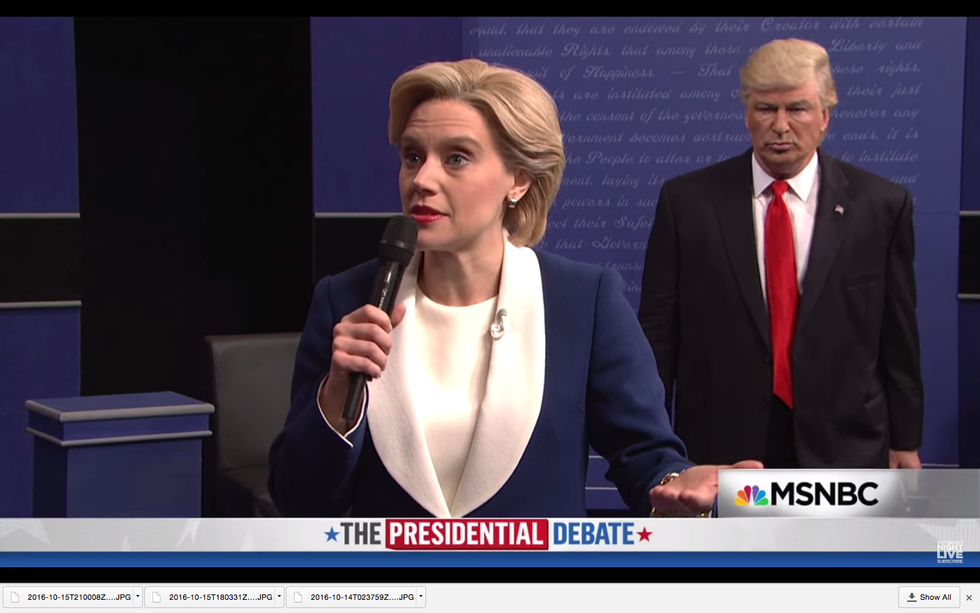
Much of the left has replaced humor with snark, which is heavy and grouchy and does not zing. The one bright lift this season came from the “Saturday Night Live” skits making fun of Clinton, Trump, Sanders and the media figures covering them.

Whatever happened to the clever retort? Whatever happened to the smart rejoinder? Portrayed as a plodding man, Lincoln said, “I am a slow walker, but I never walk back.” Not hilarious but a return shot.

Perhaps we lost our ability to laugh during the recent campaign because we didn’t find ourselves to be funny. One of the nominees was a dangerously crazy man. Scarier than Trump himself was that so many Americans found him acceptable.

Well, Churchill said, “If you’re going through hell, keep going.”

But also remember Will Rogers’ nod to the opposition: “Everything is funny, as long as it’s happening to somebody else.”

Follow Froma Harrop on Twitter @FromaHarrop. She can be reached atfharrop@gmail.com. To find out more about Froma Harrop and read features by other Creators writers and cartoonists, visit the Creators webpage at www.creators.com.

Why Do Conservatives Keep Talking About John F. Kennedy?

Why Do Conservatives Keep Talking About John F. Kennedy?

A day before Republican Senator Ted Cruz of Texas got an earful of Bronx jeers for his rightwing views on immigration and “New York values,” he summoned up the ghost of liberal icon John F. Kennedy to signal that his was a lofty, aspirational campaign not unlike one mounted by the youthful candidate for president way back in 1960.

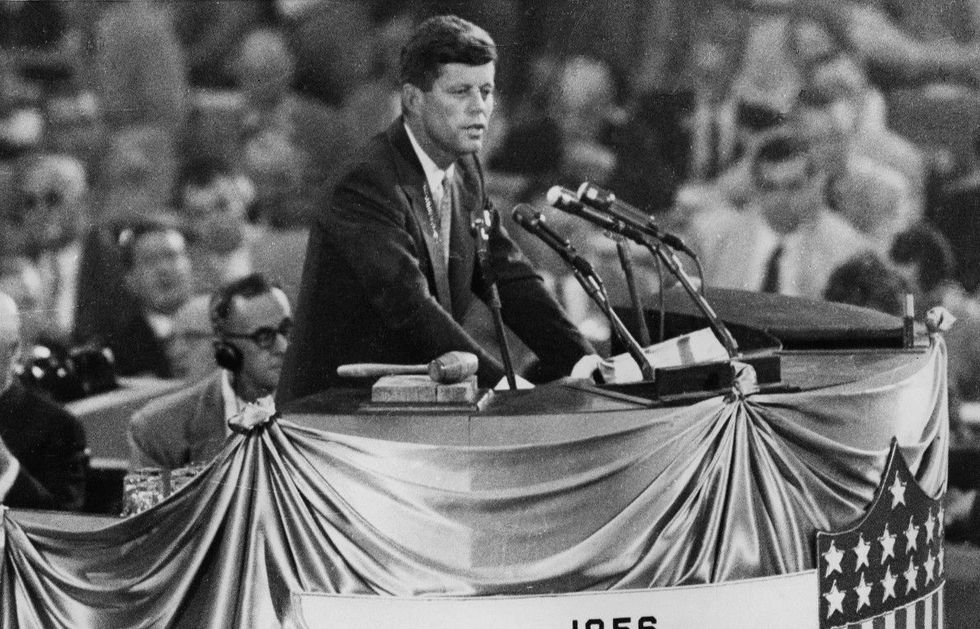
“The American people expect more from us than cries of indignation and attack,” Cruz said, quoting JFK during his acceptance speech in Wisconsin, where he had trounced his main primary rival, front-runner Donald Trump. “We are not here to curse the darkness but to light a candle that can guide us from darkness to a safe and sane future.”

Cruz, who has slowed the potty-mouthed Trump’s momentum towards the Republican presidential nomination in Cleveland this summer, has pulled out other high minded phrases from the fallen crown prince of Camelot (and also from Winston Churchill) while on the stump.

In Massachusetts, the nation’s bluest state, he contended that Kennedy was “one of the most powerful and eloquent defenders of tax cuts.” He even contended: “JFK would be a Republican today. There is no room for John F. Kennedy in the modern Democratic Party.”

Unremarkably, Cruz’s commentary elicited angry blowback from Democrats, notably Jack Kennedy Schlossberg, JFK’s Grandson, who labeled the senator’s rhetoric “absurd” in an article for Politico Magazine in January. Schlossberg also denied Cruz’s assertion that Kennedy, who would be 98 years old if he were alive today, supported limited government.

“(Kennedy) created new federal programs with ambitious goals, such as the Peace Corps,” Schlossberg wrote from Tokyo. “He did not spend his years in the House and Senate devoted to obstructing the opposition. He certainly did not lead an effort, as Cruz did, to shut down the federal government to score political points and deny health insurance to millions.”

Cruz, of course, is hardly the first Republican to invoke JFK’s name, image and age on the campaign trail. As noted by many a political junkie, Sen. Dan Quayle of Indiana, George H.W. Bush’s pick for vice president in 1988, spoke of Kennedy when defending his inexperience during a debate with Texas Sen. Lloyd Bentson, his much older Democratic counterpart and running mate of unsuccessful presidential hopeful Massachusetts Gov. Michael Dukakis.

Bentson famously put down Quayle with scathing disdain: “Senator, I served with Jack Kennedy. I knew Jack Kennedy. Jack Kennedy was a friend of mine. Senator, you are no Jack Kennedy.”

These days, Michael R. Long, chairman of the Conservative Party of New York since 1988, which was founded in 1962 with support from conservative icon William F. Buckley, doesn’t believe that Cruz’s praise of JFK is a deviation from conservative orthodoxy. “There’s no problem with Cruz (invoking) JFK,” he told The National Memo in a telephone conversation. “Reagan invoked JFK on tax cuts,” added Long, who also noted that Kennedy’s legacy crosses party lines: “He was an inspirational person who brought a lot of hope to a lot of Americans. Probably some conservatives voted for him because of his love of America.”

It appears that Cruz’s use of Democratic imagery is his attempt to sell what is otherwise a far-right candidacy to voters from both parties as well as independents. Last summer, Cruz told PBS host Tavis Smiley that his campaign was “modeled” after President Obama’s successful 2008 primary campaign with its emphasis on social media. Others don’t quite agree with that assessment

“While Cruz may hope to attract Democratic votes, I can’t think that’s his primary motivation,” said David Birdsell, Ph.D., Dean of the Baruch College School of Public Affairs in an email to this reporter. “Kennedy was known as a great speaker, Cruz fancies himself a great speaker too. Kennedy was the youngest person elected to the presidency, Cruz is only two years older than Kennedy was. Cruz wants the mantle of Camelot, but the garment doesn’t fit well and he suffers in the comparison.”

Birdsell, who believes Canada’s Justin Trudeau is far more “genuinely Kennedy-esque” than Cruz or Quayle, does regard the Texas senator as a political pro who has recognized the quality of Obama’s field operation. “He obviously loathes Obama but has the perspicacity to know there was something to learn from his campaign. That reflects well on Cruz, and the quality of his own field operation is the single most important reason he’s in second place. Lesson learned.”

Cruz, however, hit a roadblock in the Bronx this week for his hardline views on immigration and had to cancel a meeting at a charter school after students threatened a walkout. State Sen. Ruben Diaz, Sr., a conservative Democrat who is also a pastor at a Bronx pentacostal church, hosted a sparsely attended event for him at Chinese-Dominican restaurant in Parkchester that also drew a few shouting local protestors.

Diaz, whose more liberal son Ruben Diaz, Jr. is the Bronx borough president and labels Cruz a hypocrite, said that he may also “do something” in the Bronx for Donald Trump, whose views are similarly loathed by many in the hispanic community.

“We’ve got to do something about the 12 million undocumented immigrants,” said the elder Diaz. “I want to build a wall to make America great again,” he added with a laugh, echoing Trump.

Trump, meanwhile, has put himself in the same league as Ronald Reagan on the issues, while his admirers have invoked Teddy Roosevelt and Andrew Jackson to describe his bellicose bloviating.

As for Trump’s purported allegiance to Reagan’s policies, Michael Long of the Conservative Party dismisses that notion. “He doesn’t come close to Ronald Reagan. He’s more like a populist candidate. Trump has brought a different style to this campaign that’s different from anything I’ve witnessed in my entire life.”

Photo: Wikimedia Commons

Shop our Store

Headlines

Editor's Blog

Trending

World