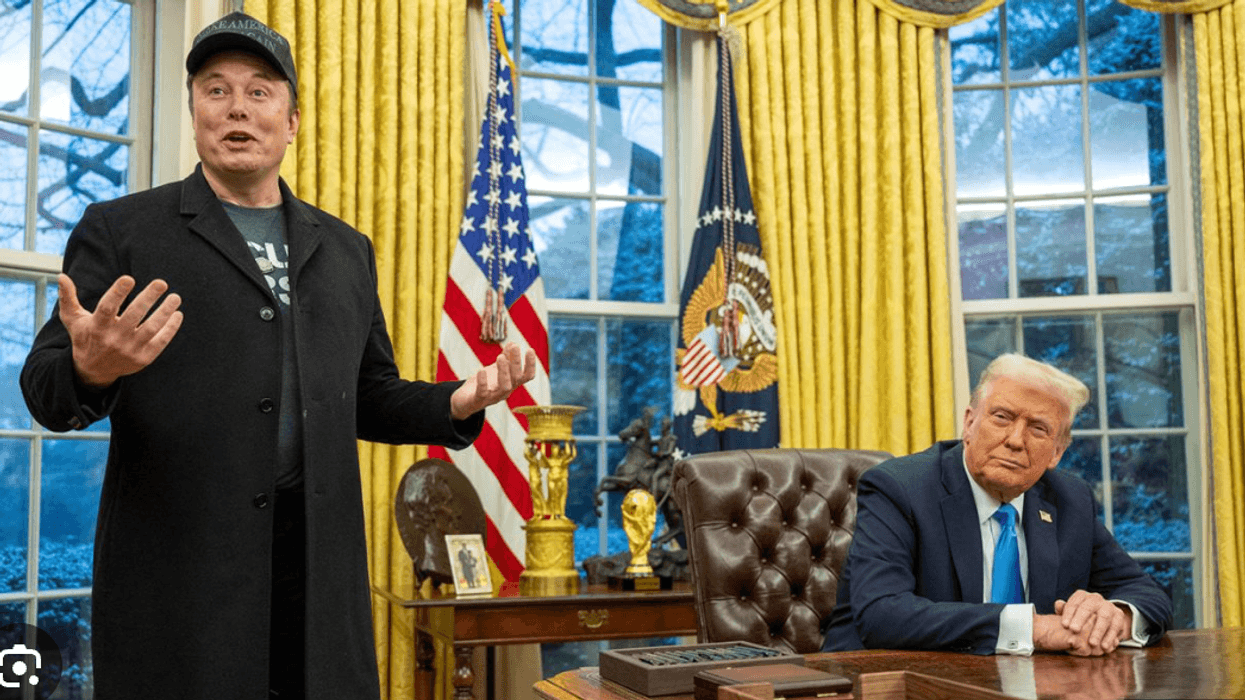
Elon Musk and President Donald Trump in the Oval Office on February 11, 2025
Since retaking the White House, President Donald Trump and his team have forced hundreds of thousands of federal workers out of their jobs. Ostensibly, they did that to save money. Realistically, it seems to have hurt the economy.
Due largely to the so-called Department of Government Efficiency, the federal workforce has shrunk by 352,000 jobs on net since January 2025, according to the U.S. Bureau of Labor Statistics. Surely, that saved us oodles? And soon the glorious efforts of Trump and former Shadow President Elon Musk, who ran DOGE, will trickle down and bless us all, right?
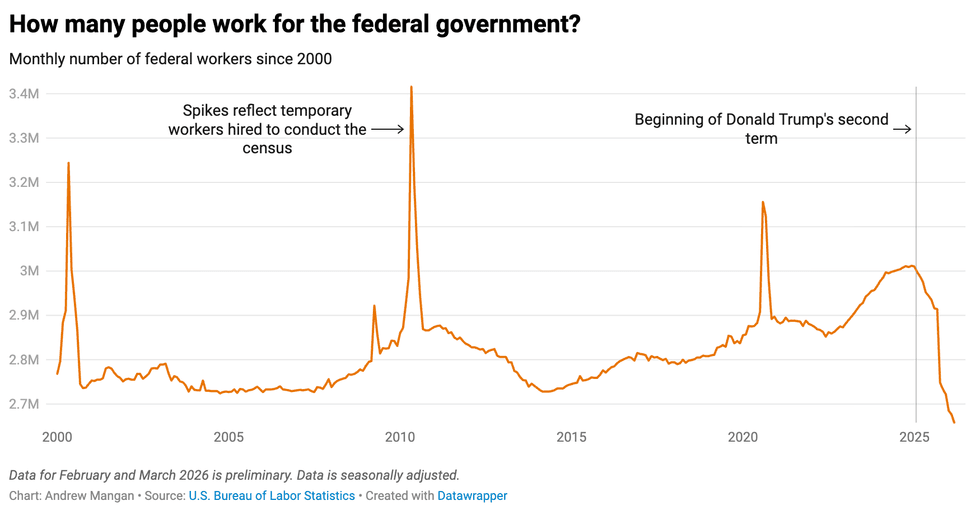
Not so much. The administration’s slipshod efforts to shove out as many workers as fast as possible, using a combination of mass firings, forced resignations, and shuttering agencies, is estimated to have cost the U.S. economy at least $165.6 billion. That comes from a new report by the Partnership for Public Service, a nonpartisan nonprofit focused on civil service.
DOGE claims to have saved $215 billion through job cuts and other measures, but those numbers are heavily inflated. For instance, as of this past August, DOGE had claimed to save roughly $54 billion in canceled contracts, but Politico could verify savings of only about $1.4 billion.
“Who is getting fired matters. How they’re getting fired, will there be lawsuits?” Dominik Lett, an analyst at the libertarian Cato Institute, told the Associated Press in March, adding that “we don’t know how much DOGE has saved.”
What DOGE has cost us, though, might be easier to measure.
In its report, the Partnership for Public Service drills down on the cost of the Trump administration’s antics.
First, there was the “deferred resignation program,” a truly grim idea. To speedily shrink the federal workforce, Musk sent out a ridiculous “Fork in the Road” email, just as he did when he took over Twitter, and over 150,000 federal workers took the offer.
Deferred resignations weren’t intended to be a cost-saving measure, which becomes clear when you learn that all of those employees were paid through at least Sept. 30, 2025. Instead, the real idea was to hobble the government by starving it of workers. But as a result, the Partnership for Public Service estimates that the administration shelled out over $4.5 billion to keep workers paid but not working. It’s hard to tell exactly where this money might be coming from. The “Fork in the Road” email came via the Office of Personnel Management, but it isn’t clear what authority OPM would have to pay for deferred retirements, since employee salaries are paid by their agencies.
Approximately 10,000 employees who left in the first 12 months of Trump 2.0 were entitled to roughly $763 million in severance pay. Thousands more, though, were placed on an “extended administrative leave,” where they were paid but not allowed to work or visit their offices. This happened at agencies Trump was trying to dismantle, like the Consumer Financial Protection Bureau, where leave-related costs are pegged to be about $152 million. Employees stuck in administrative limbo at the U.S. Agency for Global Media cost us all about $126 million, without any pesky government work in return. Over at the U.S. Agency for International Development, employees cooling their heels came with an estimated price tag of about $298 million.
You get the picture.
The rehiring of fired employees—arguably one of the dumbest things that happened since Trump took office—has run up about $12 million in costs. To date, the government has rehired over 25,000 workers.
But rehiring is costly. Workers need all sorts of things when they are onboarded, even at a place they have worked before. They need to get access to buildings and IT services. They need to sign fresh paperwork. They might need additional training.
The largest cost shown in the Partnership for Public Service’s estimate is for “disengaged workers”—people who remain employed but do the minimum. A Gallup report from several years ago found that disengagement costs an employer roughly 34% of every disengaged employee’s salary.
Federal workers became disengaged not because they are lazy sods who hate Trump but because they’ve been put in trauma, an explicit goal of OPM head Russell Vought. Employees watched their colleagues get fired en masse, their ability to serve the public was impeded or destroyed, and no one knew what arbitrary costs were coming next. That disengagement is estimated to cost $53 billion in lost engagement and productivity.
Funding DOGE itself cost an estimated $81 million.
DOGE was never about saving money. Eliminating over 300,000 federal jobs was never about saving money, either. All this is doing is compromising the work of government and costing us a fortune.
Reprinted with permission from Daily Kos
- Hundreds Of Federal Employees Who Produce Weather Forecasts Fired -- Again ›
- DOGE Cripples National Weather Service Ahead Of Hurricane Season ›
- Censored Social Security Probe Showed How DOGE Damaged Agency Services ›
- After 'Saturday Night Live' Roasts DOGE, Musk Posts Sullen Response ›
- The Fast Rise -- And Humiliating Crash -- Of House 'DOGE Caucus' ›
- Waste, Fraud And Abuse In Musk's Department Of Gross Errors ›
- Musk's 'DOGE' Cuts Will Hit Red States (And Trump Voters) Hard ›
- Stupid Rich: Elon Musk Spews Idiocy On Universal Income And Social Security - National Memo ›