Classified Leak Reveals 'Growing Turmoil' In Military Over Hegseth And Iran
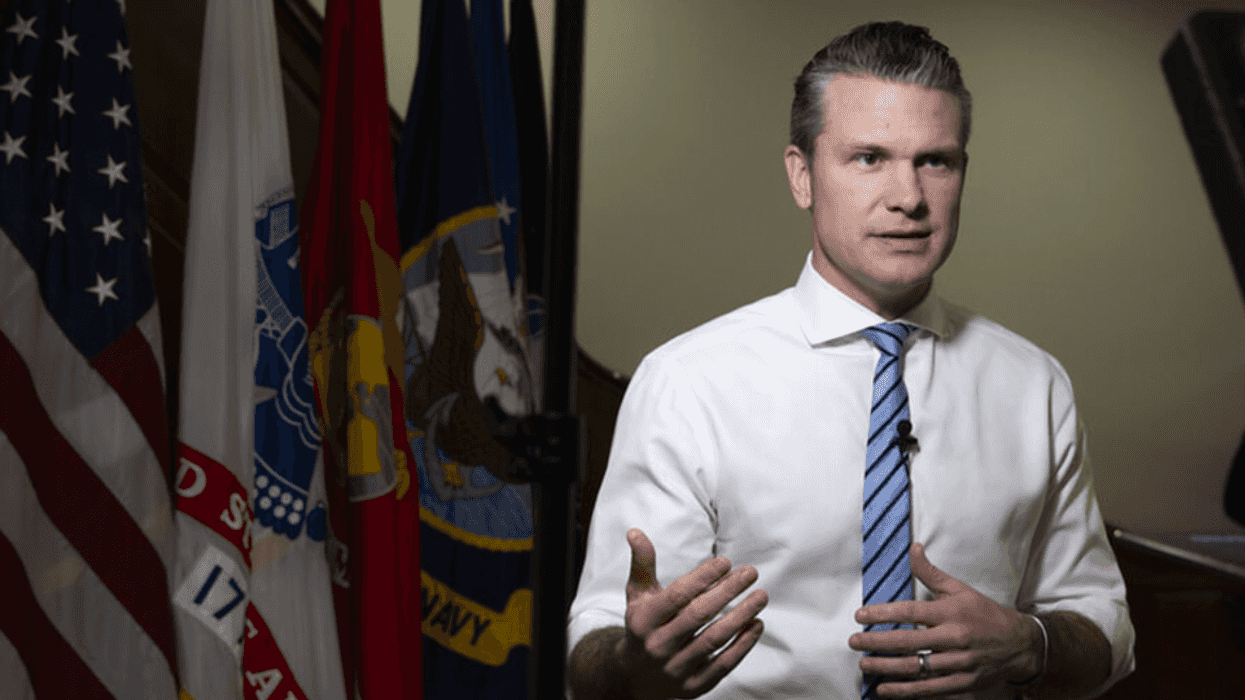
Defense Secretary Pete Hegseth
President Donald Trump's war in Iran has become increasingly unpopular, not only among independents and Democrats but even his own Republican base. Now a new report reveals that the war is worrying America's top military officials about whether they can do their jobs in their assigned regions of the world.
"A remarkable story in Monday’s Washington Post dramatizes how deeply the Iran war has degraded the U.S. military’s ability to fend off attacks by adversaries elsewhere in the world," reported Slate's Fred Kaplan on Monday. "The story is based on the leak of a little-known classified document, which itself signifies that we’ve reached a new stage in the growing turmoil among the senior officer corps over the chaotic reign of Defense Secretary Pete Hegseth."
Kaplan added, "The leaked document reveals that the three four-star commanders in charge of U.S. military operations in Europe, the Pacific,and South America, as well as the Navy’s top admiral, all informed Hegseth that because so many of their planes, ships and other weapons systems have been diverted to the war in Iran, they could no longer perform their tasks if a war broke out in their part of the world."
The journalist also contextualized the current concerns in the broader paradigm of American military history, noting that it is highly unusual for so many top military officials to express the same concern.
"The story is remarkable partially because of the scope," Kaplan wrote. "A former senior Navy officer and a retired Navy operations officer told me that past commanders have occasionally filed statements warning of risk — similar to the non-concur notes. But it is unusual for so many commanders to file such notes all at once in the middle of a combat operation. And it is still more unusual, perhaps unprecedented, for such reports to be filed by these commanders, who have been chosen — or allowed to remain in their top slots — for their loyalty to Donald Trump and Hegseth."
He added, "As several news agencies have reported, Hegseth has thrown much of the defense establishment — officers, enlisted personnel, and civilians — into disarray through his loyalty tests and other quirky demands. He has blocked the promotion of at least 45 officers, reversing the military services’ peer-review boards, whose decisions are very rarely challenged."
In addition to the supply issues, Trump has also struggled with his military because he often fires senior officers to replace them with personal loyalists.
“A series of firings and feuds initiated by Defense Secretary Pete Hegseth has left the Army essentially rudderless as it struggles to deal with the threat posed by cheap, deadly drones and missiles that have pounded U.S. bases in the Middle East,” reported The New York Times' Greg Jaffe, Eric Schmitt, Helene Cooper and Adam Entous earlier in August. “The Army has not had a chief of staff, the service’s top officer, since Mr. Hegseth fired Gen. Randy George without explanation in April, and there are no signs that he is close to filling the position, said current and former officials speaking on the condition of anonymity to discuss sensitive personnel matters.”
"Since January 2025," New York University law professor Michael N. Schmitt recently wrote, "the Defense Department has removed, replaced, or forced the early retirement of a remarkable concentration of operationally experienced senior officers. Among them are the chairman of the Joint Chiefs, the chief of naval operations, the chief of staff of the Army, and the commander of U.S. Cyber Command, who concurrently serves as director of the National Security Agency. Most recently, Gen. Christopher Donahue, one of the most decorated and combat-experienced officers of his generation, has been forced out as commander of U.S. Army Europe and Africa and, in his NATO (North Atlantic Treaty Organization) role, as commander of Allied Land Command. Public explanations have been sparse and, to the extent they have been offered, largely general."
Schmitt added, "The question regarding these departures is not whether the president and secretary of defense have broad lawful authority to reshape the senior officer corps. They unequivocally do. Nor is it a question of whether personnel decisions of this kind are ever warranted. Sometimes, they certainly are. Instead, at its core, a central question is their impact on the combat effectiveness, indeed the lethality, of our armed forces."
Reprinted with permission from AlterNet
- Retired Military Leaders Warn: Trump Purge Of Top Ranks Endangers The Nation ›
- Hegseth Weakening Military Readiness With Political Purge Of Top Generals And Admirals ›
- Flag Officers Unmoved By Hegseth's Loud 'Cringey' Speech ›
- Military Leaders Deliver Scorching Rebuke Of Hegseth In Far-Right Newspaper ›
- Hegseth Shocks Military Command With Massive Unexplained Meeting In DC ›
- New Report Explodes White House Claims Of 'Decimating' Iran's Missile Capability - National Memo ›
- ‘Could have been an email’: Officials balk at Hegseth's generals meeting - POLITICO ›
- Hegseth rails against 'woke,' lays out standards in speech to top generals, admirals - ABC News ›
- Secretary of War Pete Hegseth Addresses General and Flag Officers at Quantico, Virginia > U.S. Department of War > Transcript | U.S. Department of War ›