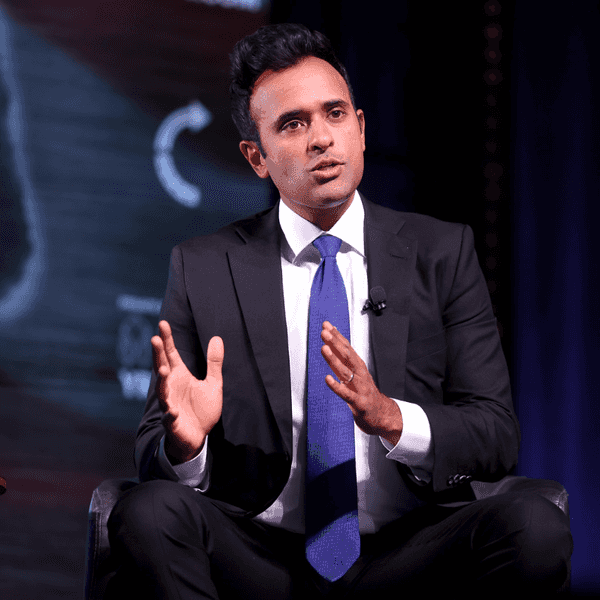
Controller of the Currency Jonathan V. Gould
The $40 trillion debt point naturally prompted much griping among pundits, many of whom see their job as promoting hysteria in order to justify cuts to Social Security, Medicare, and other popular social programs. As is clear to anyone not on the payroll of the rich and very rich, the debt is overwhelmingly the result of tax cuts, mostly to high earners, put in place by Presidents Reagan, Bush II, and Trump.
Unfortunately, confusion on the debt can spread even among the sane. Paul Krugman and Jared Bernstein, two top-notch economists (also friends) had a discussion of the debt in a podcast posted on Saturday. At one point, they noted that interest rates have risen, creating a situation where the interest rate is higher than the rate of growth, which could lead to explosive debt growing ever larger as a share of GDP.
That’s all straightforward arithmetic, but the confusion stems from the reason they see interest rates as going higher. Part of the reason is Trump’s craziness, which we all recognize undermines confidence in the economy and the debt. However, part of the reason is the investment boom from building AI data centers.
While I agree that this is a big factor in pushing rates higher, the assumption motivating this investment is that there will be some massive payoff in the form of higher profits stemming from huge gains in productivity. If these gains in productivity materialize, then we will be far richer than current projections show, and growth will have far surpassed interest rates. In other words, no explosive debt problem. Also, if we grow an extra 10-20 percentage points over the next decade, it seems a bit silly to be whining about debt, a point I will come back to.
There is also the possibility (likelihood in my view) that the productivity gains do not materialize. In that scenario, the AI-related stocks will crash at some point, the boom will bust, and we will likely be looking at a serious recession. In that world, our problem will be boosting the economy back to full employment, not the deficit. And for those who care about such things, interest rates should again be very low.
It seems this is a point that Paul and Jared should have brought into their deficit/debt discussion. I’ll give them a whack on the wrist for missing this point, but come to the more general issue that is usually lost in the tirades about gigantic debt.
Government Debt Is Not a Measure of Generational Equity
It is just atrociously bad economics to imagine the debt is some sort of measure of generational equity. At the most basic level, who owns the debt? The deficit hucksters talk like we send interest on the debt to people on another planet. In fact, the vast majority of the debt is held by U.S. citizens and U.S. corporations. We pay the debt to ourselves.
It’s true that ownership of the debt hugely skews upward, so the interest is mostly paid to higher-income people. But we can tax it back. In fact, let’s take an extreme case and say we tax back 100% of the interest.[1] In that case, is the debt a burden on future generations? We will of course not tax back 100% of the interest, but we can and should have progressive income taxes. Which, if they are actually collected, will mean that much of the money paid in interest will go right back to the government. And if we apply progressive taxes more generally, we can certainly offset any negative impact that interest payments on the debt have on income distribution.
And for trivia buffs, the rich people who will collect the interest in 30-40 years are part of future generations, the rich part. The story is again a class issue, not a generational one.
Growth and the Debt
Faster economic growth reduces the burden of the debt in the sense that it makes interest payments smaller relative to the size of the economy. But the more important point is that, in principle, faster growth makes us richer.
If the economy grows 10 percent more (in real terms) over a decade than had been expected (imagine AI actually pays off), then we would be roughly $3.9 trillion richer in 2036 than is now projected. Suppose in this story we had to pay another $500-$600 billion a year (again, in real terms) in interest compared to what we do today. Would we have done some injustice to our kids with a faster growth and higher debt story? The size of the economy is what will determine the well-being of our kids, not the amount of debt owed by the government.
But GDP growth is not everything, especially when it leads to destruction of our environment, as we are seeing now as a result of global warming. It would take some pretty batshit crazy accounting to be concerned about the debt we are passing on to our kids, but not about the environmental destruction we have caused by our use of fossil fuels.
And this is not just destruction of the lands where people like to be able to hike, fish, or hunt. It is also very much dollar-and-cents damage. The recent wildfires in Spokane are estimated to have caused over $1 billion in property damage. The damage done by the fires in Los Angeles last year may have been as high as $250 billion (0.8% of GDP). With global warming leading to more and bigger fires, as well as more frequent and severe hurricane and flooding events, we will be seriously damaging the life prospects of future generations even if we were to pay off the national debt tomorrow.
Trumpian Corruption
I know I have said this before, but the point deserves to be constantly thrown in the face of the deficit hawks: Trump’s corruption poses an infinitely greater threat to economic stability than the $40 trillion debt. Trump has been given a green light by the Roberts Supreme Court to corrupt every agency in the country (except the Fed) to enhance his power and his pocketbook. As we have seen, this means having the Justice Department and FBI focus on prosecuting his political opponents. It means selling antitrust rulings to campaign contributors. It means allowing political allies to sell unsafe food and likely drugs.
Trump has also had the Office of the Comptroller of the Currency greenlight his new crypto bank and had the Securities and Exchange Commission look the other way on his insider trading. He even ordered the Census Bureau to cook up a nonsense report on non-citizen voting to claim that, somehow, he actually won the 2020 presidential election that he lost in a landslide. (That’s the Trumpian usage of the word, where he says he won the 2024 election in a “landslide.”)
Anyhow, these are the sorts of things that happen in “shithole countries,” not advanced economies expecting the trust of investors. With Trump continually pressing his corruption further and his supporters in Congress saying it’s all good, investors should fear putting their money in the United States even if we had zero debt. That might be too difficult for the deficit hawks to understand, but most of us have parents who taught us not to do business with crooks.
[1] I know, no one would hold bonds if we taxed back all the interest, but I’m making a point. Trade economists have often assumed in their modeling that we replace tariffs with lump-sum taxes to show the benefits of trade. Unlike tariffs, lump-sum taxes don’t create economic distortions. Lump-sum taxes also don’t exist in the world, but trade economists felt it useful to assume them to make a point.
- Trump 'Settles' Bogus IRS Lawsuit For $1.8B Thug And Crony Slush Fund ›
- The Big Lie of the Day: Republicans Balance Federal Budgets ›
- Is Trump The New Boss Tweed? ›
- Excerpt: ‘Dark Money: The Hidden History of the Billionaires Behind the Rise of the Radical Right’ ›
- Worrying About $40 Trillion In Debt? Trump's Corruption Is A Far Worse Threat ›