Worrying About $40 Trillion In Debt? Trump's Corruption Is A Far Worse Threat
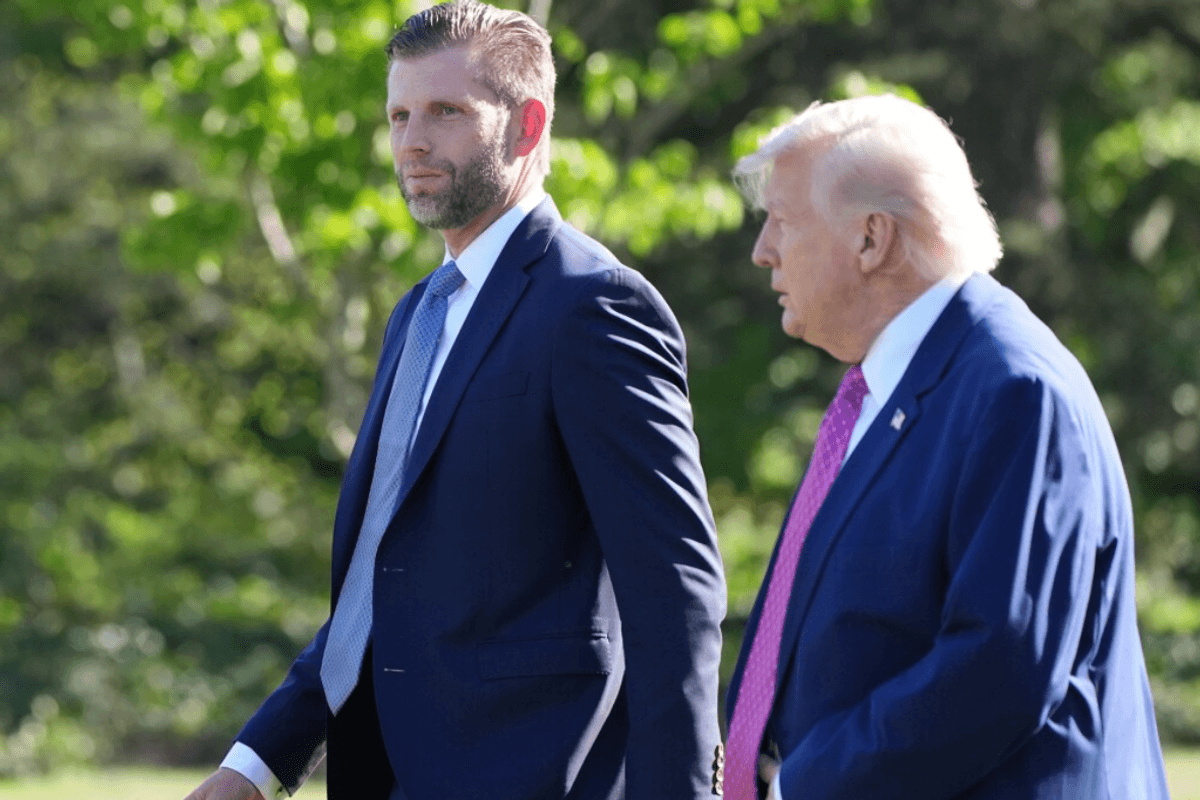
President Donald Trump and son Eric Trump, left
Yesterday, I wrote that I was far more concerned about Donald Trump’s regime of rampant corruption than the $40 trillion debt. I had a lot of pushback from people telling me that the $40 trillion debt is actually a really big deal.
I’m used to people complaining that I don’t take debt and deficits seriously enough, so I guess I would be disappointed if my post didn’t prompt some criticism. Anyhow, this gives me the opportunity to explain again why I’m not especially troubled by the $40 trillion debt. I will also explain why people really should be hair on fire over Trumpian corruption.
Debt Needs to be Understood as Part of a Larger Economic Picture
We all know that $40 trillion is a really big number, but after we give it a big salute, the question is what does it mean for the economy and for our pocketbooks? Most of the debt discussion didn’t really do this, or at least do this in a way that makes much sense.
First, we should express the debt relative to the size of the economy. The $40 trillion debt is equal to about 125 percent of Gross Domestic Product. Arguably the more appropriate measure is the publicly held debt, which excludes bonds held by the Social Security trust fund and various other public funds. This is roughly $32 trillion, or just over 100 percent of GDP. That’s large, but the debt-to-GDP ratio was considerably larger just after World War II, and that didn’t prevent us from having the most prosperous quarter century in our history. It also didn’t have investors here and elsewhere fleeing the dollar and government debt.
If we needn’t be scared by the government debt, what about the trillion dollars (3.3 percent of GDP) that we are paying out each year in interest payments? That’s a good chunk of change, but it is worth putting on our thinking caps instead of panicking.
Donald Trump just proposed, and may well get, a defense budget for fiscal 2027 of $1.5 trillion, roughly five percent of GDP. The last Biden budget for 2025 called for spending $864 billion for the military. This means Trump wants us to spend $636 billion more for the military each year, roughly 2.0 percent of GDP, than we did under Biden.
Virtually everyone thought the level of military spending under Biden was fine to meet our defense needs. If the new real or imaginary enemies that Trump has us combatting requires spending another two percent of GDP on the military, how is that better than spending another two percent of GDP on interest on the debt?
To put this simply, there are a lot of people getting hysterical about spending 3.3 percent of GDP on interest, who were fine, or at least not equivalently alarmed about Trump’s plan to increase military spending by two percent of GDP. If we make enemies in the world that require us to spend another two percentage points of GDP on the military, that is at least as bad as spending another two percentage points of GDP on interest on the debt. But only the latter will get the deficit hawks excited
In the same vein, our decision to ignore global warming is imposing high costs in dealing with wildfires and flooding. Most likely this is not close to two percent of GDP on an annual basis, but if the current path continues, we might be there before too long. In any case, if we are worried about the ongoing burden on the economy, the additional spending required to deal with the problems created by climate change is every bit as much a burden as interest on the debt.
Also, if we’re being serious, we have to recognize that spending money is not the only way the government pays for things. It also issues patent and copyright monopolies to support innovation and creative work. The annual sums transferred as a result of these government-granted monopolies are easily over $1 trillion a year. In the case of prescription drugs and other pharmaceuticals alone, it is over $500 billion.
The idea that we should worry about the debt and the interest we pay on it, but ignore the higher prices we pay for drugs, medical equipment, software, and other products because of the government-granted monopolies is something only a policy pundit could take seriously. If we’ve paid off the government debt, but a whole range of items cost twice as much as they would in a free market because we gave out patent monopolies lasting a century, would our kids have reason to thank us? In that case, they don’t have to worry about paying interest on the debt, just about paying massive patent rents on everything they buy.
Trump Corruption Threatens the Dollar, not Government Debt
For more than a century, investors, both foreign and domestic, felt comfortable having their money in the United States because they knew it was governed by the rule of law. This meant, for example, if there was a contract dispute, they could reasonably expect it would be decided in a court based on the merits, not based on political connections. The same is true for regulatory rulings, such as the Securities and Exchange Commission’s (SEC) ruling on corporate filings or the Federal Drug Administration’s (FDA) approval of drugs.
Under Trump, this is no longer true. If a company lied about its profits on its financial statements, investors could present evidence to the SEC and expect that it would impose sanctions if there was a solid case, but not under Trump. If the company is a big Trump contributor, it’s likely he will instruct the SEC to ignore the complaint or rule in favor of the perp.
The same applies with all the bureaucracies, as the Supreme Court has said Trump can tell them to do whatever he likes. The FDA can refuse to approve the drug of a company whose CEO has criticized him. The Federal Aviation Administration can refuse to recognize the safety of an airplane manufactured by a company that Trump dislikes.
The story goes on. Trump has a green light to use all parts of the government to punish companies and individuals that anger him and to favor those who hand him money.
This is an infinitely greater threat to the credit of the U.S. government and the strength of the dollar than the debt. That fact should be obvious to anyone who is not an elite pundit.
Dean Baker is a senior economist at the Center for Economic and Policy Research and the author of the 2016 book Rigged: How Globalization and the Rules of the Modern Economy Were Structured to Make the Rich Richer. Please consider subscribing to his Substack.
- GOP Senator Rejects Trump Plan To End Debt Limit ›
- America Is Still Great -- But Trump Threatens Our Prosperity And Freedom ›
- Trump's Debt 'Idea' Would Depress The Global Economy ›
- Republicans: We'll Force Massive Social Security And Medicare Cuts ›
- You Can Thank Republican Presidents For That $40 Trillion Debt ›
- House Republicans Now Whine About Debt They Helped To Create ›
- McCarthy Lies Repeatedly About GOP Debt Limit Votes Under Trump (VIDEO) ›
- Surprisingly, Even (Some) Republicans Understand Trump Deficit Peril ›
- What Even Our Smartest Economists Get Wrong About The Debt - National Memo ›
- As U.S. Debt Passes $40 Trillion, Over $11.6 Trillion Was Added Under Trump. Here Is Who We Owe. ›
- How $40 Trillion National Debt Grew Under Trump Compared to Biden and Obama - Newsweek ›
- Donald Trump Built a National Debt So Big (Even Before the Pandemic) That It’ll Weigh Down the Economy for Years ›
- US national debt nears $40 trillion as Trump adds $11.5 trillion | Fox Business ›
- U.S. debt crosses $40 trillion threshold after doubling under Trump and Biden ›