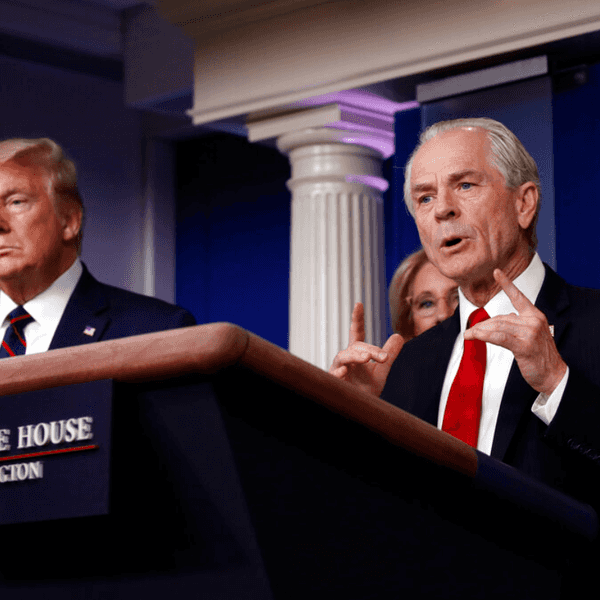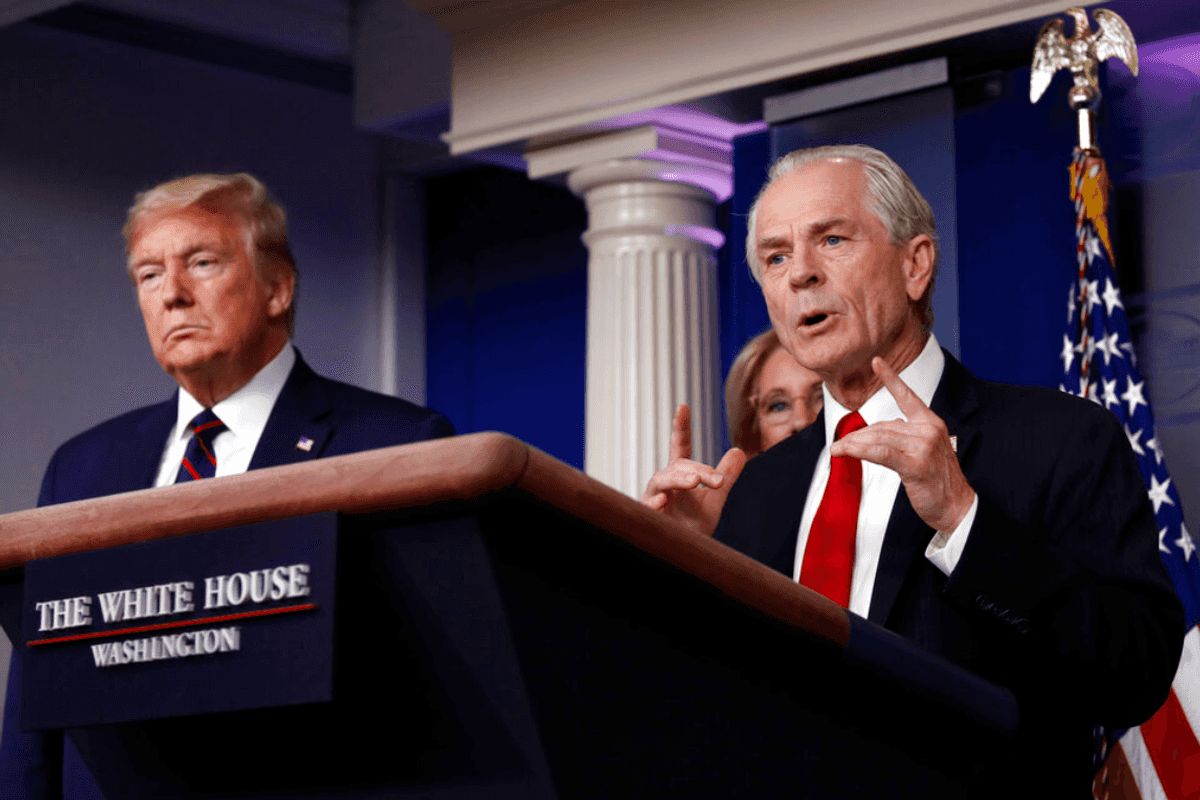
President Donald Trump and trade advisor Peter Navarro
It’s been almost a year and a half since “Liberation Day,” the day that Trump announced his “reciprocal” tariffs, slapping tariffs on imports from our trading partners to punish them for selling us stuff. Ostensibly, the goal of the tariffs was to eliminate, or at least reduce, our trade deficit.
Trump seems to believe that we are being ripped off if we buy more goods from a country than we sell to them. There can be problems caused by a large trade deficit, especially one that is rapidly growing, as was the case in the first decade of this century. But it doesn’t make sense to claim a country is ripping us off by selling us stuff.
Anyhow, whatever problems we have with trade are poorly addressed by the sort of blanket tariffs imposed by Trump. We may want tariffs to promote the development of certain industries, like solar panels or EVs, or to ensure a stable supply of essential products, like steel and rare earth minerals, but such efforts have little to do with Trump’s tariffs.
He said that he wanted to end the ripoff, which he defined as our trade deficit. It hasn’t worked out that way.
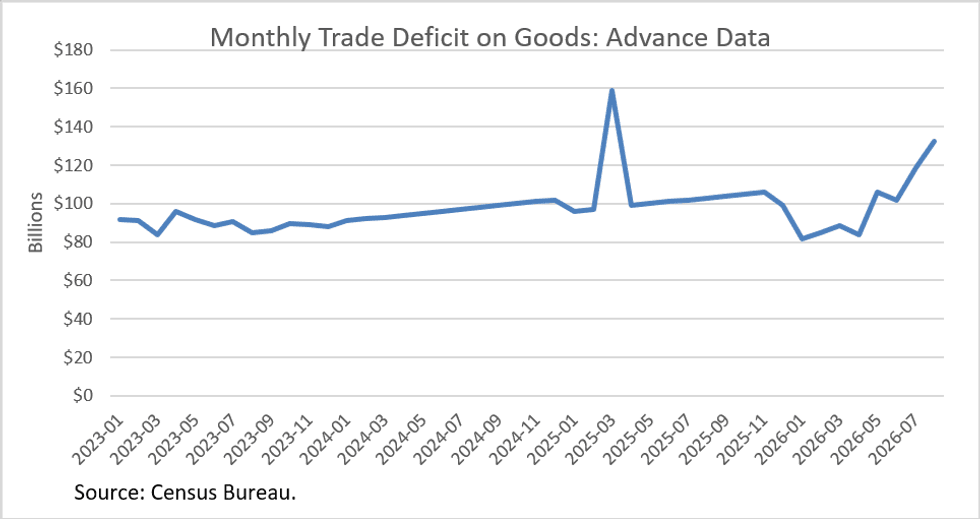
The monthly deficit had been around $90 billion through 2023. (Note that these are advance numbers based on incomplete data. They are generally higher than the final data the Census Bureau releases later.) It rose gradually in 2024, as the growth of the U.S. economy outpaced the growth of our trading partners. This caused U.S. imports to rise more than our exports to other countries. By the election, the trade deficit was up to $110 billion. It then began to rise more rapidly as consumers and businesses stocked up on imported goods in anticipation of Trump’s tariffs. The deficit hit an all-time record of $158.7 billion in March of 2025.
The deficit then fell both due to the impact of the tariffs and also because of the advance purchases in anticipation of the tariffs. By December, the deficit had risen back to $100 billion a month, roughly the same as the pre-election level.
The deficits have increased sharply again in 2026, driven in large part by a surge in semiconductor chips due to the AI boom. The August level of $132.6 billion is the second-highest deficit on record, topped only by last year’s March deficit.
It is worth mentioning that the U.S. runs a substantial surplus on services, collecting around $30 billion more each month on items like patent and copyright fees, insurance, and financial services than what we pay to foreigners. I’m not sure if this means we’re ripping them off, but that is part of the larger score on the trade balance.
Dean Baker is a senior economist at the Center for Economic and Policy Research and the author of the 2016 book Rigged: How Globalization and the Rules of the Modern Economy Were Structured to Make the Rich Richer. Please consider subscribing to his Substack, from which this is reprinted with permission.
- Why Lutnick Displaced Musk As 'Most Loathed' Trump Adviser ›
- Enraged By Rate Hike, Trump Threatens To Expand Trade War Again (Huh?) ›
- Trump Adds His Newly Appointed Fed Chair To His (Long) Enemies List ›
- Liberated? Despite Trump Tariffs, Steady Trade Deficit Jumped In July ›
- US Goods-Trade Gap Widens Unexpectedly to Largest Since 2025 - Bloomberg ›
- Trade Deficit Surges in 11.5 Percent in August – MishTalk ›
- US goods trade deficit widens sharply in August | 93.3 The Drive ›
- US goods trade deficit widens sharply in August ›
- U.S. Goods Trade Deficit Balloons Further in August - Haver Analytics ›