Tag: trade deficit
Soaring Trade Deficit In August Suggests Trump Tariffs Are Failing

Soaring Trade Deficit In August Suggests Trump Tariffs Are Failing

It’s been almost a year and a half since “Liberation Day,” the day that Trump announced his “reciprocal” tariffs, slapping tariffs on imports from our trading partners to punish them for selling us stuff. Ostensibly, the goal of the tariffs was to eliminate, or at least reduce, our trade deficit.

Trump seems to believe that we are being ripped off if we buy more goods from a country than we sell to them. There can be problems caused by a large trade deficit, especially one that is rapidly growing, as was the case in the first decade of this century. But it doesn’t make sense to claim a country is ripping us off by selling us stuff.

Anyhow, whatever problems we have with trade are poorly addressed by the sort of blanket tariffs imposed by Trump. We may want tariffs to promote the development of certain industries, like solar panels or EVs, or to ensure a stable supply of essential products, like steel and rare earth minerals, but such efforts have little to do with Trump’s tariffs.

He said that he wanted to end the ripoff, which he defined as our trade deficit. It hasn’t worked out that way.
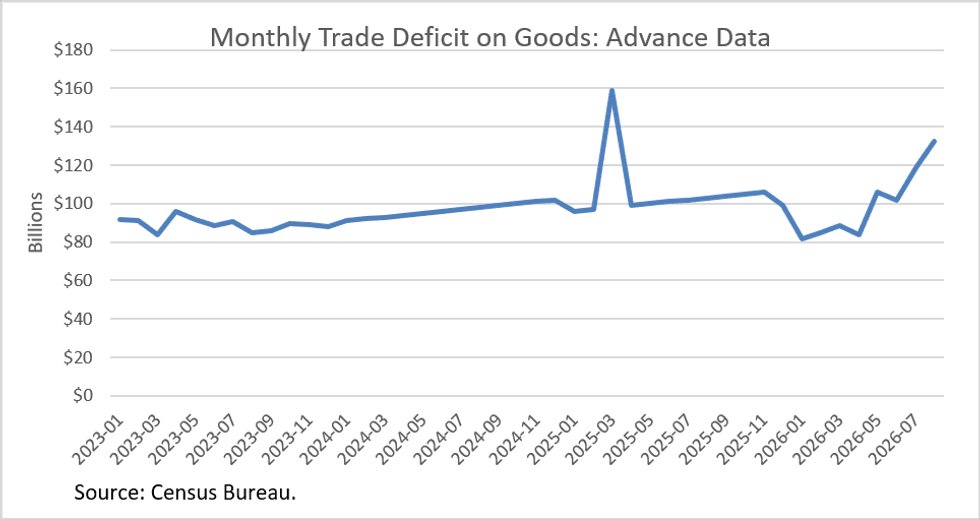
The monthly deficit had been around $90 billion through 2023. (Note that these are advance numbers based on incomplete data. They are generally higher than the final data the Census Bureau releases later.) It rose gradually in 2024, as the growth of the U.S. economy outpaced the growth of our trading partners. This caused U.S. imports to rise more than our exports to other countries. By the election, the trade deficit was up to $110 billion. It then began to rise more rapidly as consumers and businesses stocked up on imported goods in anticipation of Trump’s tariffs. The deficit hit an all-time record of $158.7 billion in March of 2025.

The deficit then fell both due to the impact of the tariffs and also because of the advance purchases in anticipation of the tariffs. By December, the deficit had risen back to $100 billion a month, roughly the same as the pre-election level.

The deficits have increased sharply again in 2026, driven in large part by a surge in semiconductor chips due to the AI boom. The August level of $132.6 billion is the second-highest deficit on record, topped only by last year’s March deficit.

It is worth mentioning that the U.S. runs a substantial surplus on services, collecting around $30 billion more each month on items like patent and copyright fees, insurance, and financial services than what we pay to foreigners. I’m not sure if this means we’re ripping them off, but that is part of the larger score on the trade balance.

Dean Baker is a senior economist at the Center for Economic and Policy Research and the author of the 2016 book Rigged: How Globalization and the Rules of the Modern Economy Were Structured to Make the Rich Richer. Please consider subscribing to his Substack, from which this is reprinted with permission.
Trump and tariffs

Liberated? Despite Trump Tariffs, Steady Trade Deficit Jumped In July

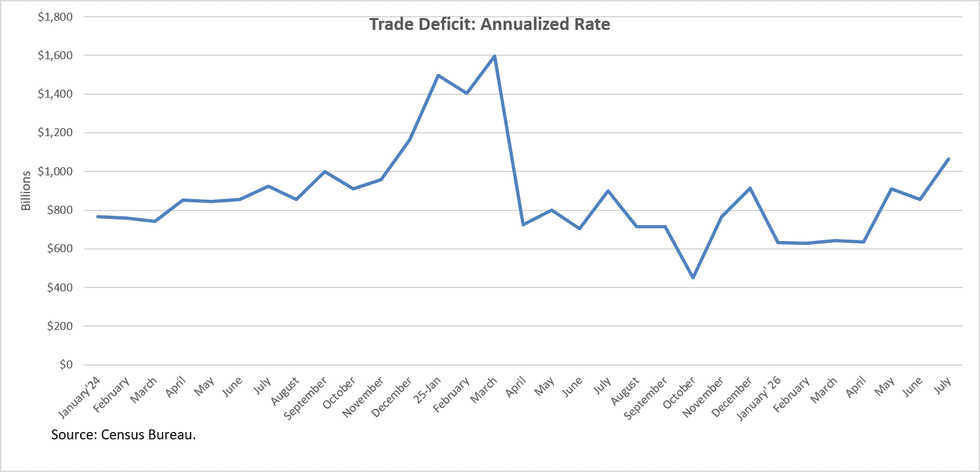
The trade deficit rose sharply in July, hitting $1,063 billion on an annualized basis. That’s up from $854 billion in June. It’s the highest since the big import surge following Trump’s election, where people and businesses stocked up in anticipation of the Trump tariffs.

In the scheme of things, there is not any big problem with August’s deficit. It’s a bit more than 3.0 percent of GDP. We’ve had much larger deficits in prior years. The main factor driving the rise was a jump in imports of computer chips and other items needed for data centers. The data centers might be a problem, but the fact that the chips are imported is not an especially big deal.

However, this does matter in the world of Trump crazy, where countries are ripping us off if they are selling things we want. In that world, we are being ripped off by $110 billion more in August than July. If we look at the pattern of trade deficits over the last two and a half years, it doesn’t look like Trump is making much progress in his efforts to “liberate” us.

The trade deficit had been running at roughly an $850 billion annual rate through the first 10 months of 2024. It then soared immediately after the election and into the first months of 2025 as people and businesses rushed to buy cars, appliances, capital goods, and other durable goods in anticipation of Trump’s tariffs. The peak was a $1,596 billion annual rate in March of 2025, just before Trump’s big tariff announcement.

After “Liberation Day,” the trade deficit did fall somewhat, but this was largely the result of the post-election buying binge. People who bought a car in March of 2025 were not going to buy another one later in the year.

In more recent months, imports have been rising, pushing trade deficits well above their pre-election level. On the plus side, when the AI bubble bursts, we will see a big decline in our trade deficit.

Dean Baker is a senior economist at the Center for Economic and Policy Research and the author of the 2016 book Rigged: How Globalization and the Rules of the Modern Economy Were Structured to Make the Rich Richer. Please consider subscribing to his Substack, from which this is reprinted with permission.

Not 'Liberated' Yet: Trade Deficit Hits Highest Level Since March 2025

Not 'Liberated' Yet: Trade Deficit Hits Highest Level Since March 2025

Donald Trump has made reducing the trade deficit a centerpiece of his economic agenda. As he has put it, the deficit means foreigners are ripping us off. Trump’s whole “Liberation Day” story was about putting an end to the rip-offs.

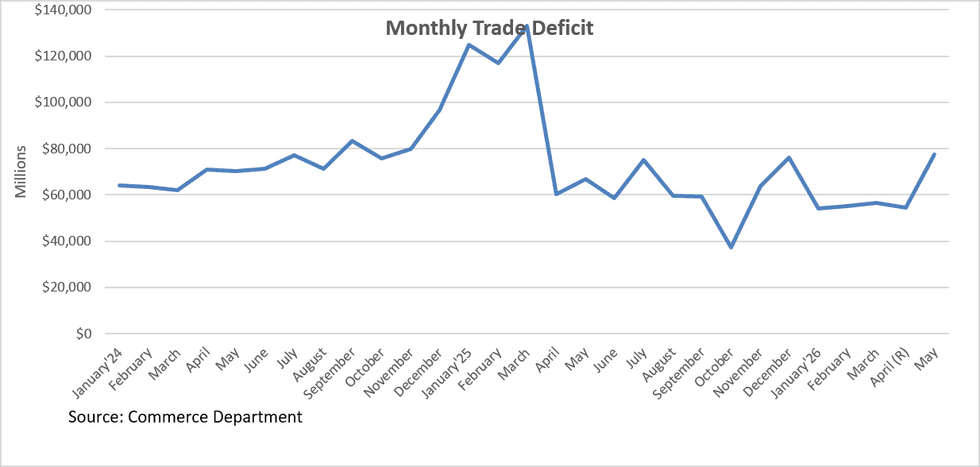
We can debate the extent to which the trade deficit means we are getting ripped off, but even accepting Trump’s claim, he is not doing a very good job by his own metric. On Tuesday, we got data from the Commerce Department showing that the monthly trade deficit jumped by $23 billion in May to $77.6 billion. The deficit would be $931 billion if this rate continued for a full year. This is the highest it’s been since March of 2025. If the trade deficit measures the extent to which we’re being ripped off, we’re going the wrong way.

To be clear, the story is a bit more complicated. The trade deficit had averaged $70.9 billion through the first ten months of 2024. It then jumped after the election, hitting $96.9 billion in December, as people rushed to buy cars, appliances, and other big-ticket items, and businesses stocked their inventories, before Trump’s promised tariffs went into effect.

It rose further in the first three months of 2025 as people became more convinced that Trump was serious about his tariffs. The peak was $133 billion in March. The deficit then fell sharply in April. Part of this story was the impact of the tariffs themselves, and part was that people who had bought cars and other big-ticket items in anticipation of the tariffs were not about to buy them again.

The impact of people buying in anticipation of tariffs had probably worn off by the start of this year, so we could see the direct impact of tariffs on the trade deficit. The average for the first four months of 2026 was $55.1 billion. That would translate into an annual trade deficit of $661 billion, a bit more than 2.0 percent of GDP. That is down from the $850 billion annual rate we had in the first ten months of 2024, but still far from balanced trade for those who care about such things.

But we then took a big step in the other direction in May. It seems the main story here is imports of AI-related capital goods. Imports of capital goods were $1.1 billion higher in May than they had been in April and $17.2 billion higher than they had been in January.

Many of the computer chips and other items that the big AI companies need for their data centers are imported, mostly from Taiwan and South Korea. If we think the trade deficit means we are being ripped off by foreigners, the AI bubble is increasing the extent of the rip-off.

Monthly trade data are highly erratic, and it’s possible that the May jump will be reversed in June or subsequent months. But for now, the data make it look like Liberation Day didn’t have its intended effect.

Dean Baker is a senior economist at the Center for Economic and Policy Research and the author of the 2016 book Rigged: How Globalization and the Rules of the Modern Economy Were Structured to Make the Rich Richer. Please consider subscribing to his Substack.

Supreme Court Strikes Down Trump Tariffs In Major Blow To White House

Supreme Court Strikes Down Trump Tariffs In Major Blow To White House

In a 6-3 ruling. the Supreme Court has rejected the legal basis for President Donald Trump’s sweeping global tariffs, imposed on “Liberation Day” in April 2025.

“The Supreme Court has struck down President Trump’s tariff authority, saying his claim of emergency authority to issue sweeping tariffs to America’s trading partners was unlawful,” Politico’s Kyle Cheney reports.

NBC News called it a “major blow” to President Trump.

During oral arguments, justices appeared skeptical of the Trump arguments. Chief Justice John Roberts said that the tariffs were “an imposition of taxes on Americans and that has always been the core power of Congress,” as Axios reported.

President Trump has repeatedly argued that his reciprocal tariffs — which studies show are almost entirely paid by American consumers and businesses — were necessary for national security. The administration relied on an obscure provision of U.S. trade law that allows a president to impose tariffs without congressional approval if imports are deemed a threat to national security. Critics, however, argued that the statute was never intended to justify sweeping, permanent global tariffs.

Trump’s public statements repeatedly broadened his rationale. At the beginning of the year, declaring the Supreme Court’s impending decision would be “their most important (ever!) Decision,” he claimed the tariffs “have rescued our Economy and National Security.”

Last month, Trump warned that “if the Supreme Court rules against the United States of America on this National Security bonanza, WE’RE SCREWED!”

As recently as Thursday, Trump lambasted the high court for taking, as he put it, “forever,” to release its decision.

“And to think I have to be, in the United States Supreme Court for many, many months, waiting for a decision on tariffs — without tariffs, this country would be in such trouble right now,” Trump said.

“I’ve been waiting forever. Forever. And the language is clear that I have the right to do it as president. I have the right to put tariffs on for national security purposes, countries that have been ripping us off.”

Just weeks ago, Trump told Fox Business that he had had an “emergency call from, I believe, the prime minister of Switzerland, and she was very aggressive. Nice, but very aggressive.”

“Again and again and again. I couldn’t get her off the phone,” the president continued, as The Hill reported. “So [the tariffs were] at 30 percent, and I didn’t really like the way she talked to us, and so instead of giving her a reduction, I raised it to 39 percent.”

The president has also suggested that there is so much money coming into the Treasury from tariffs that he would be sending tariff “dividend” checks to Americans — a claim he appeared to have forgotten about last month when asked by a reporter.

Trump has also claimed that if the Court struck down his tariffs, the U.S. would not be in a position to provide refunds, which could run between $100 billion and $200 billion. Treasury Secretary Scott Bessent, however, stated that providing refunds would be possible.

It has been estimated that tariffs are costing the average American family between $1,300 and nearly $5,000 annually.

Economist Justin Wolfers, when asked about the effectiveness of Trump’s tariffs, told CBC News, “If the trade deficit this year is bigger than it was last year, and this year we have high tariffs and a trade war and last year we didn’t, I guess it doesn’t require a lot of fancy statistics to infer that Trump’s tariffs didn’t help the trade deficit.”

On Friday, he wrote, “We had this big lousy trade war, and we’ve got nothing to show for it.”

The Wall Street Journal editorial board on Thursday wrote, “If your tariff policy is so unpopular that you have to bully the central bank into not talking about it, maybe it’s time for a new policy.”

Reprinted with permission from Alternet

Shop our Store

Headlines

Editor's Blog

Trending

World