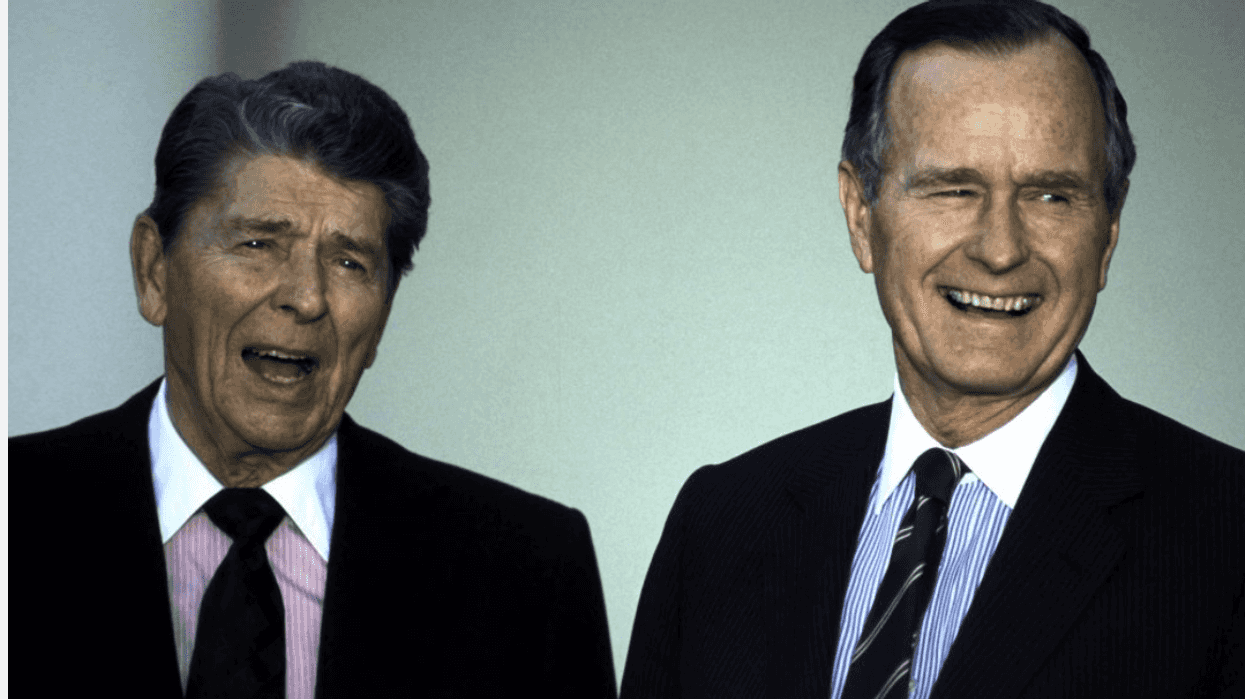
Presidents Ronald Reagan and George H.W. Bush
I have never been a deficit hawk, and I’m not about to change my religious affiliation now. But whatever we think of debt and deficits, there is one point that should be very clear: it has been run up almost entirely due to Republican tax cuts and their inept management of the economy.
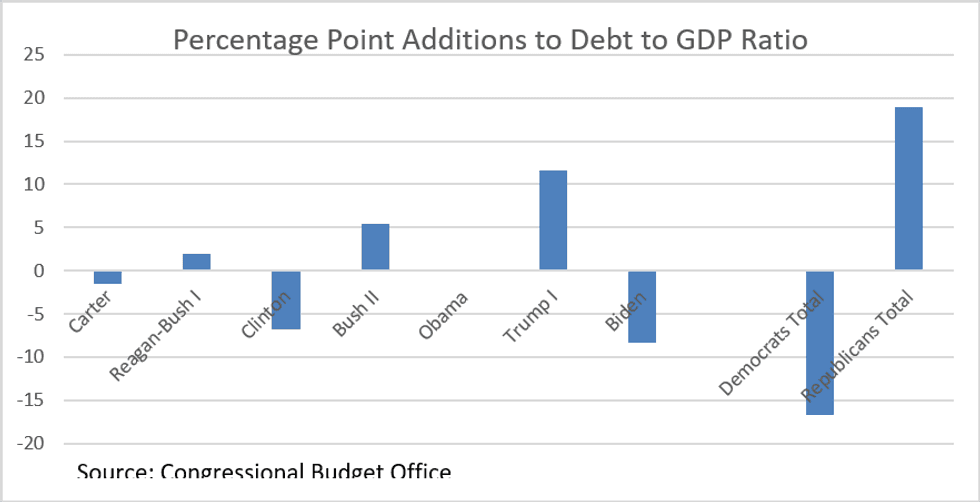
Every Democratic president of the last half century has left with a deficit that was lower, measured as a share of GDP, than the one they came in with, except Obama, who left it unchanged. By contrast, every Republican president has left with a considerably higher deficit than what they inherited.
Starting with Carter, the deficit for fiscal year 1976 was 4.1 percent of GDP. When he left office in 1980, it was down to 2.5 percent of GDP, despite a recession that year. That was the starting point for Reagan. (These figures refer to fiscal years, which end on October 1 of the year.) Reagan’s tax cuts, along with a big military buildup, were most of the story of higher deficits. When his successor, George H.W. Bush, left the White House in 1992, the deficit was 4.5 percent of GDP.
For better or worse, Clinton took deficit reduction seriously. He was helped by an explosion of tax revenue associated with the tech bubble, but he both made budget cuts and increased taxes. When he left office in 2000, the government was running a surplus equal to 2.3 percent of GDP.
George W. Bush quickly reversed the picture. A big part of the story was the collapse of the tech bubble in 2001-2002, which both led to a recession and a plunge in tax revenue from capital gains. He also had big tax cuts and a military buildup associated with his invasions of Afghanistan and Iraq. When Bush left office after 2008, he handed Obama a deficit equal to 3.1 percent of GDP, as well as a financial crisis and severe recession, resulting from the collapse of the housing bubble.
The deficit initially exploded in 2009 under Obama, as the country faced the worst recession since the Great Depression. As the economy gradually recovered, the deficit came down, falling back to 3.1 percent of GDP in 2016, just as Obama was leaving the White House.
Trump’s tax cuts caused the deficit to rise again. It hit 4.6 percent in 2019, but it really took off the following year, as a result of the pandemic. It reached 14.7 percent of GDP in 2020, the largest since World War II. The recovery and some modest increases in tax collections brought the deficit down to 6.3 percent of GDP in 2024.
Taking the cumulative changes from Democratic and Republican presidents, Democratic presidents have reduced deficits by 16.7 percentage points of GDP during their terms in office, while Republican presidents have raised them by 18.9 percentage points. Somehow, many people still talk about Republicans as the party of fiscal responsibility:
As I said earlier, I am not hugely troubled by the debt. It would be better to be paying less money in interest, but 3.0 percent of GDP going to interest is not a disaster. The more important issue is to have a healthy economy with solid growth.
Here is where the big failure is. Trump’s war is leading to shortages, most importantly of oil, but also fertilizer and other products. His tariffs have led to higher prices for a wide range of products, as has his mass deportations. Perhaps most importantly, Trump’s open corruption and self-dealing undermine confidence in the U.S. financial markets and business system more generally.
In the past, investors could view the United States markets as relatively clean and stable. Unlike in some other countries, getting your investment back didn’t depend on staying in the good graces of the political leadership. Under Trump, this is no longer true. He has openly threatened companies and their management for saying and doing things he does not like. That is not a good recipe for a stable economy with solid growth.
If there is a run on the dollar, and interest rates soar higher, it is far more likely to be the result of Trump’s corruption and incompetence than the high debt. This is what people should be losing sleep over, not the debt crossing the $40 trillion mark.
Dean Baker is a senior economist at the Center for Economic and Policy Research and the author of the 2016 book Rigged: How Globalization and the Rules of the Modern Economy Were Structured to Make the Rich Richer. Please consider subscribing to his Substack.