In understanding both how the economy is doing and how people are feeling about it—two concepts that have widely diverged for years now—I’ve paid a lot of attention to two related price indicators. One is inflation, meaning the rate of change: how fast prices are going up/down. This is of course an area of intense focus by economists and especially monetary ones, as the Fed’s mandate is “full employment at steady prices,” the latter meaning inflation stable at around their two percent target.
I’ve focused as much if not more on the price level—what things cost. I was schooled on a daily basis back in my White House days that after a price shock, as occurred in the pandemic, people are not comforted by lower inflation, which just meant the prices they thought were way too high were growing more slowly. But they still vividly remembered their old price levels, and damnit, they wanted them back.
But there’s a third dimension of prices that has gotten less attention: their variance, meaning how widely inflation has varied over time. Folks are familiar with the famous bell curve in statistics. A low-variance bell curve looks like a narrow, high mountain; a high-variable bell curve looks like a low, wide mountain. In the figure below, the blue line plots a variable with low variance, the non-blue line (color blind!) shows high variance.
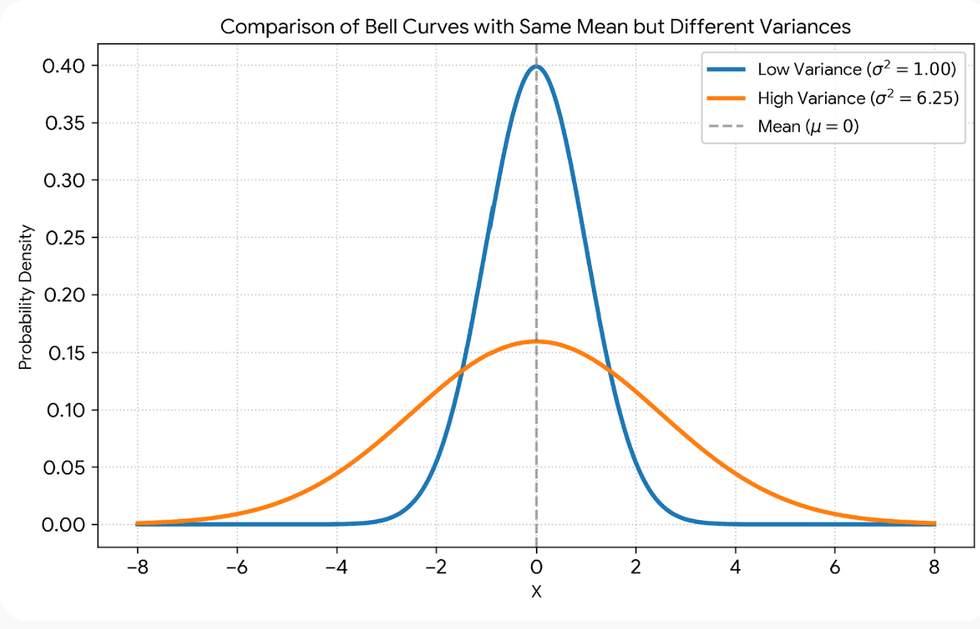
In what follows, I plot a number of CPI inflation series this way. Using year-over-year inflation, I look at two separate periods, pre- and post-pandemic, where pre is 2013-19 and post is 2020-26. Now, these variances don’t look as cleanly bell curve-y as those above, which is often the case with real life variables. But I employ a smoothing procedure (kernel density estimation) to smooth them out in a way that clarifies the presentation.
Here’s the overall CPI:
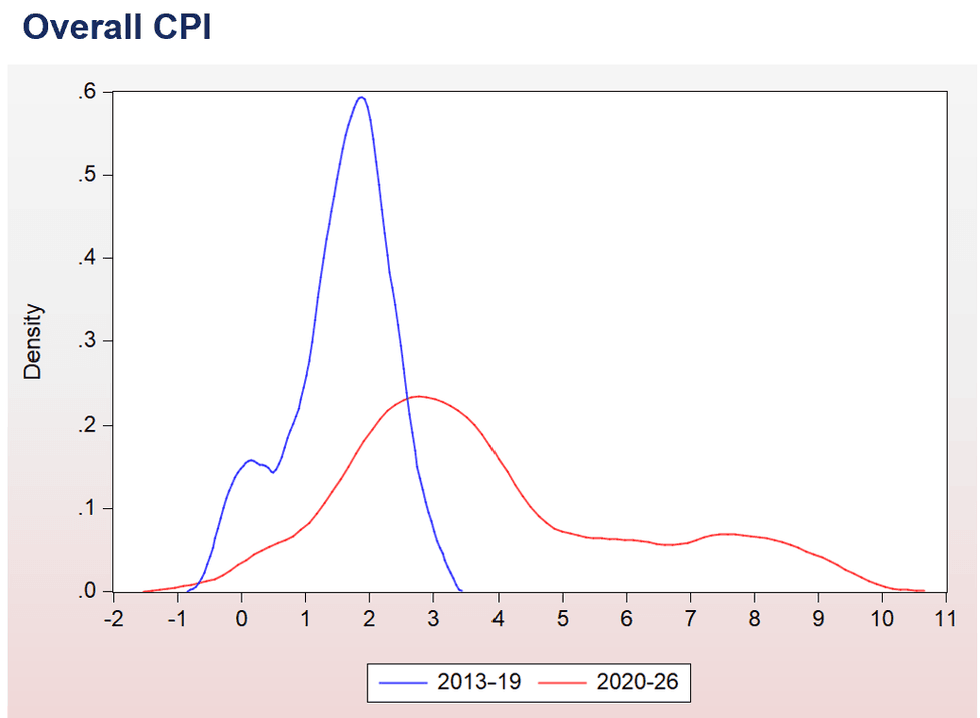
Striking, right?? Pre-pandemic, you see a tight, narrow distribution centered around two percent. But post, you see a much wider distribution centered around three percent and stretching up into double digits.
Here’s groceries, which represent just eight percent of the consumption basket but loom much larger than that in people’s minds.
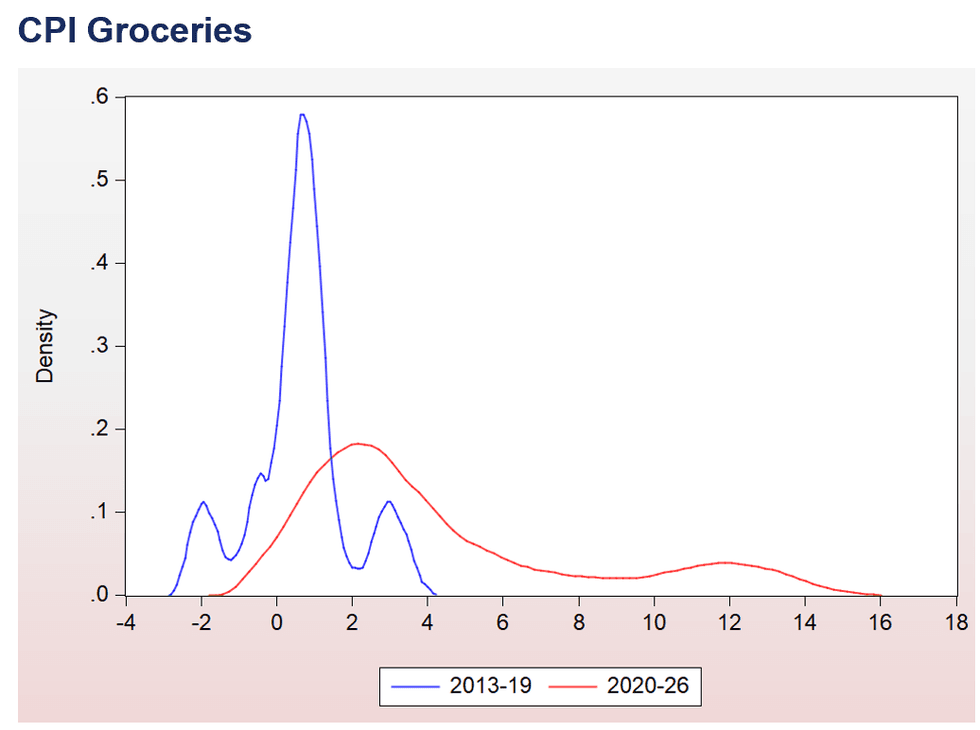
Even more striking, no?! Pre: narrow distribution clumped around zero! Post: even wider than the overall (compare x-axes) with a peak at >2 percent.
I’ve done this with many other market-basket components and with the PCE series too. Same basic results.
Of course, I’m not saying people walk around mentally ginning up such figures in their heads. But I am firmly saying this: we humans are risk-averse creatures. And higher-variances feel more risky, more unsettling to us. This is reflected in all the angst you hear these days about “uncertainty.” Higher uncertainty means higher variances.
Of course, the 100-year pandemic was the key source of these expanded distributions, but things were settling down before the Orange Menace took over. The fact that the guy is a shock-risk-uncertainty merchant, bouncing from one bad idea to the next, enabled by Republicans who refuse to check him, is also in the more recent mix when it comes to this problem.
Bottom line, when we’re thinking about the inflationary sources of folks’ current anxiety, I’d still go with inflation and price levels, but I’d add inflation’s elevated variance to the list.
Jared Bernstein is a former chair of the White House Council of Economic Advisers under President Joe Biden. He is a senior fellow at the Council on Budget and Policy Priorities. Please subscribe to his Substack, from which this is reprinted with permission.
- CNN Poll: Trump Approval Sinks To Lowest Level Since January 6 Insurrection ›
- Trump's War Delivers A Spike In The Consumer Price Index ›
- Hey, Mr. President! Please Hit The Campaign Trail (Where You Can Only Help Democrats) ›
- The Democrats' Opportunity, If Only They Can Seize It ›
- Republican Strategists Wail As More House Seats Are Seen Slipping Away ›
- Inflation won Trump the presidency, but could cost him the midterms | Inflation | The Guardian ›
- Growing National Debt and Affordability Are Key Issues for 2026 Election ›
- Trump running out of options to fix inflation, economic woes before election, experts say - Los Angeles Times ›
- As Inflation Hits 3-Year High, Voters Deeply Concerned about National Debt and Affordability ›
- Gas prices and inflation could cost Republicans the 2026 midterms | Fox News ›