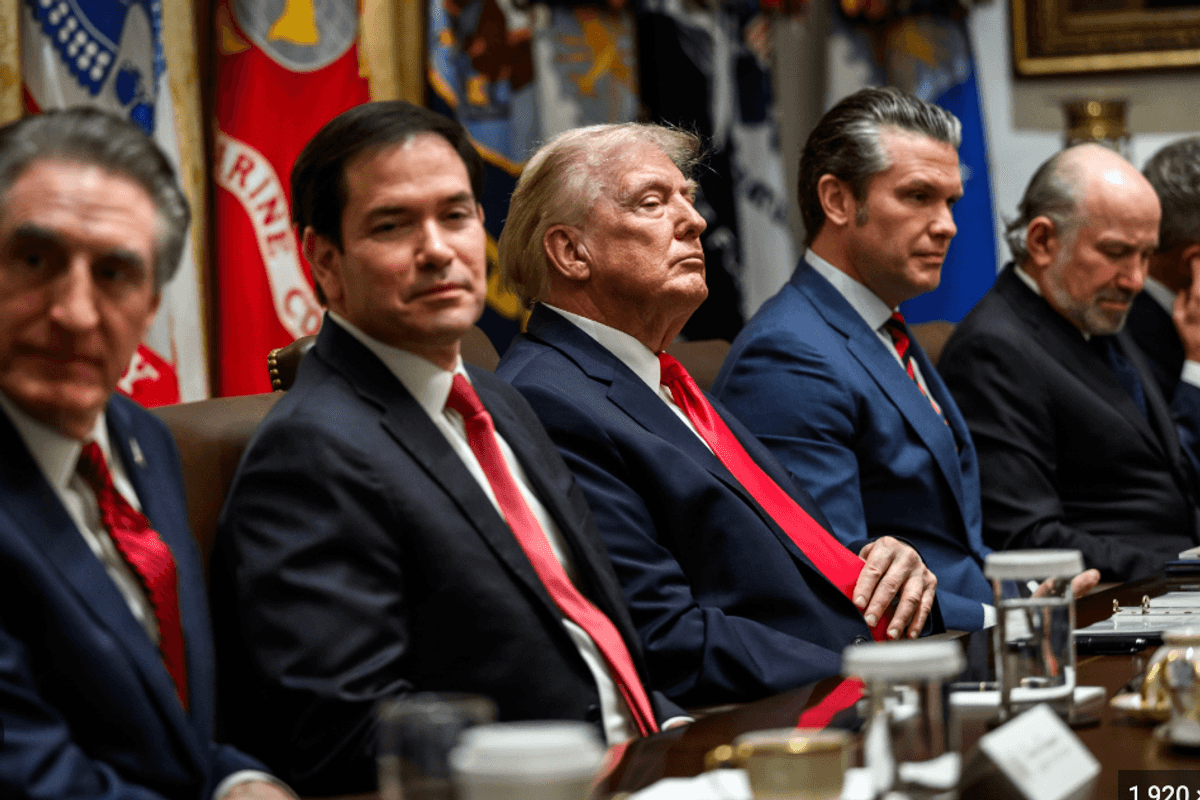
President Donald Trump, center, and members of his cabinet on January 6, 2026
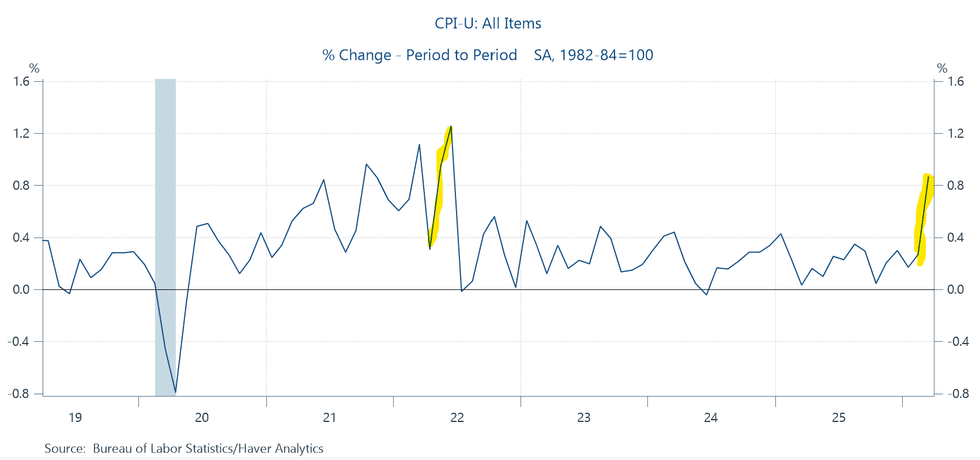
The Consumer Price Index rose 0.9 percent in March, pushed up by a war-induced, energy-price increase of 10.9 percent. On a yearly basis, inflation rose 3.3 percent, almost a full point above February’s prewar rate of 2.4 percent. The gas price rose 21.2 percent over the month and 18.9 percent over the year.
The energy-price-driven monthly spike is the sharpest since June 2022, when Russia’s invasion of Ukraine also shocked global energy prices.
Other war-impacted prices include airfares, up 2.7 percent for the month and 14.9 percent year/year. That’s a cost felt by the subgroup of consumers who are flying, but a much more pervasive “price” in the economy is wages. Combining the impact of the March spike in prices with the recent slowing of nominal wages, we see that real hourly earnings were down 0.6 percent in March for all private-sector workers and down 0.7 percent for mid/lower-wage workers. On a yearly basis, the comparable growth rates were 0.2 percent and 0.1 percent, compared to 1.3 percent and 1.2 percent last month.¹
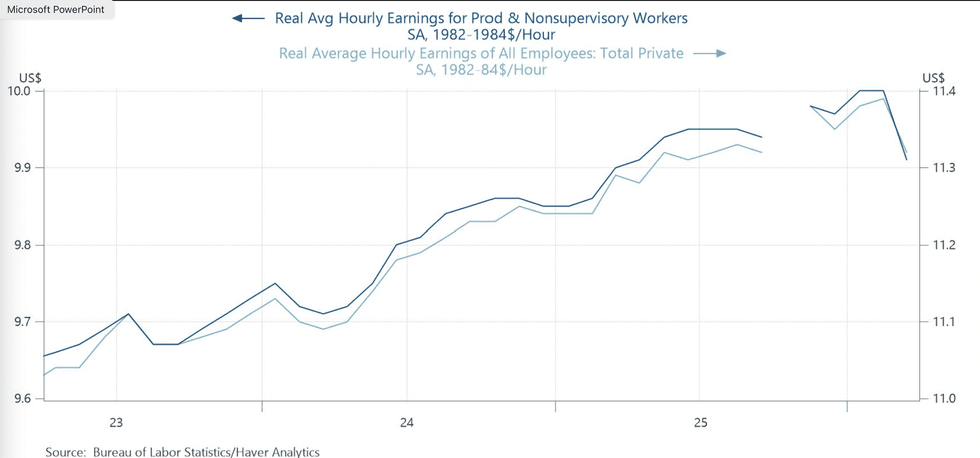
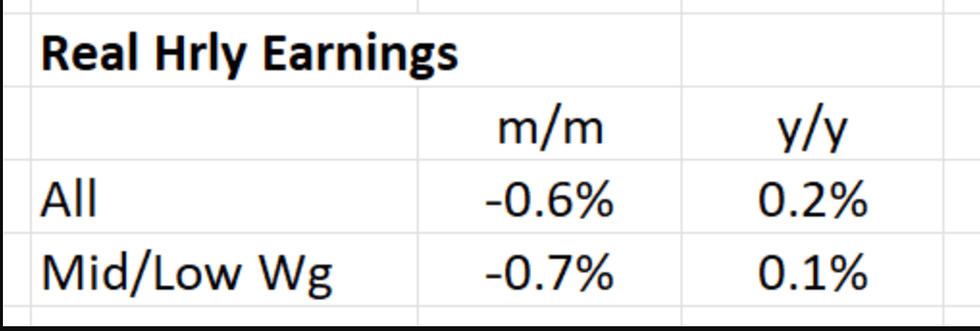
This is a sharp and damaging decline in the buying power of the hourly wage, something already cost-stressed consumers will feel. But because we’re dealing with noisy, monthly data, the question is: how long will these pressures last?
As I wrote yesterday, that’s a function of how the turmoil in the Persian Gulf plays out in coming weeks and months, the extent to which Iran maintains controls the chokepoint of Hormuz—a control that this benighted war delivered to them—and how long it will take damaged energy infrastructure to come back online.
This is, as I said, not the flipping off an off-on switch, and while a ceasefire is certainly welcomed, what we’re seeing in real time suggests the March price spike will not reverse right away, but, assuming the ceasefire holds, will hopefully fade over the next few months.
That said, the idea that President Trump has turned the the buying power of the American workers’ paycheck over to the Iranian regime is perhaps one of his most destructive and shocking actions, and that’s a high bar indeed.
Under the hood:
—Grocery prices fell slightly last month, a welcome change, down 0.2 percent, and up 1.9 percent over the year, down from 2.4 percent in February. My expectation is that the war’s impact on trucking costs—diesel fuel is up over 50 percent since the war started and 80 percent of our food is delivered by trucks—and other inputs (fertilizer, much of which flows through the Strait of Hormuz), will add pressure to this component in coming months.
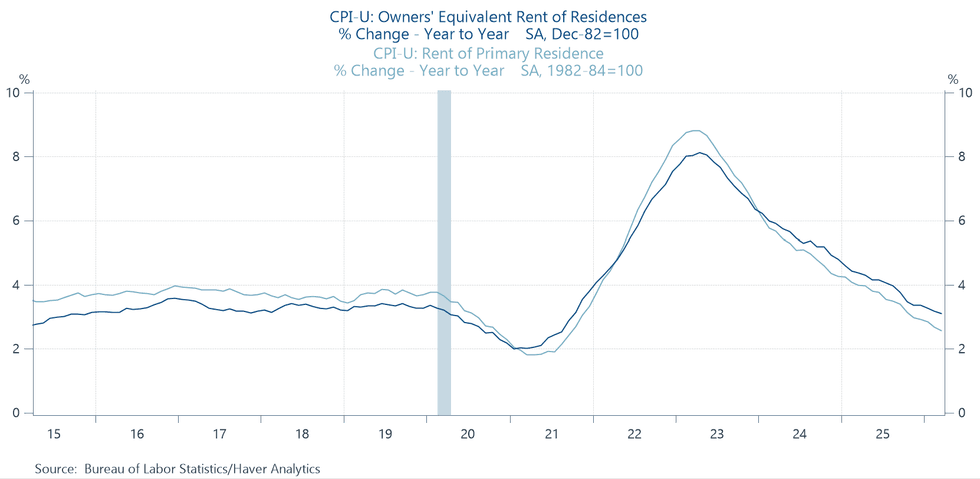
—Housing inflation continues to ease, back to its pre-pandemic levels, which, given its heavy weight in the index, is helping to keep overall inflation—aside from the war shock—in check.
Readers know I’ve been worrying about core services (ex-housing) inflation as it has been a) pretty high and sticky, and b) not obviously connected to tariffs, so a sign of underlying price pressures. Here’s that series on a six-month annualized basis. It’s jumpy and I’m not convinced it’s out of the woods, but it’s tracking pretty close to pre-pandemic levels, which is a good sign.
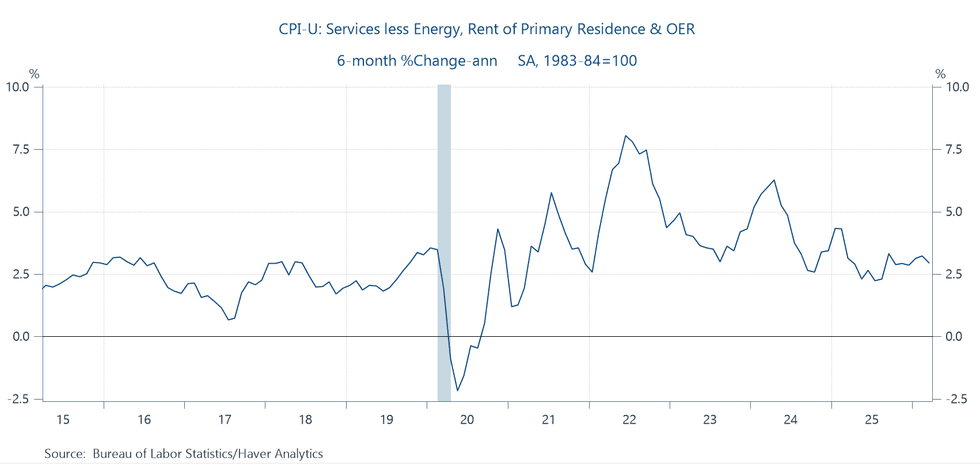
Putting that pretty-good-under-the-hood news next to the very bad war effects raises, once again, the own-goal kick proclivities of the Trump administraton's economic agenda. In case after case—tariffs, deportations, budget cuts to key services, war—their decisions make life more expensive and wage-buying-power less strong. The highly resilient U.S. economy can fight back for only so long.
[1. BLS uses CPI-W to deflate the production, non-manager wage; I use the CPI-U.]
Jared Bernstein is a former chair of the White House Council of Economic Advisers under President Joe Biden. He is a senior fellow at the Council on Budget and Policy Priorities. Please consider subscribing to his Substack.
Reprinted with permission from Econjared.
- 'One-Hit Wonder': Trump's Military Adventurism Is Sinking In Strait Of Hormuz ›
- Trump Tweets ’No Inflation’ As Consumer Prices Hit New High ›
- Iran War's Explosive Costs Could Finance Health Care Coverage For Millions ›
- Wildly Expensive And Unpopular: Scales Of Trump's War Are Far Out Of Balance ›
- As Trump Fumbles War, The Human And Economic Costs Keep Rising ›
- Inflation Rising As Trump's Confused Economics (And Iran War) Drive Costs Up ›
- Ceasefire! What Might This Mean for the Strait, the Markets, and You ›
- Cyclical Or Structural? Figuring Whether The World Is Stuck With Higher Inflation - National Memo ›
- Will Surrendering To Iran Relieve Trump's Gas Pains? Alas, Probably Not! - National Memo ›
- Trump Economy: July Inflation Index Shows Wages Fell Further Behind Prices - National Memo ›
- Trump's Iran War Is Pushing Up Interest Rates And Stifling Housing Starts - National Memo ›
- Diesel Fuel Hits Record High As Holiday Drivers Cope With Gas Spike - National Memo ›