Tag: aca
The Same Politicians Who Invented 'Pet-Eating' Migrants are Yelling Fraud!

The Same Politicians Who Invented 'Pet-Eating' Migrants are Yelling Fraud!

Republicans may not be very good at governing, but they are world-class at exploiting racism. It is a proud tradition dating back more than half a century.

In the 1960s, Richard Nixon yelled about “soft-on-crime” Democrats to get into the White House. Ronald Reagan pushed his stories about the welfare queen driving to pick up her check each month in a new Cadillac. The senior George Bush used Willie Horton, a convicted murderer in Massachusetts, who was given a furlough from prison on which he committed a series of brutal crimes.

Donald Trump’s foray into national politics began by inventing a Kenyan birth certificate for President Obama. His last campaign centered on pet-eating migrants, along with schools that turn children from boys into girls during recess.

With the economy and Trump’s Iran War both going badly, the Republicans are again doubling down on racism. This time, the cry is “fraud,” which they insist is massive in Medicare, Medicaid, and the Affordable Care Act (ACA) in the exchanges.

Not only is the latest round of accusations almost completely evidence-free, pretty much the norm for most Republican claims, it doesn’t even make any sense. In contrast to claims that people might cheat on things like Temporary Assistance for Needy Families (TANF), food stamps, or small business loans, beneficiaries of these programs get no direct benefit from cheating, other than possibly getting healthcare provided for which they were not entitled.

This takes an even more bizarre twist in the claims being pushed now by HHS Secretary Robert F. Kennedy Jr. and Dr. Mehmet Oz, the director of the Center for Medicare and Medicaid Services. RFK Jr. claims that one million people have insurance on the exchanges without identifying Social Security numbers. Dr. Oz claims that 40 percent of the people in the ACA exchanges never filed a claim.

Dr. Oz’s evidence of fraud isn’t quite the slam dunk he seems to believe. According to the Employee Benefit Research Institute, 20 percent of the people with employer-provided insurance don’t file any claims in a year.

Since the average period people have a policy in the exchanges is just eight months, we would expect 30 percent of beneficiaries never to file a claim, if its population were the same as it is for employer-provided insurance. But we know that the age distribution in the exchanges skews younger, which means that they would be less likely to file claims than people getting employer-provided insurance. This means there is nothing obviously suspicious in Dr. Oz’s factoid.

But beyond the questionable status of these claims, the question is, who is committing fraud? If there is a fake policy in someone’s name, and they never even file a claim, how are they benefiting?

There are intermediaries who match people to plans in the ACA exchanges. These people get between $15 and $30 per member per month. That does provide an incentive to push phony policies, although it’s not clear anyone will get too rich this way. One hundred phony policies would get someone between $1,500 and $3,000 a month. We would want to crack down on this fraud, but $36k a year is not exactly big bucks.

The real bucks would be in the pockets of the insurers. The average plan in the exchanges costs around $600 a month, or $7,200 a year. Insurers don’t have to worry about paying out much in premiums on fake plans. That means they can pocket the full $7,200 paid by the government. If they have an agent who gave them 100 fake plans, they can pocket $720,000 a year. A thousand agents getting them fake plans at this rate would net them $720 million, which is real money even for a large insurance company.

It’s not clear how big a problem fake plans are, but it is clear that the main beneficiaries are the big insurance companies. And while we can’t expect insurance company CEOs making tens of millions of dollars a year to be very sharp, if their companies are pulling in hundreds of millions of dollars a year from fake policies, surely they have some idea.

This means that if Robert F. Kennedy Jr., Mehmet Oz, and the rest of the Trump administration are serious about cracking down on fraud in the ACA exchanges, we should be looking to see some of the CEOs of the major insurance companies doing a perp walk. And Republicans do know about insurance companies defrauding the government, since Sen. Rick Scott was involved with the largest Medicare fraud at the time when he was CEO of HCA.

Locking up insurance company CEOs may not be the fraud that Trump politicians want us to envision, but it is likely the fraud that would be closer to reality, even if all the perps are white.

Dean Baker is a senior economist at the Center for Economic and Policy Research and the author of the 2016 book Rigged: How Globalization and the Rules of the Modern Economy Were Structured to Make the Rich Richer. Please consider subscribing to his Substack.
Who Will Benefit From The Latest Version Of Trump RX? Not Most Consumers

Who Will Benefit From The Latest Version Of Trump RX? Not Most Consumers

I’m a relatively healthy 75-year-old man who takes one prescription drug, a generic statin to keep my cholesterol count below the level recommended for preventing heart attacks and strokes. Those levels were recently lowered by the American College of Cardiology and the American Heart Association, which will likely lead many more Americans to be eligible for taking the pills.

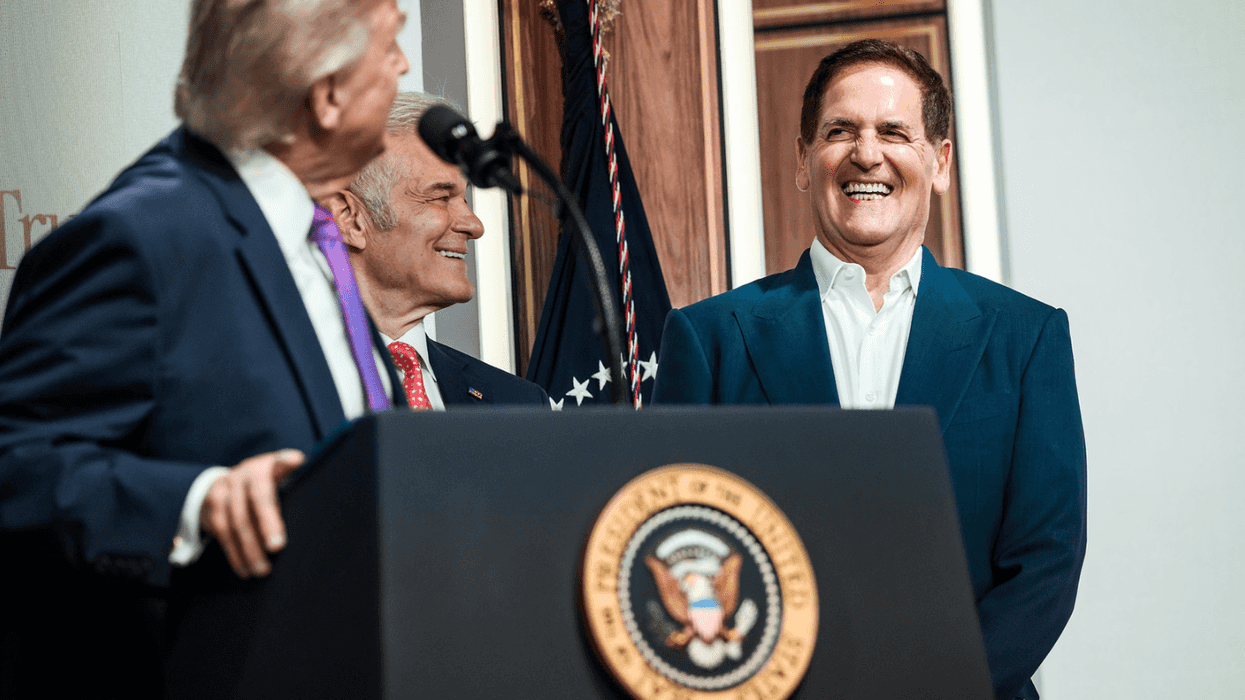
Both those facts piqued my curiosity about the announcement made Monday by Donald Trump with Mark Cuban, who runs Cost Plus Drugs, at his side. They were touting adding 602 generic drugs, including statins and blood pressure control meds, to TrumpRx, the government website that directs consumers looking for lower cost drugs to Cuban’s company GoodRx and Amazon Pharmacy.

Who will actually benefit from TrumpRx, I wondered, which is touting mostly generic drugs? And how much will they actually save?

First, I looked up what I could save by buying my generic statin from Cost Plus. Under my Medicare supplemental plan, which comes through my retired wife’s former employer (a public school system), CVS Caremark manages the pharmacy benefit. The PBM requires I pay a $20 co-pay at the pharmacy counter to obtain a 90-day supply of 20-milligram rosuvastatin, the generic name for Crestor.

Cuban’s Cost Plus mail-order website says it would charge me $7.85 for a 90-day supply plus a $5 shipping fee, thus saving me $7.15 for each refill or $28.60 a year. However, Cost Plus also tacks on a $5 pharmacy handling fee. It was unclear from the website if that was part of the $7.85. If not, adding that $20-a-year into the total cost would wipe out most of any savings for me.

I then called CVS Caremark to inquire about their savings should I decide to jump off their plan for those meager savings. I use the phrase “their savings” cautiously. I have no idea if my wife’s former employer or its plan’s medical insurer hires the nation’s second largest PBM, or how much either pays to CVS Caremark. Moreover, how much the PBM profits from the ultimate payer — the taxpayers behind the public employee retirement system — is unknown. So is the price it pays the generic manufacturer and any other middlemen that may have stuck their hands into the honey pot.

In any case, the call center operator told me the total cost to the PBM was $60.86 every 90 days. But that was before I paid $20 every three months at the pharmacy, so the cost reduction for everyone else would be about $164 a year, at least six times more than me. As noted above, how those savings would be divvied up between the PBM, the medical insurer and the employer-payer is safely contained in someone’s black box.

Will it benefit the uninsured?

How about the alleged major beneficiaries of TrumpRx — the uninsured who have to pay for any health care out of their own pockets? Their ranks are growing daily due to this year’s massive increase in rates for Affordable Care Act plans triggered by the regime’s handmaidens in the Republican-run Congress, who allowed the Biden-era increase in plan subsidies to expire.

When ACA-insured, the people dropping plans paid nothing for their cholesterol and blood pressure control medications, even if their plan had deductibles. All preventive services rated “A” or “B” by the U.S. Preventive Services Task Force must be offered free of charge under the ACA. Statins are rated “B.”

But under TrumpRx, those dropping coverage (or those that never had a plan in the first place) will have to pay the full cost. If they turn to Cost Plus Drugs, that would be at least $52 a year with maybe an additional $20 for the pharmacy fee.

Of course, both groups could run into trouble when renewing their prescriptions if they no longer have or never had a primary care physician. When signing up for Cost Plus Drugs, which I did today, I had to provide the name and contact information for my prescribing physician.

Even if they can get past that hurdle, people who are uninsured are usually pinching pennies. They no longer have a primary care physician. They don’t go in for routine checkups, which might identify when they have high blood pressure or dangerously elevated cholesterol. They are less likely to adhere to diets with less salt and less processed foods, which promote better heart health.

The ACA had it right. Drugs that have been proven to prevent serious diseases should be entirely free of charge to the consumer/patient. They are a wise investment that pays off in reduced hospitalizations and reduced complications from chronic diseases, which in turn reduces long-term health care costs. Plans like my supplemental should eliminate their co-pays entirely for such drugs, especially when they are generics like most statins and blood pressure meds.

TrumpRx sets up a financial barrier to access. It will decrease the population taking these important interventions. It is a public relations stunt designed to look like the regime is doing something about the high cost of drugs, which is entirely driven by the cost of new drugs coming to market and the high prices on those that remain on patent, not the extra fees PBMs tack onto prices.

Paying for value

One final thought: The regime is stepping up its pressure on European countries to raise their drug prices, which are substantially less than what is paid in the U.S. Why? Other advanced industrial countries are effective drug price negotiators. They refuse to pay more than the carefully calculated medical value of a prescription.

The U.S., on the other hand, insists that foreigners pay their “fair share” for innovation instead of using the same negotiating and value measurement tactics. Big Pharma’s argument — that the high cost of drugs is driven by the high cost of research and development — never held much water and has grown increasingly shallow given how much innovation has moved to China in the wake of the regime’s immigration policies and gutting of National Institutes of Health funding.

This Trump regime’s attempt to impose so-called reference pricing is, in essence, a strategy to maintain as much revenue as possible flowing to Big Pharma. It provides no long-term brake on rising costs. The U.S. would pay slightly less; other industrialized countries would pay slightly more; less developed countries would continue to go without the latest therapeutics; and the drug industry would maintain the status quo on profitability.

Merrill Goozner, the former editor of Modern Healthcare, writes about health care and politics at GoozNews.substack.com, where this column first appeared. Please consider subscribing to support his work.

Reprinted with permission from Gooz News


Amy Coney Barrett

Trump Chooses Far-Right Judge Barrett For Ginsburg Seat

Donald Trump will select U.S. Appeals Court Judge Amy Coney Barrett as his Supreme Court pick Saturday, multiple news outlets confirmed with White House officials on Friday — and the outlook couldn't be more bleak for reproductive rights, LGBTQ rights, immigration, and the future of health care in the United States.

According to the New York Times, Trump "will try to force Senate confirmation before Election Day."

"The president met with Judge Barrett at the White House this week and came away impressed with a jurist that leading conservatives told him would be a female Antonin Scalia," the Times reported.

Read NowShow less
Joe Biden

Biden’s Real Health Care Reform Is Far Better Than Trump’s Imaginary Plan

Health care policy has been a major issue for a long time. It played a big role in Barack Obama's 2008 election victory, his entire presidency and the 2010 GOP takeover of the House of Representatives. Repealing Obamacare was a Republican priority before and after Donald Trump became president. The debate on "Medicare for All" dominated the 2020 Democratic primaries.

Now, in the middle of the nation's worst pandemic in 100 years, you would think health care policy would be the object of obsession among politicians and voters. Instead, the issue has gone missing.

Read NowShow less

Shop our Store

Headlines

Editor's Blog

Trending

World