Tag: alan greenspan
RIP Alan Greenspan: Why New Fed Chair Warsh Shouldn't Imitate His Cryptic Style

RIP Alan Greenspan: Why New Fed Chair Warsh Shouldn't Imitate His Cryptic Style

I was not an Alan Greenspan fan, but I will give him some serious credit on his passing. I’ll also give him serious blame for missing two huge bubbles, the collapse of which gave us serious recessions. I’ll also add a comment about the opaque way he ran the Fed, to which I fear our new Fed chair is returning.

Starting with the positive, Greenspan allowed the unemployment rate to fall to 4.0% as a year-round average in 2000. This was huge. The prevailing view in the economics profession had been that the unemployment rate could not fall much below 6.0% without triggering spiraling inflation.

Greenspan was not a mainstream economist and therefore did not accept this view. In 1995, when the unemployment rate was already under 6.0%, he famously argued with two ostensibly more liberal Fed governors, Janet Yellen and Lawrence Meyer, over this point. They both wanted Greenspan to raise rates to head off inflation. Greenspan insisted that he didn’t see evidence of inflation and was not going to raise rates just because the unemployment rate was low.

Greenspan stood pat as the unemployment rate fell to 5.0% and then 4.5%, and finally in 2000 to 4.0% as a year-round average. We actually had several months of 3.9% and 3.8% unemployment. This allowed millions of workers to get jobs who would have otherwise remain unemployed if Yellen and Meyer had gotten their way.

Even more importantly, the low unemployment of the late 1990s gave tens of millions of workers the bargaining power to secure real wage gains. This was the first period of sustained real wage growth for low- and middle-wage earners since the early 1970s. The low unemployment of this period also set a benchmark for the future, where economists recognized that 6.0% unemployment was not a floor. (Yes, we can do better with a federal jobs policy, but that is not Alan Greenspan’s domain.)

Greenspan and the Bubbles

Greenspan decided to ignore the two huge bubbles that grew under his watch. He famously commented about the irrational exuberance in the stock market in 1996, which quickly sent stocks tumbling. Greenspan then mumbled some nonsense about growth possibly justifying market prices, and stocks recovered and continued to rise for another three and a half years.

The bubble began to deflate in March of 2000, and the market eventually lost close to half its value. The NASDAQ, where the major tech stocks were listed, lost almost 80%. The popular wisdom is that the resulting recession in 2001 was short and mild. This was not true from a labor market perspective. We went four full years without creating jobs and the strong real wage growth of the late 1990s quickly stopped and went into reverse.

The next bubble was even worse. There was already some evidence of a housing bubble in the late 1990s, as house sale prices began to outpace inflation. They also outpaced rents, which were still rising roughly in step with overall inflation.

This divergence increased in the 00s, triggered in part by low interest rates, but also incredibly lax lending standards. At their peak in 2006, house sale prices had risen 70% in real terms compared to where they were a decade before. The subsequent collapse gave us a financial crisis and the worst recession since the Great Depression, as the unemployment rate nearly reached 10.0%.

After the collapse all the people in economic policy positions gave themselves a “who could have known?” amnesty. The answer of course was everyone should have known. The dodgy lending practices of mortgage issuers were hardly a secret; they were bragging about it. People were buying houses with no money down and in many cases even borrowing more than the value of their home to cover moving expenses and closing costs. The same was true for the securitization that allowed issuers to offload any mortgages immediately after it was sold, regardless of the quality.

In an interview that Greenspan gave to the Washington Post after the crash, he commented that he had become concerned that the share of subprime mortgages had jumped to 25% in 2005. He said he couldn’t remember if he had passed this information on to his successor, Ben Bernanke, when he stepped down in 2006.

This was infuriating. The idea that the Fed chair was not aware of the explosion in subprime lending (even worse Alt-A, which had risen to 15%) was truly incredible. It’s not clear if it would be worse if Greenspan’s claim was true or not.

Remedies for Bubbles

I have written about this before, but I’ll just make a couple of points here. First, in the case of the stock bubble, I think talk would have gone a long way. Greenspan’s offhand “irrational exuberance” comment had a huge effect. Imagine he had the Fed churning out papers showing how stock prices were completely out of line with pretty much all projections of future GDP and profit growth.

The point is not that investors had to agree with Alan Greenspan, but they would have to answer him. The “who could have known?” defense might save a fund manager when it is just random gadflies yelling about a bubble. It is a very different story when a Fed chair is putting out the warning. A person managing tens of billions at a pension fund or endowment will be looking at the unemployment line if, after the crash, they say they didn’t pay Greenspan any attention.

In the case of the housing bubble, in addition to warnings, the Fed has substantial regulatory authority. The bad practices of banks and other financial institutions were easy to see. The Fed could have cracked down. Instead, they could not even be bothered to issue updated mortgage lending guidelines until after the crash.

Greenspan Thought the Fed Should be Opaque

This one is timely since our new Fed chair, Kevin Warsh, seems to want to turn back to the Greenspan era. Since I just wrote about this last week, I’ll pick up part of what I said.

“Under Alan Greenspan, the Fed was deliberately opaque. I remember walking to work one day in the mid-1990s, the day after Greenspan had given some big speech. Back then, we had newspaper boxes where you could buy the paper. I always glanced at the machines as I walked by. Half of the papers had headlines saying something to the effect of “Greenspan Plans to Raise Rates.” The headlines for the other half were something to the effect “Greenspan to Leave Rates Unchanged.”

“Greenspan, who followed his press closely, was reportedly delighted. He had given a major speech, and no one had any idea what he was talking about.

“Ben Bernanke, his immediate successor, wanted the Fed to be more transparent. He explicitly introduced the concept of “forward guidance” to Fed policy: the idea that the Fed would tell people where it expected interest rates to go in the near-term future. In their tenures as Fed chair, both Janet Yellen and Jerome Powell continued this policy. Their view was that they did not want the public to be surprised by the Fed’s decisions.”

I argued that this makes good sense both from the standpoint of the economy, being clear about Fed plans creates more certainty for investment decisions and is also important for reducing corruption. As I noted:

“Wayne Angell, who served as a Fed governor from 1986 to 1994, began consulting at the rate of $100 a minute (roughly $220 in today’s dollars) after he stepped down from his position in 1994. Angell may have been an insightful observer of the national economy, but he was obviously being paid for his knowledge of his former colleagues’ views on interest rates.

“If the Fed is fully transparent about its intentions, no one is going to get paid $220 a minute for their insights on what the FOMC is thinking. We don’t know how far Warsh will look to go with this move away from Fed transparency, but the further he goes the more room there is for corruption.”

Anyhow, Greenspan’s deliberate opaqueness was not a good policy for the Fed. We should hope that Kevin Warsh does not follow his example as chair.

How Warsh May Infect The Federal Reserve With Trump's Rampant Corruption

How Warsh May Infect The Federal Reserve With Trump's Rampant Corruption

This week was the first meeting under new Federal Reserve Chair Kevin Warsh of the Federal Reserve Boards Open Market Committee (FOMC). Warsh has promised to restructure the Fed, but it is still not clear he means by this.

Donald Trump very explicitly picked Warsh because he expected that he would lower interest rates. That goes against Warsh’s past history of being an inflation hawk. In his earlier tenure as a Fed governor during the Great Recession, Warsh was arguing against expansionary monetary policy even when the unemployment rate was close to ten percent. And he was concerned about hyperinflation when the actual inflation rate was near zero.

We still don’t know how Warsh plans to resolve these seemingly contradictory impulses. He has said that he wants to reduce the Fed’s balance sheet. This would mean selling off trillions of dollars of bonds that the Fed bought both during the financial crisis and more recently during the pandemic.

Selling off bonds would have the effect of raising the long-term interest rates that matter most for the economy, like car loans and mortgages. But it’s possible that Trump wouldn’t be bothered, since he probably doesn’t understand the connection between reducing the balance sheet and raising rates.

The other area where Warsh has indicated he wants to make a sharp departure from past practice is the amount of information that the Fed discloses to the public about its discussions. This reverses the trend toward greater transparency under the last three Fed chairs.

Under Alan Greenspan, the Fed was deliberately opaque. I remember walking to work one day in the mid-1990s, the day after Greenspan had given some big speech. Back then, we had newspaper boxes where you could buy a newspaper. I always glanced at the machines as I walked by. Half of the papers had headlines saying something to the effect of “Greenspan plans to raise rates.” The headlines for the other half were something to the effect “Greenspan to leave rates unchanged.”

Greenspan, who followed his press closely, was reportedly delighted. He had given a major speech, and no one had any idea what he was talking about.

Ben Bernanke, his immediate successor, wanted the Fed to be more transparent. He explicitly introduced the concept of “forward guidance” to Fed policy: the idea that the Fed would tell people where it expected interest rates to go in the near-term future. In their tenures as Fed chair, both Janet Yellen and Jerome Powell continued this policy. Their view was that they did not want the public to be surprised by the Fed’s decisions.

As an economic matter, this makes good sense. It is desirable to reduce uncertainty so that businesses and individuals can better make plans for the future. If a business is considering borrowing to expand, it may want to put its plans on hold if the Fed says it is likely to raise rates substantially in the near future. By sharing as much information as practical, businesses and individuals can be better informed about the likely future state of the economy and take this information into account in making their decisions.

Transparency is also important for combatting corruption. If anyone has inside knowledge of the Fed’s interest rate plans, they can make a huge amount of money, at the expense of others in the market, through their inside trades.

Wayne Angell, who served as a Fed governor from 1986 to 1994, began consulting at the rate of $100 a minute (roughly $220 in today’s dollars) after he stepped down from his position in 1994. Angell may have been an insightful observer of the national economy, but he was obviously being paid for his knowledge of his former colleagues’ views on interest rates.

If the Fed is fully transparent about its intentions, no one is going to get paid $220 a minute for their insights on what the FOMC is thinking. We don’t know how far Warsh will look to go with this move away from Fed transparency, but the further he goes, the more room there is for corruption.

And that is what makes Warsh a true Trump appointee. No administration in U.S. history has ever been as blatantly corrupt as Trump in his second term. Warsh seems intent on bringing that corruption to the Fed.

Dean Baker is a senior economist at the Center for Economic and Policy Research and the author of the 2016 book Rigged: How Globalization and the Rules of the Modern Economy Were Structured to Make the Rich Richer. Please consider subscribing to his Substack.

Warning: Here's Why The Fed Can't Rescue Markets From AI Bubble

Warning: Here's Why The Fed Can't Rescue Markets From AI Bubble

While everything feels political now – a kind of fin de siècle chaos politics – I want to take a brief break from the political today. Instead I want to talk about asset markets and the Fed.

We could say that the US economy in 2025 was schizoid. On the one hand Donald Trump abruptly reversed 90 years of U.S. trade policy, breaking all our international agreements, and pushed tariffs to levels not seen since the 1930s. Worse, the tariffs keep changing unpredictably. This uncertainty is clearly bad for business and is depressing the economy. On the other hand, there has simultaneously been a huge boom in AI-related investment, which is boosting the economy.

As many people have already noted, the AI boom bears an unmistakable resemblance to the tech boom of the late 1990s — a boom that turned out to be a huge bubble. The Nasdaq didn’t regain its 2000 peak until 2014.There’s intense debate about whether AI investment is similarly a bubble, which I would summarize as a shoving match: “Is not!” “Is too!” “Is not!” “Is too!”

While my personal guess is that AI is indeed in the midst of a bubble, I won’t devote today’s post to that debate. Instead, I want to talk about one recent aspect of market behavior that is very striking and carries strong echoes of the tech bubble a generation ago. Namely, AI-related stocks, like tech stocks back then, are reacting very strongly to perceptions about the Fed’s short-term interest rate policy.

Now as then, these strong reactions don’t make sense.

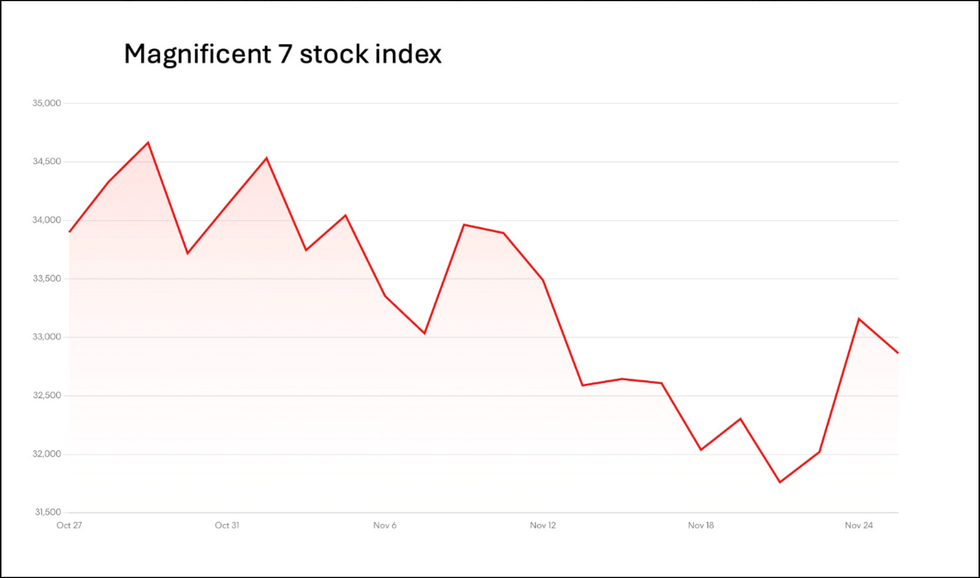
To see what I’m talking about, consider recent moves in stock prices closely related to AI. This chart shows movement over the last month of Bloomberg’s “Magnificent 7” stock index:

bloomberg magnificent 7 Source: Bloomberg News

During most of that month, these stocks were falling, as concerns that AI is a bubble increased. But on Monday the Mag7 index surged, erasing a large fraction of the losses. Why? Analyst chatter about supposed causes of stock market swings should always be taken with many grains of salt. But it’s clear that this surge was catalyzed by remarks by Fed officials which the market interpreted as making a cut in the Fed Funds rate next month more likely.

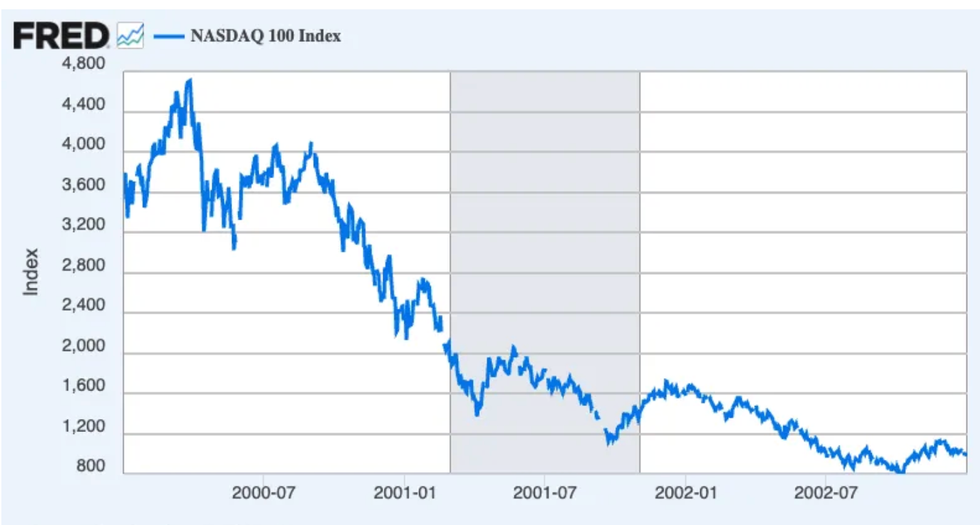
Some of us have seen this movie before. For those who haven’t, there is a pervasive view that the deflation of the 90s tech bubble was something that happened all at once — a Wile E. Coyote moment in which investors looked down, realized that there was nothing supporting those high valuations, and the market plunged. In reality, however, it was a long, drawn-out process, punctuated with some significant dead cat bounces along the way. Here’s the Nasdaq 100 over the relevant period (the gray bar represents the 2001 recession):

FRED NASDAQ 100 index Source: NASDAQ via FRED/St.Louis Federal Reserve (stlouisfed.org)
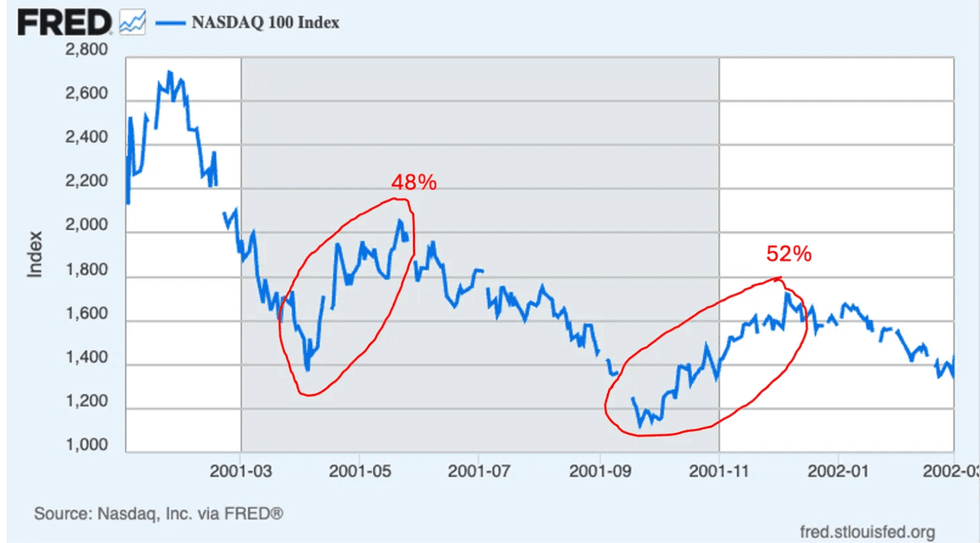
Measured against the awesome scale of the ultimate tech-stock decline, the temporary rallies along the way don’t look that big. But they were actually huge compared with normal stock movements. Let’s look at a closeup:


FRED NASDAQ 100 Index tech bubble Source: NASDAQ via FRED/St.Louis Federal Reserve

What drove these temporary bouts of optimism? At the time the conventional wisdom was that they were the result of Fed interest rate reductions and the prospect of further cuts. In fact, many observers used to argue that the stock market was underpinned by the “Greenspan put”: Don’t worry about a crash, Uncle Alan will ride to the rescue.

And after Monday’s stock price spurt, it’s clear that belief in a “Fed put” has made a modest comeback.

Indeed, the graph below shows the numerous rate cuts as the tech bubble burst:

But while these rate cuts did create brief bouts of, well, irrational exuberance, they did nothing to prevent the tech bubble from eventually deflating.

Why couldn’t Greenspan rescue tech stocks? To answer that question, think about why interest rates matter for asset prices: Lower interest rates reduce the rate at which investors discount expected future returns. A dollar delivered to you X years from now has a higher “present value” (that is, a higher current value) if interest rates are one percent than if they’re six percent. How much higher depends on X, the number of years until you receive it.

For example, a house can last for generations, and it delivers value to its owner in the form of a place to live over the years. That stream of housing consumption over the years is worth more – has a higher present value -- when the interest rate is one percent than when it is six percent. Or to put it another way, if you can make six percent on your money in a bank deposit, you may be better off renting rather than buying. That’s why the demand for houses is strongly affected by mortgage rates.

Interest rates matter much more for the value of assets that will still be yielding returns 10 or 20 years from now than they do for assets that will only yield returns for a few years.

That is, the value of assets that have a short economic life is much less affected by interest rates. Not surprisingly, economists have consistently had a hard time finding evidence for any effect of interest rates on business investment.

Moreover, investments in digital technology tend to have an especially short half-life, precisely because rapid technological progress quickly makes equipment and software obsolete. How valuable will data centers currently under construction be 5 years from now? Will they be worth anything 10 years from now? A realistic answer to these questions surely implies that the Fed’s interest policy should have little to no impact on Mag 7 valuations, or the sustainability of the tech boom.

As we saw on Monday, however, Fed policy and rumors about future Fed policy can sometimes affect AI-stock prices in the short run. But by the straight economics, these movements are more the result of market psychology than of any objective assessment of future returns.

So as doubts about AI creep in, I’m hearing growing chatter to the effect that the Fed can and should save the industry. But the lesson from the last big tech bubble is that it can’t. In fact, I have doubts about whether the Fed can head off a broader recession if the tech boom collapses — but that’s a topic for a future post.

For now, my point is that if you’re worried about an AI bubble, don’t expect Jerome Powell or his Trump-appointed successor — rumors are not encouraging — to come to the rescue. They can’t.

Paul Krugman is a Nobel Prize-winning economist and former professor at MIT and Princeton who now teaches at the City University of New York's Graduate Center. From 2000 to 2024, he wrote a column for The New York Times. Please consider subscribing to his Substack.

Reprinted with permission from Paul Krugman.

Shop our Store

Headlines

Editor's Blog

Corona Virus

Trending

World