'No One Is Watching': How Trump Reversed Biden’s Crackdown on Gun Trafficking
This story was originally published by ProPublica
Marianna Mitchem grew up in the Denver suburbs, where she played high school soccer. One day in April 1999, her team faced off against a nearby rival, Columbine High. The next day, two teenagers went on a shooting rampage at Columbine, killing more than a dozen people.
The massacre left an imprint on Mitchem. After graduating from Providence College, she joined the Bureau of Alcohol, Tobacco, Firearms and Explosives. “Fearing for my friends and watching what was happening — you don’t forget things like that,” she told me. “I wanted to make a difference.”
She started in the ATF’s Denver office as an industry operations investigator, the bureau’s term for inspectors who ensure that firearms dealers are conducting the required background checks on buyers and maintaining sales records. When the bureau found discrepancies, it tended to settle for reprimands and improvement plans, rarely going so far as to revoke a dealer’s license.
In 2021, things started to change. The country was experiencing a surge of deadly violence, with homicides up more than a third since 2019, and the administration of President Joe Biden was desperate to reverse the trend. For years, data had shown that a large share of guns used in shootings came from a small fraction of dealers, and that guns that were trafficked — sold by stores to straw purchasers (people other than the intended users) or resold on the street — were far more likely to be used in shootings.
Acting on this data, the administration in June 2021 announced what became known as “zero tolerance”: Dealers found to be willfully violating the law would lose their licenses, period. Revocations spiked, from fewer than 50 in 2019, 2020 and 2021 to a record 181 in 2023.
Also in 2021, Biden’s attorney general, Merrick Garland, started urging federal prosecutors to prioritize gun violence. A year later, Congress passed a law that added a firearms trafficking conspiracy charge to the federal criminal code, a crucial new tool for prosecutors.
After 2021, the homicide rate started falling, which criminologists attributed to several factors, including repair of the social fabric since the coronavirus pandemic and a closing of the breach in police-community relations that followed the 2020 murder of George Floyd. One other factor got less attention: the clampdown on the illegal flow of firearms.
The Biden administration struggled to broadcast its gains on public safety, and Donald Trump won election in 2024 partly by vowing to restore order. By the time Trump reentered the White House, Mitchem had risen to associate assistant director for industry operations, overseeing inspectors across the country. “We were making incredible progress on trafficking, on violent crime,” she said late last year.
But the Trump administration, driven both by gun-lobby advocacy and its own political priorities, quickly set about undoing much of its predecessor’s moves to combat gun violence. It repealed the zero-tolerance policy, going so far as to invite revoked dealers to reapply for new licenses. It shifted hundreds of ATF agents to immigration work. And it scaled back on prosecutions for gun trafficking. The White House declined to comment, referring questions to the ATF and the Department of Justice.
The homicide rate fell further last year, but criminologists warn against complacency, because the illicit gun trade is a classic pipeline problem: The harm can take a while to make itself felt. Research has found that the typical “time to crime” for trafficked firearms ranges up to about three years, which means that any positive lag of the anti-trafficking efforts of the Biden years would still be in effect now, with any negative effects of the Trump pullback lying in the years to come.
Among those now sounding the alarm is Mitchem. Dismayed at the policy reversal, she left the ATF last spring, after 21 years, and joined Everytown, the gun-safety group founded by Michael Bloomberg.
“Just because no one is watching the trafficking pipelines right now doesn’t mean guns aren’t flowing through it. It just means they’re not being intercepted,” she told me.
“And as you walk away from that, and you don’t have your focus on that anymore,” she added, “that pipeline is going to be flowing, and we are going to start to see the violent crime impact from that over time.”
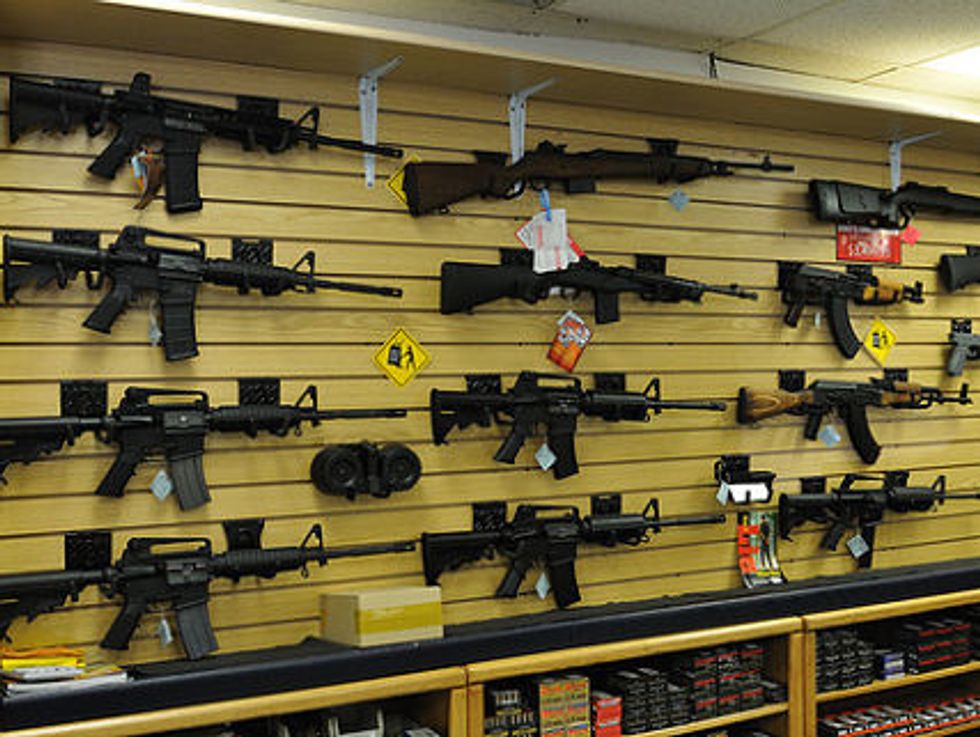
Estimates put the number of guns in the United States at close to 400 million, but the odds that any of them will be put to ill use rise exponentially if they are obtained illegally. Of the 2.3 million firearms traced from crime scenes between 2017 and 2023, half were bought less than three years earlier and 87 percent were recovered in possession of someone other than the original, legally authorized buyer. Over that period, stores sold almost 1.3 million guns to traffickers that were subsequently recovered in a crime, according to an Everytown analysis of ATF statistics.
This is why the laws governing gun sales carry such high stakes for public safety. But enforcement of these laws has long occupied an unusual no-man’s-land in this country, scrambling the standard political lines around criminal justice. Conservatives favoring tough-on-crime rhetoric are frequently torn when it comes to firearms trafficking: On the one hand, traffickers are helping fuel the violent crime that conservatives decry; on the other, prosecution of gun laws brushes against tenets that conservatives hold sacrosanct. It is liberals who are more likely to push for tougher enforcement, though they can be conflicted, too, as their belief in stricter gun laws runs up against a general preference for a less punitive approach to lawbreaking.
Marooned in this no-man’s-land for decades now has been the agency assigned the task of enforcing federal gun laws, the ATF. Going back to an episode at Ruby Ridge, Idaho, in 1992, where an ATF investigation of illegal gun dealing led to federal agents killing the wife and son of a white separatist, the ATF has been viewed with scorn by people who otherwise might side with armed government authorities. “ATF IS GAY” read the T-shirt worn by one attendee of a big gun show I attended earlier this year in Manassas, Virginia.
The agency’s radioactivity with the gun-rights lobby has left it on shaky political ground. It went seven years without a Senate-confirmed director. Its budget has not enjoyed the same expansion as that of other federal law enforcement agencies. And stringent laws constrain any ATF capabilities viewed as potentially threatening the rights of gun owners. To comply with a 1986 law preventing the creation of a federal gun registry, for example, the ATF uses software with some features disabled. Steve Dettelbach, who served as director under Biden, joked in a 2024 congressional hearing that the ATF might be “the only customer of Adobe Acrobat that pays money to remove search function.”
Despite these constraints, the ATF has developed its investigative capability. In the 1990s, the agency started sharing with local law enforcement agencies its National Integrated Ballistic Information Network, which collects the unique marks on bullet casings found at shooting scenes. The system has become much more potent as it became easier to share large numbers of images from crime scenes rapidly and compare them against the NIBIN database. The work was boosted further by the creation, starting in 2016, of 25 crime gun intelligence centers to process the data.
Given that a tiny share of the nation’s guns are used in shootings, with many of those used multiple times, the leads produced by the technology can have an outsized impact, said Daryl McCormick, who retired last year as special agent in charge of Ohio and southern Indiana. “It’s crazy how it might spiderweb out,” he told me, “because you have a gun that’s used in three shootings, but in one of those three shootings, there’s a guy that’s linked to three more shootings.”
Starting in the spring of 2020, that technology was put to the test. As homicides rose sharply, so did sales at dealerships. By one estimate, there were 3 million more guns sold between that March and July than would have been expected. Many soon turned up in shootings; the number of guns recovered at crime scenes that had been bought from a dealership less than a year earlier, an especially strong indicator of firearms trafficking, jumped by nearly a third from 2019 to 2021.
Meanwhile, many shootings involved ghost guns assembled from kits, which had begun proliferating a few years prior. Amid other factors driving the killing, the sheer plenitude of weaponry on the streets was pivotal, said Daniel Webster, a gun-violence researcher at Johns Hopkins University. “We know,” he told me, “that a small number of dealers can create a substantial amount of harm, and traffickers as well.”