Tag: drug prices
How Trump's Patent Office Appointees And Big Pharma Delay Low-Cost Drugs

How Trump's Patent Office Appointees And Big Pharma Delay Low-Cost Drugs

What’s the easiest and smartest thing a president could do right now to bring down drug prices? That’s easy. Allow quicker market entry for generic versions of biologics.

What’s the biggest thing the Trump administration has done in recent months to impact biologic prices? It made it far more difficult for biologic generics, better known as biosimilars, to enter the market.

How did that happen when the president is constantly using his Truth Social platform to brag about how much he’s doing to lower the price of drugs? He appointed leaders at the Patent and Trademark Office (PTO) who are imposing policies that will make it far more difficult for biosimilar manufacturers to challenge improperly granted patents.

They are already allowing Big Pharma companies to maintain their illegitimate patent portfolios, known as patent thickets, which they use to deny market entry to cheap, generic competitors. These delays can last for years — even decades — beyond the expiration of an initial patent.

Why is this such a big deal and such a big gift to Big Pharma? While biologics make up only two to five percent of prescriptions (estimates vary), they generated around half of the pharmaceutical industry’s $634 billion in revenue in 2024. When still on patent, the price of individual biologic treatments can reach as high as several hundred thousand dollars per year. But when biosimilars enter the market, patients and their insurers save nearly 80 percent on average, according to a recent study in Health Affairs.

Before I get into the shenanigans at the PTO and how it will delay biosimilars, allow me to share some background for those not familiar with the complexities of the pharmaceutical industry and its biotechnology offspring, which was birthed by government-funded inventions that began in the mid-1970s.

Biologics are large organic molecules produced through genetic engineering that are usually delivered through injection or intravenous drips. Many of the greatest advances in drug therapy over the past half century have been through biologics.

The genomic revolution allowed scientists to replace proteins that patients’ bodies cannot produce because they have organ failure or genetic mutations. Genetic engineers also created monoclonal antibodies that target specific cancer mutations and the blood vessels that feed tumors. Vaccines are biologics. Scientists are now working on gene therapies that may permanently repair genetic birth defects.

Producers of biologics – like all drug makers – get patents on their inventions, a right guaranteed in the Constitution (thank you, James Madison) to promote innovation in “science and useful arts.” The idea was to create a limited period that incentivized creation of new inventions, but eventually ended so patent owners couldn’t use their patent monopoly to permanently levy exorbitant prices.

Patent terms have been changed repeatedly over the nation’s history. In 1994, Congress established a 20-year term for patents that began with the date of filing, an increase from the previous 17 years. In 2010 it added a 12-year guarantee of exclusivity to biologic manufacturers, whose products often remain in development for years after the initial patents are filed.

While that add-on was controversial, potential biosimilar manufacturers embraced the bill because it finally provided them with a pathway for entering the market. They also stood to benefit from the 2011 America Invents Act, which created a streamlined process at the PTO for challenging questionable patents. Instead of long and costly litigation in federal court, patent challenges would be heard by expert judges inside the PTO at a fraction of the cost. Appeals would be heard by an internal appeals board.

Information technology’s role

The impetus for the streamlined challenge process came from leading information technology firms (Google, Amazon, Facebook, etc.) who were being besieged by so-called patent trolls, who would buy or write patents they never intended to use that were similar to cutting edge info-tech technologies. The trolls, often backed by private equity investors, used those patents to file patent infringement lawsuits against well-heeled high-tech firms who had actually developed, patented, and used similar technologies. The goal: To extract huge settlements through patent purchases or licensing fees.

One major user of the new challenge process, called inter partes reviews (IPRs), turned out to be biosimilar manufacturers, who wanted a faster and cheaper way to challenge the patent thickets being erected by Big Pharma and biotech firms. Virtually every company that produces FDA-approved biologics and small molecule drugs (pills and capsules) files follow-on patents at the PTO. Any individual product may win a dozen or more, usually involving small changes in dosages, formulations or routes of administration.

“By creating large patent portfolios, companies can make it more difficult for competitors to enter the market by increasing transaction costs and/or delaying US Food and Drug Administration (FDA) approval,” law professors Sean Tu of the University of Alabama and Ana Santos Rutschman of Villanova University wrote this month in JAMA Health Forum. “Patent thickets can also be leveraged to force competitors to settle litigation, thus delaying market entry, or to enter under unfavorable conditions (such as restricted volume entry).”

One study they cited showed 78 percent of all “new” drug patents are part of a post-approval patent thicket for an already approved drug. This tactic has slowed adoption of biosimilars to a crawl. Fifteen years after passage of the law creating a pathway for biosimilar market entry, there are still fewer than 50 on the market, despite there being over 600 FDA-approved biologics, according to the Association for Accessible Medicines, the trade group for biosimilar manufacturers.

The process sped up during the Biden administration as biosimilar manufacturers increasingly turned to the IPR process to challenge questionable patents. They were aided by the fact that the administrative process at the PTO takes only 12 months and costs about $725,000, according to another recent paper co-authored by Tu. Patent litigation in federal court, by contrast, costs on average over $6 million and takes years to resolve.

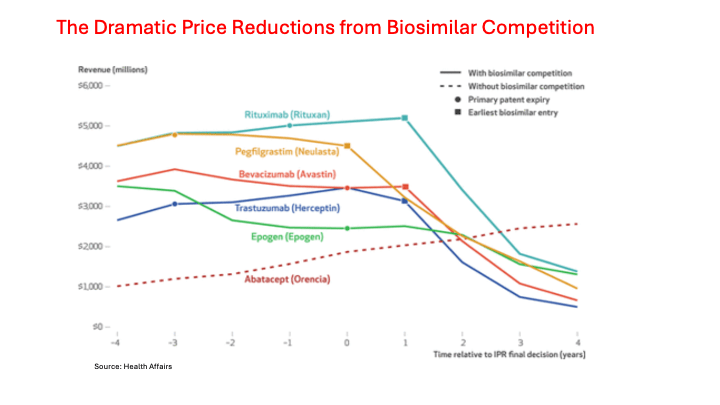
Biosimilar manufacturers started racking up an impressive IPR win rate at the PTO. Another recent study showed biosimilar manufacturers won 14 of 20 challenges that were holding up market entry for their products. They eventually won FDA approval and saved patients and their insurers tens of billions of dollars. Five are shown in the following chart.

(Note: The bottom scale (-4 to 4) represents the years before and after a biosimilar manufacturer won a patent invalidation case at the PTO. The solid lines represent five of the more expensive biologics that lost exclusivity over the past decade. In each case, the sharp drop in revenue due to lost sales to biosimilars didn’t show up until a year after the PTO ruled because the Big Pharma firm defending the patents had a year to appeal. The bottom dotted line shows how one representative biologic that didn’t face biosimilar competition more than doubled its revenue over a similar time period.)

Big changes at PTO

But the PTO reversed field this year. PTO acting director Coke Morgan Stewart, who had worked at PTO during the first Trump administration before joining O’Melveny & Myers, a major corporate law firm, began using a process she dubbed “discretionary denial” to block patent challenges. In 2024, the patent appeals board had approved nearly 75 percent of all patent challenges. By September of this year, the first under Trump, that rate had declined to 35 percent, according to another study by Tu, this time with Arti Rai of Duke University and Aaron Kesselheim of Harvard Medical School.

The scholars reviewed Stewart’s decisions and found she had created a novel rationale for dismissing patent challenges. She argued that after six years (about the average age for drug patents being challenged), the patent holder should expect they will no longer be administratively challenged. “Before 2025, the ‘settled expectations’ rationale never even existed,” Tu and his colleagues wrote. “It now accounts for a large percentage of denials and is even used when administrative review petitions raise reasonable technical grounds for invalidation.”

In September, the Senate approved John Squires to run the PTO, though he is not a registered patent attorney. He did chair the Emerging Companies and Intellectual Property practice at Dilworth Paxson LLP in Washington where he represented numerous AI, blockchain, crypto, and financial technology companies. He also made campaign contributions to both of Donald Trump’s victorious election campaigns and more recently to the Never Surrender PAC, which is one of the president’s vehicles for supporting GOP candidates in the 2026 mid-term elections.

One of Squires’ first acts after winning Senate approval was to centralize the IPR decision-making process in the director’s office, thus removing it from the experts who understood the technical issues. He also limited the length of briefs that petitioners could file. Then, in mid-October, Squires announced that “he would personally decide every IPR proceeding,” which cannot be reviewed judicially. He also declared he could issue “summary notices,” that may include little or no explanation for denials.

“By aggressively invoking discretionary denials, the USPTO is subverting an important administrative pathway that Congress specifically created to check weak patents,” Tu, Rai and Kesselheim wrote. Seven lawsuits have already been filed challenging the new policy. They call on Congress to “step in” and “explicitly prohibit denials based on non-merit-based criteria such as ‘settled expectations’.”

This Congress? Fat chance. Look for a dramatic slowdown in the pace of biosimilar adoption over the next few years and for a continuing sharp rise in consumer and payer spending on biologics, the most expensive drugs on the market.

Merrill Goozner, the former editor of Modern Healthcare, writes about health care and politics at GoozNews.substack.com, where this column first appeared. Please consider subscribing to support his work.

Reprinted with permission from Gooz News
One Big Problem With Trumponomics: The President Can't Do Arithmetic

One Big Problem With Trumponomics: The President Can't Do Arithmetic

It is striking that many people feel the need to claim that Donald Trump has some coherent economic plan for the country. It’s understandable that Trump’s team likes to pretend that his random ramblings and angry acts of revenge are all part of some grand strategy, but why would anyone not on his payroll play along with this obvious absurdity?

To anyone paying attention, it should be pretty clear that Donald Trump is clueless about the economy. Just to take an obvious example to make the point: Trump has repeatedly promised to lower drug prices by 800, 900, or even 1,500 percent. As he rightly says, no one thought it was possible.

It wouldn’t be a big deal that he got confused once or twice and forgot that you can’t lower prices by more than 100 percent, unless you envision drug companies paying people to use their drugs. But Trump has done this repeatedly, over many months.

This tells us two things. First, he really doesn’t have even a basic understanding of arithmetic and percentages. That would be bad in and of itself. After all the president is sometimes directly negotiating deals and it would be bad if he agreed to something and then had to call back his negotiating partner and tell them he didn’t understand what he had agreed to.

But the other issue is even more serious. Surely people like Treasury Secretary Scott Bessent and Kevin Hassett, Trump’s National Economic Advisor, understand percentages. But apparently, they are too scared of Trump to explain how they work. Instead, they let him go out week after week and make a fool of himself by making nonsensical promises on lowering drug prices.

This fact is crucial if we are trying to assess whether Trump has a coherent economic strategy. The point is he is obviously confused about many things when it comes to the economy. He seems to think that other countries pay tariffs and send the U.S. checks. He also seems to think that wind and solar power are very expensive sources of energy. And he seems to think that the economy was collapsing when he took office.

All of these claims are 180 degrees at odds with reality, but it is extremely unlikely that his aides would be able to correct him on these or other absurd views that Trump seems to hold. Given how out of touch Trump is with reality and the inability of his aides to correct him on anything, why would anyone think that he has a coherent economic strategy?

As many of us have pointed out, even most hard-core free traders will concede tariffs can serve a useful purpose. They can be used strategically to build up important industries. This is what Biden tried to do when he used tariffs, along with subsidies and regulatory changes, to promote domestic production of advanced computer chips, electric vehicles, batteries, and wind and solar and other forms of clean energy.

But what is the coherence in a tariff policy when some of the highest tariffs, like Trump’s 50 percent tariff on imported steel, are reserved for intermediate goods that are inputs for other manufacturing industries? How does it make sense to impose an extra 10 percentage point tariff on imports from Canada because Trump didn’t like a television ad they ran during the World Series? And India got whacked with a tariff of 50 percent on its exports because its president would not support Trump’s drive to get a Nobel Peace Prize.

Anyone trying to weave together these and other tariff decisions by Trump, along with many other economic decisions he has made since taking office, is really stretching if they think they can find anything coherent. It is bad for the country and the world that policy in the United States is being determined by a man child who has no idea what he is doing beyond stuffing his pockets, but that is the reality.

There may be a market for thoughtful pieces describing the grand Trump strategy in major intellectual outlets, but that is yet one more example of market failure. There ain’t nothing there.

Dean Baker is a senior economist at the Center for Economic and Policy Research and the author of the 2016 book Rigged: How Globalization and the Rules of the Modern Economy Were Structured to Make the Rich Richer. Please consider subscribing to his Substack.

Reprinted with permission from Dean Baker.

Drug Prices

Democrats Should Pick A Fight With Trump Over Drug Prices

Donald Trump is executing a shock and awe strategy, burying the public in a smoky cloud of flamboyant proposals. Some, like ending birthright citizenship, are quickly slapped down in the courts. Some, like threatening to invade Greenland, are dismissed as moronic. But all are radical enough to provide news media with easy entertainment.

The problem for Democrats is that these flashbangs distract from plans that would hit Americans, in Bill Clinton's words, "where they live." Democrats need to focus.

Start with actions to weaken Biden-era programs to restrain the prices drugmakers may charge for their products. His first day back in office, Trump canceled the Biden order to test new models for lowering drug costs.

When Trump ran for president in 2016, he promised to have Medicare negotiate drug prices. Why? It was a very popular idea. Upon election, the vow promptly vanished. Trump named Alex Azar, a top executive at Eli Lilly, to head Health and Human Services. (Under Azar, Eli Lilly tripled the price of its top-selling insulin drug.)

But Joe Biden's Inflation Reduction Act did follow through. As a result, 10 popular drugs covered under Medicare Part D (the prescription drug benefit) were selected for price reductions by 2026. They include such popular medications as Jardiance (diabetes), Enbrel (rheumatoid arthritis) and Eliquis (blood clots).

In its last days, the Biden administration targeted another 15 Part D drugs for price negotiations. They include Trelegy Ellipta (asthma, COPD) and three big-name drugs for weight loss, diabetes and heart disease: Rybelsus, Ozempic and Wegovy. These negotiations would have to be implemented by the Trump administration. Don't bet the farm on much relief.

Novo Nordisk, maker of Ozempic and Wegovy, has been charging Americans outlandish prices for these blockbusters. Wegovy's list price in the U.S. is over $1,300 for a month's supply. It is five times the price in Canada ($265) and 14 times the price in Britain ($92).

The right-wing argues, as Project 2025 puts it, that government negotiations on Medicare drugs amount to "price controls" that will reduce patient access to new medication. That's news to the citizens of just about every other advanced country. And no, other countries don't let drugmakers charge their people whatever they want.

In Novo Nordisk's home country of Denmark, Wegovy costs only $186 a month. It should surprise no one that 72% of the company's sales come from the United States. We are the land of suckers.

Thanks to Biden, the catastrophic coverage tier for Part D begins when a beneficiary's out-of-pocket spending reaches $2,000. Project 2025 calls for "eliminating the coverage gap in Part D, reducing the government share in the catastrophic tier, and requiring manufacturers to bear a larger share." (You may laugh at the "requiring manufacturers" part.)

It's true that Trump has yet to reverse the caps already in place on seniors' drug costs, and so beneficiaries won't notice much change right off. He's certainly too clever to mess with the $35 limit on the monthly price of insulin, one of Biden's marquee achievements. Doing so might break through the smoke.

However, Project 2025 has its own ideas, and Trump is stocking his administration with Project 2025 folk. Furthermore, as Republicans comb through the budget for ways to pay for tax cuts, Medicare would seem a ripe place to slash spending. Trump did vow to leave Medicare alone. Then again, he vowed to have Medicare negotiate drug prices.

Why would Trump be OK with forcing Americans to pay more than the rest of the world for their drugs? The answer is simple: Because the drug companies want them to.

Democrats, step around some of those rabbit-hole distractions. You have an issue.

Reprinted with permission from Creators.

Can These Corporate Titans Reform Health Care — And Tame Big Pharma?

Can These Corporate Titans Reform Health Care — And Tame Big Pharma?

President Trump offered few words about health care in his State of the Union address. He did mention drug prices, though.

“One of my greatest priorities is to reduce the price of prescription drugs,” he said. “In many other countries, these drugs cost far less than what we pay in the United States. … That is why I have directed my administration to make fixing the injustice of high drug prices one of my top priorities.”

Which is an interesting thing for Trump to say, given that he has just made Alex Azar, a top executive at drugmaker Eli Lilly, head of Health and Human Services. Lilly tripled the price of insulin during Azar’s tenure there. Suffice it to say, the one injustice Eli Lilly does not want to fix is high drug prices.

There was a bigger story going on, and it was not unrelated. Amazon, Berkshire Hathaway and JPMorgan Chase announced that they are putting their heads together to create a health care plan for their 1.1 million U.S. employees. Sounds like leverage to me. Eight states have fewer people.

During the presidential campaign, Trump vowed that if elected, he would have Medicare negotiate more favorable drug prices with the manufacturers. Since he took office, that pledge has not seen the light of day.

Washington was never good at standing up to the medical-industrial complex. There’s too much money to be made in standing down. And a separation between the public’s wallet and Big Pharma’s desire to extract huge profits is surely one wall Trump will never build.

But the medical industry does not own Amazon, the world’s largest internet company, or Berkshire Hathaway, the conglomerate Fortune ranks as America’s third-most profitable company, or JPMorgan Chase, America’s biggest bank.

The fine details have yet to be revealed, but the stated plan is to create a company that would be free from profit-making incentives. That’s not great news for profit-oriented suppliers. The stocks of UnitedHealth Group, Aetna and CVS — which plans to buy Aetna — all took a beating after the announcement.

The partners say they will use technology to simplify the delivery of health care. And they insist the new system will improve the services available to employees.

The beauty of this corporate trio’s gambit is they are bypassing the politicians. Their aim is to “disrupt” the forces that saddle them with exorbitant prices.

“The ballooning costs of health care act as a hungry tapeworm on the American economy,” Warren Buffett, Berkshire’s fabled CEO, stated with trademark simplicity.

Wonder what they’re going to do about drug prices. The drug Humira offers a window into the challenges.

According to the ads, Humira enables a woman hurting from rheumatoid arthritis to chase her puppy all over the house. (“Ask your doctor about Humira.”) In 2012, Humira cost a ridiculous $19,000 a year. Its maker, AbbVie, recently raised the price to a piratical $38,000.

The bottom line is that the U.S. spends nearly twice as much on health care as a percentage of the economy as do other industrialized countries — while its people use about the same amount of health care. Corporate America has long objected to what this costly health care is doing to its bottom line.

So bringing down the prices is the big game in taming total health care spending. No one says this will be easy, and doubters point to past failed corporate efforts. But these are three giants who don’t scare easily. Amazon has already shown interest in selling pharmaceuticals.

Since Washington won’t do much about the prices for health care, let’s see what Amazon, Berkshire and JPMorgan come up with. Go forth and disrupt, we say.

Follow Froma Harrop on Twitter @FromaHarrop. She can be reached at fharrop@gmail.com. To find out more about Froma Harrop and read features by other Creators writers and cartoonists, visit the Creators webpage at www.creators.com.

PHOTO: Warren Buffett, chairman and CEO of Berkshire Hathaway, speaks  in Washington, D.C.,  October 13, 2015. REUTERS/Kevin Lamarque

Shop our Store

Headlines

Editor's Blog

Corona Virus

Trending

World