Reprinted with permission from ProPublica.
Given how President Donald Trump has taken aim at the Environmental Protection Agency with regulatory rollbacks and deep proposed budget cuts, it may come as no surprise that the Office of Environmental Justice is on the chopping block.
This tiny corner of the EPA was established 24 years ago to advocate for minorities and the poor, populations most likely to face the consequences of pollution and least able to advocate for themselves.
It does so by acting as a middleman, connecting vulnerable communities with those who can help them. It heads a group that advises EPA officials about injustices and another that brings together representatives from other federal agencies and the White House to swap proposals.
When it works, all the talk leads to grants, policies and programs that change lives.
In the Arkwright and Forest Park communities in Spartanburg, South Carolina, residents were living near contaminated industrial sites and a landfill — and dying of respiratory illnesses and cancer at extraordinary rates. They used a $20,000 environmental justice grant from the EPA as seed money to form partnerships with local businesses and government agencies. Those alliances, in turn, helped bring more than $250 million in infrastructure, community health centers, affordable housing, environmental cleanups and job training to the area.
Trump’s budget proposal would effectively eliminate the office and the $2 million it takes to operate it. An EPA spokesperson suggested in a statement that the agency doesn’t need a special arm devoted to environmental justice to continue this work.
“Environmental justice is an important role for all our program offices, in addition to being a requirement in all rules EPA issues,” the statement said. “We will work with Congress to help develop and implement programs and continue to work within the Agency to evaluate new ideas to properly address environmental justice issues on an agency-wide basis.“
In theory, this is right. Federal agencies are required to consider the impacts of environmental and health-related decisions on the poor and minorities anyway — President Bill Clinton mandated they do so in an executive order. But, in practice, that order was vague and didn’t carry the force of law, leaving each president to decide how little, or how much, to do.
Now, with the Office of Environmental Justice’s fate in doubt, it’s become achingly apparent that well before Trump, those who purported to champion environmental justice — primarily Democratic legislators and presidents — did little to codify the progress and programs related to it, even when they were best positioned politically to do so.
“We haven’t done enough,” acknowledged Sen. Cory Booker of New Jersey.
Booker and other Democrats are racing to file bills that save the Office of Environmental Justice and similar initiatives on an emergency basis, though they know they have little chance of success.
“There’s no time like the present for doing what is right,” Booker said. “We can’t wait.”
“First Steps”
The concept of environmental justice began bubbling up toward the end of the civil rights movement. But it wasn’t until 1982 that it began to really take hold.
That’s when residents in the town of Afton in Warren County, North Carolina, mounted mass demonstrations against a landfill where the state planned to dump contaminated soil. The dirt was laced with toxins called polychlorinated biphenyls or PCBs, a now-banned substance that even then, the EPA knew to cause birth defects and potentially cancer.
“We know why they picked us,” the Rev. Luther G. Brown, pastor of Coley Springs Baptist Church, said at the time. “It’s because it’s a poor county — poor politically, poor in health, poor in education and because it’s mostly black. Nobody thought people like us would make a fuss.”
The protests and subsequent lawsuits didn’t stop the landfill; in the years since, the site has actually expanded. But the uproar was enough to spark Congress’ attention.
In 1983, a government report found that three of the four landfills it examined were located in some of the region’s poorest or predominantly black communities. In 1987, a more expansive survey by the United Church of Christ Commission for Racial Justice found that nationally, hazardous waste facilities were more likely to be located in predominantly minority communities.
“These were invisible problems in invisible communities until they organized themselves and started to have their own dialogue with EPA,” said Vernice Miller-Travis, a former member of the advisory council convened by the Office of Environmental Justice.
Pressure was mounting for the government to act.
In 1990, the EPA took a look at its policies, for the first time examining environmental risks through the lens of race and class. It issued a report in 1992 that found that “EPA should give more explicit attention to environmental equity issues,” collect better data, revise its enforcement and permitting programs, and communicate more with communities of color.
It’s worth noting, this was a hot moment in American politics. President George H.W. Bush, a Republican, was defending his place in the White House against a young Democratic governor named Bill Clinton. The tenor of the debate was radically different from the most recent election; these candidates argued over who was a better environmentalist.
Bush announced the creation of the Office of Environmental Equity, which would evolve into today’s Office of Environmental Justice. Its purpose in the 1990s was the same as it is today: Listen to communities, get their concerns in front of policymakers, funnel grant money into local projects. “We have been negligent,” Clarice Gaylord, the office’s first director told the St. Petersburg Times. “Now we will have to focus more on how we affect people.”
Bush lost the election, but his replacement pushed forward on environmental justice, moving the mission beyond that one EPA office.
Clinton signed an executive order in 1994 requiring federal agencies to consider environmental justice in all of their policies. He established policies that would allow people the right to participate in decisions that impacted them and ordered an analysis of health and environmental impacts for projects seeking federal permits. He also declared environmental injustice a violation of Title VI of the Civil Rights Act — the same law that sought to end segregation in schools. Now, communities could ask the EPA to investigate environmental discrimination. EPA could strip violators of funding until they got in line.
“I think it’s important for people to understand that this is a first step,” EPA Administrator Carol Browner said at the time. “There are many, many more steps to come if we are really going to address the problems that these communities are raising.”
In hindsight, this might have been the time to take additional steps.
For the first six years, lawyers were unclear on exactly how much power the executive order gave the EPA to enforce environmental justice via existing laws, like the Clean Air Act. A legal opinion eventually resolved that issue, but a broader problem remained: The executive order was more of a philosophical guide than a rigid list of requirements. Some have wondered, looking back, whether the language directing administrations to enforce environmental justice “to the greatest extent practicable” could have been stronger or more specific.
Those invested in environmental justice would soon learn just how much rode on the sitting president.
Fickle Justice
George W. Bush didn’t approach environmental issues like his father.
In addition to walking back arsenic standards for drinking water and refusing to regulate greenhouse gas emissions from power plants, the younger Bush’s administration began to erode environmental justice programs.
Clinton’s executive order required every federal agency to consider the health and environmental impacts policies had on minority and low-income communities. Under Bush, the focus shifted to ensuring protections for “all people.” The EPA inspector general rebuked that position in a 2004 report, saying that reversing the emphasis on vulnerable communities had led to confusion, a lack of consistency and “return[ed] the Agency to pre-Executive Order status.”
In 2006, the inspector general found that the EPA wasn’t conducting environmental justice reviews of its policies and programs, nor had it developed a framework to do so. The EPA office charged with policing environmental discrimination ground to a halt, amassing a backlog that stretched for a decade.
The weakness of the executive order prompted Democratic legislators to sponsor bills almost every year to legally establish the advisory groups created under the executive order, force the EPA to abide by the IG report recommendations, and give citizens the right to sue under Title VI for environmental discrimination. The bills were often championed by Democratic heavyweights — Sens. John Kerry and Hillary Clinton, and Reps. Hilda Solis and Mark Udall — but even when Democrats held the most power in Congress, they never came close to passing.
“There’s not been an environmental justice bill that’s ever been put to a floor vote,” said Albert Huang, director of environmental justice at the National Resources Defense Council.
“Politically, it’s a very attractive issue to introduce legislation around because it threads so many needles: civil rights, environment, social justice, low-income — so many issues,” said Huang. “But for those same reasons, it’s a lightning rod for moderates and conservatives because those issues are viewed as the most progressive and liberal of each of those topics.”
By 2007, it was becoming clear that the promise of environmental justice was stalled. The United Church of Christ updated its toxic waste report and found that 20 years later, little had changed.
Then, Barack Obama was elected. He’d promised in his campaign to “resurrect” civic environmental responsibility and to prioritize remediation efforts in “neglected communities so that living daily with extreme environmental pollution and health risks will be a condition of the past.”
His administration raised the profile of the Office of Environmental Justice, audited the Office of Civil Rights and eliminated a backlog of cases against polluters (though it drew criticism from those who said it hadn’t done enough).
It also took a laundry list of other incremental steps: developed strategic plans for environmental justice and enforcing civil rights, issued a case-resolution manual to guide investigations, and created a compliance toolkit to help state agencies stay within the bounds of the law. The administration added a senior adviser for environmental justice, who participated in high-level meetings at the EPA and advocated for vulnerable communities in major budget and policy decisions.
But the Obama years also featured plenty of missed opportunities.
Obama could have created an Office of Environmental Justice at the White House or installed senior advisers focused on the issue at every agency — not just the EPA — to help guide policy. He didn’t.
And during the two years Democrats controlled the House, the Senate and the White House, they didn’t file a single bill focused on strengthening environmental justice protections like the ones filed during the Bush administration.
The one big swing on the environment front came in 2009, with the American Clean Energy and Security Act, commonly known as the Waxman-Markey bill or cap-and-trade. It was the first major legislative effort to address climate change by placing limits on the amount of greenhouse gases facilities could emit, and allowing them to buy credits to offset overruns. It passed the House narrowly, but died in the Senate, as legislators focused their political capital on health care reform. When Democrats lost seats in 2010, the prospect for passing major environmental legislation faded.
There were other ways lawmakers could have pushed to protect or even expand environmental justice initiatives. They could have offered up amendments on federal spending bills that required withholding of funds from any jurisdiction that didn’t prioritize environmental justice, similar to riders Rep. Adam C. Powell Jr. proposed for school districts that refused to desegregate.
But when it comes to environmental justice, legislative efforts have tended to be reactive, not proactive.
The one environmental justice law proposed during the Obama administration came with the end of his presidency in sight.
Rep. John Lewis, D-Ga., introduced the Environmental Justice Act in February 2016, with the presidential campaign in full swing and Donald Trump — thanks to a spree of primary wins — emerging as the GOP frontrunner. Even then, the EPA was emerging as a potential target for cuts and regulatory changes.
“Mr. Speaker,” Lewis said on the House floor, introducing the measure, “there is still much work to be done.”
But that bill, like the others that came before it, went nowhere.
Trump Takes Aim
Six months into the Trump administration, environmental regulation and enforcement is in broad retreat.
Changes at the EPA have made it easier to dump coal-mining waste in waterways, spew greenhouse gasses into the atmosphere and spray a pesticide that has been found to damage the developing brains of children.
Attorney General Jeff Sessions has banned settlements in cases that allowed companies to fund community projects not directly related to their violations. For example, when Harley Davidson was cited for selling equipment that polluted the air, it agreed to give $3 million to an American Lung Association program to help people replace wood stoves with cleaner appliances — a move toward clean air that was unrelated to motorcycles, but would’ve helped low-income homeowners. Last week, the Department of Justice said it didn’t have to pay.
“Any settlement funds should go first to the victims and then to the American people — not to bankroll third-party special interest groups or the political friends of whoever is in power,” Sessions said when he announced the policy last month.
Key members of the administration have sharply different views on environmental justice than their Obama administration predecessors. Trump’s nominated top environmental prosecutor Jeffrey Bossert Clark — who defended BP against state claims arising from that same oil spill — once called environmental justice an overstepping “crusade.”
In addition to shutting down the Office of Environmental Justice, the proposed budget reduces funding for civil and criminal enforcement of environmental laws, and directs the agency to curtail enforcement inspections as much as possible.
The proposal prompted the head of the environmental justice office, Mustafa Santiago Ali, to resign in March. The cuts send a message that the opinions and lives of those who live in vulnerable communities aren’t valued — a message that’s clearly intentional, Ali said.
“These are not dumb people leading the agency,” Ali said of the Trump administration’s choices at the EPA. “You may not agree with how they do business, but they have a strategy. You weaken policy development when you don’t have an Office of Environmental Justice to play a role in that space.
“You’re placing communities’ health at risk, and most people don’t get that,” he continued. “When you’re building a house, if you start pulling bricks out of the foundation, it will weaken and eventually, a collapse will happen.”
The White House did not respond to questions from ProPublica about the proposal to cut the office or the president’s position on the federal government’s role in issues of environmental justice. A House Appropriations bill currently awaiting a floor vote proposes a less drastic cut for the EPA.
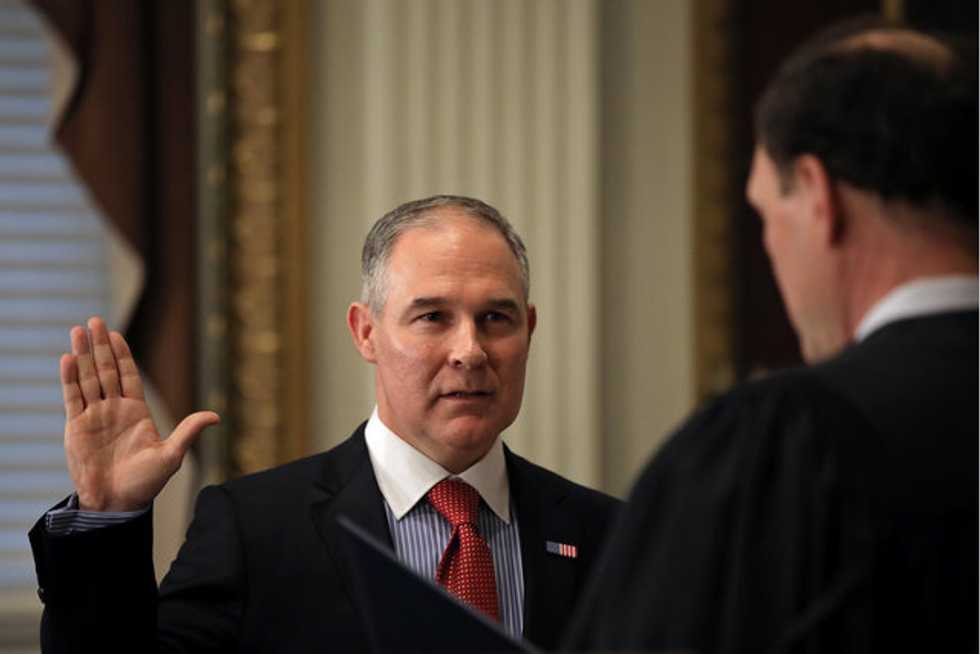
EPA Administrator Scott Pruitt, who was a longtime opponent of the agency, hasn’t explicitly articulated an approach to environmental justice, but his public statements prior to taking the agency’s reins echo those of the Bush administration.
“I agree that it is important that all Americans be treated equally under the law,” he said in written responses to questions raised during his confirmation hearing, “including the environmental laws.”
The language sounds fair on its face, said Huang, of NRDC, but ignores that environmental harm is not experienced equally by all communities.
“They’re saying environmental justice is for everybody, regardless of your race,” he said. “It’s like saying ‘All Lives Matter’ but for environmental justice.”
Communities have already done the work of proving that minorities and the poor bear more environmental costs than others, Miller-Travis said. “Do we have to do that again? Will they accept that data or will we have to go back to ‘everybody is in harm’s way’ which is where they started?”
Early statistics suggest that Trump’s administration may be less stringent on environmental enforcement than his most recent predecessors.
The EPA Office of Enforcement and Compliance Assurance investigates cases of potential environmental crimes cases, then turns them over to the Department of Justice for prosecution.
It’s unclear how many cases the EPA’s enforcement arm referred to the Justice Department, but in the first four months of the Trump administration, 133 environmental cases have been prosecuted. By comparison, 315 cases were prosecuted in the first four months under George W. Bush and 171 in the first four months under Obama.
Trump’s nominee for head of EPA enforcement, Susan Parker Bodine, a former lobbyist and head of the Office of Solid Waste under Bush, offered her support of environmental justice initiatives during her confirmation hearing.
“Yes, I will be a champion for communities of color and communities of poverty,” she said.
But Clark, who’d decide whether to prosecute the cases Bodine investigated, has been less sympathetic. Clark served as Mitt Romney’s energy policy advisor in the 2012 campaign and is a member of the Federalist Society, a conservative legal group.
During a 2010 Federalist Society panel, Clark said the EPA’s environmental justice focus overstepped its boundaries and that locating a facility in a low-income neighborhood isn’t the same as racial or gender discrimination. “That is just not an equation that works,” Clark said. “And I think actually most of the people who live in those areas now would say if there’s a new plant opportunity, bring it on.”
Former DOJ officials and colleagues spoke positively of Clark’s legal abilities and dismissed concerns that his personal beliefs would filter to his work. At his confirmation hearing, Clark wasn’t asked explicitly about environmental justice, but generally defended his ability to be impartial. “When in private practice, if you have a client, your job is to defend them,” Clark said. “I don’t think [my past work will] affect my general ability to enforce federal law.”
Clark declined an interview request from ProPublica, as did Pruitt. Bodine did not respond to an e-mail requesting an interview.
An Uphill Battle
Just as they did under Bush, Democrats under Trump are once again filing bills to try to preserve environmental justice initiatives.
In the House, two bills proposed in May by three freshmen representatives would create an environmental justice czar in the president’s office and establish by law the Office of Environmental Justice at the EPA. The legislation, and a resolution on the importance of environmental justice, is an extension of the work Washington Rep. Pramila Jayapal, California Rep. Nanette Diaz Barragan and Virginia Rep. A. Donald McEachin did before coming to Congress.
“We’re still trying on numerous levels … to bring forward the disproportionate burden communities of color face and the institutionalized racism that exists within our systems of government,” Jayapal said. “It’s not easy to talk about, but it’s true. If we want to address environmental justice, we have to recognize that not all people are suffering equally.”
Twenty-two Democratic senators signed a letter in May asking for the Appropriations Committee to override Trump’s budget and fund EPA’s civil rights and environmental justice offices, saying the cuts are “putting all Americans at risk, and especially those Americans who bear a disproportionate burden of exposures to pollution.”
“These communities have long been suffering under unconscionable conditions,” said Booker, one of the signatories. “We’re not doing enough to stop this evil.”
Booker expects to introduce an environmental justice bill after Labor Day, and while the contours are still murky, the legislation is being guided by conversations with advocates and people dealing with environmental hazards, and by his own visits to hog farms in North Carolina and landfills in Alabama.
Public support for environmental justice efforts has gotten a boost from the Flint water crisis and the Standing Rock protests, which raised awareness. This could encourage more legislators to push back against proposed cuts to the EPA, advocates said.
But depending on how the bill is structured, it could open up settled law and make a target of some existing protections, said environmental justice consultant Miller-Travis.
“I wouldn’t want to give them a chance to look at amending the Clean Air Act,” Miller-Travis said. “I don’t trust these people. … We’re in a defensive posture. We’re trying to defend that which we have. I would be elated to be proven wrong at the end of the day, but it’s going to take every ounce of integrity, resources, muscle … to defend and hold onto the rights we have so painstakingly worked to achieve.”
Republicans have sought to add language or otherwise prohibit funding for environmental justice initiatives in at least 13 bills since 2006. In February, Rep. Sam Johnson, R-Texas, re-introduced his Wasteful EPA Programs Elimination Act, which would cut 13 programs — including the environmental justice office — and close EPA field offices. The goal, Johnson told ProPublica, is to “save taxpayers’ money and reduce the size of a government agency that has grown too big for its britches.” Much of the work of the EPA, including environmental justice, Johnson said, would be better handled by states.
The political climate makes it difficult for proponents of environmental justice to be optimistic.
“Unfortunately, for the last 20 years, we’ve been in a period of trying to find the right political moment when the stars align so that you might be able to get a bill through Congress,” said Miller-Travis. “Is this a moment when I think we can get something passed that expands civil rights and equal protection? I don’t think this is that moment. That doesn’t mean we won’t try.”