Enabling Decades Of Epstein Coverup Was A Sprawling Legal Power Network
One of the unprecedented benefits of the Epstein Files Transparency Act is that the records expose how power actually works – especially among lawyers. A whale like Epstein, a locus of money and influence, attracted elite lawyers no matter how dirty a client he was. The legal circle around him was filled with insiders who began their careers wearing the white hats of federal prosecutors before switching sides to defend immense fortunes and powerful men like Leon Black, Donald Trump, and Epstein himself.
Some of Epstein’s lawyers – Alan Dershowitz, Ken Starr, Jay Lefkowitz, Roy Black – are practically household names now thanks to the infamous Palm Beach plea deal they helped craft, cutting their client loose to traffic a thousand more women and girls before his death.
Others are more private. But their names come up again and again in the Epstein files – not always actively representing him, but also chatting with, socializing with, and hanging around the sex trafficker and his johns. Some dished more passive assists to the cover-up, such as producing exonerating reports or leading Trump administration efforts to tie prominent Democrats to Epstein.
Together, these lawyers possess decades of confidential info on colossal financial (and other) crimes, matters that extend far beyond Jeff. They represent the institutional knowledge of the power networks they have served from well before the 2008 crash, through the second Epstein investigation, and into Trump 2.0’s orgy of corruption. Of course, they are masters of the fine art of the confidential settlement and NDA – the silence-for-money mechanism that the House Oversight Committee has only recently tried to peel back in its Epstein investigation.
Here we take a closer look at four lawyers who matter not just to Epstein, but to the Epstein class: DC-based white collar criminal lawyer Reid Weingarten (2285 mentions in the Epstein files); Brad Karp, former chairman of Paul, Weiss, Rifkind, Wharton & Garrison (1801 mentions in the Epstein files); Dechert LLP partner Andrew Levander, who oversaw the “independent investigation” that exonerated Leon Black; and Manhattan’s current chief federal prosecutor Jay Clayton, who never represented Epstein, but was tasked with the only Epstein-related investigation of Trump’s second term and whose office oversaw most of the Epstein file review for the Department of Justice (Clayton is also Trump’s nominee for Director of National Intelligence).
Brad Karp famously became the first Big Law leader to bend the knee to Trump’s outrageous – and ultimately illegal – threat to bar Democratic-supporting lawyers from federal court buildings. Karp lost his chairmanship of the firm as a result of his exchanges with Epstein, made public in the files.
Their communications are chummy and indeed embarrassing. Among the emails, Epstein calms Karp’s fears about some unspecified public embarrassment and recommends doctors for the attorney’s unnamed maladies.
Karp often strategized with Epstein on how to protect his client, Leon Black. “I genuinely believe that the two of us are the two people on the planet who he most trusts and who he understands try to protect him at all times,” Karp wrote to Epstein in a 2018 email.
The two also discussed whether Black was using cocaine. Epstein wondered if the drug was behind what he called Black’s “aggressiveness” and “high risk taking.” According to Epstein, Black admitted to using it in his younger days, but said he no longer did.
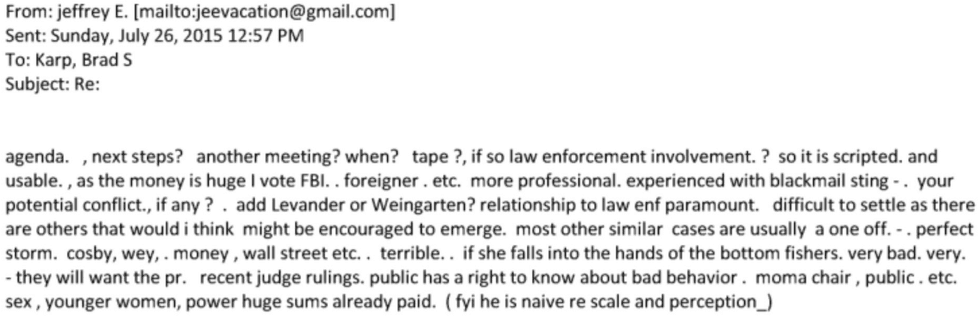
In a 2015 email, while brainstorming with Karp about how Black should handle a woman threatening to go public about their affair, Epstein suggested hiring either his own longtime lawyer and buddy, Reid Weingarten, or another attorney, Andrew Levander, to help.
Reid Weingarten is a former federal anti-corruption prosecutor turned white collar defense lawyer. His clients have included an Enron miscreant, two of Bill Clinton’s Cabinet Secretaries, former Goldman Sachs CEO Lloyd Blankfein post-2008 financial crash, and countless other high profile (accused) corporate fraudsters. He also represented Roman Polanski, who remains wanted in the U.S. for a decades-old charge of having sex with a 13-year-old.
A consummate Washington player, Weingarten has been involved in numerous politically sensitive cases.
In 1992, the Senate Foreign Relations Committee hired him to belatedly investigate the “October surprise” allegations, that Reagan’s henchmen had secretly cut a deal with Iran to delay the release of American hostages until after the 1980 election in exchange for weapons traded through Israel. Weingarten concluded that the prime sources for the story were “wholly unreliable” and that there was nothing to see, when in fact, as author Craig Unger has written, House investigators had already found actual receipts from the Iranian payments.
One of the key players in the nothing-to-see-here report was former federal attorney Stan Pottinger, who was himself investigated for selling arms to Iran, and a man with whom a young Epstein happened to share an office. (The Freakshow has previously uncovered evidence of Epstein’s travels to Israel timed to the Iran–Contra deal.)
Weingarten was not part of Epstein’s Palm Beach defense team, but he appears to have advised him on the wave of post-2008 civil suits brought against him by the victims. The two remained in close contact. Weingarten appears throughout the DOJ Epstein library, including in a photo sitting behind a desk surrounded by young women whose faces have been redacted. For years, Weingarten served as a sounding board for Epstein and was a frequent visitor to the New York mansion for breakfasts, lunches, and dinners. In a 2011 email, Epstein offered the frazzled attorney some signature advice: “time to relax. go get a massage.” Weingarten replied: “I wish.”
Weingarten led the defense team after Epstein’s arrest in 2019 and has indicated he believes Epstein was murdered in jail.
Andrew Levander is a straight-out-of-central-casting Manhattan white-shoe lawyer. Bowtied and bespectacled, he looks like he has an apt quote from Horace for every occasion.
But Levander has long been comfortable operating in darker company. He once served as personal attorney to legendary arms dealer Adnan Khashoggi and his relationship with Epstein was almost longer than Donald Trump’s. Epstein even once recommended Levander to Leon Black as a possible lawyer to handle a mistress who was demanding money.
As a federal prosecutor in the Southern District of New York (SDNY) during the 1980s, Levander reportedly enlisted the ambitious Coney Island thug morphing into Jeff Bondstein to help track down money related to the collapse of Drysdale Securities, according to James Patterson’s Filthy Rich. This early Epstein adventure – as a government tool of sorts – deserves further attention, which we will someday give it. It also occurred around the same time he was working for British arms kingpin Douglas Leese.
Years later, Levander was just the man for the job to produce the so-called Dechert Report, the findings of an “independent investigation” commissioned by Apollo’s Board in 2020 that ultimately exonerated Leon Black in the Epstein matter. After interviewing Black and twenty people and reviewing some financial records, Levander concluded that Black neither knew about nor participated in Epstein’s crimes against women.
Apollo and Black have leaned heavily on that report ever since – including before the Oversight Committee last week, shortly before Black walked out of the hearing.
Here are some of the risible and easily disproven statements in the Dechert Report:
Black stated that he was repulsed by the details of Epstein’s crimes … witnesses agreed that Black was shocked when the allegations became public … witnesses noted specifically that they did not believe Black would have allowed Epstein to be introduced to Black’s wife and children if Black had had any suspicion that Epstein had done anything inappropriate or illegal with girls or young women.
Dechert has seen no evidence that Black or any employee of the Family Office or Apollo was involved in any way with Epstein’s criminal activities at any time. There is no evidence that Epstein ever introduced Black, or offered to introduce Black, to any underage woman.
[See last week’s Freakshow on Black’s payments to recruiters here.]
Black viewed Epstein as a confirmed bachelor with eclectic tastes, who often employed attractive women. However, Black did not believe that any of the women in Epstein’s employ were underage. Black has no recollection of ever seeing Epstein with an underage woman at any time.
[The use of the word “underage” here hedges the fact that Epstein provided Black with a so-far unknown number of women, alluded to in this November 2016 email below.]
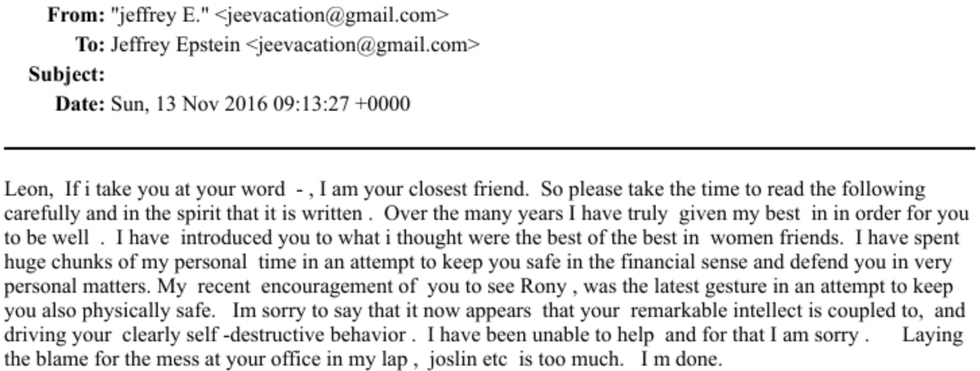
The word “underage” does a lot of heavy lifting for Epstein’s pals, like Black. The DOJ files are rife with evidence that Epstein introduced Black to numerous young women whose exact ages remain unknown, but who often seem to have been in their early 20s. As we’ve discussed before, the “pedo” designation for Epstein and his johns was useful for ginning up the baby-eating liberals MAGA conspiracy theories that juiced Trump’s campaigns, but it also obscures the harm done to an untold number of vulnerable young women. And it has also allowed the men Epstein was supplying with trafficked young women to skate or at least buy time.
Finally, we come to Jay Clayton.
Clayton worked for the venerable Manhattan law firm Sullivan & Cromwell until 2017, specializing in mergers and capital market offerings. During the 2008 financial crisis, he was one of the lead attorneys advising Bear Stearns and handled JPMorgan’s acquisition of the collapsing investment bank.
Clayton, a reliable friend to Wall Street and corporate America, easily sailed through his years as Trump’s first term SEC chief. “Over time, Clayton pushed through more than two dozen measures that eased regulations for corporate America,” Reuters reported.
Then, suddenly, in the fraught summer of 2020, in the midst of COVID and mere months before the presidential election, something curious happened. Just as New York federal prosecutors were preparing to take a second bite out of the rotten Epstein apple by indicting still-at-large Ghislaine Maxwell, Trump’s Attorney General Bill Barr tried to sack Geoffrey Berman, the U.S. Attorney for SDNY, and replace him with Jay Clayton.
The excuse for this odd shuffle? Barr claimed Clayton really wanted to live in New York, even as COVID was still circulating and most sentient beings with money were parked outside the city.
The timing of the switch, however, is almost comically precise as it relates to the Maxwell indictment. Between June 11-18, 2020, a draft of an indictment circulated inside the SDNY office. On June 19, AG Barr told Berman he wanted to replace him with Clayton, but Berman refused to step down. Barr then informed him that Trump would be sacking him and Berman resigned on June 20.
Democrats immediately cried foul, albeit without identifying the reason for the scheme.“Jay Clayton can allow himself to be used in the brazen Trump-Barr scheme to interfere in investigations by the U.S. Attorney for SDNY, or he can stand up to this corruption, withdraw his name from consideration, and save his own reputation from overnight ruin,” Sen. Chuck Schumer said on Twitter.
Clayton stayed in Washington. SDNY Deputy U.S. Attorney Audrey Strauss replaced Berman, and became the public face of the Maxwell case. A few days after she announced the indictment, the FBI apprehended Maxwell in her coastal mansion hideout in Maine, where she’d wrapped her phone in tinfoil in an effort to evade surveillance.
Jay Clayton remained at the SEC until the end of Trump’s first term. Soon after Biden entered the White House, Leon Black’s company hired him. A few days after Biden was inaugurated, Apollo released Andrew Levander’s “independent investigation,” which concluded that Black had no knowledge of Epstein’s crimes. Nevertheless, the now publicly known gargantuan sum he paid to Epstein for “tax and estate planning” was hurting the firm’s reputation.
In February 2021, Apollo named Jay Clayton its “lead independent director.” One month later, Black announced he would step aside as chairman and that Jay Clayton would become the “non-Executive Chairman of the Board.”
Clayton sat out the Biden years at Apollo.
Then Trump returned.
Within months of taking office, Trump appointed Clayton – Leon Black’s handpicked “non-executive” and a man who’d spent four years in the HQ of a major Epstein cover-up – as U.S. Attorney for the Southern District of New York. He took office just as Trump administration elves were poking through the SDNY’s Epstein files and finding – whoops! – Trump’s name often enough to raise panic in the White House. Clayton held onto millions of dollars in Apollo stock while overseeing the final review and redaction of the DOJ files before they were released to the public.
As Congress began digging into the case, Rep. Ro Khanna observed that the first name survivors often mention is Leon Black.
The Epstein cover-up legal revolving door has come full circle.
Nina Burleigh is a journalist, author, documentary producer, and adjunct professor at New York University's Arthur L. Carter Journalism Institute. She has written eight books including her recently published novel, Zero Visibility Possible.
Katie Chenoweth is associate professor of French at Princeton University and an investigative researcher
Reprinted with permission from American Freakshow