As Trump Dismantles NATO And Abandons Ukraine, Putin Couldn't Be Happier
A lot of people finally have begun to notice that Donald Trump, much to the pleasure of Vladimir Putin, is not terribly supportive of NATO.
In fact, also to Putin’s extreme pleasure, he kind of wants to destroy it.
In other words, Trump is finally coming out of the closet—more or less— as a Russian asset. How else to explain why he is granting sanctions relief to Russia? Why he’s agreeing to buy billions of dollars in diesel fuel. And why, in doing so, he’s decided to subsidize the Kremlin’s brutal war against Ukraine.
If Trump’s affinity to Putin, and his distaste for NATO surprise you, then you—like so much of the American media— haven’t been paying attention. Enthusiastic support of NATO is one of the very few issues that has enjoyed true bipartisan support for nigh on eighty years. Yet for more than four decades Trump has argued the same thing: America’s allies are freeloaders, the Western alliance is a bad deal, and Moscow is someone to bargain with rather than contain.
Trump is dismantling the foundation of American power — and fulfilling Putin’s greatest dream
Now that he is well into his second term in office, Trump has really and truly begun to do something about it. He has begun to dismantle the entire world order that is the foundation of American power since the end of World War II, and, in so doing, he has begun to fulfill Vladimir Putin’s greatest dream.
It’s worth pointing out that Russian money started flowing into Trump’s coffers decades before he developed his Russia-friendly policies. Indeed, as I have reported in my Trump Russia Timeline, in 1984, David Bogatin, an émigré tied to the Russian Mafia, met with Trump at 721 Fifth Avenue—aka Trump Tower— and plunked down $6 million(nearly $20 million in today’s dollars) to buy five condos in a deal that, according to the New York State attorney general’s office, laundered money for the Russian Mafia.
In the four decades since then, Trump has repeatedly made the same argument: that America’s allies are freeloaders, that our alliances with Japan and Europe are bad deals, and that we should regard Moscow as someone to bargain with rather than contain. In a 1990 interview in Playboy Magazine, for the first time, Trump explicitly equated allies and adversaries as equally untrustworthy, and framed tariffs on both European and Japanese goods as the cure:
We Americans are laughed at around the world for losing a hundred and fifty billion dollars year after year, for defending wealthy nations for nothing, nations that would be wiped off the face of the earth in about fifteen minutes if it weren’t for us. Our “allies” are making billions screwing us.
Ten years later, in The America We Deserve, co-written by Trump and Dave Shiflett, he said, “Pulling back from Europe would save this country millions of dollars annually. The cost of stationing NATO troops in Europe is enormous, and these are clearly funds that can be put to better use. Our allies don’t seem to appreciate our presence anyway.”
Ghostwriter Shiflett later characterized the book as a “work of fiction,” but recent events have shown, alas, that Trump seems to have really meant what he said.
In the 1990’s and 2000’s, Russian mobsters replicated David Bogatin’s practice of buying high-end real estate from Trump as an ideal vehicle through which it laundered money from criminal enterprises. In large measure, it was thanks to the influx of Russian money that Trump, who filed for six corporate bankruptcies, managed to sustain a reputation as a successful businessman.
In the 2000’s, the Bayrock Group, managed by Felix Sater, a twice-convicted felon with ties to the Russian Mafia, helped transform Trump into the Colonel Sanders of luxury high-rises by franchising the Trump brand and erecting Trump Towers in SoHo, Toronto, and all over the world.
Bayrock’s former finance director, Jody Kriss, portrayed the Trump SoHo as a “monument to spectacularly corrupt money-laundering and tax evasion.” Documents and emails unearthed in related litigation indicated that the project served as a vehicle for laundering illicit funds. (Bayrock settled the lawsuit out-of-court in 2018. Terms of the settlement were not revealed.)
When Trump began running for the presidency 2016, he retained his antipathy towards NATO—even though it has enjoyed extraordinary bipartisan support since its birth immediately after World War II. During the 2016 campaign, Trump asked the Washington Post editorial board why the US should carry NATO’s costs and the defense of Ukraine. Later that month, he called NATO “obsolete” and said America’s allies were not paying their fair share.
Similar sentiments prevailed during the Republican National Convention that year, when Trump’s campaign aides famously watered down a plank calling for lethal arms shipments to Ukraine. Similarly, that same month, in an interview with the New York Times, Trump said that if the Baltic states were attacked by Russia— a threat that is all too real now— he would check first to see if they had fulfilled their financial obligations to the US before agreeing to defend them.
And so it went. Before his first inauguration, in January 2017, in interviews with the Times of London and Bild, Trump repeated the line about NATO being obsolete. Not long afterwards, in a May 25 speech at NATO headquarters in Brussels, he deleted a planned line reaffirming Article Five. A year later, he justified stiff tariffs on Canada, Mexico and the EU on national security grounds. In early June 2018, he urged readmitting Russia to the G7.
At the NATO summit in July, he threatened to leave NATO and go it alone if spending didn’t rise. On July 16, at Helsinki, Trump famously accepted Putin’s denial of interference in the US elections—accepting the assertions of the Russian president—a former KGB officer, mind you—over the findings of America’s own intelligence services. In January 2019, the New York Times cited senior officials saying that Trump had threatened to withdraw from NATO on multiple occasions.
As for his second term, Trump’s two-pronged strategy—ripping apart NATO while he wooed Vladimir Putin— began even before he was inaugurated. On January 7, two weeks before he was sworn in, Trump called Canada “the 51st state,” and refused to rule out the use of military or economic force to take over Greenland, an autonomous territory within the Kingdom of Denmark that, like Canada is a NATO member. (There is no mechanism in NATO to deal with one member that threatens another.)
In early February, Trump announced punishing tariffs on Canada and Mexico. Then, on February 24, 2025, just five weeks into his second term, Trump made it crystal clear what side he was on. On the the third anniversary of Russia’s invasion of Ukraine, the US voted with Russia and North Korea against a resolution condemning the invasion. Russia and North Korea were our allies. Ukraine and Europe were not. It was official.
Four days later, in the Oval Office, with Vice-President Vance at his side, Trump publicly berated Zelensky: “You don’t have the cards!”
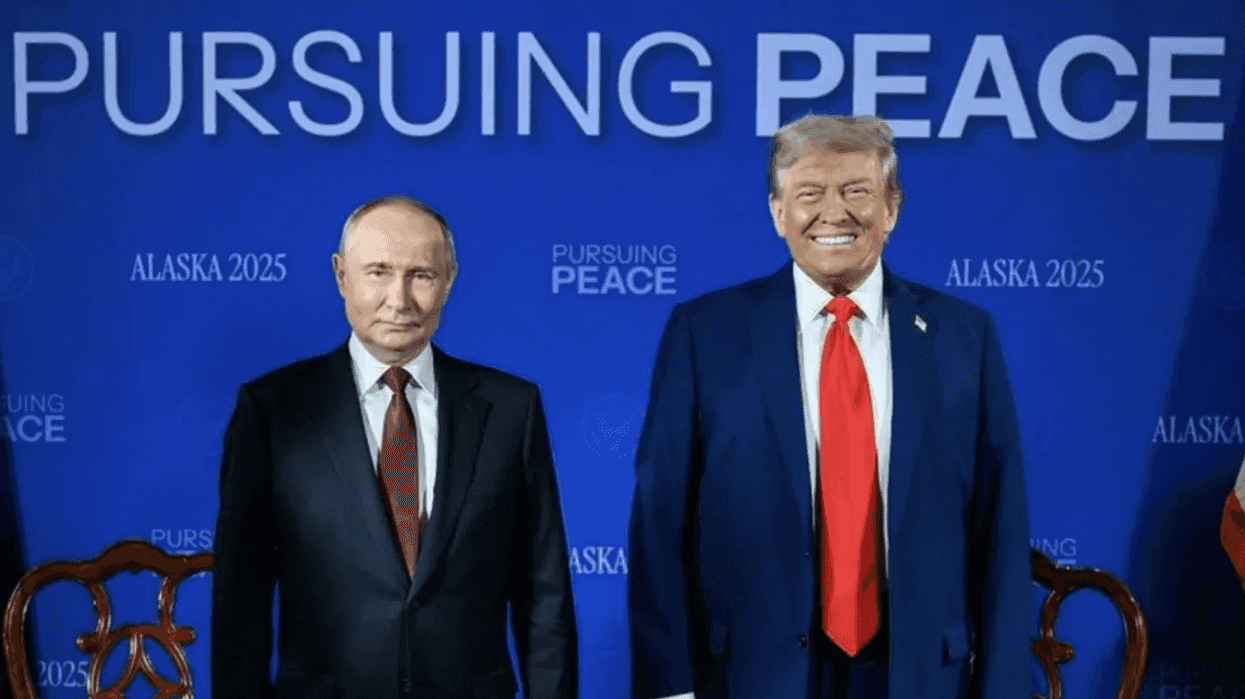
If it seemed like Trump was tormenting America’s longtime allies over the next few months while he cozied up to Putin, that’s because he was. He blitzed Canada and NATO allies with a chaotic series of on-again-off-again tariffs. Then, in the fall, after Trump greeted Vladimir Putin with a red carpet reception in Alaska, special envoy Steve Witkoff, a billionaire real estate developer with no experience in diplomacy, came up with a 28-point peace plan that essentially capitulated to Putin’s desire to eliminate Ukraine’s sovereignty. Dismissing the proposal as “blatant corruption,” Garry Kasparov, the chairman of the Renew Democracy Initiative, told TVP, the Polish broadcast network, that the plan sought to place U.S. hands on frozen Russian assets earmarked for Ukraine’s reconstruction. “It’s a business deal… nothing to do with peace,” he said.
He added, “Putin cannot continue this war indefinitely if the free world is united behind Ukraine.”
But the “free world,” or at least the President of the United States, was NOT behind Ukraine. Thanks to Trump, the US had become an unreliable partner in NATO, and the November 2025 National Security Strategy, released December 4, made that crystal clear. Without mentioning NATO by name, the White House’s official strategy document asserted that “Our elites badly miscalculated America’s willingness to shoulder forever global burdens to which the American people saw no connection to the national interest.”
It was official: Russia and North Korea were our new allies, Ukraine and Europe were not
The White House effectively dismissed NATO as one of those burdens. But in fact, the alliance supports the world’s largest trade and investment relationships, which are worth roughly $8 trillion and support millions of U.S. jobs. Its collective defense has deterred adversaries from launching a great power war for more than 75 years. The alliance also gives the US enormous advantages in intelligence sharing. It provides international legitimacy for sanctions on Russia or pressure on China—neither of which have comparable alliances. And, finally, it projects American power into the Middle East, Africa and the Arctic.
All of which is particularly relevant because in recent weeks both Vladimir Putin and Donald Trump appear to be facing existential crises. In Putin’s case, it’s because his three or four day “special military operation” is now well into its fifth year and has caused more than one and a half million Russian casualties. In other words, Russia is losing it war with Ukraine, and if Putin’s imperial ambitions go up in flames—well, so does Putin.
As for Trump, his Republican Party is facing a wipeout in the November 3 midterms and, if that comes to pass, Trump will have to face the rest of his terms handcuffed by an adversarial Congress that will likely spend its time investigating one malfeasance after another.
And so, 42 years after David Bogatin walked into Trump Tower, the Kremlin continues to collect on the $6 million Bogatin plunked down for Trump real estate. The only question left is whether Russia can cash out before American voters close the account.
Craig Unger has served as the deputy editor of The New York Observer, editor-in-chief of Boston Magazine, and a frequent contributor to The New Republic and Vanity Fair. His most recent book is American Kompromat: How the KGB Cultivated Donald Trump, and Related Tales of Sex, Greed, Power, and Treachery. Please consider subscribing to his Substack, from which this is reprinted with permission.