Those "people" have come to include most of the National Basketball Association and hundreds of other athletes in professional baseball, hockey, football, women's basketball, and the top tiers of college sports. As for that "more" they have become? They are now active participants in the most significant and inclusive wave of the often crushed or coopted yet ever breathing "athletic revolution" that first took shape in the 1960s.
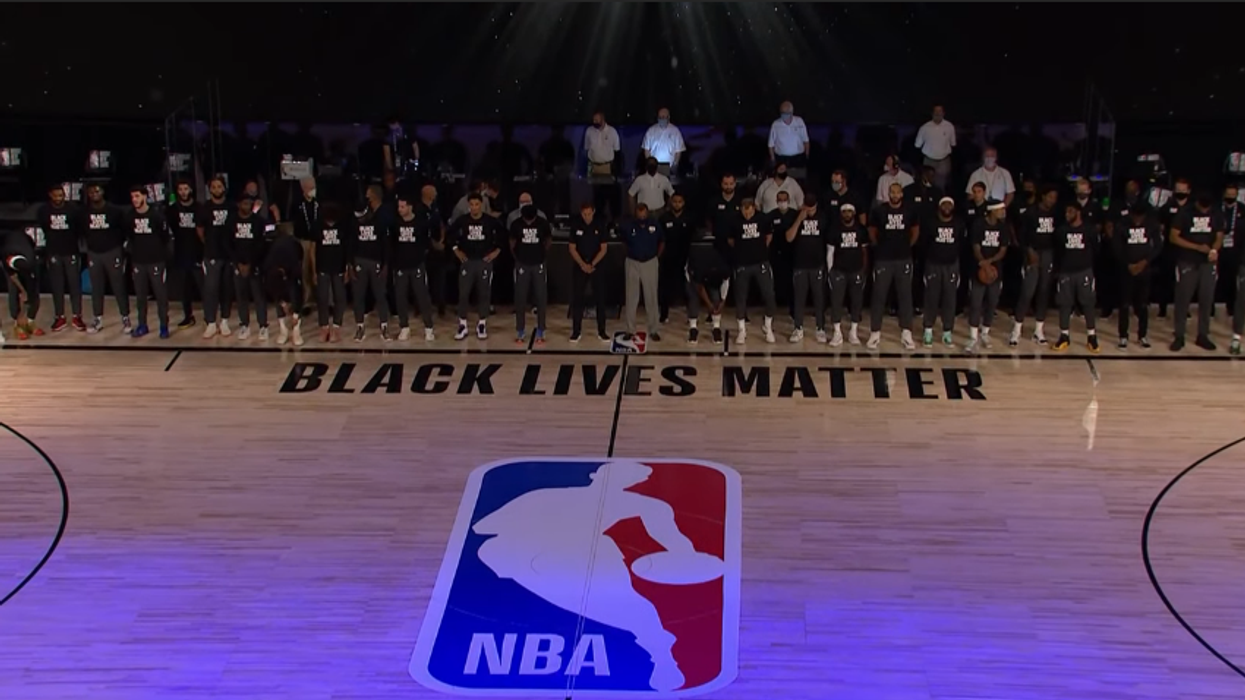
Thanks to the pandemically isolated "bubbles" in which some teams are now living and playing, and driven by Donald Trump's continuing racially based attacks on various sports, some athletes are now communing with each other ever more regularly and making collective decisions as never before -- decisions often supported by their teams and even leagues. In the process, many of their protests against systemic racism and specific acts of police brutality have gone from messages at their usual social media outlets to acts like forcing games to be postponed via wildcat strikes.
As baseball and basketball, battered by the Covid-19 pandemic, cautiously continue their delayed and shortened seasons and the National Football League and some college football conferences finally launch their own belated starts, more and more questions arise: Will such physically dangerous playing conditions be sustainable? (Is there even such a thing as a socially distanced tackle?) Will fans accept rule changes meant to take the coronavirus into account and still keep watching (while their own lives threaten to go down the tubes)? Will former San Francisco 49er Super Bowl quarterback Colin Kaepernick, who sparked the current sports revolt by kneeling to the national anthem four years ago and was subsequently abused by the president and functionally banished from football, ever get to play again? And above all, what effect will the various protests of such athletes have, if any, on the election?
The Women Led the Way
However it plays out, the most recent victory of National Basketball League players striking during their playoffs over yet another grim death of a black man at the hands of the police was spectacular. The team owners agreed that, in the Covid-19 moment with polling places potentially in short supply on November 3rd, pro basketball arenas would be made available as just such sites. Consider this path breaking: it's the first time a player-owner bargaining agreement has included such a gift to democracy from two of the (previously) most self-centered groups in America.
Before we cry "Bravo!" however, let's cry "Brava!" After all, it was the most marginalized of the professional leagues, the Women's National Basketball Association (WNBA), that provided the impetus for the current movement and remains its moral center. Keep in mind that, for years now, women pro basketball players have been protesting against gun violence and police brutality, both individually and as teams, while their male equivalents, who earn so much more money and possess so much more security, tended to posture and pontificate while putting themselves at much less risk.
Last month, the women upped their game. The WNBA's Atlanta Dream players donned T-shirts endorsing Dr. Raphael Warnock, the Democratic opponent of Georgia Republican Senator Kelly Loeffler, who has disparaged Black Lives Matter and, as the New York Times reported, "publicly and frequently derided the league for dedicating its season to the Black Lives Matter movement." Loeffler just happens to be the Dream's co-owner. Other teams in the league followed suit and soon most teams were wearing such "Vote Warnock" T-shirts, while also proclaiming that Black Lives Matter. (BLM, by the way, was a group founded by women.)
Soon after, something stunning happened in the male version of pro basketball with the NBA in the first round of its playoff games in a "bubble" at Florida's Disney World. After a white police officer shot an unarmed black man, Jacob Blake, in the back seven times in Kenosha, Wisconsin, the Milwaukee Bucks refused to take part in their next playoff game. And that protest then produced a cascade of brief strikes by other NBA and WNBA teams and, most surprisingly, by predominantly white Major League Baseball teams.
While the statements of the protesters tended to describe the strikes as a response to recent incidents of police brutality, the underlying cause may have lain elsewhere. Those angry strikes may really have been side effects of the Covid-19 "bubbles" in which they were playing. In them, the usual focus on the game of the moment and the party to follow was replaced by conversations about Donald Trump, racism, and the responsibilities of rich Black sports celebrities to express themselves and act in the interests of their communities.
The New Yorker's Isaac Chotiner conducted a revealing interview with Andre Iguodala, a Miami Heat forward and the first vice-president of the NBA players' union, who said:
"African-Americans are trying to search for ourselves and ask where we stand in the world and where we stand in America. And we don't know. We shoulder a lot of the burdens of our community, but I think a lot of that responsibility should fall on the majority, and those who are the lawmakers and who are supposed to insure that every man and woman is treated as an equal. But we still haven't seen that. So we are still searching for our place."
Take the Money or March?
One of the most poignant expressions of that search came from the coach of the Los Angeles Clippers, Doc Rivers, whose father had been a police officer. "It's amazing," he commented, "why we keep loving this country, and this country does not love us back. It's really so sad... I'm so often reminded of my color... We got to do better. But we got to demand better."
What exactly does "demand better" mean and what could it achieve? In the sports world, at least, with the possible exception of those still-must-be-seen-to-be-believed arena voting sites, the sporadic protests of various players over the years for equality and social justice have usually resulted, at best, in yet more discussion about the issues they were raising rather than actual solutions, however provisional. Although over the decades, the integration of baseball, the introduction of free agency, and the emergence of the Black quarterback could all certainly be viewed as progress in the sports world itself.
Today, however, it remains a question whether players will continue pushing for social reform or, as so often in the past, settle for better salaries and pensions. As Iguodala put it:
"Historically, money determines a lot of our actions. Do we stand up for something or take the money? We will always get caught in those crosshairs. But I think players are smartening up, and I think that will come into play with a lot of guys."
Similar optimism has been expressed recently by a number of sporting icons including Hall of Fame basketball player Kareem Abdul Jabbar who began his career with the Milwaukee Bucks. He found hope in "the instantaneous support of other sports teams and athletes," especially ones from Major League Soccer (only 26 percent black), Major League Baseball (8 percent), and overwhelmingly white pro tennis.
Times, Jabbar believes, may indeed be changing. After all, he remembers that "when I boycotted the 1968 Olympics because of the gross racial inequities, I was met with a vicious backlash criticizing my lack of gratitude for being invited into the air-conditioned Big House where I could comfortably watch my community swelter and suffer."
Another long-time sports activist, retired sociology professor Harry Edwards who was instrumental in inspiring the memorable Black power salute given from the medal stand at the 1968 Mexico Olympics by American track stars Tommie Smith and John Carlos, is similarly hopeful. An adviser to Kaepernick, Edwards sees an opening for genuine change in this moment because, he says, it's no longer just about the acts of individual sports figures. This wave of protest, he adds, "is distinctively different from the single athletes who were involved. These are entire teams that are reacting to this situation and leveraging their power to demand change. It's not just a Colin Kaepernick or Eric Reid or Michael Bennett or Maya Moore. This one is about an entire organization and I could see this coming from the time the University of Missouri football team protested."
That was back in 2015 when that football team joined a campus-wide demand for the resignation of the university's president for mishandling racial incidents at the school. (He did finally resign.) Such a full-scale involvement of a college sports team in a protest movement was unheard of at the time. It would take another five years and so many more racial nightmares before that spirit of unity with a larger protesting culture in this Black Lives Matter era, not to mention the willingness of athletes to risk their own brief careers, would bloom throughout sports.
"Spoiled Rotten Millionaires"
The current reaction of the Trump administration and its allies to such protests has underlined the threat that they clearly feel from wildcat strikes, bent knees, and other actions disrupting their notions of "normality" in an unnerved and unnerving world. The president, in particular, has been counting on the return of pro sports and college football to help project an image of him being in control in this ongoing pandemic.
Weighing in from the White House, President Trump's son-in-law and senior advisor Jared Kushner typically dismissed the recent set of basketball wildcat strikes by saying, "Look, I think that the NBA players are very fortunate that they have the financial position where they're able to take a night off from work without having to have the consequences to themselves financially."
That snide attempt to separate the athletes from their fan base, itself stricken by a weakening economy, the still-spreading coronavirus, and a mounting sense of political anxiety, soon blossomed into something more like a political campaign theme. At the right-wing website Newsmax, for instance, conservative radio host Chris Salcedo attacked "the spoiled rotten millionaires." He then added: "Pro sports is no longer about unifying us but about shoving left-wing politics down our throat and up our nearest orifice. They push social justice, which is the absence of justice."
For all the right-wing outrage over the basketball protests, football is now the true American national pastime and carries the most weight with Trump and gang. Several months ago, I speculated that, "if the National Football League plays regular season games this fall, President Trump stands a good chance of winning reelection for returning America to business as usual -- or, at least, to his twisted version of the same."
Despite the fact that most NFL owners have been Trump donors, the league, which did away with pre-season games, has been bending leftward to avoid a NBA-style set of strikes that could cripple the season just as it's starting. Last month, League Commissioner Roger Goodell professed regret for not paying more attention to Colin Kaepernick's message when he took those knees. Topping that, earlier this month, Goodell announced that "End Racism" and "It Takes All of Us" signs will be stenciled in the end zones of all stadiums this season and the so-called Black national anthem, "Lift Every Voice and Sing," will be sung before each opening game. Political slogans will even be allowed on helmets.
In certain ways, when it comes to the Trump voter in particular, the return of college football -- a major multibillion-dollar business that pays most of its "employees" nothing whatsoever -- with its own cult-like regional passions is of particular importance. While college football fans tend to lean right and insist on their entertainment, no matter who has to die for it, college players have used the health risks of Covid-19 to ramp up their demands for more control over their lives and a share of the revenue that their schools collect from the sale of jerseys with their names on them.
After two of the five major conferences, the West Coast's Pac-12 and the Midwestern-based Big 10, worrying about the toll that the pandemic might take, called off their fall seasons, the Trump campaign declared: "The Radical Left is trying to CANCEL college football." The electoral implications were obvious: five key swing states -- Pennsylvania, Michigan, Wisconsin, Ohio and Minnesota -- have Big Ten teams and calling off the season in this fashion does, of course, send a message to future voters about the state of Trumpian America.
In reality, the urge to protest playing football in the midst of a pandemic was spreading (and not just among the usual suspects). Buzz Bissinger, the author of Friday Night Lights, a famed book on high school football in Texas, for instance, called on players in the remaining leagues to boycott their games:
"[M]any of the states advocating to play are the same states that find wearing protective masks optional, college football a sacred American right. Football is not like other sports. It is blood, snot, sweat and spit, bodily meals the virus craves. How can these schools even be contemplating the risk when several medical advisers to the N.C.A.A. said it was ill advised? Some coaches have suggested that football players alone should return to campus, which provides additional evidence that they are viewed more like employees than traditional students and should be compensated."
Such evidence has, of course, been in plain sight for years, but maybe it takes a plague to see it clearly. College administrators may be no better than Trumpsters in their willingness to sacrifice lives for money and power. They certainly do fit comfortably with the sort of sentiments Donald Trump, Jr., expressed on Chris Salcedo's show: "I can't tell if some of this stuff is politically motivated because not going back to normalcy allows you to instill some fear that can be used as political leverage. Let them play, man."
In other words, the position of the Trump administration as it makes a Covid-19-ignoring scoring drive for November 3rd is distinctly shut up and dribble. However, the question, in this moment from hell, is: Will the players and fans agree?
Who will take the next knee?
Robert Lipsyte, a TomDispatch regular, was a sports and city columnist for the New York Times. He is the author, among other works, of SportsWorld: An American Dreamland.
Copyright 2020 Robert Lipsyte