he MAGA plot to subvert the 2026 midterm elections is coming into focus. Election denial bigwig Steve Bannon has outlined a scheme in which President Donald Trump — aided by right-wing journalist John Solomon at the White House and Bill Pulte as acting director of national intelligence — would declassify and release documents purporting to show significant foreign interference in past U.S. elections. The president would then use that theory as the “predicate” to declare a “national emergency” and try to seize control of the elections apparatus to curtail voting rights in November.
The foundational lie of this scheme — and of election denial writ large — is that Trump is such a popular figure that only massive election fraud could explain the defeat of his movement at the polls. And the right’s propaganda apparatus is essential in buttressing that lie by ignoring or explaining away all evidence to the contrary. Outlets like Fox News don’t just celebrate the president as an heroic, visionary figure — they tell viewers that the polls are wrong and “The MAGA Momentum Is Unstoppable.”
Here's how this scheme has worked in the past, and a glimpse into how Trump and his propagandists are kicking into gear again this cycle.
Poll trutherism is the foundation of election denial
Trump is an historically unpopular president. Polls over the decade since he entered the political spotlight have consistently found that he is broadly disliked, and his job approval is currently tracking near its all-time lows, according to poll aggregations from The New York Times, Nate Silver’s Silver Bulletin, and the conservative RealClearPolitics. The most recent results from pro-Trump Fox News are in line with those averages, showing 39 percent of respondents approve of the job Trump is doing while 60 percent disapprove, with his performance underwater by large margins on issues from the economy to immigration.
The president has responded to these dire numbers not by trying to appeal to a broader swath of the country but by declaring that he is actually popular and that news outlets have fabricated these results to damage his political standing.
“Fake polls — I got one today,” the president told reporters in February. “I saw one today that I'm at 40 percent. I'm not at 40 percent. I'm at much higher than that. I'd love to run against anybody. The real polls say ‘you'd kill everybody, it wouldn't even be close.’”
In late June, he likewise argued that other, unnamed surveys show his “REAL POLL NUMBERS ARE THE HIGHEST THEY HAVE EVER BEEN,” with his job approval at “at 65 percent, and more!”
As with so many of Trump’s actions, this is simultaneously laughable and menacing. It is ridiculous on its face that the president of the United States is so unwilling to accept that the majority of the public don’t like him that he’s instead concocted a vast conspiracy theory implicating the bulk of the nation’s pollsters and media outlets while apparently inventing “REAL POLL NUMBERS” that show he is beloved.
But Trump inevitably carries that absurd argument to its logical conclusion: When election results correspond with the public polls and Trump loses, he decries those elections as “rigged.” He famously attributed both his popular vote defeat in 2016 and his popular and electoral vote losses in 2020 to election fraud, and baselessly warned in the leadup to the 2024 election that only rigging could explain it if he lost again (this time he won both the popular and electoral votes despite his low favorability).
He’s also extended that argument to elections for other allied candidates. If you accept the polls, Trump’s actual unpopularity is “putting the Republican Party at risk of a severe rebuke from voters in just six months’ time in the 2026 midterm elections,” as CNN noted in May. But Trump’s lie turns that reasoning on its head — if his “REAL” numbers are so good that the GOP should really be romping in their elections and only massive election fraud could explain Democratic victories.
Last month, for example, Trump baselessly claimed that “cheating dogs” who administer elections in California had stolen the Los Angeles mayoral race from former reality TV personality and conservative candidate Spencer Pratt. He added that “they” had only “approved” Republican gubernatorial candidate Steve Hilton to make the run-off because “I started hitting them” with baseless fraud allegations. (Pratt’s share of the vote was on track with polling of the race and just under the vote share Trump himself received in LA in 2024, while Hilton and fellow Republican gubernatorial candidate Chad Bianco combined to run three points under Trump’s statewide total that year — but the president has claimed that loss was also the result of fraud.)
He has also urged Republicans to pass legislation to curtail voting rights, arguing that failure to do so will result in midterm defeats. “We can only lose the midterms if we allow ourselves to lose the midterms, if we are foolish, stupid and unwise,” Trump said Friday. “But if we terminate the filibuster as we should do and immediately vote for the SAVE America Act, then we will not lose an election for 100 years.”
MAGA media are hiding Trump’s unpopularity from their audience
The right-wing propaganda machine plays a key role in this farce.
Republicans spent decades tearing down the press and urging their supporters to get their information only from ideological allies. That opened up the party base to Trumpian lies, like his claims about news outlets producing fake polls.
MAGA media could try to keep their audiences grounded in reality, leveling with them about Trump’s unpopularity and pushing the party to change course. But in the lead-up to both the 2020 and 2024 elections, they portrayed Trump as the odds-on favorite and suggested a defeat could only result from fraud. And since Trump returned to office, the right-wing commentariat has largely toed the president’s line and hidden worrying signs about his faltering support.
The strategy is particularly obvious — and noxious — on Fox. The network’s hosts and commentators are aware that Trump is deeply unpopular, as it employs pollsters whose own surveys show it. But they are concealing that knowledge from viewers — a group that often includes the Fox-obsessed president himself — rather than leveling with them.
Fox hosts hide the network’s brutal polls while touting Trump as “the ultimate dealmaker” ushering in a “golden age” that makes the United States “the envy of the world” — and that “America, just like McDonald’s, we’re loving it.”
Its pundits swoon over how his “support among his base, among Republicans, is as strong as any president we've seen in modern history” and assure viewers that “the polling that you're seeing come in on Trump is incorrect.”
They point to outdated polls that suggest Trump’s actions are popular over their own survey data when it says otherwise.
After the crowd at Madison Square Garden loudly jeered the president when he appeared on the Jumbotron at Game 3 of the NBA Finals between the hometown New York Knicks and the San Antonio Spurs, Fox & Friends claimed his reception was actually “mixed.”
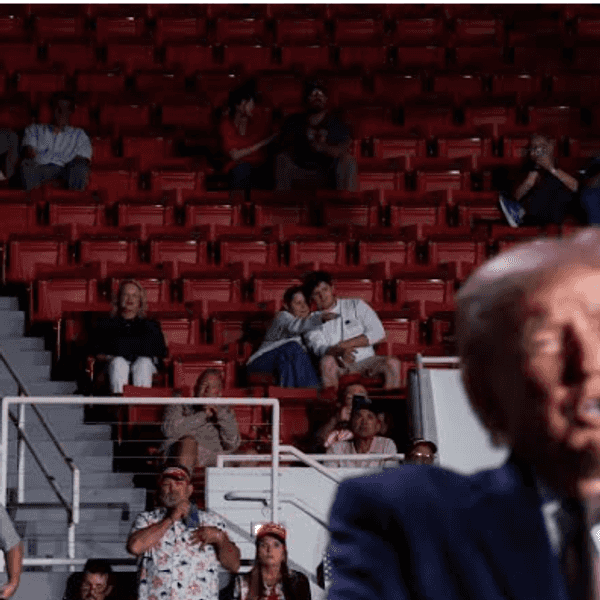
And when dismal turnout marred Trump’s efforts to make the celebration of the 250th anniversary of the signing of the Declaration of Independence all about himself, they pretended otherwise.
Those efforts have not fully assuaged the president — he has publicly urged Fox to fire its pollsters and even threatened to have them criminally investigated on the grounds that their negative results purportedly constitute “ELECTION FRAUD.”
But by downplaying the evidence of the president’s unpopularity, the network is nonetheless priming its viewers to believe him if Republicans are defeated in the midterms and he responds by crying “fraud.” And with election deniers consolidating power across the administration and laying the groundwork for a future attempt to subvert the vote, the stakes couldn’t be higher.
Reprinted with permission from Media Matters
- Did Trump Just Reveal His Plans To Steal The 2026 Midterm Elections? ›
- 'Wipeout': Republicans Terrified 2026 Blue Wave Will Flip Senate And House ›
- If You Love Democracy, Prepare Now To Defend Free Elections In 2026 ›
- How Trump Uses A 'Chum Cycle' To Promote Conspiracies And Attack Democracy - National Memo ›
- Primetime Speech: Trump Fabricates Chinese Plot To Rig 2020 Election - National Memo ›
- CNN Poll: Trump Approval Sinks To Lowest Level Since January 6 Insurrection - National Memo ›
- Election Deniers -- Led By Tina Peters -- Pitch A Midterm 'Security Plan' To White House - National Memo ›
- Pause From Doomscrolling -- And Be Hopeful As MAGA And Trump Swirl The Toilet - National Memo ›
- How Trump Is Demolishing Election Security -- And Preparing To Hijack The Midterms - National Memo ›
- Danziger Draws - National Memo ›
- Why Democrats Are Loving (And Laughing At) Trump's Very Bad Midterm Ads - National Memo ›
- Fox News Presents GOP Midterm Convention As A Very Special Episode Of 'Hannity' - National Memo ›
- Trump’s Election Subversion Plans? | Washington Monthly ›
- Democrats concerned Trump will interfere with 2026 midterm elections - WHYY ›
- Democrats are campaigning as if the 2026 election will be fair. That’s a mistake | Austin Sarat | The Guardian ›
- A Stark Warning About the 2026 Election, with Robert Kagan | The New Yorker ›
- What election officials are worried about ahead of the 2026 elections - Votebeat ›