Tag: ukraine
Putin and Trump in Alaska

As Trump Dismantles NATO And Abandons Ukraine, Putin Couldn't Be Happier

A lot of people finally have begun to notice that Donald Trump, much to the pleasure of Vladimir Putin, is not terribly supportive of NATO.

In fact, also to Putin’s extreme pleasure, he kind of wants to destroy it.

In other words, Trump is finally coming out of the closet—more or less— as a Russian asset. How else to explain why he is granting sanctions relief to Russia? Why he’s agreeing to buy billions of dollars in diesel fuel. And why, in doing so, he’s decided to subsidize the Kremlin’s brutal war against Ukraine.

If Trump’s affinity to Putin, and his distaste for NATO surprise you, then you—like so much of the American media— haven’t been paying attention. Enthusiastic support of NATO is one of the very few issues that has enjoyed true bipartisan support for nigh on eighty years. Yet for more than four decades Trump has argued the same thing: America’s allies are freeloaders, the Western alliance is a bad deal, and Moscow is someone to bargain with rather than contain.

Trump is dismantling the foundation of American power — and fulfilling Putin’s greatest dream

Now that he is well into his second term in office, Trump has really and truly begun to do something about it. He has begun to dismantle the entire world order that is the foundation of American power since the end of World War II, and, in so doing, he has begun to fulfill Vladimir Putin’s greatest dream.

It’s worth pointing out that Russian money started flowing into Trump’s coffers decades before he developed his Russia-friendly policies. Indeed, as I have reported in my Trump Russia Timeline, in 1984, David Bogatin, an émigré tied to the Russian Mafia, met with Trump at 721 Fifth Avenue—aka Trump Tower— and plunked down $6 million(nearly $20 million in today’s dollars) to buy five condos in a deal that, according to the New York State attorney general’s office, laundered money for the Russian Mafia.

In the four decades since then, Trump has repeatedly made the same argument: that America’s allies are freeloaders, that our alliances with Japan and Europe are bad deals, and that we should regard Moscow as someone to bargain with rather than contain. In a 1990 interview in Playboy Magazine, for the first time, Trump explicitly equated allies and adversaries as equally untrustworthy, and framed tariffs on both European and Japanese goods as the cure:

We Americans are laughed at around the world for losing a hundred and fifty billion dollars year after year, for defending wealthy nations for nothing, nations that would be wiped off the face of the earth in about fifteen minutes if it weren’t for us. Our “allies” are making billions screwing us.

Ten years later, in The America We Deserve, co-written by Trump and Dave Shiflett, he said, “Pulling back from Europe would save this country millions of dollars annually. The cost of stationing NATO troops in Europe is enormous, and these are clearly funds that can be put to better use. Our allies don’t seem to appreciate our presence anyway.”

Ghostwriter Shiflett later characterized the book as a “work of fiction,” but recent events have shown, alas, that Trump seems to have really meant what he said.

In the 1990’s and 2000’s, Russian mobsters replicated David Bogatin’s practice of buying high-end real estate from Trump as an ideal vehicle through which it laundered money from criminal enterprises. In large measure, it was thanks to the influx of Russian money that Trump, who filed for six corporate bankruptcies, managed to sustain a reputation as a successful businessman.

In the 2000’s, the Bayrock Group, managed by Felix Sater, a twice-convicted felon with ties to the Russian Mafia, helped transform Trump into the Colonel Sanders of luxury high-rises by franchising the Trump brand and erecting Trump Towers in SoHo, Toronto, and all over the world.

Bayrock’s former finance director, Jody Kriss, portrayed the Trump SoHo as a “monument to spectacularly corrupt money-laundering and tax evasion.” Documents and emails unearthed in related litigation indicated that the project served as a vehicle for laundering illicit funds. (Bayrock settled the lawsuit out-of-court in 2018. Terms of the settlement were not revealed.)

When Trump began running for the presidency 2016, he retained his antipathy towards NATO—even though it has enjoyed extraordinary bipartisan support since its birth immediately after World War II. During the 2016 campaign, Trump asked the Washington Post editorial board why the US should carry NATO’s costs and the defense of Ukraine. Later that month, he called NATO “obsolete” and said America’s allies were not paying their fair share.

Similar sentiments prevailed during the Republican National Convention that year, when Trump’s campaign aides famously watered down a plank calling for lethal arms shipments to Ukraine. Similarly, that same month, in an interview with the New York Times, Trump said that if the Baltic states were attacked by Russia— a threat that is all too real now— he would check first to see if they had fulfilled their financial obligations to the US before agreeing to defend them.

And so it went. Before his first inauguration, in January 2017, in interviews with the Times of London and Bild, Trump repeated the line about NATO being obsolete. Not long afterwards, in a May 25 speech at NATO headquarters in Brussels, he deleted a planned line reaffirming Article Five. A year later, he justified stiff tariffs on Canada, Mexico and the EU on national security grounds. In early June 2018, he urged readmitting Russia to the G7.

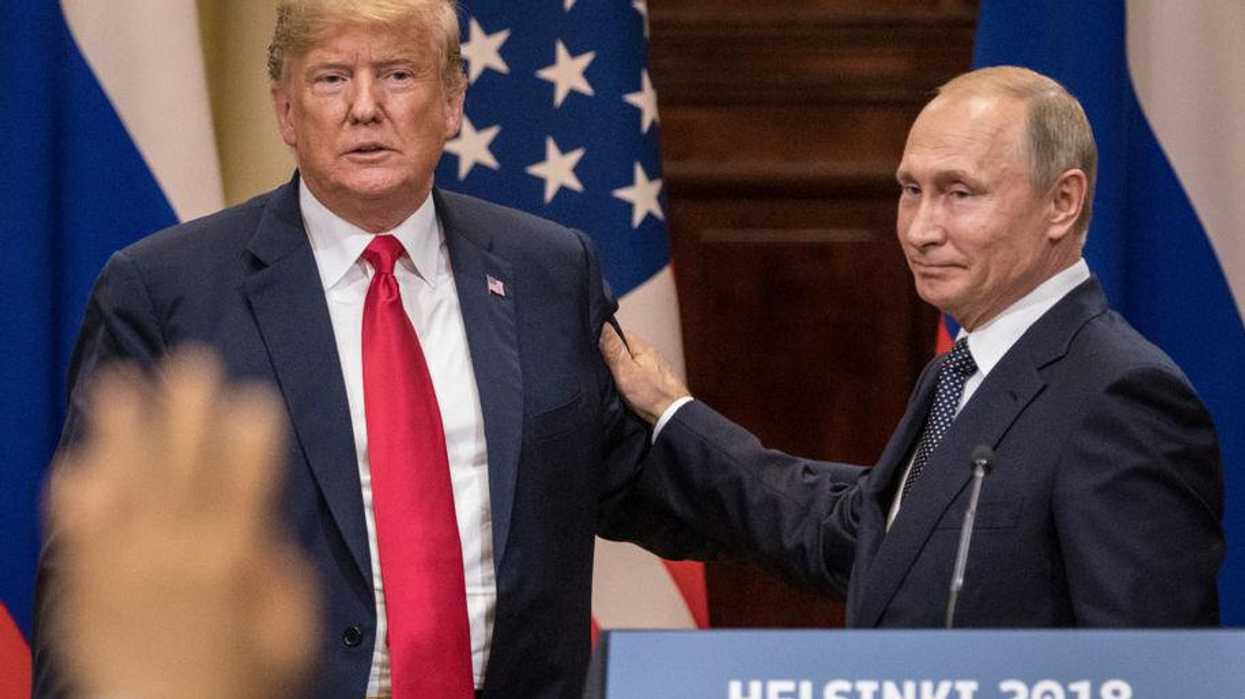
At the NATO summit in July, he threatened to leave NATO and go it alone if spending didn’t rise. On July 16, at Helsinki, Trump famously accepted Putin’s denial of interference in the US elections—accepting the assertions of the Russian president—a former KGB officer, mind you—over the findings of America’s own intelligence services. In January 2019, the New York Times cited senior officials saying that Trump had threatened to withdraw from NATO on multiple occasions.

As for his second term, Trump’s two-pronged strategy—ripping apart NATO while he wooed Vladimir Putin— began even before he was inaugurated. On January 7, two weeks before he was sworn in, Trump called Canada “the 51st state,” and refused to rule out the use of military or economic force to take over Greenland, an autonomous territory within the Kingdom of Denmark that, like Canada is a NATO member. (There is no mechanism in NATO to deal with one member that threatens another.)

In early February, Trump announced punishing tariffs on Canada and Mexico. Then, on February 24, 2025, just five weeks into his second term, Trump made it crystal clear what side he was on. On the the third anniversary of Russia’s invasion of Ukraine, the US voted with Russia and North Korea against a resolution condemning the invasion. Russia and North Korea were our allies. Ukraine and Europe were not. It was official.

Four days later, in the Oval Office, with Vice-President Vance at his side, Trump publicly berated Zelensky: “You don’t have the cards!”

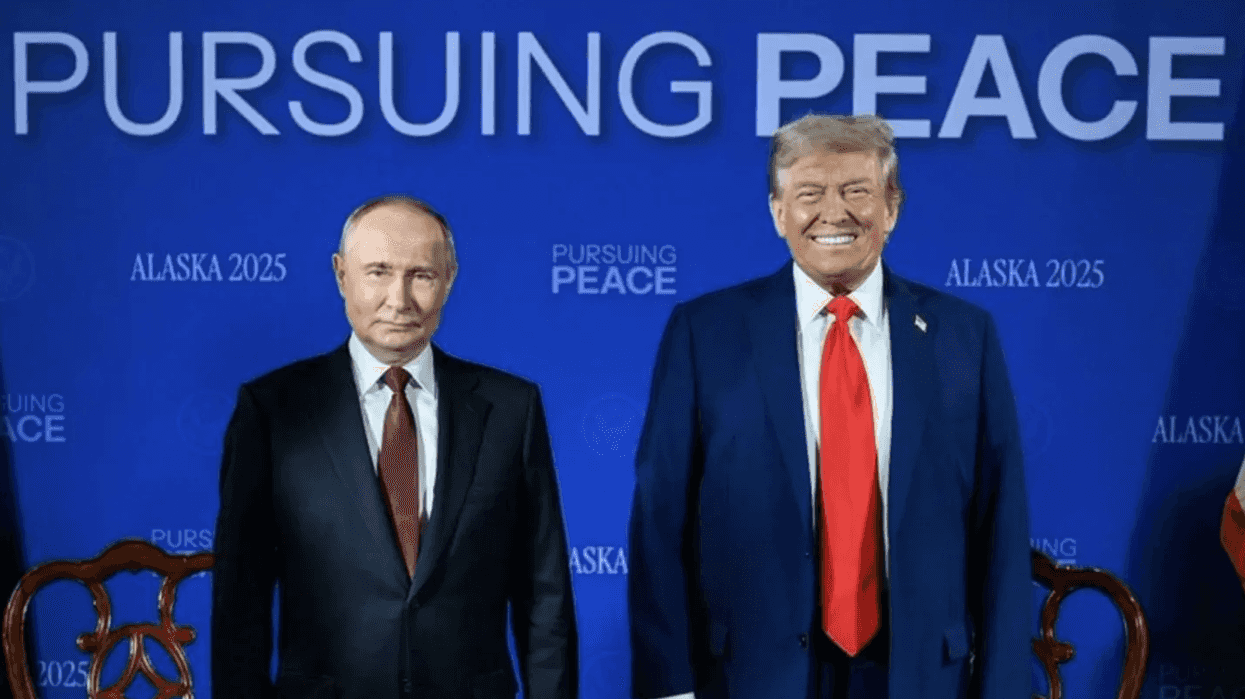
If it seemed like Trump was tormenting America’s longtime allies over the next few months while he cozied up to Putin, that’s because he was. He blitzed Canada and NATO allies with a chaotic series of on-again-off-again tariffs. Then, in the fall, after Trump greeted Vladimir Putin with a red carpet reception in Alaska, special envoy Steve Witkoff, a billionaire real estate developer with no experience in diplomacy, came up with a 28-point peace plan that essentially capitulated to Putin’s desire to eliminate Ukraine’s sovereignty. Dismissing the proposal as “blatant corruption,” Garry Kasparov, the chairman of the Renew Democracy Initiative, told TVP, the Polish broadcast network, that the plan sought to place U.S. hands on frozen Russian assets earmarked for Ukraine’s reconstruction. “It’s a business deal… nothing to do with peace,” he said.

He added, “Putin cannot continue this war indefinitely if the free world is united behind Ukraine.”

But the “free world,” or at least the President of the United States, was NOT behind Ukraine. Thanks to Trump, the US had become an unreliable partner in NATO, and the November 2025 National Security Strategy, released December 4, made that crystal clear. Without mentioning NATO by name, the White House’s official strategy document asserted that “Our elites badly miscalculated America’s willingness to shoulder forever global burdens to which the American people saw no connection to the national interest.”

It was official: Russia and North Korea were our new allies, Ukraine and Europe were not

The White House effectively dismissed NATO as one of those burdens. But in fact, the alliance supports the world’s largest trade and investment relationships, which are worth roughly $8 trillion and support millions of U.S. jobs. Its collective defense has deterred adversaries from launching a great power war for more than 75 years. The alliance also gives the US enormous advantages in intelligence sharing. It provides international legitimacy for sanctions on Russia or pressure on China—neither of which have comparable alliances. And, finally, it projects American power into the Middle East, Africa and the Arctic.

All of which is particularly relevant because in recent weeks both Vladimir Putin and Donald Trump appear to be facing existential crises. In Putin’s case, it’s because his three or four day “special military operation” is now well into its fifth year and has caused more than one and a half million Russian casualties. In other words, Russia is losing it war with Ukraine, and if Putin’s imperial ambitions go up in flames—well, so does Putin.

As for Trump, his Republican Party is facing a wipeout in the November 3 midterms and, if that comes to pass, Trump will have to face the rest of his terms handcuffed by an adversarial Congress that will likely spend its time investigating one malfeasance after another.

And so, 42 years after David Bogatin walked into Trump Tower, the Kremlin continues to collect on the $6 million Bogatin plunked down for Trump real estate. The only question left is whether Russia can cash out before American voters close the account.

Craig Unger has served as the deputy editor of The New York Observer, editor-in-chief of Boston Magazine, and a frequent contributor to The New Republic and Vanity Fair. His most recent book is American Kompromat: How the KGB Cultivated Donald Trump, and Related Tales of Sex, Greed, Power, and Treachery. Please consider subscribing to his Substack, from which this is reprinted with permission.

Whose National Interests Are Served By Trump's Global Bullying? Not Ours

Whose National Interests Are Served By Trump's Global Bullying? Not Ours

With Donald Trump as president, international humiliation has become a condition of being American.

Trump arrived at the NATO summit in Ankara fresh from his gross interference with World Cup officiating. His bullying call to the FIFA chief evidently resulted in the suspension of Folarin Balogun's red card, restoration of the star player to the US National Men's Team roster, and a poor outcome in their Monday match against Belgium -- eliminating the United States from the tournament amid imprecations against the "Trump curse."

As usual, Trump instantly set to work insulting America's traditional allies, renewing his absurd demand to annex Greenland and denouncing NATO, which he said "is never there for us" because its European leaders have no use for his war on Iran. He knows that he is lying about the all iance's fidelity to its parnership with the US, proved with blood and sorrow during the war in Afghanistan, the only time in history when NATO's Article 5 requiring mutual defense has been activated.

Trump's principal complaint against NATO is the reluctance of its member states to support the war that he and Israeli Prime Minister Benjamin Netanyahu have been waging on Iran. But while preparing to depart Turkey, he demonstrated again why our allies won't join in that idiotic endeavor, when he declared an end to the Iran "ceasefire" that had scarcely been in effect. Like his initiation of the war, that announcement came without consulting the allies whose cooperation he has demanded. Of course, this was exactly how Trump behaved during his first term, when he ended the Joint Comprehensive Plan of Action that President Barack Obama had negotiated -- with the assistance and participation not only of our European allies but China and Russia as well.

Having dismissed European interests and views back then, only a president as arrogant as Trump would assume that they would join in lockstep when he attacked Iran amid this year's bilateral negotiations. No doubt the Europeans were as shocked by that perfidious strike as the Iranians themselves -- and they just as certainly were appalled by the absence of strategic planning that has led to the Strait of Hormuz closure, destabilizing the Mideast, many thousands of deaths, and the pointless disruption of the world economy.

For the moment, Trump reaffirmed the US commitment to NATO with today's unanimous declaration by its leaders of “our ironclad commitment to our collective defense under Article 5." He even offered a vague commitment to allow Ukrainian production of Patriot missiles, although it will be the Europeans and Canadians who provide $80 billion in new military aid to Kiev.

Trump probably knows that US law prohibits him from simply quitting NATO, and he may not want that fight with Republican senators on the eve of midterm elections. Nobody should be surprised, however, when he returns to spiteful attacks on the Western nations that have been our faithful friends for decades. He will keep undermining our relationships with those countries for as long as he is president. His ego and ignorance won't allow him to act in our real interest -- and those countries won't serve up the corrupt deals to enrich him that he has come to expect, as he flies around in the "Air Force One" that landed in Washington as a Qatari bribe.

If too many Americans don't grasp these realities, be advised that the Europeans, and people around the world, assuredly do. They look upon the United States and its leadership with a mixture of scorn and pity. Yes, "America is back," as Trump and his stooges bray -- back to the disgrace inflicted on our reputation by atrocity and misadventure in places like Iraq and Indochina.

Who is served by all of the chaos and ill feeling that Trump exacerbates with every dim utterance? That would be our adversaries in Moscow and Beijing, who despise NATO as a beacon of democracy in a dark time.

Joe Conason is founder and editor-in-chief of The National Memo. He is also editor-at-large of Type Investigations, a nonprofit investigative reporting organization formerly known as The Investigative Fund. His latest book is The Longest Con: How Grifters, Swindlers and Frauds Hijacked American Conservatism (St. Martin's Press, 2024). The paperback version, with a new Afterword, is now available wherever books are sold.


Vladimir Putin and Donald Trump

In Another Abrupt About-Face, Trump Says Ukraine Can Win War With Russia

President Donald Trump is so stupid and clumsy with words, he just endorsed Ukraine’s annexation of Russian territory. But hey, it’s better than the opposite!

In one of his patented Truth Social rants, his target is, for once, warranted. Let’s break down the post:

After getting to know and fully understand the Ukraine/Russia Military and Economic situation and, after seeing the Economic trouble it is causing Russia, I think Ukraine, with the support of the European Union, is in a position to fight and WIN all of Ukraine back in its original form.

The battle lines have barely shifted for months. Drones dominate the battlefield, preventing Russia from making meaningful advances, but also stopping Ukraine from doing the same. Tanks and armored vehicles are mostly absent and obsolete; progress comes in small infantry groups trying to dodge drone detection. Anything exposed in the open is dead.

That’s why the Russia-Ukraine War, despite staggering casualties, has become primarily economic. Both sides are targeting each other’s infrastructure. Russia can feed the front with endless waves of men, but if Ukraine keeps degrading its enemy’s oil and gas industry—Russia’s one real economic engine—that’s a different story.

With time, patience, and the financial support of Europe and, in particular, NATO, the original Borders from where this War started, is very much an option. Why not?

NATO is Europe … and the U.S. (and Canada). It would really help if the U.S. lent assistance, but this is still a welcome change in Trump’s rhetoric for several reasons:

  1. He’s not trashing NATO. Maybe we’ve survived his obsession with leaving the alliance.
  2. Just last week he insisted Ukrainian President Volodymyr Zelenskyy should “make a deal,” meaning surrender territory. Now he’s suggesting Ukraine could restore its 2014 borders … for the moment.
  3. One of the problems Ukraine had at the start of this Trump presidency was the notion that it couldn’t possibly defeat Russia. Remember the infamous “You have no cards!” ambush at the White House? Trump no longer believes that.
Russia has been fighting aimlessly for three and a half years a War that should have taken a Real Military Power less than a week to win. This is not distinguishing Russia. In fact, it is very much making them look like “a paper tiger.”

The Trump administration’s unlikely hero remains Secretary of State Marco Rubio, who has argued this point since Day 1. Most of Trump’s orbit—Vice President JD Vance, Director of National Intelligence Tulsi Gabbard, House Speaker Mike Johnson, and the MAGA movement—are pro-Russia or openly hostile to Ukraine. Rubio, with a small cadre of congressional Republicans, resisted.

Somehow, Trump is now anti-Russia. The trick may have been convincing him that Russia is weak. Nothing enrages him more than weakness, and on the battlefield, Russia is exactly that.

When the people living in Moscow, and all of the Great Cities, Towns, and Districts all throughout Russia, find out what is really going on with this War, the fact that it’s almost impossible for them to get Gasoline through the long lines that are being formed, and all of the other things that are taking place in their War Economy, where most of their money is being spent on fighting Ukraine, which has Great Spirit, and only getting better, Ukraine would be able to take back their Country in its original form and, who knows, maybe even go further than that! Putin and Russia are in BIG Economic trouble, and this is the time for Ukraine to act. In any event, I wish both Countries well.

That is all one sentence. Trump remains a butcher of language.

It’s true that Russia—despite being a major oil producer—is experiencing fuel shortages thanks to Ukrainian strikes on energy infrastructure. It’s also true that Ukraine has fought with extraordinary spirit. Two truths in one Trump sentence might be a record.

But his leap to suggesting Ukraine might “go further than that” is bizarre. Is he endorsing Ukraine invading Russia? Annexing Russian territory? Ukraine just wants its land back, Crimea included. Can we stick to that?

We will continue to supply weapons to NATO for NATO to do what they want with them. Good luck to all!

Now this is something. The U.S. doesn’t supply weapons to NATO; NATO isn’t an army. But if Trump means the U.S. will funnel weapons through NATO to Ukraine, that’s a major reversal. More likely, it’s incoherent babble. Still, if he really does intend to use NATO as a laundering mechanism for U.S. support, Ukraine’s prospects brighten considerably.

Europe has to step up—not just with weapons, but with money. Ukraine’s domestic arms industry is cranking. What it needs most is financing for its long-range missiles to keep hammering Russian infrastructure. If Trump wants to frame U.S. support as “NATO’s business” to dodge MAGA fury, fine. As long as the weapons flow, Russia will struggle against a U.S.-E.U. one-two punch.

The irony is that Russian dictator Vladimir Putin once had Trump in the palm of his hand. Flattery and promises of a Nobel Peace Prize could have helped him starve Ukraine into submission. But Putin, too arrogant to debase himself and suck up to Trump the way other world leaders did, may have overplayed his hand.

And that arrogance might ultimately help doom him.

What a crazy twist.

Reprinted with permission from Daily Kos.

President Donald Trump

Just What Power Does Donald Trump Still Have?

Way back in March of 2023, Donald Trump went on Sean Hannity’s show on Fox News and said he would “solve” the war in Ukraine in “24 hours” if he was elected president in 2024. “There’s a very easy negotiation to take place. But I don’t want to tell you what it is because then I can’t use that negotiation; it’ll never work. But it’s a very easy negotiation to take place. I will have it solved within one day, a peace between them,” Trump confided to the ever-eager, ever-gullible Hannity.

In May of 2023, Trump told a CNN town hall, “I want them to stop dying. And I’ll have that done — I’ll have that done in 24 hours.”

In August of 2024, Trump told a National Guard conference, “Before I even arrive at the Oval Office, shortly after I win the presidency, I will have the horrible war between Russia and Ukraine settled. I’ll get it settled very fast.”

On February 28 of this year, just after the three-year anniversary of Russia’s invasion of Ukraine, Trump and Vance infamously sandbagged Ukrainian President Zelenskyy in the Oval Office. Accusing Zelenskyy of starting the war, Trump declared that he had not taken sides in the conflict and was “in the middle.” He berated the shocked Ukrainian leader before having him escorted out of the White House, “You see the hatred he’s got for Putin. That’s very tough for me to make a deal with that kind of hate.”

A few days later, Trump paused military and intelligence aid to Ukraine.

In April, after Putin fired yet another barrage of drones and missiles at civilian targets in Ukraine, Trump posted on Truth Social, “Not necessary, and very bad timing. Vladimir, STOP!”

On Sunday, Trump fired off this blast at the Russian president: “I’ve always had a very good relationship with Vladimir Putin of Russia, but something has happened to him. He has gone absolutely CRAZY! I’ve always said that he wants ALL of Ukraine, not just a piece of it, and maybe that’s proving to be right, but if he does, it will lead to the downfall of Russia!”

Yesterday, Trump whined again on Truth Social that “if it weren’t for me, lots of really bad things would have already happened to Russia, and I mean REALLY BAD. He’s playing with fire!”

Dmitry Medvedev, deputy chief of Russia’s security council and Russia’s puppet-president when Putin took a time-out as Prime Minister between 2008 and 2012, fired back: “Regarding Trump’s words about Putin ‘playing with fire’ and ‘really bad things’ happening to Russia. I only know of one REALLY BAD thing — WWIII. I hope Trump understands this.”

Russian President Putin did not attend the abortive “peace talks” in Turkey earlier this month, although Zelenskyy did show up. Now the two sides are trading “proposals” that amount to demands if there is to be a ceasefire and eventual peace.

The Institute for the Study of War (ISW) reports that Putin’s army is pressing to take more Ukrainian land across a wide swath of territory that includes the area around the Zaporizhzhia nuclear power plant and has been running what it calls “illegal” new power lines near the Sea of Azov in Russian occupied territory, “suggesting that Russia intends to bring the ZNPP's reactors out of their current cold shutdown state…acting upon its long-held plans to connect the ZNPP to the Russian power grid.”

Meanwhile, over the last three days, Russia has bombarded Ukraine with more than 900 Shahed and decoy drones against civilian targets in Ukraine, along with dozens of ballistic missiles and Kh-101 cruise missiles.

ISW reports that Putin is in it for the long haul, importing hundreds of mobile missiles and 155 mm artillery pieces and ammunition from North Korea and thousands of computer chips from China to ramp up its drone production.

Trump’s frustration at not being able to end the war in Ukraine is boiling over. He has changed his timeline for ending the war multiple times, and now he is changing his rhetoric about his “friend” Putin.

The words “World War III” are now being flung back and forth between the superpowers. European nations are sufficiently alarmed that they have just completed a security conference and pledged to increase their defense budgets in many cases to 5 percent of their GDP. The upcoming NATO summit in The Hague is being met with headlines about the “dark cloud” cast by the “war of words” between Trump and Putin.

The biggest question at the summit should be, where is Trump’s power?

Here at home, Trump’s power is taking hit after hit. Tonight, the U.S. Court of International Trade handed down a ruling that Trump exceeded his power to impose tariffs under federal law. “The challenged Tariff Orders will be vacated and their operation permanently enjoined,” the panel ruled. The three judges on the Court of Trade were appointed by Obama, Reagan, and…you guessed right…Donald Trump.

Trump had invoked the International Emergency Economic Powers Act or IEEPA in setting the taxes on imported goods. The court found that Trump exceeded his authority under the IEEPA and ended tariffs he had imposed on Canada, Mexico, China, and all the other 10 percent tariffs Trump had imposed on every other country on earth, as well as several uninhabited islands.

The Constitution gives the Congress the power to impose tariffs, although the legislature has enacted several laws, including the IEEPA, ceding certain powers over the economy to the president. No president before has invoked the IEEPA to impose “emergency” tariffs. The trade court found that Trump had not adequately supported the reasons for his emergency declaration, ruling that the law did not allow “the President to impose whatever tariff rates he deems desirable.”

Trump has been losing in other courts, which have ruled that his attempt to shut down the Department of Education was illegal, that his takeover of the United States Institute of Peace was illegal, and that many of the federal workers fired by Elon Musk’s DOGE assault on the government must be rehired.

With Musk resigning his “special government employee” status in the face of the reversals of so many of his and Trump’s efforts to remake the government in either Musk’s or Trump’s image – it was never clear which – and Musk’s announcement that he opposes Trump’s “Big Beautiful Bill,” where is Trump’s power now?

Reprinted with permission from Lucian Truscott Newsletter.

Shop our Store

Headlines

Editor's Blog

Trending

World