Tag: voter id laws
Fake Journalist Nick Shirley Recycles A Debunked 'Voter Fraud' Narrative

Fake Journalist Nick Shirley Recycles A Debunked 'Voter Fraud' Narrative

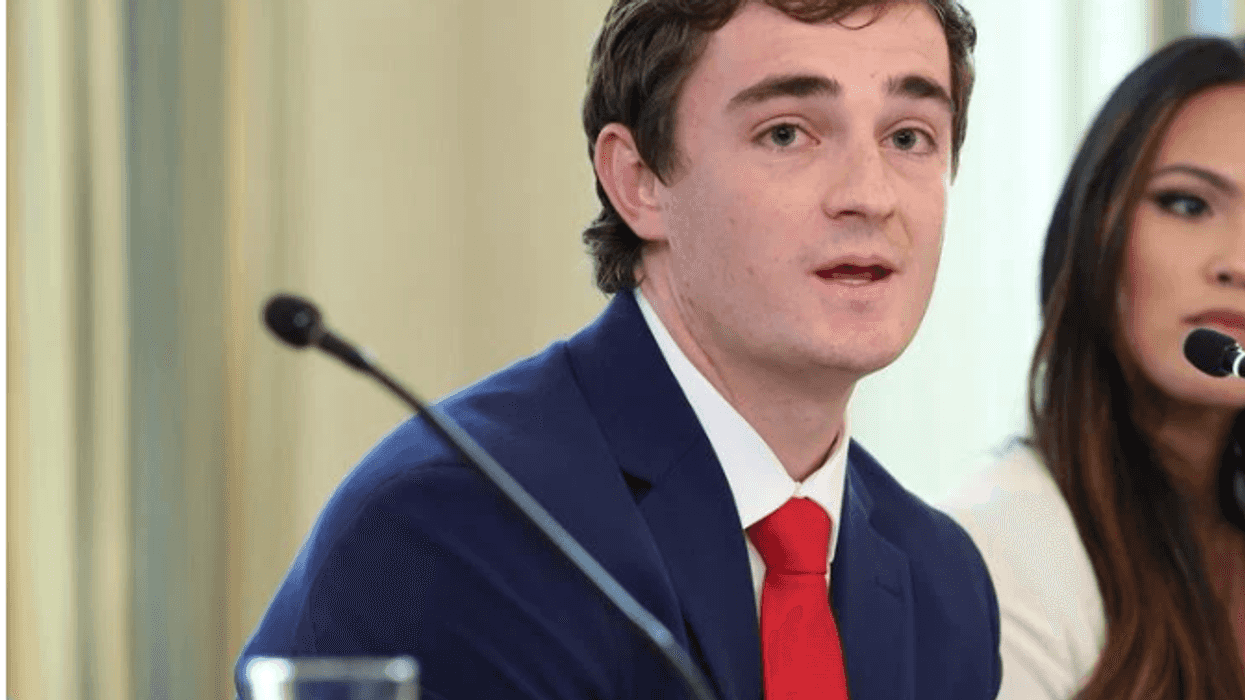
A new video by MAGA provocateur Nick Shirley purports to expose voter fraud in California, but in fact it’s little more than a repackaging of false narratives spread over a decade ago by right-wing operative James O'Keefe. In both cases, the right-wing influencers suggest that fraud could exist without actually exposing any, relying on innuendo and hypotheticals rather than evidence.

O’Keefe created the template for undercover videos meant to expose and embarrass liberal organizations and causes. His old videos, like Shirley’s new ones, were frequently debunked in real time, but they nevertheless served a role in providing fuel to conservative content creators hungry to stoke outrage about perceived liberal excesses. Shirley’s repackaging shouldn’t be surprising given the incentives for young, MAGA-aligned influencers to make a name for themselves in a crowded field. But the original claims didn't provoke any policy changes — reasonably so, given that they were bogus — so Shirley's repackaging has little to offer beyond a hope that new consumers take the bait.

Shirley gained prominence in recent months following a so-called investigation into fraud in Minneapolis day care centers. Although there were some real instances of fraud within the city’s social services, local news and prosecutors had already exposed and investigated many instances of wrong-doing. Still, The New York Times referred to Shirley as having “spurred the federal crackdown on Minneapolis.”

Once the right-wing’s most identifiable creator of sting-style — often deliberately misleading — exposés, O’Keefe’s star has since somewhat fallen. In 2010, O’Keefe founded Project Veritas, and over more than a decade the organization produced videos meant to discredit perceived liberal organizations, often through tactics such as manipulation and deceptive editing. According to Rolling Stone, in 2023 O’Keefe “either left or was pushed out of his own company … depending on whom you ask.” He has since tried to reestablish himself in the right-wing media ecosystem, including by creating an award in 2025 for the so-called citizen journalists who have followed in his footsteps. The first recipient was Nick Shirley.

Shirley, like O’Keefe, is promoting the possibility of fraud that he hasn't actually found

Shirley’s video is one of many from right-wing influencers, such as Benny Johnson, decrying supposedly rampant voter fraud in California, and it includes many examples and myths that have already been debunked. One of the most prominent narratives in Shirley’s video, which was already debunked when Johnson spread it, is that voters whose registrations list central locations, like an abandoned building, as an address are a clear sign of fraud. However, as Democracy Docket notes, California law “gives people experiencing homelessness the flexibility to use any location to register to vote. As long as unhoused residents can describe the place where they spend most of their time — whether it’s an address, a cross street, or a vacant lot — they can legally list it as their address on their voter registration form.”

Another one of Shirley's key examples of “fraud” in the video is a previously reported story about a woman who registered her dog to vote and cast two ballots for him in 2021 and 2022, only one of which was counted. The woman, a registered Republican, self-reported her crimes and is facing six years in prison.

The premise of Shirley’s 20-minute video is that there could be fraud in California without stricter voter ID laws and “with the state receiving millions of illegal migrants, the opportunities for fraud now are even higher.” California does require a valid ID or Social Security number when registering to vote or when voting for the first time after registering by mail, and extensive research has shown that noncitizen voting in U.S. elections is exceedingly rare and extremely unlikely to impact elections. Yet Shirley’s video has been picked up by others in right-wing media, including livestreamer Tim Pool, former FBI Deputy Director Dan Bongino, and conspiracy theory website The Gateway Pundit.

Had someone just awoken from a decade-long coma, they might find these types of claims quite familiar. In 2012, O’Keefe attempted to show how easy it was to commit voter fraud in a state without strict voter ID laws via a video titled “Dead people receive ballots in NH primary,” which claims that conspirators could use the names of the deceased to cast fraudulent ballots to steal an election. But, as Media Matters noted at the time, the video “actually demonstrates just how difficult it would be to pull off such a plot.”

Although it’s true that making sure ballot rolls are accurate is important, O’Keefe’s stunt only showed that without knowing how many votes were needed, the conspirators would need to engage in a massive plot and subsequent cover-up to make sure they had covered the spread. It would be an enormous undertaking. O’Keefe provided no evidence that such a scheme existed for the simple reason that there was no such plot.

In another one of O’Keefe’s “gotcha” videos on voter fraud, a Project Veritas employee almost obtains a ballot meant for registered voter Eric Holder, then the U.S. attorney general. Project Veritas marketed the video as a slam dunk, claiming it had “proven” fraud occurred while in reality no vote was cast and no fraud occurred. The manufactured stunt, like Shirley’s escapades in California, was another senseless attempt to rally people behind more restrictive voter ID laws.

Though Shirley’s claims about California include some different details from O’Keefe and Project Veritas’ claims, the gist is the same: Both attempt to prove “voter fraud” and fail to show any actual fraud being committed. Such right-wing misinformation has been debunked for years while the truth is still that fraud is just not happening at the scale they claim.

Reprinted with permission from Media Matters
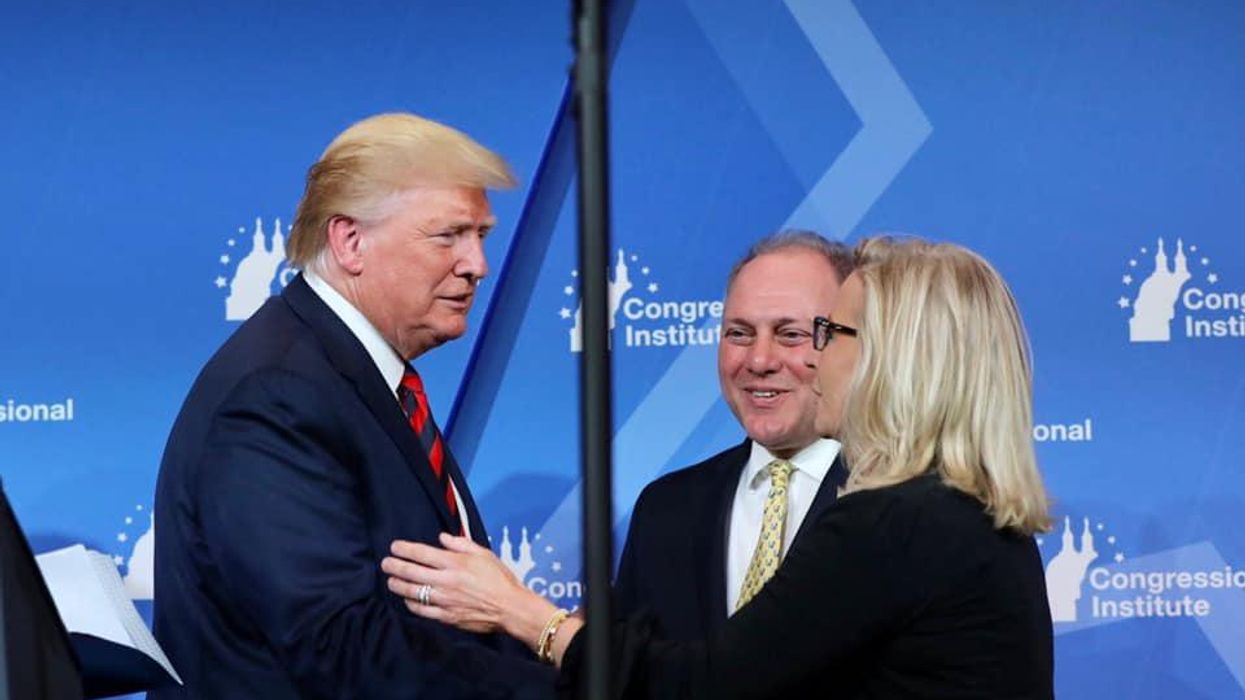
Rep. Liz Cheney, right, shaking hands with former President Trump.

Cheney Backs Voter Suppression Bills Based On Trump’s Big Lie

Reprinted with permission from American Independent

Rep. Liz Cheney (R-WY) has been an outspoken critic of Donald Trump and her fellow Republican lawmakers who have lied about voter fraud in the 2020 election — so vocal, in fact, that she lost her position in House GOP leadership over it.

Yet in an interview with Axios that aired on Sunday, Cheney said she supports the voter suppression legislation Republicans have pushed across the country in 2021, even as the same lies of fraud are being used to justify those bills.

In the interview with Axios' Jonathan Swan, Cheney denied that the hundreds of voter suppression bills — some of which have already become law — were based on Trump's voter fraud lies.

"I will never understand the resistance, for example, to voter ID," Cheney told Axios' Jonathan Swan. "There's a big difference between that and a president of the United States who loses an election after he tried to steal the election and refuses to concede."

However, many of the more than 360 pieces of voter suppression legislation Republican state legislators have introduced this year attack the very same methods of voting Trump has falsely blamed for his loss.

For example, GOP-controlled state legislatures in Arizona, Florida, Georgia, and Iowa have all passed laws making it harder to vote by mail — a method of voting Trump falsely said is rife with fraud and demanded be scaled back in future elections.

Arizona's Republican governor recently signed into law a bill that purges the state's Permanent Early Voting List of voters who do not vote in two straight election cycles. The list allowed voters to opt to receive absentee ballots for every election, and the change could purge more than 125,000 voters from the list.

Georgia and Florida also now require ID to vote by mail, and both cut back on the use of ballot drop boxes — which Trump falsely said could lead to fraud.

Voting rights advocates say the changes are directly aimed at making it harder for voters of color to cast ballots. It's led voting rights experts to describe the GOP voter suppression effort as Jim Crow 2.0.

What's more, states like Georgia took away power from Secretary of State Brad Raffensperger — who refused to follow Trump's demand to steal the 2020 — and instead gave it to GOP state lawmakers who could use it to overturn elections.

"Had their grand plan been law in 2020, the numerous attempts by state legislatures to overturn the will of the voters would have succeeded," Stacey Abrams, the former Georgia state representative who now runs a voting rights organization, told the New York Times in March.

Ultimately, Cheney's refusal to fight back against voter suppression efforts shows she is still a Republican, even though she's bucked her party on support for Trump.

And the Republican Party has been the party of voter fraud lies and voter suppression even before Trump's 2020 effort to steal the election.

For example in 2019, conservatives in Wisconsin sought to purge more than 230,000 people from the voter rolls ahead of the 2020 election. The effort failed; however, a report showed that the purge would have affected Black voters at higher rates — a group that backs Democrats by wide margins.

Meanwhile, in 2016, Republicans in North Carolina passed a voter ID law that was struck down by a federal court, which said the law targeted "African Americans with almost surgical precision," and that it would "impose cures for problems that did not exist."

Published with permission of The American Independent Foundation.

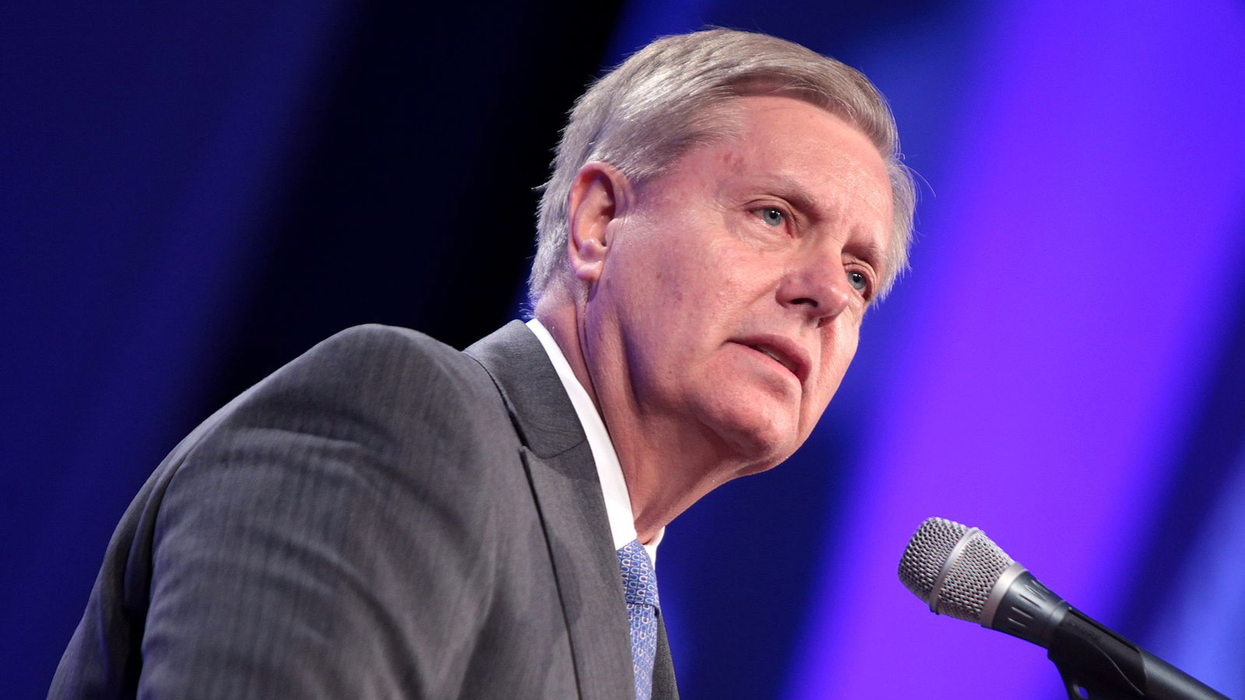
Sen. Lindsey Graham

Done With 2020, Lindsey Graham Is 'Moving On' To Voter Suppresion 2022

Reprinted with permission from American Independent

Sen. Lindsey Graham (R-SC) said Monday that he accepts the results of the 2020 election as well as President Joe Biden's win, but supports the myriad voter suppression efforts Republicans are undertaking across the country, ahead of the 2022 midterm contests.

Graham made the comments in response to a reporter's question about the controversial election audit in Arizona, which is based on voter fraud lies and conspiracy theories of a stolen victory, pushed by Donald Trump. That audit has sparked concern from the Justice Department that the audit is not adhering to election law.

Graham claimed to not know much about the audit, but said, "I accept the results of the election," adding that he is ready to "move on."

"2020 is over for me, I'm ready to march on and hopefully take back the House and the Senate in 2022," Graham told reporters in his home state of South Carolina.

The senator did not say whether he believes there was fraud in the November race, but advocated for voter suppression laws ahead of the next election, specifically singling out a desire to make it harder to vote absentee.

"I think it's smart to reform our laws to make sure you are who you are," Graham said, noting he supports voter ID laws. "I think there are a lot of people that feel like bad things happened in the election ... But I think President Trump and the Republican Party needs [sic] to focus on election reform and the upcoming election."

Experts have said repeatedly that voter ID laws are often discriminatory and target low income and minority communities, as well as those with disabilities. Further, those experts say ID laws are largely useless, considering that the kinds of fraud those laws claim to target are rare.

Despite this, a number of states have attempted to make it harder for people to vote in the months since Biden's win, many citing baseless claims fraud in the November election while introducing legislation limiting ballot drop-boxes, shortening early voting, and enacting other strict policies that frequently target minority and low-income communities.

Graham, for his part, initially backed Trump's effort to steal the 2020 election, even suggesting in a November 2020 call with Georgia Secretary of State Brad Raffensperger that mail-in ballots in certain counties in the state be tossed.

"During our discussion, he asked if ballots could be matched back to the envelope. I explained our process, after it went through two sets of signature match, at that point they were separated," Raffensperger said after the call.

He continued, "But then Senator Graham implied for us to audit the envelopes and then throw out the ballots for counties who have the highest frequency error of signatures. I tried to help explain that because we did signature match, you couldn't tie the signatures back anymore to those ballots."

Graham's conversation with Raffensperger was later included as part of a criminal investigation into Trump's effort to steal the state, according to the Washington Post. The investigation stemmed from Trump's demand that Raffensperger "find" 11,780 ballots — the exact number needed for Trump to be declared winner of the state.

Graham himself also made allegations of fraud in the immediate aftermath of the 2020 election.

"We'll see what that comes up with. So I think you're going to see some major irregularities," Graham said on Nov. 6, 2020, a day before the media called the race for Biden. "Democracy depends upon fair elections. President Trump's team is going to have the chance to make a case, regarding voting irregularities. ... I'm going to stand with President Trump."

After no voter fraud evidence surfaced, and after Trump incited the deadly insurrection at the Capitol on Jan. 6, Graham said that Trump needed to stop pushing voter fraud lies and move forward, voting to certify Biden's win along with the overwhelming majority of the Senate.

Trump, for his part, has not listened.

Since May 12, Trump has published seven posts on his new blog saying there was fraud in the 2020 election and that the election was stolen. One blog post was so full with lies that a Republican election official in Arizona called it "unhinged."

Still, Graham has said he has no intention of ditching Trump, despite the voter fraud lies.

"Can we move forward without President Trump? The answer is no," Graham said earlier in May, when Republicans were waging their effort to remove Rep. Liz Cheney (R-WY) from leadership. "I've always liked Liz Cheney, but she's made a determination that the Republican Party can't grow with President Trump. I've determined we can't grow without him."

Published with permission of The American Independent Foundation.

Georgia Republicans Vote To Eliminate No-Excuse Absentee Voting

Georgia Republicans Vote To Eliminate No-Excuse Absentee Voting

ATLANTA — The Georgia Senate passed a bill Monday to roll back no-excuse absentee voting and require more voter ID, which would create new obstacles for voters after Republicans lost elections for president and the U.S. Senate. The legislation would reduce the availability of absentee voting, restricting it to those who are at least 65 years old, have a physical disability or are out of town. In addition, Georgians would need to provide a driver’s license number, state ID number or other identification. The Senate approved the bill on a party-line 29-20 vote, a one-vote majority of the chamber...

Shop our Store

Headlines

Editor's Blog

Corona Virus

Trending

World