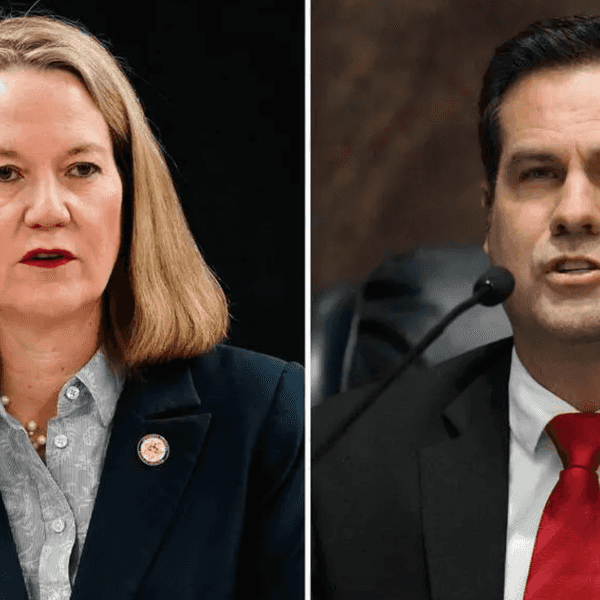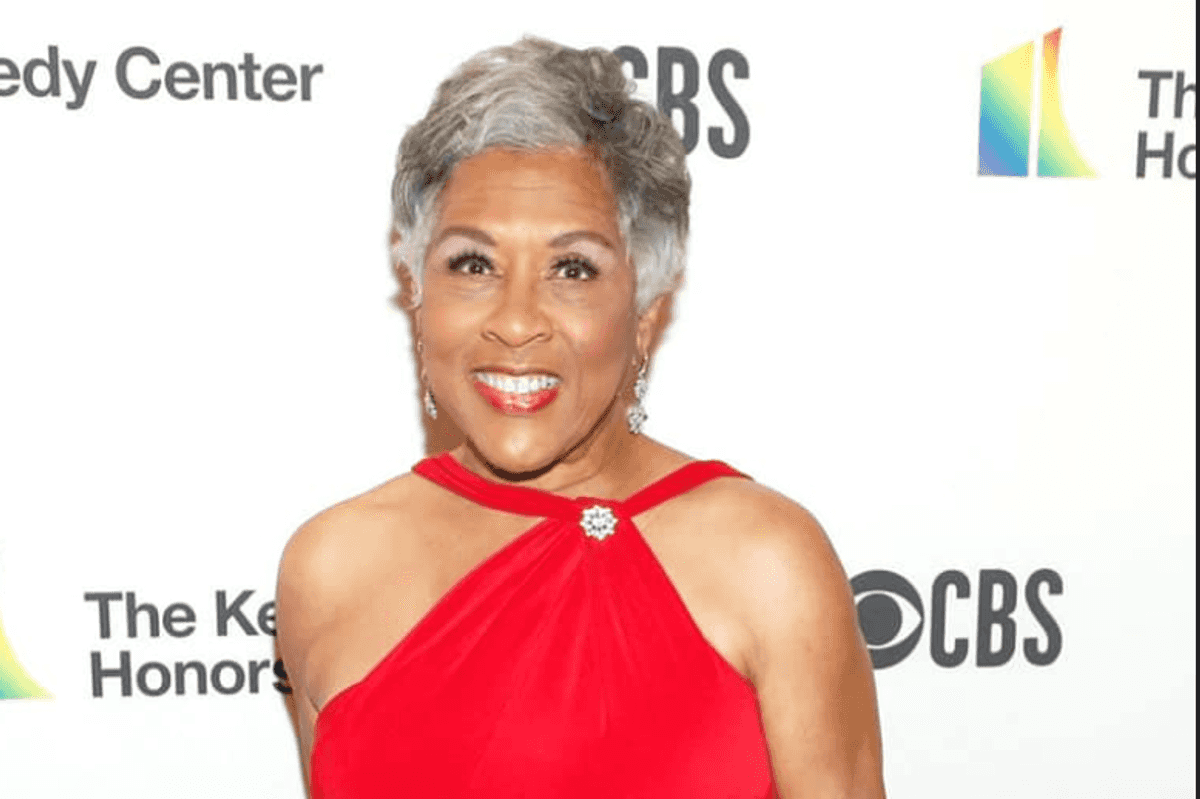
Rep. Joyce Beatty at Kennedy Center honors on December 11, 2021
Well, that was pretty fun.
There was an almost physical satisfaction seeing the letters “Donald J. Trump” removed from the facade of the John F. Kennedy Center for the Performing Arts. We saw the tangible payoff of the triumph of the law over Trump’s raw vanity, like the expulsion of a usurper to the throne. It was reminiscent of the post-Communist toppling of the giant statues of Stalin that Russian people had had to endure for decades.
In its ultimate pettiness, the Trump administration launched a 12th-hour appeal for a short delay in complying with the order to take down the Trump name that had sullied the John F. Kennedy Center for the last six months. The apparent goal was to deny the gathering crowd the satisfaction of seeing the tyrant’s name physically removed. They got a 12-hour extension and then waited until the wee hours to comply, in a process that took less than an hour.
Besides the satisfaction of a modest but tangible victory, the case provides a workable template for many of Trump’s lawless power grabs.
A significant percentage of the outrages of Trump’s second term reduce to some version of the same move as with the Kennedy Center. Congress long ago made a decision and put it into law, and the Trump administration acted as if it could just ignore it.
The administration has refused to spend appropriated funds, asserted the power to fire officials Congress insulated by law, rewritten election procedures Congress had already legislated, and stood up a $1.776 billion “compensation fund” with no clear appropriations basis at all. Each of these fights involves its own tangle of doctrine and politics, but the general principle of steamrolling congressional decisions is the unifying factor.
In the case of the Kennedy Center, Congress passed a statute in 1964 designating the National Cultural Center as “the John F. Kennedy Center for the Performing Arts” and providing that it would serve as the nation’s “sole national memorial” to the slain president. Nothing in that statute gives a board of presidentially appointed trustees the authority to rename the institution. Full stop.
U.S. District Judge Christopher Cooper’s meticulous May 29 opinion runs 94 pages, but its holding fits in two sentences anyone can understand:
“The Kennedy Center’s organic statute makes crystal clear that the Center is to be named for President Kennedy, and it cannot bear any other formal name or public memorial based on the Board’s unilateral say-so. Congress gave the Kennedy Center its name, and only Congress can change it.”
That’s the whole separation-of-powers argument, stated with simple elegance.
The Trump takeover of the Kennedy Center was of a piece with his takeover of the government. The whole operation rededicated the Kennedy Center to the interest of the new Trump namesake, abandoning the broader cultural mission and service to the people that was its animating purpose.
The letters “THE DONALD J. TRUMP AND” had been installed last December, less than 24 hours after a hastily called, off-agenda board vote. When Rep. Joyce Beatty (D-OH), the board’s ex officio member and the only trustee not chosen for loyalty, tried to object, her microphone was cut; and the vote was gaveled through as “unanimous.” The new letters went up on the building’s portico the very next day. The fix was in.
The Center’s foundation, the entity raising private money for the renovation, adopted bylaws conditioning every donation on the name staying exactly as Trump wanted it: “Donald J. Trump and John F. Kennedy Memorial Center for the Performing Arts.” If the Center ever removed Trump’s name from “its filings, marketing, branding, façade, or any other affiliated location,” the Foundation would claw back every dollar it had given.
Anyone who has served on a nonprofit board knows what the job entails: looking out for the health, finances, and reputation of the institution. It was a straightforward breach of fiduciary duty for the board to insert a provision saying that if the Center ever complied with the law and dropped Trump’s name, every dollar raised under the Trump brand would be clawed back. Plainly, the only person this policy served was Trump.
The same instinct drove the emergency stay motion DOJ filed once the litigation went south. As with the wacky legal submissions in the ballroom case, the brief here seemed to bear Trump’s personal imprint: its first paragraph runs three solid pages, larded with overheated rhetoric to the effect that only Trump could fix the Center.
It didn’t matter legally, but in fact, that submission was dead wrong. Judge Cooper’s opinion, along with a stream of accounts from people who worked at the Kennedy Center before Trump’s team purged them, makes clear that the takeover, far from being the salvation Trump claimed, gutted a storied institution.
Under Trump’s nominal leadership, the institution was quickly driven into freefall. A discharged curator, Josef Palermo, described leadership with no arts management experience whose apparent goal was to “show up on a red carpet and take pictures,” and a fundraising operation that sold proximity to Trump as the product. His overall word for the takeover: desecration.
That same pettiness ran through the broader record of how this institution treated the artists it depended on. A series of performers canceled their bookings, unwilling to lend their names to the Trump brand.
In January, the great American composer Philip Glass withdrew the premiere of his Symphony No. 15, “Lincoln,” from the Center, explaining that “the values of the Kennedy Center today are in direct conflict with the message of the symphony.” Trump’s response was a sneering dismissal.
The institutional toll was equally stark. The Washington National Opera, the Center’s resident company since 1971, announced it would leave, while ticket sales across the Center’s programming plunged 70 percent after the renaming. It was the same flim-flam Trump perfected decades ago in Atlantic City and New York, bankrupting one venture after another while insisting each was the greatest of its kind, selling brass and calling it gold.
As it does in every dispute, the administration led with a standing argument—not that it had the legal right to rename the Center, but that nobody had the right to bring a court challenge in the first place. The emergency stay motion repeated the claim that Rep. Joyce Beatty, the board’s ex officio member who brought the suit, lacked standing to challenge any of this in the first place.
Cooper didn’t buy it. Beatty, as a trustee with fiduciary obligations under the statute, had standing to challenge the full board. And at that point, the path was clear to restore what Congress had written into law. Congress gave the Kennedy Center its name, and only Congress can change it. Q.E.D.
Cooper’s order didn’t specify that the restored name had to remain visible, and that apparently gave someone in the White House the idea of covering it with a tarp—to spare Trump’s bruised feelings and deny the public the satisfaction of watching his name come down.
It’s as if the federal government were saying that if Donald Trump’s name couldn’t appear on the building, nobody’s could. Had the protagonist been anyone else, the spectacle might have seemed pitiable. Because it was Trump—the third-grade spoiled child incarnation—it registered instead as ridiculous.
That fairly absurd coda aside, it’s evident that while legal doctrine fueled the opinion, public outrage at Trump’s vainglory supplied the kindling. It’s one of several recent episodes in which the public, and as a result at least some Republicans in Congress, stood against the Trump tide. Democracy-loving Americans should take the win, and then get up tomorrow and fight the next fight.
Harry Litman is a former United States Attorney and the executive producer and host of the Talking Feds podcast. He has taught law at UCLA, Berkeley, and Georgetown and served as a deputy assistant attorney general in the Clinton Administration. Please consider subscribing to Talking Feds on Substack.
Reprinted with permission from Talking Feds.
- Despised Team Owner Dolan Shouldn't Make Knicks Visit Trump's White House - National Memo ›
- To Wield Power Effectively, This Is What Democrats Must Learn From Trump - National Memo ›
- Danziger Draws - National Memo ›
- CNN Reveals Trump's 'Effing Crazy' Call To Kennedy Center Board Meeting - National Memo ›