Tag: cdc
Erupting Crisis Of Uninsurance, Created By Republicans, Will Soon Engulf US Families

Erupting Crisis Of Uninsurance, Created By Republicans, Will Soon Engulf US Families

The GOP-fostered uninsurance crisis is growing faster than a newborn volcano, one that will do grave harm to those directly affected and later this year will begin spewing its molten crap on everyone.

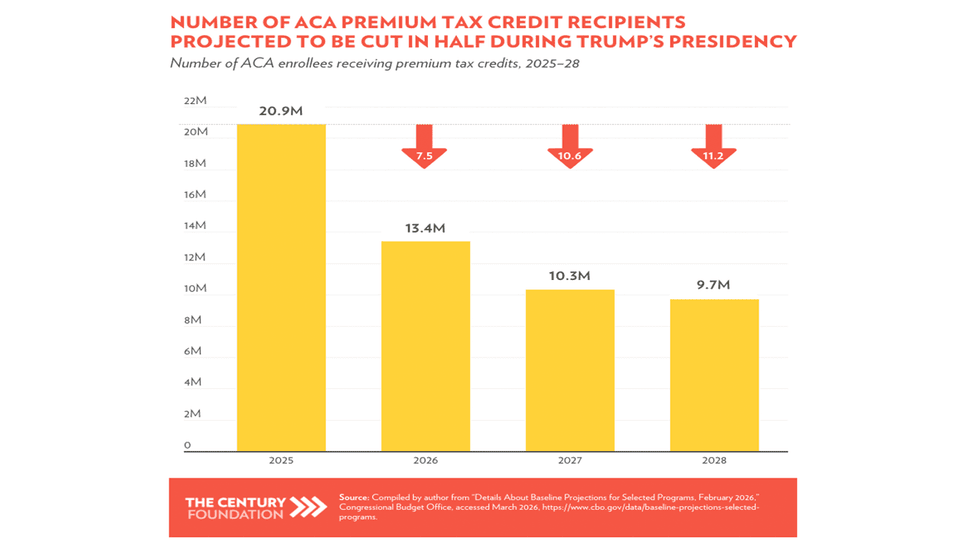
The Associated Press reported Friday that nearly 3 million people dropped Obamacare health insurance plans during the first two months of 2026. That’s a 13 percent fall from the 22.1 million people who purchased individual or family plans on the exchanges in 2025.

That’s already 40 percent of the total the Congressional Budget Office projected would drop coverage for the entire year because the GOP-run Congress refused to reauthorize those Biden-era subsidies during last year’s budget negotiations. That left millions of low-wage workers whose employers don’t provide coverage with out-of-pocket premiums they can no longer afford without the extra help.

The end to people dropping coverage is nowhere in sight. The CBO conservatively estimated 7.5 million people would drop Obamacare coverage this year. If the first quarter average holds for the rest of the year, that number will soar to more than 10 million.

Add to that the millions of people being thrown off Medicaid due to the new work requirements and bureaucratic hurdles thrown in their way, the ranks of the uninsured will likely see its largest increase in years when data for 2026 is released next year. Last May, the CDC reported 28 million people or 8.3 percent of the population did not have health insurance in 2025. With the Trump regime adding another 10 million people or more to the ranks of the uninsured, the uninsured rate is likely to jump to more than 11 percent.

(That’s my calculation: Put 38 million uninsured over a population projected to grow to 344 million this year and you get an 11 percent uninsured rate.)

How about the rest of us?

What will that mean for the 156 million or so people with employer-based coverage? Their rates will be jacked up by insurance companies to pay for the uncompensated care hospitals deliver to the uninsured in nation’s emergency rooms, where, when they get sick, they turn for care since ERs legally cannot turn them away. Moreover, they will likely be far more costly to care for since ERs are the most expensive place to get care, and they will have waited until their conditions had worsened to the point where they had to seek care.

We’re already beginning to see evidence of the premium price spikes to come. Nona Tepper of Modern Healthcare reported last week that health insurers’ preliminary filings with state regulators for individual plans sold on the exchanges will show big premiums increases next year. Employer surveys showing next year’s premiums usually aren’t released until the late fall.

Leaving people uninsured is about the stupidest and most inhumane policy any society could adopt, especially one that can afford to ensure than everyone has coverage. But, as Forrest Gump liked to say, stupid is as stupid does.

Merrill Goozner, the former editor of Modern Healthcare, writes about health care and politics at GoozNews.substack.com, where this column first appeared. Please consider subscribing to support his work.

Reprinted with permission from Gooz News


Trump And Kennedy Render America Defenseless Against A Deadly Virus, Again

Trump And Kennedy Render America Defenseless Against A Deadly Virus, Again

When ominous reports of a highly lethal and potentially communicable illness reach our airwaves, Americans now must rely on foreign authorities to reassure us — or to warn us.

The hantavirus is at our doorstep, but the Trump administration, and specifically its top health official Robert F. Kennedy Jr., have dismantled the federal scientific infrastructure that traditionally protected the nation from such threats and substituted literally nothing in its place. While we may escape the direst consequences of their vandalism for the moment, there is no guarantee that far worse is not coming, and soon.

The ruinous public health impact of Donald Trump's return to the White House was just as predictable as his rush to enrich himself and his family by every corrupt means. We knew what he is because we saw what he was. His historic failure to competently manage the COVID-19 pandemic mostly occurred in plain sight, as he tried to ignore and then downplay a deadly onslaught of which he had been duly warned.

With his presidential messaging warped by egomania, Trump promised that the spreading pandemic would swiftly and "miraculously" fade away. He knew that was a lie but resisted a sound public testing program because he didn't want "bad numbers" as the election season began. He failed to provide critically needed hospital supplies as doctors and nurses died. And he undercut the Centers for Disease Control and Prevention's guidance on safety protocols while promoting quack cures, comic-book science, and loony ideas like "injecting" bleach.

Trump's mindless, chaotic response led to many thousands of unnecessary deaths, for which he somehow mostly escaped blame, while right-wing media demonized veteran public health officials. And all that insanity occurred while responsible federal officials were still in office — meaning before Kennedy got the chance to pursue his impulse to destroy the public health edifice that required decades to build.

That course of destruction accelerated as soon as Trump and Kennedy took over last year, although the dismantling had begun during the first Trump administration. Within weeks after his second inauguration, the president signed an executive order terminating United States membership in the World Health Organization, a token of his pig-ignorant attitude about the global vectors of diseases that know no borders. At the same time, he ended U.S. observance of International Health Regulations that govern cross-border investigations of disease outbreaks like COVID-19, Ebola and now hantavirus.

Trump's malign commands are not only leading to the deaths of millions of innocent people in other countries, suddenly deprived of essential medicines and care, but now are jeopardizing American access to vital, timely, lifesaving information. Whatever capable officials are still left in our government can no longer see the WHO surveillance databases or communicate with its working groups of doctors and scientists — who played a major part in our defense against Ebola during the Biden administration.

Meanwhile, Trump's sycophant Kennedy has directed an even more damaging reign of ruin on the systems that protect us within our own borders. Apparently motivated by an urge for vengeance on the CDC, which thwarted his anti-vaccine propaganda, Kennedy ousted nearly a third of the agency's employees. Among the functions most harmed by his stupid waves of firing and rehiring was the renowned Epidemic Intelligence Service, whose medical detectives are trained to investigate and assess infectious outbreaks like hantavirus (or, to take another topical example, the measles epidemic conjured by Kennedy's anti-vax imbecility).

According to Dr. Celine Gounder, everyone who worked for the CDC's Vessel Sanitation Program, which monitors cruise ship health conditions, cashiered all its full-time civilian workers in early 2025. (Most of them were later rehired.) Only an idiot would imagine that the government should save money by ruining such precious public services.

The demoralizing impact of Trump and Kennedy on American public health will take a toll that has scarcely been felt yet.

"I hope it's fine," said the president when asked about the hantavirus on Sunday. This time it probably will be. But his halting answer was an eerie echo of what he said in January 2020 — before he and his stooges demolished the best public health system in the world.

Reprinted with permission from Creators.

Joe Conason is founder and editor-in-chief of The National Memo. He is also editor-at-large of Type Investigations, a nonprofit investigative reporting organization formerly known as The Investigative Fund. His latest book is The Longest Con: How Grifters, Swindlers and Frauds Hijacked American Conservatism (St. Martin's Press, 2024). The paperback version, with a new Afterword, is now available wherever books are sold.


Kennedy's CDC Chief Censors Research Proving Benefits Of COVID Vaccination

Kennedy's CDC Chief Censors Research Proving Benefits Of COVID Vaccination

Previous administrations, including Donald Trump’s first, usually upheld the ideal that the Food and Drug Administration and other federal health agencies would adhere to the “gold standard” for research.

For the FDA, whose jobs include the approval of new drugs, vaccines and medical devices, the gold standard meant requiring rigorous clinical studies to prove that experimental products were both efficacious and safe. That usually means a manufacturer has to submit at least two trials, both of which are placebo-controlled and double-blinded (neither patients nor their physicians know if they received the real thing). Patients in the trials are randomly assigned to one group or the other — hence its name, the randomized controlled trial or RCT.

The Center for Disease Control and Prevention is charged with monitoring the extent and seriousness of health threats in the U.S. Its gold standard is different because it involves epidemiological studies, where researchers measure the extent of a disease and its outcomes in the population by mining medical records or conducting surveys drawn from well-matched cohorts. It often relies on data collected by state and city public health agencies.

In recent weeks, the press has reported that both agencies’ staff scientists have had studies withdrawn from medical journals (the FDA) and an in-house publication (the CDC). On Tuesday, the New York Times reported that “In October, (FDA) scientists were directed to withdraw two Covid-19 vaccine studies that had been accepted for publication in medical journals. In February, top F.D.A. officials did not sign off on submitting abstracts about studies of Shingrix, a shingles vaccine, to a major drug safety conference.”

Two weeks ago, the Washington Post and other publications reported top officials at the CDC refused to allow publication of a study showing the effectiveness of the Covid vaccine in reducing hospitalizations. It had been scheduled for publication in Morbidity and Mortality Weekly Report, the agency’s well-regarded in-house journal.

Jay Bhattacharya, who runs the National Institutes of Health and is the interim head of the CDC, defended his decision to deep-six the study in a a op-ed. “I raised specific concerns about the statistical methodology chosen for the study in question,” he wrote. “These concerns about the test-negative design used go directly to the validity of the study’s conclusion.”

I’ll have more to say on test-negative design in a moment.

A new journal for CDC

Bhattacharya also announced plans for the agency to launch a peer-reviewed journal “to elevate scientific rigor across all CDC publications,” he wrote. “Peer review remains the gold standard because it subjects findings to independent scrutiny, forces transparency about limitations and strengthens confidence in the results.”

The peer review panels for this new journal, when chosen, will definitely warrant “independent scrutiny.” Should they follow in the footsteps of how the CDC has remolded its vaccine advisory committee, it should provide plenty of grist for the Retraction Watch, which monitors medical and scientific journals for published retractions. The RW website database lists tens of thousands of incidents where peer reviewed failed to catch factual errors, deliberate falsifications and other misfeasance and malfeasance in the academic journal publication process.

I have served on several peer-review panels. I will never forget the note I received from one author after I made a number of pointed suggestions for improving his study’s conclusions. He thanked me for giving him one of the most comprehensive reviews he had ever received, one that was very helpful in improving the manuscript.

I don’t offer this anecdote to pat myself on the back. It confirmed something I’ve often heard said about peer review. A better name for the process might be “colleague review,” or “friendly review,” or even “ideological fellow-traveler review.” It would be out of character (and I will be pleasantly surprised) if the Trump regime’s CDC sets a higher standard.

“I cannot recall CDC stopping an MMWR report in the publication phase after scientific clearance and editorial review.” — Michael Iademarco, who directed the CDC center that publishes MMWR from 2014 to 2022.

Bhattacharya, who trained as an economist and physician at Stanford, has never worked as an epidemiologist or as a practicing physician. But he emerged as an expert during the Covid pandemic by co-authoring the Great Barrington Declaration, which called for allowing the general population to opt out of vaccination while adopting special measures to protect seniors, who were most vulnerable to the disease. The one country that tried that approach (Sweden) quickly abandoned it due to mounting mortality among its working-age population.

'Test-Negative' Epidemiological Research

His demand for something better than “test-negative” design sounds to me like obfuscating jargon that could be used to call into question most epidemiological research. “The core problem” with that approach, he wrote, “is that, to measure the effectiveness of a vaccine in keeping people out of a hospital (for instance), this method throws away all data about people, vaccinated or not, who are never hospitalized. Instead, it replaces data with unverifiable assumptions, leading to bias. Factors such as prior infection, behavioral differences and who shows up for care can all skew results in ways that are hard to adjust for.”

Yes, all epidemiological studies that compare outcomes among two groups that haven’t been randomized have unmeasured factors that might skew the results. And there’s lots of junk science in the medical literature that makes no attempt to adjust results for unmeasurable factors. Here’s one: Martin Makary’s most recent book (he now runs the FDA) cited a study that “proved” fluoride reduces intelligence by comparing the average IQ scores in two Canadian communities, only one of which had fluoridated water (and slightly lower IQ scores among its school age children).

But most studies, especially those published in reputable journals, attempts to adjust for those unmeasured factors. The Times in its story pointed out that the “test-negative” design has been used in numerous CDC studies over the years and is well accepted in the peer-reviewed medical literature. It was used in a 2021 study on Covid vaccine effectiveness that was published in the New England Journal of Medicine, and in numerous peer-reviewed studies published in journals like JAMA Network Open, The Lancet, and Pediatrics.

The Post, in its story two weeks ago, quoted Michael Iademarco, who directed the CDC center that publishes MMWR from 2014 to 2022, which included Trump’s first term in office. “I cannot recall CDC stopping an MMWR report in the publication phase after scientific clearance and editorial review,” he said.

That is, not until contrarians like Bhattacharya and Makary and the anti-science, anti-vaccine Robert F. Kennedy Jr. took over the agencies that are charged with protecting the public’s health. Now, science is whatever they say it is.

Merrill Goozner, the former editor of Modern Healthcare, writes about health care and politics at GoozNews.substack.com, where this column first appeared. Please consider subscribing to support his work.

Reprinted with permission from Gooz News

At Kennedy's CDC, Measles Fatalities Are Now Just 'A Cost Of Doing Business'

At Kennedy's CDC, Measles Fatalities Are Now Just 'A Cost Of Doing Business'

Measles is a "cost of doing business," says a highly placed official at the Centers for Disease Control and Prevention.

I'd like to know what business that is.

To be fair, let me finish the CDC principal deputy director's quote. Ralph Abraham said that measles is a cost of doing business "with our borders being somewhat porous for global and international travel."

Thing is, the U.S. saw over 2,200 measles cases in 2025, the highest number since 1991 — when the border was presumably less porous and after the disease had been virtually eradicated. Its latest surge in South Carolina follows outbreaks along the Utah-Arizona border.

Measles is a nasty disease. It causes body temperature to spike above 103 degrees, coughs, fatigue and its famous rash. It can lead to pneumonia, hearing loss and brain damage.

And it can end in death. In high-income countries with good medical care, 1 to 3 people die for every 1,000 measles cases. Children under the age of 5 are at extra risk.

Measles infections are growing in places where large numbers aren't vaccinated against it. In South Carolina's Spartanburg County, only 90 percent of schoolchildren had received the measles, mumps and rubella shots. That sounds like a high percentage, but experts say you need at least a 95 percent vaccination rate to stop the disease's spread in a community.

Donald Trump's director of Health and Human Services, Robert F. Kennedy Jr., is a vaccine skeptic who feeds distrust of medical authorities. He advises taking Vitamin A (including cod liver oil) as a treatment for measles. He also recommends an antibiotic (clarithromycin) and a steroid (budesonide), claiming they had been "shown very effective." Neither works for measles, according to real scientists. Measles is a virus for which there is no cure.

Unnecessary deaths could be deemed a cost of doing business, one supposes. But for bad cases, so is hospitalization requiring oxygen, X-rays, isolation and long stays. It can be more costly if you put a dollar figure on it.

Kennedy's HHS sounds like a Ministry right out of Orwell's 1984, where controlling truth matters more than addressing problems. This cost-of-business talk is another weaponization of reality: The overhead for addressing measles had been largely limited to cheap vaccinations that are free for most schoolchildren. Preventing the disease from spreading in the first place is cost effective, is it not?

Plagues can be a significant cost of doing business. In the 14th century, the Black Death killed more than 50 million Europeans. It spread mainly through fleas hiding on rodents. Science back then couldn't supply an adequate explanation, and so the best minds of the day blamed the horror on divine retribution and planets out of whack.

Be mindful that Kennedy in 2014 left a bear cub corpse in Central Park. That was against the law because dead animals harbor bacteria and parasites, posing a public-health risk. New York City advises anyone coming across a carcass to report it and not touch it. When it is found near a busy path in a place like Central Park, witnesses are urged to call 911.

Well, Bobby just wanted to get rid of the thing and so dropped the bear under bushes to let the taxpayers deal with it. Nowadays, he's a far bigger threat to public health with his attacks on vaccine safety and nutty theories on cures. He deviously sows distrust by urging Americans to first consult with one's health care provider on whether vaccination "is best for your family."

In sum, outbreaks of diseases that used to be rare are without a doubt an added cost. It's a cost of the business of living in Trump's America.

Froma Harrop is an award winning journalist who covers politics, economics and culture. She has worked on the Reuters business desk, edited economics reports for The New York Times News Service and served on the Providence Journal editorial board.

Reprinted with permission from Creators.

Shop our Store

Headlines

Editor's Blog

Trending

World