Tag: economic policy institute
Democracy Needs A Stronger Labor Movement -- And Americans Can Build It

Democracy Needs A Stronger Labor Movement -- And Americans Can Build It

A few weeks ago, I interviewed John Cassidy, the New Yorker economics writer, on his latest book, Capitalism and Its Critics, which I also reviewed. I found the book to be an elucidating and well-timed look at our economic system through the eyes of capitalism’s founders, scholars, critics, and revolutionary opponents. Reading this sweeping treatment in 2025, I believed that it carried a important lesson from history as to how we got into our current mess and how to get out of it.

Towards the end of our interview, I asked John about this, and I found his answer highly resonant. We had been talking about Karl Polanyi’s concept of the “double movement,” which observes that throughout history, the push and pull of capitalism’s destructive tendencies have been offset by measures to temper such outcomes. Polanyi, a socialist who witnessed the rise of fascism, argued that without a movement to counterbalance capitalism’s inevitable trajectory towards concentrated resources and power, societies would devolve into the highly unequal, inhumane, and violent state that Polanyi himself observed in Europe in the 1930s and 40s.

Throughout history—with tragic exceptions—when the system drifted too far one way, pressure from below would push back on its hard edges through the introduction of measures like social insurance (against old-age, ill-health, unemployment), job protections, wage policies, and so on.

When I asked John about this in the current context, he said (lightly edited):

You need a political basis for any sort of lasting economic movement. And I think that's the great challenge we face now, because back in the mid-century, there was a pretty clear blueprint based on the labor movement.
The pressure came from below, but where was that pressure coming from?
It was coming from workers and the labor unions, which were very strong in the U.S., the famous Treaty of Detroit, etc., very strong in the U.K., the labor movement, the Labor Party. Same in Germany, same in France. How do you create a political movement to sort of underpin a new social bargain when you don't have a strong labor movement? That seems to me to be the central question, the sort of left, center-left, even the center, is facing in the 21st century. And I don't think we've answered it yet. I mean, Trump has got an answer. He has a movement, whatever you think of him. He has a popular movement, and he has a very simplistic economic nationalism.

Especially on Labor Day, we often think of unions as getting a better deal for their members, ensuring that they get a fairer slice of the pie they’re helping to bake. And that’s of course unquestionably the case: labor unions first responsibility is to improve the living standards of their members by improving the quality—compensation, benefits, working conditions—of their jobs. And the evidence across time and place shows that they do so.

But that’s not all they do.

There is copious analysis as to how populists—in Trump’s case, a faux populist—ascend to power. One explanation is that the labor-left party drifts right, captured by the same deep-pocketed donors that bankroll the conservative party and abandoning or ignoring the plight of the working class. Much like nature, politics abhors a vacuum, which in this case gets filled by a populist, who promises to re-elevate and address the economic concerns of the working class.

As always, nuance abounds. From the 1970s to Trump, it wasn’t that Democrats stopped opposing Republicans. But the focus shifted from the working class and the poor to just the poor. Bill Clinton was notoriously indifferent at best towards unions, especially as they fought him, unsuccessfully, on NAFTA and China’s joining the World Trade Organization, which they did to protect their constituents from competition with cheaper labor and the loss of manufacturing jobs. But Clinton also presided over the largest poverty-reducing expansion on record of refundable (meaning you get the credits even if you have no tax liability) tax credits for low-income workers (which itself was in part a response to his poverty-increasing “welfare reform”).

The working class was then left to fight it out on their own as they were thrown into global competition with much lower-wage countries. The minimum wage went on a long-slide, with insufficiently small adjustments (all by Ds, of course, including Clinton). Labor standards and protections came to be viewed by members of both parties as “rent-seeking” by workers and thereby antithetical to growth and innovation. Unions went from being viewed as a crucial partner in Democratic politics to a hindrance at best and at worst, a barrier to globalization and the power of unfettered markets.

And anyway, many high-ranking Ds thought at the time, where are they gonna go? (Not all Ds, to be clear; I admit to painting with a broad brush but I believe I’m painting the right picture). As Ds became disengaged with the unions, and certainly didn’t fight to stop their decline, they assumed that when push came to shove, they’d have their remaining votes, which turned out to be a consequential miscalculation.

This was a huge blow to the double movement, essentially taking the pressure-from-below off of the field. The result was the absence of a countervailing force, an organized workers’ movement to block the rise of a phony populist whose blatantly empty promises went largely unchallenged.

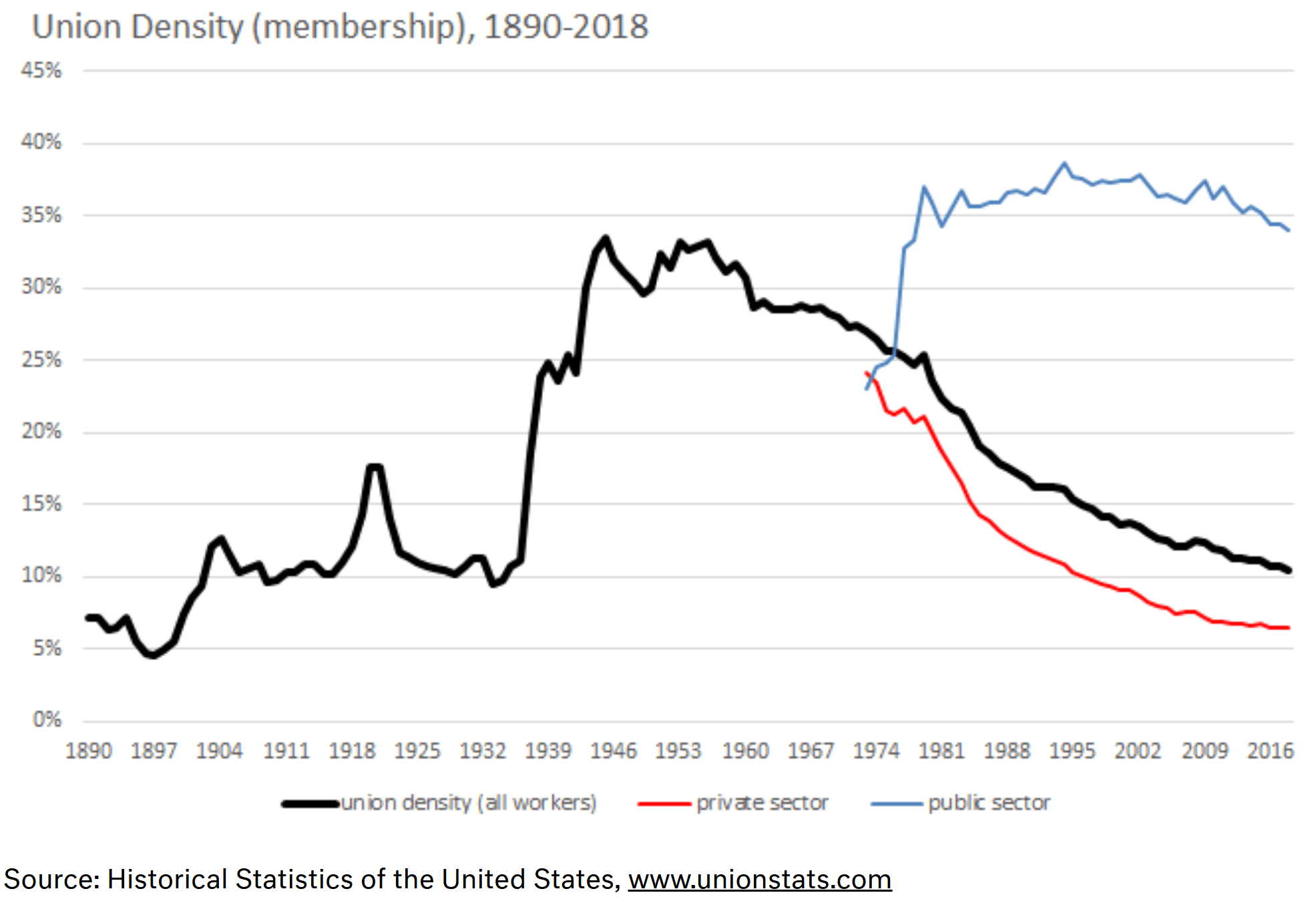
At this point, union coverage is around 10% in the U.S., though much higher in the public than the private sector (the figure below ends in 2018 but that’s still around where we are), and much lower than in most of Europe and especially in Scandinavia, where labor’s role in double movement has been especially powerful.
But what are the chances of a revived labor movement? If that’s what it takes to bring back pressure from below, we’re toast, right?

Wrong!

First, look at what happened in 1932 when union membership jumped more than 3-fold. Yes, it was the Great Depression, a massive failure of capitalism that laid bare what can happen when capital is unconstrained, thereby heralding in a strong counter-movement. But more than that, it was policy, including the National Industrial Recovery Act and the National Labor Relations Act, which, for the first time in our nation, created the legal framework supporting unionization.

In our context, it was a moment when government was forced to acknowledge and address the fact that absent pressure from below, pressure from above would break the system. And the legislation that followed unleashed strong, untapped demand for union coverage.

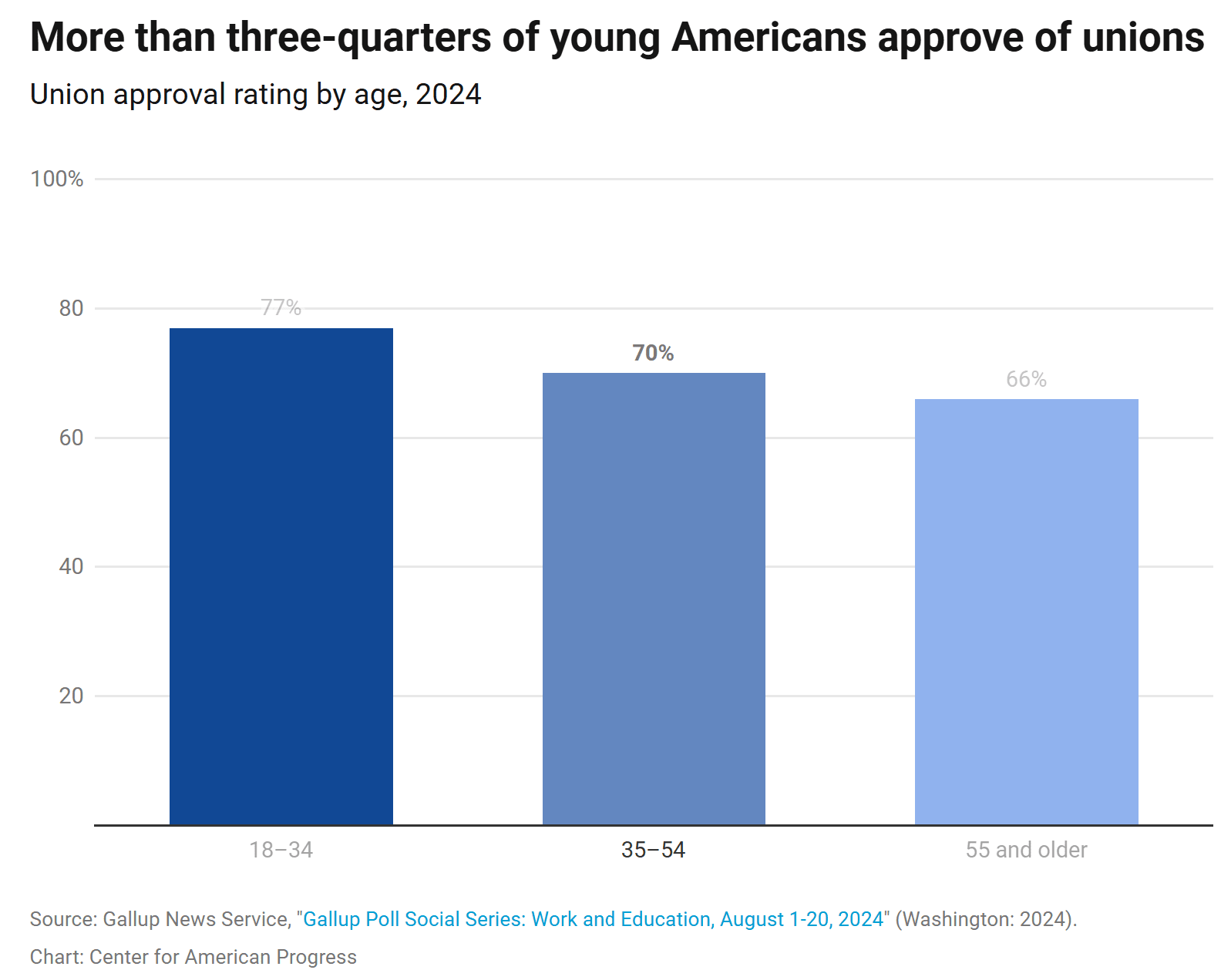
The thing is, that same untapped demand exists today. EPI points out that “in 2023, [when about 16 million workers were covered] more than 60 million workers wanted to join a union but couldn’t do so.” The figure below, from the Center for American Progress’ American Worker Project (a deep resource for this information), shows that union approval in public opinion ranges from two-thirds to three-quarters. Again, as these links make clear, the gap between demand for union coverage and its supply is a policy problem. The playing field is tilted against union organizing, such that in bargain-power conflicts between labor and capital, labor’s fighting with an anvil around its neck.
Look at the public sector line in the first figure above. The big difference there is that the process of forming and building public-sector unions is far more legally protected than in the private sector, where there’s virtually no penalty for blocking unions’ efforts to organize, even when such blockage violates standing labor laws. The links above explain policy proposals like the PRO Act, designed to remove these blockages, giving workers the chance they’ve long lacked to pursue their legal right to union coverage.

All of which leads to my Labor Day message. History is clear that capitalism remains a highly effective system of generating growth and technological gains. But without an organized and aptly sized political counterforce, it will concentrate wealth and power in ways that will leave huge swaths of the population behind and erode the guardrails that are essential for containing the system’s excesses.

That is where we are now, and a major reason for that, as John points out, is that the size and power of the labor movement, a force that has throughout history played this role, is insufficient.

That’s the bad news. The good news is that there is a strong demand to rebalance this skewed power imbalance, a demand that’s growing as Trump continues to build on and abuse the power of the presidency in ways that redound against the very working class he claimed he’d help. And there are policies to tap that demand.

Even without a much stronger labor movement, anti-incumbency and the sheer incompetence of the current administration may bring them down. But that’s not good enough as recent history suggests it just means we keep swinging back-and-forth from one side to other, with no foundation upon which to build a lasting coalition for economic justice and balanced power.

That foundation requires a strong labor movement and it is well within our grasp to build it.

Jared Bernstein is a former chair of the White House Council of Economic Advisers under President Joe Biden. He is a senior fellow at the Council on Budget and Policy Priorities.

Reprinted with permission from Jared's Substack. Please consider subscribing.
The Failure To Raise The Federal Minimum Wage Is A Moral Outrage

The Failure To Raise The Federal Minimum Wage Is A Moral Outrage

Reprinted with permission from DCReport

Very few of the poorest paid workers in America have unions to advocate for them, but many have a proxy for unions: government.

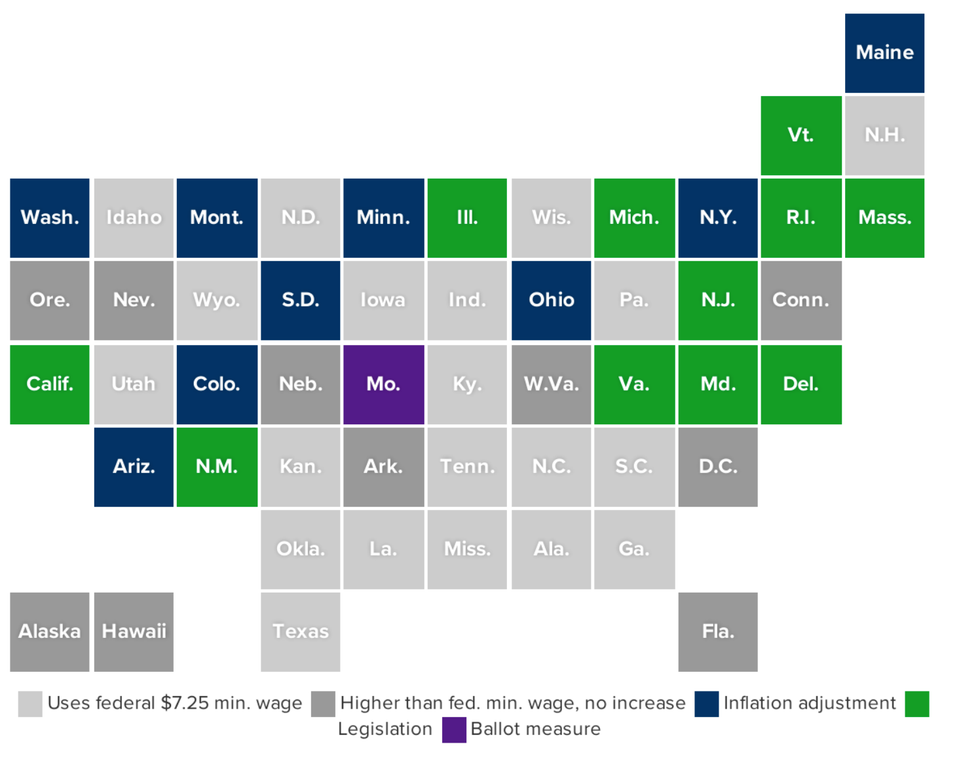
The minimum wage rose in 21 states this month thanks to a combination of ballot measures passed by voters, state laws raising the minimum and automatic inflation adjusters authorized by nine legislatures. These laws set a floor, a minimum standard, of pay.

That’s not as good as it could be. Indeed, it’s a glass-less-than-half-full scenario for the lowest paid American workers in 29 states. For them, the New Year meant continuing to labor for the same old inadequate wages.

Voting out those officeholders who use their power to keep the poor impoverished, especially those who do so while claiming to be Christians, would solve this problem of favoring capital at the expense of labor. It would also save money because people with inadequate incomes use a host of social services that cost taxpayers.

The federal minimum wage increased last in 2009 thanks to legislation signed by President George W. Bush. That law authorized three consecutive annual increases. Since then, Republicans have blocked every effort to raise the minimum wage even as inflation erodes its value.

The $7.25 that took effect in 2009 is worth less than $5.50 in today’s money, the government’s official inflation calculator shows. That calculator tends to understate the effects of rising prices on the poor because they spend so much of their money on food, energy and rent.

Economy Up, Minimum Wage Down

Compare this with1969, when the nominal minimum wage was $1.60. That’s the equivalent of $12.50 today. Our country today is a vastly wealthier country with a Gross Domestic Product per person of $66,144, about three-quarters larger than in 1969. Yet the minimum wage has shrunk dramatically rather than grown in tandem with inflation, the economy or overall worker productivity as lawmakers have bit-by-bit tilted the economic playing field in favor of investors and against workers.

You can check the minimum wage in your state and what effect state law will have on future pay in a report from the Economic Policy Institute, which focuses on the poor and poorly paid workers.


Minimum Wage Workers In 21 States Got A Raise On New Year's Day

States with minimum wage increases effective January 1, 2022 by type of increase

Notes: The New York State increase took effect on December 21, 2021. Source: Economic Policy Institute
Republicans in Congress block every proposal to raise the federal minimum wage. They claim, falsely, that paying higher wages would ruin many small businesses and would mostly benefit teenagers, neither of which is even close to being true.

Studies of counties that share a border at a state line in which one side raised the minimum wage and the other didn’t find strong earnings effects and no employment effects of minimum wage increases.

Bible Belt States

Sixty percent of minimum wage workers are age 25 or older, the Bureau of Labor Statistics says. The highest levels of workers being paid the minimum wage or less are found in so-called Bible Belt states, which are also among the poorest states. About 5% of workers in Louisiana and South Carolina earn the minimum wage or less as do about four percent in Mississippi.

Raising the minimum wage, numerous studies have shown, may eliminate one in 200 low-wage jobs. The increased pay to the other 199 workers would be vastly greater than the loss of that one job, increasing overall capacity to buy goods and services. That is, raising the minimum wage is a win for workers, for businesses with products and services to sell. Customers have more to spend; tax more revenue flows in and less is spent on subsidies for the poorest workers among us.

The resistance to raising the minimum wage among politicians who shout that they are Christians is especially appalling given the many teachings in testaments Old and New about paying workers what their labor is worth and the Christian obligation to sacrifice for the poor.

The Baylor University Center for Christian Ethics shows simply and eloquently why actual Christians should support a living wage to protect workers against bad employers:

Since the 13th century, Christians have urged employers to pay a just wage—not the low payment that desperate workers will accept, but the amount they would take for their labor if they were neither coerced nor deceived nor bargaining from a vastly unequal position.

Indeed, “remuneration for labor is to be such that man may be furnished the means to cultivate worthily his own material, social, cultural, and spiritual life and that of his dependents,” wrote Pope Paul VI in Gaudium et Spes [the Pastoral Constitution on the Church in the Modern World] (1965).

By itself, this appeal is impractical, says [Prof.] Jerold Waltman. “Unless all employers are equally convinced of the rightness of paying a just wage, and all do so in fact, the unscrupulous employer wins a competitive advantage. Therefore, only a law compelling all employers to pay the just wage will level the playing field.”

Moral Duty

Consider this moral duty to pay a living wage in the context of the law on minimum wages for restaurant and bar workers. President Bill Clinton and Congress fixed the minimum wage in 1993 at $2.13. Adjusted for inflation that’s just $1.10 an hour today.

Waitstaff, busboys and the like must apply their tips to fill the gap between $2.13 and $7.25. That means that the first $5.12 in tips they collect each hour is just a subsidy to the restaurant or bar owner who pays only the federal minimum.

To get an idea of just how hard congressional Republicans are making life for the lowest-paid workers consider this: The average cost of a municipal bus to get to work and back was $3.20 – and that was in 2019. That’s an hour and a half of minimum wage restaurant work just for bus fare.

Wage Gap Between Black And White Americans Is At 40-Year High

Wage Gap Between Black And White Americans Is At 40-Year High

A new report from the Economic Policy Institute reveals a stark disparity between the hourly pay of blacks and whites; on average, whites make 26.7 percent more than blacks, earning $25.22 an hour compared with $18.49 for blacks. Amazingly, blacks today earn less relative to their white counterparts than they did in 1979.

“The finding that stands out the most, our major result, is that the racial wage gaps were larger in 2015 than they were in 1979. That’s huge because the impression people have, in general, is we know there’s still racism in this country, but we think or at least believe that it’s getting better,” Valerie Wilson, director of EPI’s program on race, ethnicity and the economy, told the Guardian.

According to EPI, the driving force behind the pay gap is “discrimination… and growing earnings inequality in general.”

“Race is not a skill or characteristic that should have any market value as it relates to your wages, but it does,” Wilson said.

According to the report, wage inequalities build up over time, which explains why black male college graduates “started the 1980s with less than 10 percent disadvantage relative to white male college graduates, but by 2014 similarly educated new entrants were at a roughly 18 percent disadvantage.”

Wilson also noted factors like the mass incarceration rates for black men and women in the 1980s and ’90s and barriers to hiring for black individuals in general also contribute to the pay disparity. Studies show people with black-sounding names are less likely to be hired than those with white-sounding names.

No doubt the group facing the most discrimination in the workforce is black women. While the gender wage gap for white women shrunk in the 1990s, the pay gap for black women remained largely the same.

“Black women are faced with both kinds of discrimination,” Wilson said. “And that racial disadvantage has basically limited their achievements in narrowing the gender gap.”

Elizabeth Preza is an AlterNet staff writer focusing on politics, media and cultural criticism. Follow her on Twitter @lizacisms.

Photo: Cars travel north towards Los Angeles on interstate highway 5 in San Diego, California February 10, 2016. REUTERS/Mike Blake 

Trump’s 5 Biggest Lies

Trump’s 5 Biggest Lies

It’s true. Donald Trump probably should be winning this election.

That’s not just the assessment of Trump himself — who has reached the stage of mourning where all he does is complain about how powerless he is to the mean old press and warn his supporters that their votes probably won’t even count. That’s the verdict of the “Time for a Change” model developed by political scientist Alan I. Abramowitz, which has correctly predicted every presidential election since 1988.

But Abramowitz doesn’t see a Trump victory coming any more than Trump does.

“Based on the results of other recent presidential elections, however, as well as Trump’s extraordinary unpopularity, it appears very likely that the Republican vote share will fall several points below what would be expected if the GOP had nominated a mainstream candidate and that candidate had run a reasonably competent campaign,” he wrote last week. “Therefore, despite the prediction of the Time for Change model, Clinton should probably be considered a strong favorite to win the 2016 presidential election as suggested by the results of recent national and state polls.”

Americans want a change. Maybe it’s the eight years of a Democrat. Maybe it’s the 36 years of conservative economics spewing money up while trickling nothing down.

Whatever the cause, it’s increasingly clear the change they’re seeking won’t be coming from Donald Trump.

Screen Shot 2016-08-14 at 9.23.47 AM

In a recent YouGov poll, 50 percent of voters found that Trump’s version of change feels more like regression, which makes sense since that’s the promise of his campaign — to return American to a time when minorities, the LGBTQ community, women and people with pre-existing conditions had fewer rights.

If Trump ends up winning, it will be because Hillary Clinton presents a too rosy view of the possibilities America faces. But Trump’s defeat will come from his assertion that he “alone” can deliver a change that America doesn’t want.

It isn’t just Trump’s policies that are extraordinarily unpopular. It’s the man, personally.

While about 30 percent of the population loves him and would believe him if he started quoting passages from The Hobbit and insisting they were from the Gospel of Luke, much of America senses that he’s trying to sucker them with a constant stream of lies and propaganda more suited for convincing cult members to drink Kool-Aid than sustaining a democracy.

Here are the five biggest lies Trump keeps trying to sell a nation that  doesn’t seem to be in the market for his nonsense.

  1. His supporters are the only “real Americans.”
    In several recent polls, Trump has no — zero — support from African Americans. Trump’s support among Latinos is lingering around 20 percent, much worse than Romney’s 27 percent, which was worse than John McCain’s support in the low thirties, which was worse than George W. Bush, the last Republican nominee to get near 40 percent. To win, Republicans either need to increase to Romney level of support among minority voters or attract more white votes than any candidate since 1988. Instead, Trump is doing worse with white voters, suffering unprecedented losses with college-educated Republicans and Republican women. Still, somehow, Trump has convinced America’s loudest, angriest, and most ungrateful minority that they’re silent and a majority. “Most Americans are white, most are Christian, most don’t have college degrees, and most live in the South or Midwest Census Bureau regions,” FiveThirtyEight‘s Nate Silver wrote. “And yet, only about 1 in 5 voters meets all of these descriptions.” America’s working class is increasingly diverse. While Trump has endeavored to do something Republicans have failed to do for generations — empathize with the pain of American workers who’ve been displaced by globalization — he’s speaking to a stereotype of blue-collar hard hats who won Richard Nixon the 1968 election, while ignoring the millions of service and retail workers who increasingly represent the real working class of America. That working class is sick of blaming minorities for their suffering and is ready to take on the real problem — a system that’s tilted entirely to the rich.
  2. He was against the Iraq War.
    Trump’s one foreign policy credential is a lie. Unlike Barack Obama, Trump was for the war when it was hardest to be against it. And he was for the withdrawal that he now blames for the creation of ISIS. In a sane world what Trump feels about Iraq would be irrelevant, but since he’s using this to bolster his credentials to seek a job where he has promised to use torture, intentionally kill civilians, and shut down basic freedoms of the press and religion that we take for granted, he needs to be confronted on this lie every time he trots it out.
  3. He would help workers.
    In his big economic speech in Detroit last week Trump completed his evolution to full Romneyism/ Bushism/ Rubioism while maintaining his trademark racism. It’s the same old tax breaks that mostly or only help the rich, matched with… nothing to help workers. “If such policies were effective, we would remember George W. Bush’s presidency as one of great prosperity, instead of a period of stagnant wages for blue- and white-collar workers,” said Larry Mishel, president of the Economic Policy Institute. Trump would uninsure 20 million Americans from working families while pushing policies that would drive wages lower and lower, eliminating one of the biggest raises workers have gotten in decades.
  4. The press is killing his campaign. 
    When he’s focused enough to care, Trump is now running against the press. As if the press were to blame for a disastrous campaign that has Republicans abandoning him like he was the Iraq War in 2007. Trump’s act used to feature him bragging about polls and acting awed over his success. Now that the stench of failure follows him like a dazed Mike Pence, he’s stuck ranting against the institution that made his rise possible — free media. The Washington Post‘s Greg Sargent points out that while Trump’s “dominate all media” strategy worked in the GOP primary, he was completely unprepared for how “the coverage and scrutiny are inevitably getting a lot harsher, at precisely the moment when Trump is devolving into his worst bouts of depravity and unhinged behavior yet.”
  5. Society is rigged against a fortunate son who’s relied on government help his entire career.
    Trump’s rich daddy gave him every advantage known to man, which helped Trump avoid the draft and launch his business. The courts protected him from creditors — over and over again. City government and tax breaks fueled his first development projects. Powerful lobbyists keep him from paying taxes. Conservative media gave him a platform. Cable news desperate for relevance let him exploit their airwaves to perform informercials of hate. And a Republican Party eager to win an election that could decide the Supreme Court for generations begged him not to leave it. Yes, the system is rigged — for Donald Trump and his kids. And his escalating wrath comes from knowing that as rigged as his success has been, he’s facing the greatest failure of his life, perhaps the most resounding defeat suffered by any candidate in a generation. And he’s losing fair and square. Sad!

Shop our Store

Headlines

Editor's Blog

Corona Virus

Trending

World