Tag: energy independence
Spiking Oil Prices Will Damage Economy Even As US Keeps Pumping Crude

Spiking Oil Prices Will Damage Economy Even As US Keeps Pumping Crude

There has been a lot of sloppy commentary from people who should know better about who is being hit hardest by the runup in oil and natural gas prices since the start of the war in Iran. There’s a simple story where the countries in Europe and East Asia are the big losers, because they produce relatively little of their own oil. By contrast, the United States is supposedly relatively well-off since we are largely self-sufficient and in fact a net exporter of natural gas.

While the point about the U.S. having large oil and gas production is important, it distorts the impact in important ways. The simplest way to think about the surge in oil and natural gas prices is as a big tax on consumers of these products.

When people pay $3.50 at the pumps, instead of the $2.80 we paid a month ago, this would be the same thing to consumers as if the government imposed a 70 cent a gallon gas tax. There would be a similar story with higher prices for home heating oil or natural gas. From the standpoint of consumers, the price increases are the same as if they just got hit with a big tax increase.

The difference is that instead of the money going to the government, as it would with a tax, it’s going to the oil and gas industry, Donald Trump’s campaign contributors. In principle, for a country like the United States, which is largely self-sufficient in oil and gas, if we could just rebate the money people paid in higher prices back to consumers, all would be fine.

But that sort of rebate would require big taxes, like a windfall profit tax, on the oil and gas industry. Since this industry is very powerful politically, this sort of recycling of higher revenue is not very likely. Therefore, for those of us who don’t have a lot of stock in oil and gas companies, the impact of higher prices is what we pay at the pump or for heating our homes. It doesn’t make a great deal of difference whether the people getting that money live in Houston or Saudi Arabia, it’s not going to us.

From that vantage point, if we do a cross-country comparison of the hit from higher oil and gas prices, it really just depends on how much of the stuff we consume relative to our income. By this measure, the United States does not fare especially well.
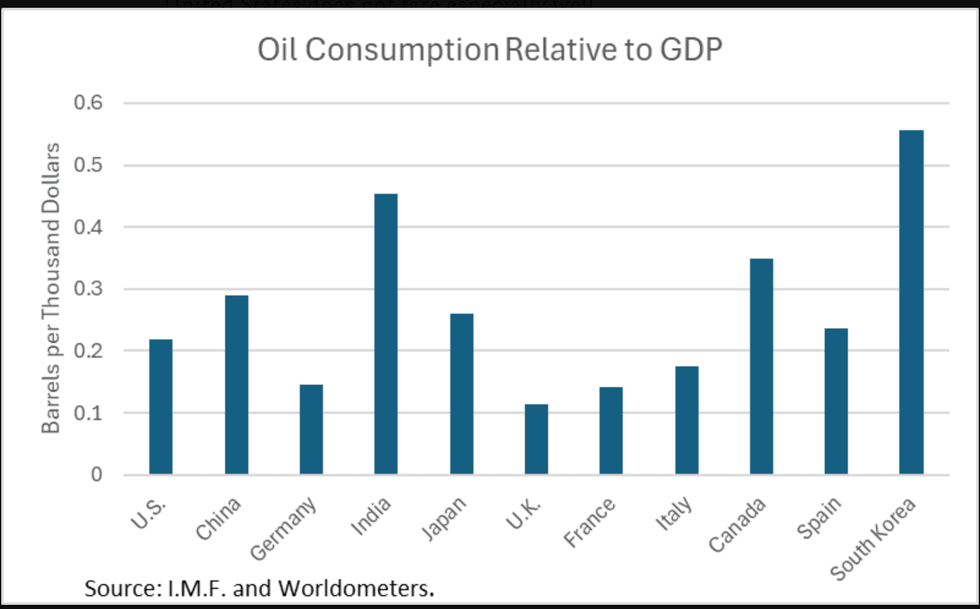
U.S. oil consumption per unit of GDP is pretty much in the middle of the pack for wealthy countries. We use slightly less oil per dollar than Spain and Japan, and far less than Canada. South Korea uses more than twice as much oil per dollar of GDP than the United States.[1]

By contrast, the other European countries use less oil per unit of GDP. Italy and Germany both use somewhat less oil per unit of GDP, while France uses about one-third as much, and the UK just over half as much. Both China and India using considerably more oil per unit of GDP, with India using more than twice as much.

The story with natural gas is somewhat more complicated. Here, domestic production does matter, since natural gas is far more expensive to ship overseas. Prices in Europe and Asia can be two to four times higher than in the United States. Therefore, the loss of natural gas from the Middle East will be a big hit to Europe and Asia, while having limited impact on the U.S.

Most European countries use considerably less natural gas per unit of GDP than the U.S. Italy uses roughly a quarter less, while Germany, Spain, and the UK all use about half as much. France only uses about a third as much natural gas as the United States.

In East Asia, Japan uses about 30 percent less per unit of GDP, while South Korea uses about 20 percent more. China uses about 25 percent less, while India uses half as much.

In terms of who gets the biggest hit by the flow and oil and gas from the Middle East being cut off, it seems clear that the East Asian countries will see the worst effects. Japan, and especially South Korea, will be hard hit by both higher oil and higher gas prices.

Consumers in European countries will mostly see less of an impact from the rise in oil prices than consumers in the United States. On the other hand, since natural gas prices are likely to rise much more outside the U.S., Europe and Asia are likely to see much more impact, as the huge domestic production limits the impact in the United States.

The cutoff of oil from the Middle East is a huge blow to the world economy and will likely cause a recession if it lasts for a long period of time. The takeaway here is that while the large amount of natural gas production in the United States insulates it from the impact seen by European and East Asian countries, greater domestic oil production does not do much to help consumers paying more at the pump.

Dean Baker is a senior economist at the Center for Economic and Policy Research and the author of the 2016 book Rigged: How Globalization and the Rules of the Modern Economy Were Structured to Make the Rich Richer. Please consider subscribing to his Substack.

Reprinted with permission from Dean Baker.
Drill Baby Drill? How 'MAGA Brain' May Kill US Energy Independence

Drill Baby Drill? How 'MAGA Brain' May Kill US Energy Independence

Does anyone remember “Drill, baby, drill?” What with all the tumult over Donald Trump’s disastrous trade war, many have forgotten that energy production played a big role in his second inaugural address. He claimed that we were facing a “national energy emergency,” and that he would bring prices down and make America rich by releasing the “liquid gold under our feet.”

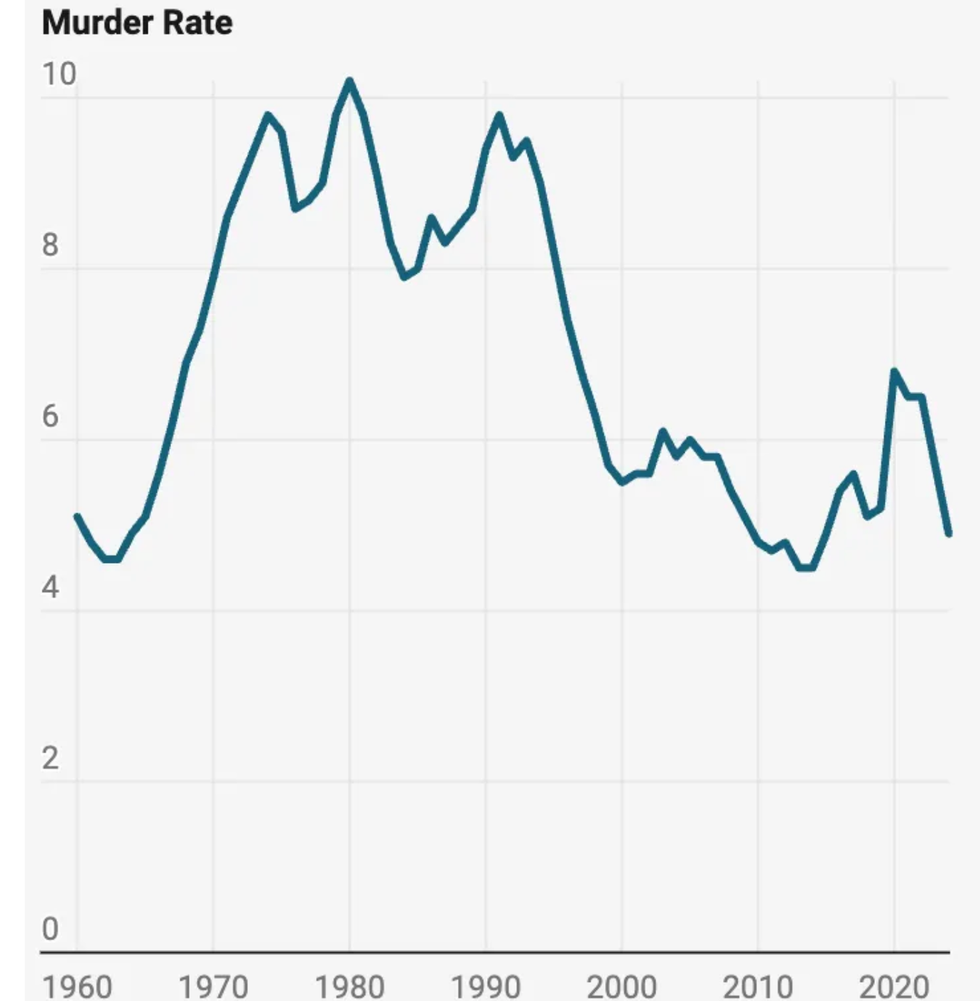
There was, in fact, no energy emergency. One thing you always find Trump and MAGA in general doing is assuming that the real world must look the way their prejudices say it should look. Squishy liberals who believe in rule of law were in charge last year, so America must have been in the grip of a terrifying crime wave — even though the homicide rate in 2024 was close to a 65-year low:


Source: Jeff Asher

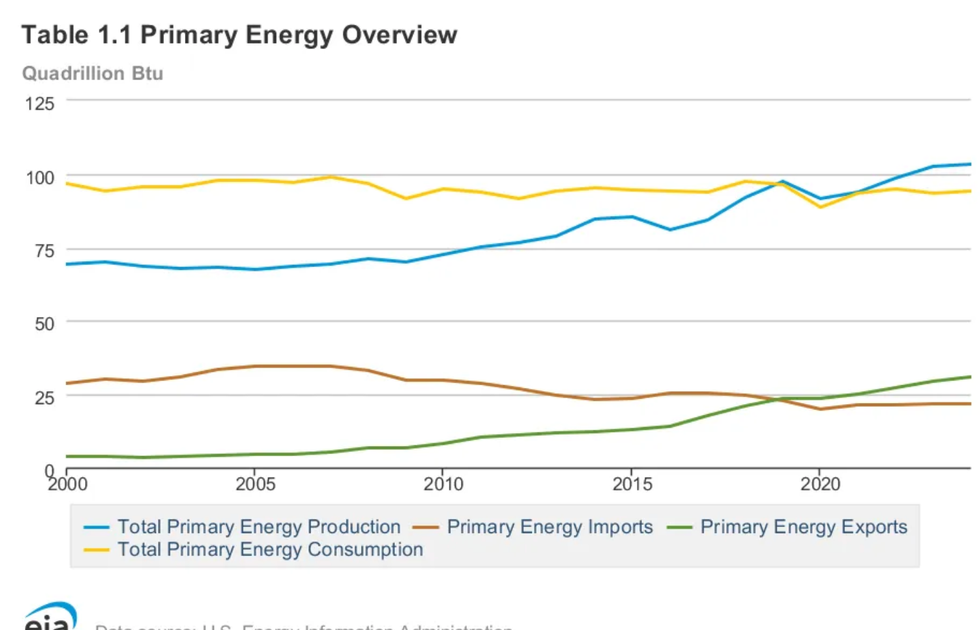
Similarly, the Biden administration was full of woke environmentalists who believe in the global warming hoax, so they must have crippled energy production — even though America in the Biden years was, for the first time in generations, producing more energy than it consumed:

When I wrote about this at the time, I suggested that Trump was suffering from "MAGA brain,"

the belief that the only way you can get results is by being tough and nasty, avoiding anything that might be considered woke. Thus, to achieve energy independence, we must put aside worries about pollution and climate change while blocking clean energy.

So administrations that care about climate change and the environment in general must be crippling the energy sector. Biden may have presided over record oil production and growing energy exports, but we’ll just say that we have an energy emergency anyway.

You can probably guess what’s coming next. There appears to be a real chance that America will lose its newly reacquired energy independence. And if it does, we know who will be responsible: Trump himself.

To see why, we need to look at the factors responsible for America’s return to energy self-sufficiency.

One of these is fracking — extracting oil and gas embedded in shale by fracturing that shale with high-pressure liquids. Yes, there are serious environmental issues involved both in the fracking process and in the fact that more fossil fuel production adds to greenhouse gas emissions. But while the Biden administration took climate change seriously, that didn’t stop oil and gas production from rising on its watch.

The other factor was the incredible rise of renewable energy. Not that long ago wind and solar power were widely seen as silly, hippy-dippy conceits. Now they’re major contributors to energy supply:


Data source: US Energy Information Administration

In the case of shale, it’s all about prices. Drilling new shale wells is expensive. In fact, Trump’s vision of drastically lower oil prices never made any sense, because any large drop in oil prices would make new shale wells unprofitable. And since production from any given shale well drops quickly over time, anything that caused new drilling to fall substantially would quickly translate into declining oil production.

How low would prices have to go to shrink the U.S. oil industry? Recently the Dallas Fed did a survey which suggested that drilling in many major fields would stop if the price per barrel fell below the low 60s:

And that was before Trump’s tariffs raised costs, so the critical price is probably higher now. And guess what: oil prices right now are at a level where we can expect production to fall. Here are oil futures:

Why did oil get cheap? Look at the sudden drop on April 2, a.k.a. Liberation Day, when Trump first announced extreme tariffs. It’s obvious that oil prices are down thanks to pessimism about the global economy, which in turn is tied to Trump’s trade war. And by the way, that war is by no means over. A new analysis by the Yale Budget Lab finds that the damaging effects of Trump’s tariffs are only modestly mitigated by his surrender to China.

And as for renewables: Trump hates them, wind power in particular. He offers crazy justifications for that hatred — did you hear about his claim that offshore wind farms kill whales? — but it’s pretty clear that he has been nursing an irrational grudge ever since he was unable to stop a Scottish wind farm that he thought ruined the view from a golf course he owns.

Oh, and I’m pretty sure that MAGA types in general dislike renewable energy because they don’t consider it manly.

So what will be the economy-boosting effects of drill, baby, drill? Nil, baby, nil.

Paul Krugman is a Nobel Prize-winning economist and former professor at MIT and Princeton who now teaches at the City University of New York's Graduate Center. From 2000 to 2024, he wrote a column for The New York Times. Please consider subscribing to his Substack, where he now posts almost every day.

Reprinted with permission from Paul Krugman Substack.

Energy Boom Brings New Focus On Rail, Pipeline Safety

Energy Boom Brings New Focus On Rail, Pipeline Safety

By Jeffrey Stinson, Stateline.org

WASHINGTON — The sharp increase in U.S. oil production and its promise of energy independence is coming with a disastrous byproduct: spills that threaten lives, communities, and the environment.

In the past 18 months, about 1.2 million gallons of crude oil produced in the United States or Canada has been spilled from train cars and pipelines in at least seven states, sparking explosions, fires, or the evacuation of homes or offices in four instances.

Nobody has to tell the residents of Lynchburg, Va., about the danger of the millions of gallons of crude oil rolling along rail lines or through pipelines every day. On April 30, more than a dozen train cars filled with crude oil derailed near Lynchburg’s downtown, causing a fire that forced hundreds of people in a 20-block area to evacuate. Nobody was injured, but thousands of gallons of oil spilled into the James River.

In response to the growing problem, the U.S. Department of Transportation last week issued proposed rules calling for upgraded railroad cars, better braking systems, and tighter speed controls.
The federal action followed stepped-up efforts by several states to try to prevent spills and respond to disasters:

The California legislature in June approved a new 6.5-cent fee on every barrel on crude oil carried by rail and some pipelines through the state. The state will use the money, estimated to bring in $11 million in the first full year, to expand its coastal spill prevention and response program to inland streams, rivers, lakes, and wetlands. It’s also beefing up its rail safety inspection program.

Minnesota Gov. Mark Dayton, a Democrat, signed legislation in May to implement stricter oversight of railroad companies, require more rail inspections, and provide for better emergency response training and preparedness. To pay for it, Minnesota this year will collect $6.4 million in fees from railroads and pipeline companies.

New Hampshire Gov. Maggie Hassan, a Democrat, signed legislation in July that authorizes the state to impose stricter preparation and response requirements on pipelines than federal law requires. The state Public Utility Commission also was given authority to inspect interstate pipelines to provide more frequent checks than federal officials give.

Oregon Democratic Gov. John Kitzhaber last week released a study of oil moving through his state that calls for more state rail inspectors, more money for training, and improved cooperation with railroads. In June, Washington Gov. Jay Inslee, a Democrat, ordered a similar review of risks, regulations, and preparedness in his state. In January, New York Democratic Gov. Andrew Cuomo also issued a similar order and dispatched inspectors to rail yards to look for defects on cars that could cause derailments.

Nearly all the action in the states was prompted by disasters governors and lawmakers saw in other states or across the border in Canada. Their worst fear is what happened in Lac-Megantic, Quebec, where 47 people were killed last July when an unattended 74-car train derailed. The spilled crude caught fire, then several cars exploded and about half the downtown was destroyed.

“I want to know how much oil will be shipped through my state and how we can be assured the kind of tragedy that happened in Quebec won’t devastate families in our communities,” Inslee said in June in ordering the study in Washington.

Matt Swenson, Dayton’s press secretary, said Minnesotans only needed to look at neighboring North Dakota to see what could happen: Last December, a train carrying grain derailed in front of a mile-long train carrying crude oil near Casselton, not far from the Minnesota border. Twenty cars spilled oil, some exploded. Fire forced evacuation of the town, but nobody was injured.

Every day, seven similar oil trains with about 110 cars carrying about 3.3 million gallons of crude travel through Minnesota, the state said. Other states are witnessing similar traffic, and it’s on the rise.

About 264 million gallons of crude oil were shipped by rail through California last year, said Alexia Retallack in the state Fish and Wildlife Department’s Office of Spill Prevention and Response. That’s 46.2 million gallons more than in 2012.

More crude oil is on the move across states as production in North America booms from the fracking of Bakken oil deposits underlying North Dakota, Montana, and Canada’s Saskatchewan and Manitoba provinces, and from the tar sands of Alberta.

Production in the United States alone will be 8.5 million barrels a day this year, the U.S. Energy Information Administration estimates. That’s estimated to grow to 9.3 million barrels daily next year. And there aren’t enough pipelines to get the crude to the nation’s 115 refineries to be turned into gasoline and other products.

Republican North Dakota Gov. Jack Dalrymple said in June that pipeline capacity in his state needs to double to about 1.4 million barrels a day by 2016 to carry all the crude produced there. Currently, the state is producing about 220,000 barrels a day more than pipes can carry.

Railroads are picking up the slack, even though the Congressional Research Service said in a May report that it can cost from $5 to $10 more a barrel than pipeline delivery. The number of carloads of crude oil, each carrying about 30,000 gallons, that ended up inside the United States rose to 435,560 last year, the Association of American Railroads says. That’s up from about 30,000 in 2010.

In a recent analysis of data from the federal Pipeline and Hazardous Material Safety Administration, the McClatchy Washington Bureau found that 1.15 million gallons of crude oil spilled from rail cars in the United States last year. That’s more than in all the years combined since the data was first collected nearly four decades ago.

The worst accident was in November in Aliceville, Ala., where 748,800 gallons spilled from a 90-car train after 12 cars derailed and three exploded. Nobody was injured.

Although widely considered safer than rail shipment of crude, pipelines do spill. A split in a pipeline in March 2013 dumped as much as 5,000 barrels of Canadian tar sands oil into a neighborhood in Mayflower, Ark.

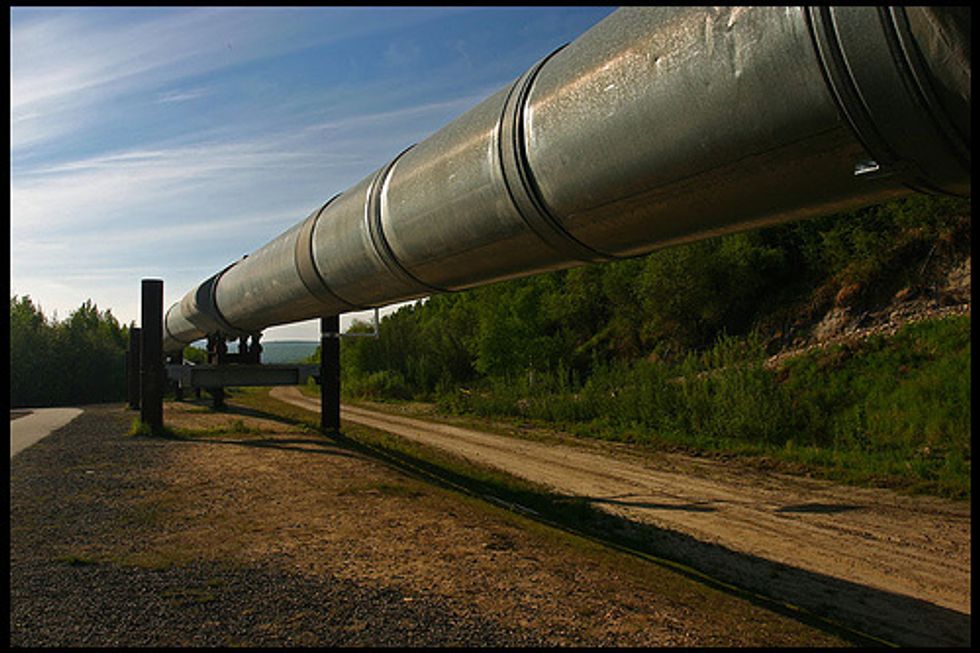
Photo: Rickz via Flickr

Interested in national news? Sign up for our daily email newsletter!

Shop our Store

Headlines

Editor's Blog

Corona Virus

Trending

World