There has been a lot of sloppy commentary from people who should know better about who is being hit hardest by the runup in oil and natural gas prices since the start of the war in Iran. There’s a simple story where the countries in Europe and East Asia are the big losers, because they produce relatively little of their own oil. By contrast, the United States is supposedly relatively well-off since we are largely self-sufficient and in fact a net exporter of natural gas.
While the point about the U.S. having large oil and gas production is important, it distorts the impact in important ways. The simplest way to think about the surge in oil and natural gas prices is as a big tax on consumers of these products.
When people pay $3.50 at the pumps, instead of the $2.80 we paid a month ago, this would be the same thing to consumers as if the government imposed a 70 cent a gallon gas tax. There would be a similar story with higher prices for home heating oil or natural gas. From the standpoint of consumers, the price increases are the same as if they just got hit with a big tax increase.
The difference is that instead of the money going to the government, as it would with a tax, it’s going to the oil and gas industry, Donald Trump’s campaign contributors. In principle, for a country like the United States, which is largely self-sufficient in oil and gas, if we could just rebate the money people paid in higher prices back to consumers, all would be fine.
But that sort of rebate would require big taxes, like a windfall profit tax, on the oil and gas industry. Since this industry is very powerful politically, this sort of recycling of higher revenue is not very likely. Therefore, for those of us who don’t have a lot of stock in oil and gas companies, the impact of higher prices is what we pay at the pump or for heating our homes. It doesn’t make a great deal of difference whether the people getting that money live in Houston or Saudi Arabia, it’s not going to us.
From that vantage point, if we do a cross-country comparison of the hit from higher oil and gas prices, it really just depends on how much of the stuff we consume relative to our income. By this measure, the United States does not fare especially well.
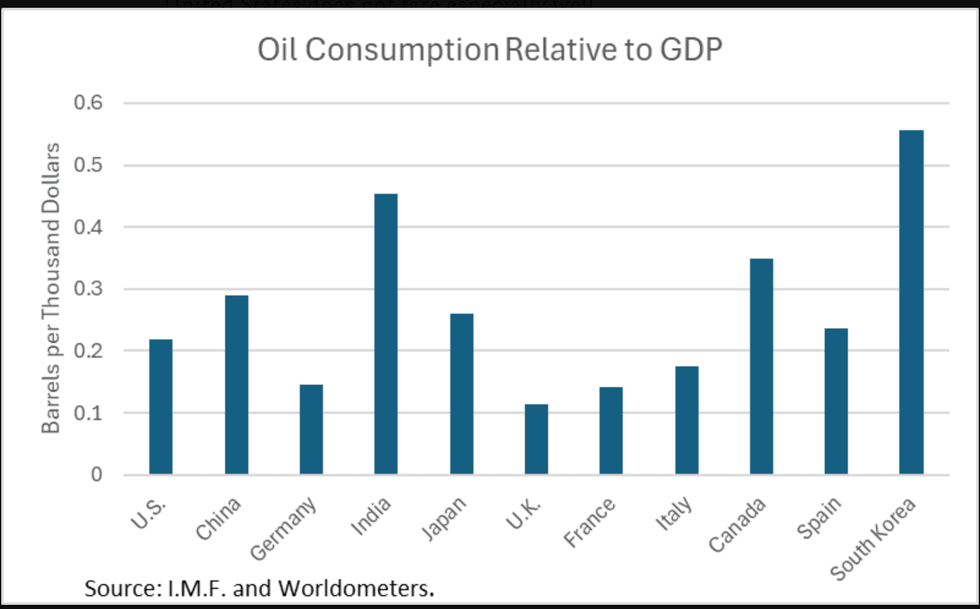
U.S. oil consumption per unit of GDP is pretty much in the middle of the pack for wealthy countries. We use slightly less oil per dollar than Spain and Japan, and far less than Canada. South Korea uses more than twice as much oil per dollar of GDP than the United States.[1]
By contrast, the other European countries use less oil per unit of GDP. Italy and Germany both use somewhat less oil per unit of GDP, while France uses about one-third as much, and the UK just over half as much. Both China and India using considerably more oil per unit of GDP, with India using more than twice as much.
The story with natural gas is somewhat more complicated. Here, domestic production does matter, since natural gas is far more expensive to ship overseas. Prices in Europe and Asia can be two to four times higher than in the United States. Therefore, the loss of natural gas from the Middle East will be a big hit to Europe and Asia, while having limited impact on the U.S.
Most European countries use considerably less natural gas per unit of GDP than the U.S. Italy uses roughly a quarter less, while Germany, Spain, and the UK all use about half as much. France only uses about a third as much natural gas as the United States.
In East Asia, Japan uses about 30 percent less per unit of GDP, while South Korea uses about 20 percent more. China uses about 25 percent less, while India uses half as much.
In terms of who gets the biggest hit by the flow and oil and gas from the Middle East being cut off, it seems clear that the East Asian countries will see the worst effects. Japan, and especially South Korea, will be hard hit by both higher oil and higher gas prices.
Consumers in European countries will mostly see less of an impact from the rise in oil prices than consumers in the United States. On the other hand, since natural gas prices are likely to rise much more outside the U.S., Europe and Asia are likely to see much more impact, as the huge domestic production limits the impact in the United States.
The cutoff of oil from the Middle East is a huge blow to the world economy and will likely cause a recession if it lasts for a long period of time. The takeaway here is that while the large amount of natural gas production in the United States insulates it from the impact seen by European and East Asian countries, greater domestic oil production does not do much to help consumers paying more at the pump.
Dean Baker is a senior economist at the Center for Economic and Policy Research and the author of the 2016 book Rigged: How Globalization and the Rules of the Modern Economy Were Structured to Make the Rich Richer. Please consider subscribing to his Substack.
Reprinted with permission from Dean Baker.
- Why Trump’s Oil Deal Is Bad For Americans ›
- Remember When Trump Jacked Up Oil Prices? Neither Does The Media ›
- Fortunes Of War: How Will Trump Deal With Spiking Gasoline Prices? ›
- 'One-Hit Wonder': Trump's Military Adventurism Is Sinking In Strait Of Hormuz - National Memo ›