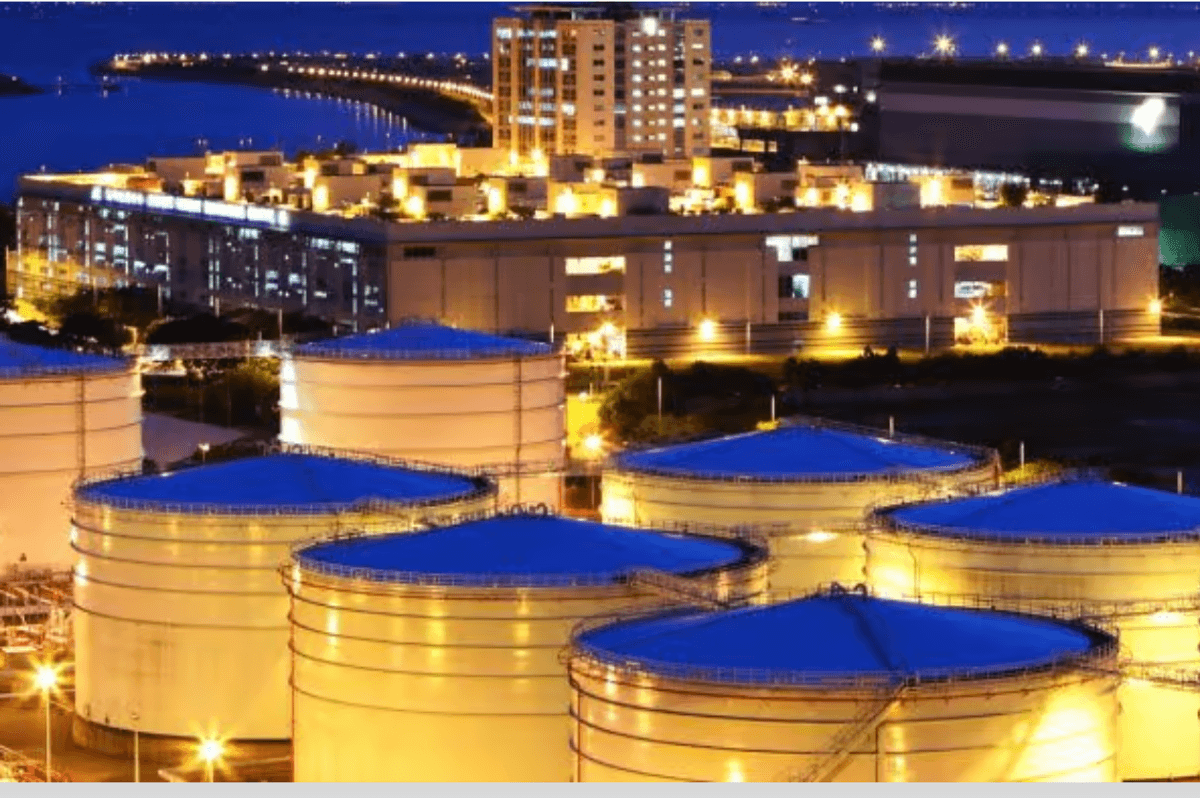
Strategic Petroleum Reserve storage facility
$3.20 a gallon—today’s national gas price—is not that high a price in historical terms. But it’s 40 cents higher than $2.80, where the pump price was a few months ago. A jump of the magnitude you see above is rare, and only happens when there’s some sort of supply shock. Fill up a 15-gallon tank twice a month and that's an extra $12, which isn’t game changing for anyone, but is noticeable.
When I left the Obama administration, the president was kind enough to have my family come in for a quick goodbye in the Oval. The gas price was up at the time, and I have a great memory of my nine-year old daughter asking the POTUS why he gets blamed for high gas prices. He gave her that big, broad Obama smile and said “I know, right?!” I’m pretty sure he high-fived her.
Fact is, the president gets credit and blame for the gas price, which makes about zero economic sense. If ever there was a global price set in global markets—with cartel influence, of course—it’s the oil price. That price per barrel is up about $17 since January, and given that a $10 increase corresponds to $0.25 more at the pump, the $0.40 increase is what you’d expect.
In this case, however, the Trump administration's choice to go to war is behind the spike. The West Texas Intermediate crude (WTI) oil price is up about $10 since the war started, and if you’ve followed the developments, you know that there are ongoing disruptions to shipping, production, and refining, and not just for oil but for natural gas too.
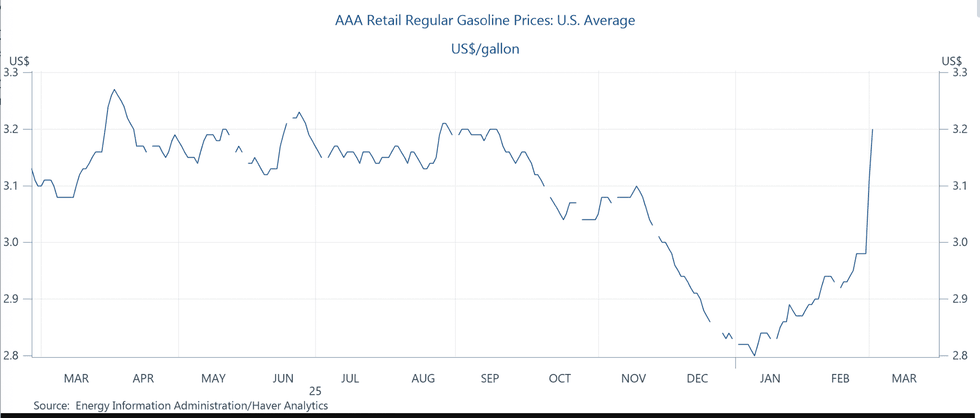 Source: Energy Information Administration/Haver Analytics
I guarantee you this isn’t going unnoticed at the White House and I also guarantee you they’re talking about the Strategic Petroleum Reserve (SPR), the “world’s largest stockpile of emergency crude oil.” The SPR, which is a bit over half-full right now (415 million barrels of ~700mb capacity), was last tapped by the Biden administration when, post-Russia’s invasion of Ukraine, oil topped $100 per barrel. That release, which occurred in sync with that of other countries’ reserves, pretty quickly lowered prices by about $0.35, according to estimates at the time (one wonders if the Trump administration, given their antipathy towards foreign governments, could organize any such multi-country intervention).
The Trump White House says they have no plans to tap the SPR, but I’m skeptical of their claim. As I’ve stressed here many times, Trump is justly getting clobbered on affordability, as he wavers between saying it’s a hoax and he’s solved it. But the one thing he’s had to tout in this space, and it’s a big one, is the low gas price. Again, even with this recent bump, that price is still low, but if we’ve learned anything about affordability dynamics, it’s that sudden price shocks of key household-market-basket components are a source of economic stress.
As I’ve stressed in discussions of the economics of this new conflict, its impact is a function of its duration. If it ends quickly, I’d expect blocked supply chains to reopen and oil/natural gas production/refinement to recommence pretty quickly.
But when it comes to the gas price, there’s rockets and there’s feathers.
When oil prices shoot upward, gas prices rise with them. And when oil prices fall, gasoline prices also fall; but they can fall at a slower rate. Economists refer to this market dynamic as “asymmetric pass-through.” A more colorful description of the phenomenon is “rockets and feathers.”
The explanation has to do with market power and consumer search patterns. Re the latter, apparently, when the gas price goes up, we tend to exert a bit more effort to search for cheaper options. But when it starts to fall, we’re just happy to see it come down and we don’t search as much, dampening price-reducing competitive forces.
None of this gas-price analysis speaks to the geopolitics of the war. There are, of course, just wars worth fighting regardless of their impacts on prices at home. With 80-90 percent of Iranians anxious to see the toppling of the oppressive theocracy under which they suffered, a few more cents at the pump is arguably worth it. But I don’t see how that’s the case when there’s no plan for a true regime change and an uncomfortably high chance that the power vacuum we and Israel have created is filled by an equally, or even more, repressive regime.
Meanwhile, we’ll see how this plays out in coming days in terms of oil, gas, and public opinion. My sense is that a lot of people are thinking this isn’t what they voted for.
Jared Bernstein is a former chair of the White House Council of Economic Advisers under President Joe Biden. He is a senior fellow at the Council on Budget and Policy Priorities. Please consider subscribing to his Substack.
Reprinted with permission from Econjared.
- Why Trump's 'Erratic' Move Against Iran's Nuclear Proliferation Will Backfire ›
- Iran Negotiators Had Offered Trump A Better Nuclear Deal Than Obama Got ›
- War's Oil Shock May Not Sink Economy, But Trump Policy Still Perilous ›
- Spiking Oil Prices Will Damage Economy Even As US Keeps Pumping Crude - National Memo ›
- 'One-Hit Wonder': Trump's Military Adventurism Is Sinking In Strait Of Hormuz - National Memo ›
- Spinning Trump's Oil Crisis, Energy Secretary Flails And Apologizes - National Memo ›
- Rising Gas Prices Enraged Republicans Under Biden, But Not Any More - National Memo ›
- The Energy Future We Could Have Had, If Only Trump Hadn't Trashed It ›
- Nation's Electric Bill Jumped In 2025 Despite Trump's Promise To Slash Cost - National Memo ›
- Here's How Gas Prices Will Rise This Year (And Eat Your Tax Refund) - National Memo ›
- Orange Man Goes Green? How Trump's Attack On Iran Is Advancing Clean Energy - National Memo ›
- Ceasefire! What Might This Mean for the Strait, the Markets, and You - National Memo ›
- Why China's EV Industry Should Honor Trump As 'Salesman Of The Year' - National Memo ›
- Trump's Murky Iran Ceasefire Won't Instantly Restore Global Oil Supplies - National Memo ›
- Average Gas Prices Were Slightly Higher Under Biden, But Trump Is Closing In Fast! - National Memo ›
- Is The Trump Administration Using Media Leaks To Manipulate Oil Markets? - National Memo ›
- Gas prices are set to rise amid U.S.-Israeli war with Iran. Here's what you could pay at the pump. - CBS News ›
- Oil Prices Jump After Iran Attack, Pointing to Economic Risks ›
- Oil prices surge, but no panic yet, as Iran war continues ›
- How high can oil and gas prices go because of the Iran war? Here are the scenarios ›
- What you should expect to pay for gas as the war with Iran continues | CNN Business ›
- War in Iran leading to increased gas prices across the US ›