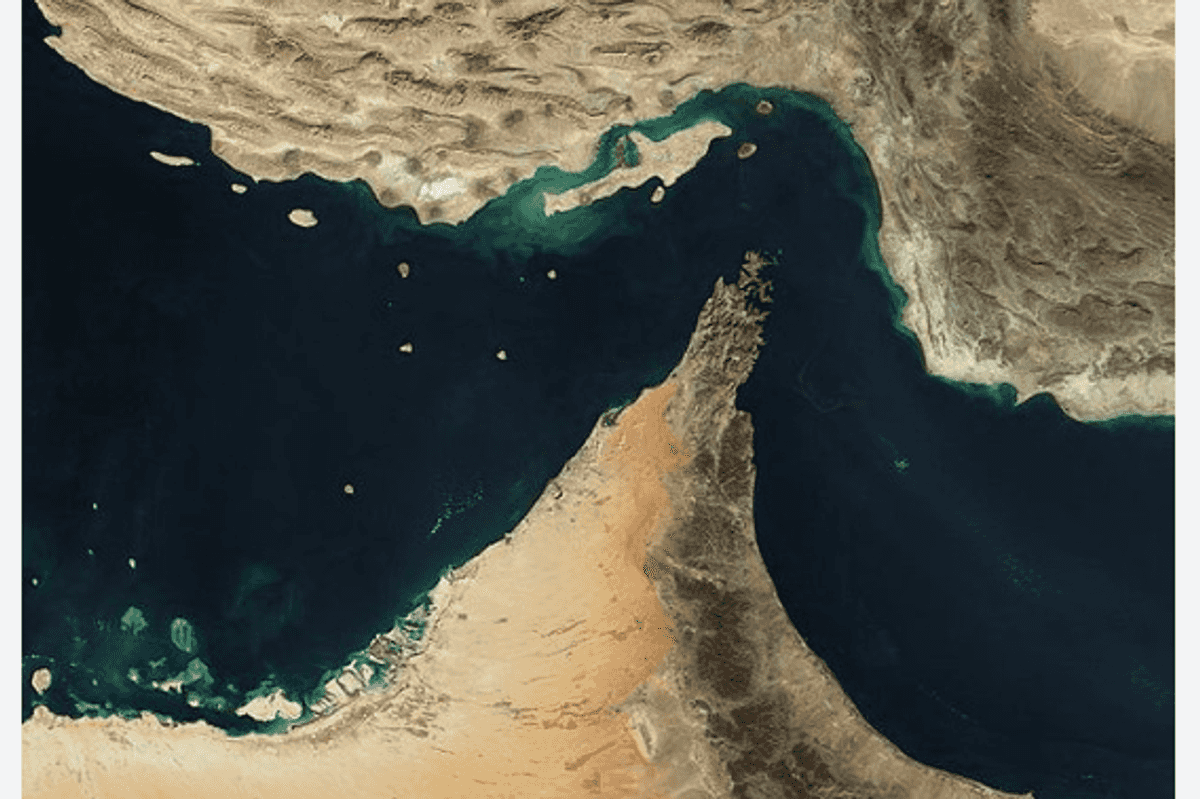
Satellite image of the Strait of Hormuz
On Monday, the market reaction to the Trump/Netanyahu war with Iran was surprisingly muted. Stocks were roughly flat. Prices of oil and gas futures were up, but only moderately.
Yesterday reality apparently began to set in, although stocks made up most of their initial losses.
This will be a brief post, with some bad news and some good news.
The bad news comes in two parts.
First, any hopes that this war might be extremely brief are fading. The Trump administration may have imagined that decapitating the Iranian government would bring swift regime change, but the Islamic State isn’t a government of mere thugs — yes, they’re evil thugs, but they’re also serious religious fanatics facing what for them is an existential threat, and their grip on power isn’t that easy to break. Furthermore, it’s painfully obvious that Trump and co. had no plan beyond bombing Iran, killing its current leaders, and hoping that something good would happen.
Second, war in the middle of the world’s most important oil-producing region — which is also a key source of liquefied natural gas — inevitably has major consequences for energy prices. Once upon a time US and Israeli air superiority might have contained Iran’s ability to harm its neighbors. But in an age in which even third-rate powers have the ability to launch missiles and drones, Iran has a huge stockpile of drones and also has ballistic missiles that are destructive, hard to intercept, and have a 1200 mile range.
The U.S. embassy in Saudi Arabia has been hit by two drone strikes. Airports in Dubai, Abu Dhabi and Doha and the U.S. consulate in Dubai have also been hit.
U.S. officials have urged all Americans in the region to leave, but they did so after almost all flights had been canceled. Only now are they saying that they’re going to arrange flights on military aircraft and charter flights — an airlift that will have to be immense given that there are surely tens of thousands of Americans currently stranded. Did I mention that Trump and co. clearly went to war without a plan?
The potential targets at risk include key parts of the region’s energy infrastructure. Above all, the war threatens tanker traffic through the Strait of Hormuz, which is how the bulk of Middle Eastern oil and gas normally reaches world markets. And the risk of Iranian attacks has effectively closed the Strait.
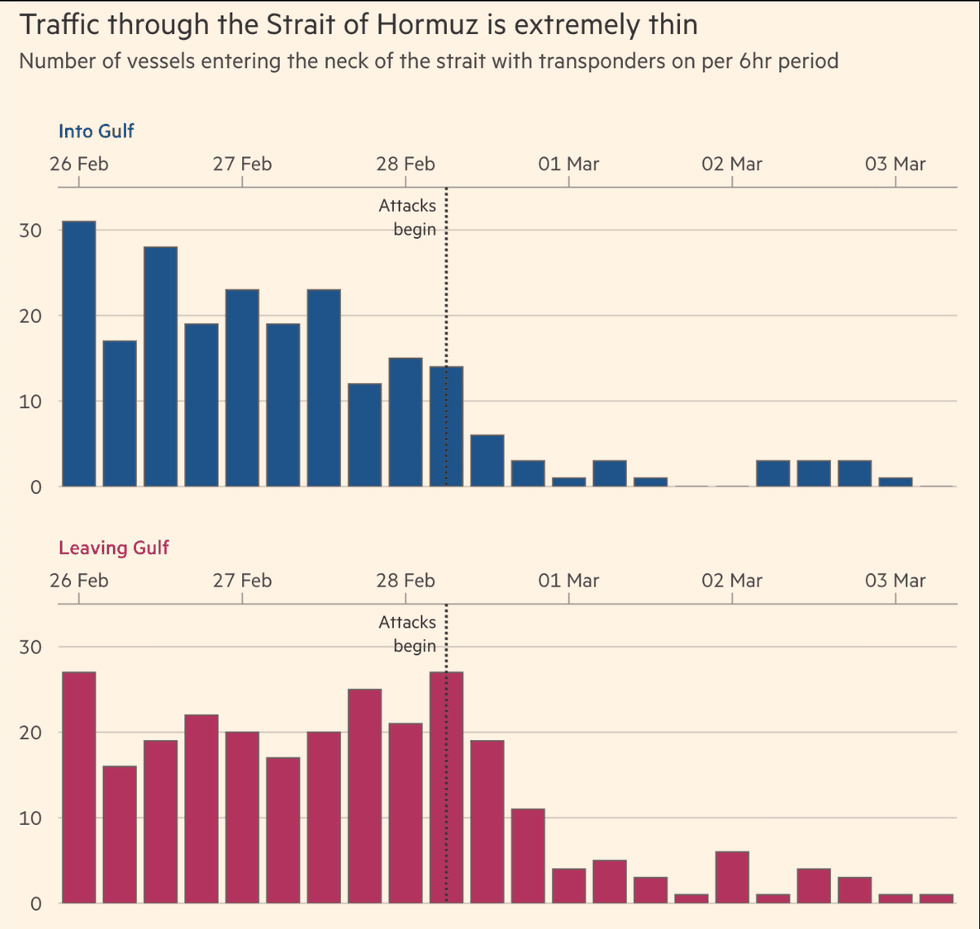
Yesterday Trump, obviously scrambling to limit the damage, declared that he is ordering the U.S. International Development Finance Corporation to provide “guarantees for the Financial Security of ALL Maritime Trade, especially Energy, traveling through the Gulf,” as well as telling the Navy to provide security. Do we have the resources to do all of that?
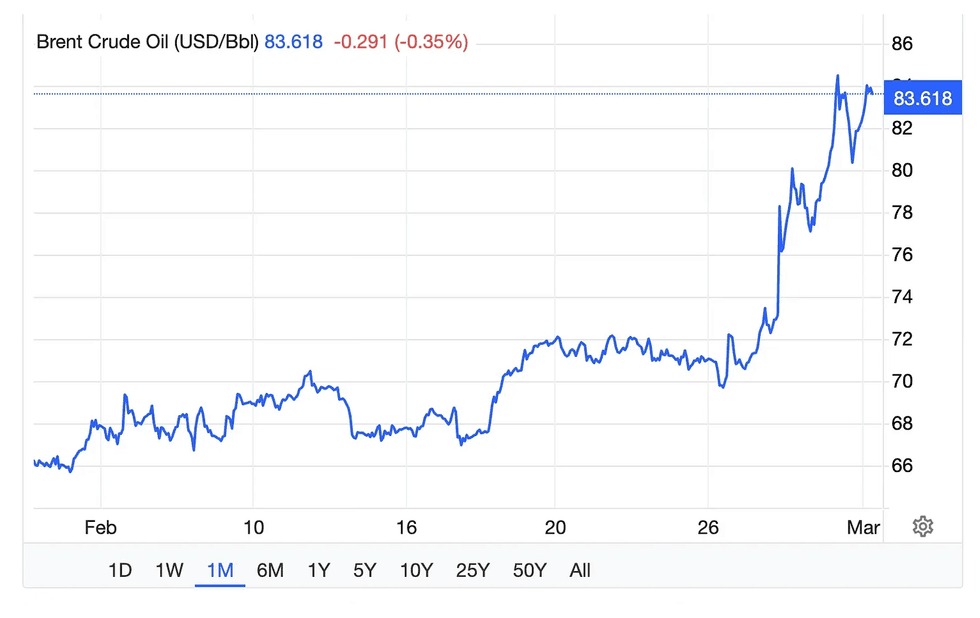
Oil prices are up around $15 per barrel since mid-February.
In case you’re wondering, there are 42 gallons in a barrel.
Indeed, it’s hard to understand why oil prices haven’t risen even more. “Why has oil not hit $100 a barrel?”, asks the Financial Times. The best answer seems to be that even now traders are betting that the Strait of Hormuz won’t stay closed for more than a few days. I hope I’m wrong, but I expect the strait to remain closed for weeks despite Trump’s assurances.
Now the good news: Even if oil prices go much higher, to $100 a barrel and beyond, it won’t necessarily trigger an economic crisis. I explained why on Monday: The United States and other advanced nations are far less oil-dependent than they were in the 1970s, when oil shocks did cause major economic disruption.
It’s true that Europe, which depends heavily on imported LNG from both the Middle East and the United States, will be hit harder than we will. However, even with a sustained closure of the Strait of Hormuz Europe will face a smaller shock than it did following the Russian invasion of Ukraine in 2022.
My back of the envelope calculations say that a $15 a barrel rise in oil prices, which is what has happened so far, will raise overall U.S. consumer prices by about 0.3 percent. A $50 a barrel rise from the pre-bombing level, which would take the price to more than $120, would raise consumer prices by about 1 percent. For perspective, that’s roughly what Trump’s tariffs have done. Yet those tariffs, while they have hurt, have caused neither runaway inflation nor a recession. Neither will rising oil prices on their own even if they go well above $100 a barrel.
However, the key point is that this latest economic shock isn’t happening on its own. The tariffs — and the huge uncertainty they create for the future — haven’t gone away. Neither have draconian anti-immigrant policies and their growing economic drag. There are widespread concerns about AI — both as a bubble that might burst and as a force driving job losses. And many people, myself included, are worried about financial stability: In many ways we have recreated the “shadow banking” risks that made the 2008 crisis possible.
Now we’ve added a fresh level of massive uncertainty. Bear in mind that this isn’t even a war of choice; it’s a war of whim, marked by a near-total lack of planning.
One shouldn’t exaggerate the economic fallout from this war. But it isn’t occurring in isolation: There are many stresses on our economy, and this could be the straw that breaks the camel’s back — a straw that becomes heavier the longer the war goes on. Furthermore, if Trump is this erratic now, what will he do as the midterms get even closer?
Paul Krugman is a Nobel Prize-winning economist and former professor at MIT and Princeton who now teaches at the City University of New York's Graduate Center. From 2000 to 2024, he wrote a column for The New York Times. Please consider subscribing to his Substack.
Reprinted with permission from Paul Krugman.
- Real Men Burn Stuff! Trump's Stupid War On Renewable Energy ›
- Fortunes Of War: How Will Trump Deal With Spiking Gasoline Prices? - National Memo ›
- 'One-Hit Wonder': Trump's Military Adventurism Is Sinking In Strait Of Hormuz - National Memo ›
- Spinning Trump's Oil Crisis, Energy Secretary Flails And Apologizes - National Memo ›
- Rising Gas Prices Enraged Republicans Under Biden, But Not Any More - National Memo ›
- Why America Is On Its Own: Slavery, Tariffs And Trump's Dire Strait - National Memo ›
- Here's How Gas Prices Will Rise This Year (And Eat Your Tax Refund) - National Memo ›
- Danziger Draws - National Memo ›
- Orange Man Goes Green? How Trump's Attack On Iran Is Advancing Clean Energy - National Memo ›
- Danziger Draws - National Memo ›
- Danziger Draws - National Memo ›
- Danziger Draws - National Memo ›
- Under Trump, 'Predation Economy' Swells As Insiders Scam The Oil Market - National Memo ›
- Facing Iran Coverup, MAGA Media Figures Choose Propaganda Over Independence - National Memo ›
- Middle East conflict poses fresh test to central banks as oil shock fuels inflation ›
- Trump's Iran War Pushes World to the Brink of an Energy Crisis - Bloomberg ›
- Gas prices soar and oil jumps as Iran war pushes down global stock markets | US-Israel war on Iran | The Guardian ›
- How the Iran War Could Turn Into an Oil Shock Nightmare ›
- War in Iran could cause the biggest oil shock in years ›
- Iran War Oil Shock Threatens to Unleash Wave of Global Inflation ›