Tag: social democracy
Red Scare: Almost None Of Us Are 'Socialists,' But Most Are Social Democrats

Red Scare: Almost None Of Us Are 'Socialists,' But Most Are Social Democrats

Fox News has a poll supposedly showing “socialism gaining ground with young voters.” But I don’t believe it. Young people may be more receptive to the word socialism, but that’s only because right-wingers constantly use that word to smear policies that have nothing to do with real socialism — i.e., government ownership of the means of production.

The fact is that very few Americans — even among politicians who call themselves “democratic socialists” — are really socialists. What many, I’d say a majority, of Americans support is what Europeans call social democracy — an ideology that is OK with living in a mostly market-driven economic system in which some people make much more money than others, but one that advocates policies to tame markets and inequality with progressive taxation, safety net programs, and regulations.

America already has an extensive range of social-democratic policies, although they are weaker than those in most other rich countries. And sustaining social democracy — indeed, making U.S. social democracy stronger — has very broad support, even among Republicans. Actual socialism, by contrast, has little public appeal.

Why, then, does it look as if socialism is on the rise? Mainly because right-wing propagandists continually smear social democratic policies as socialist, trying to make popular, mainstream policy ideas sound extreme. And some Americans who are basically social democrats in effect respond by saying, “Well, if that’s socialism, I guess I’m OK with socialism.”

Right-wingers often try to portray social democratic policies as somehow un-American. But social democracy is as American as sliced bread, invented in 1928. The Social Security Act, which created a safety net for the disabled and the unemployed as well as retirees, was passed just a few years later, in 1935. A national minimum wage was established in 1938. The big healthcare programs, Medicare and Medicaid, weren’t established until 1965 — but even that was 60 years ago.

So very few Americans even remember a nation that didn’t have a large, expensive social safety net — albeit one with some big holes in it. (In Texas, 19 percent of the population under 65 and 14 percent of children lack health insurance.)

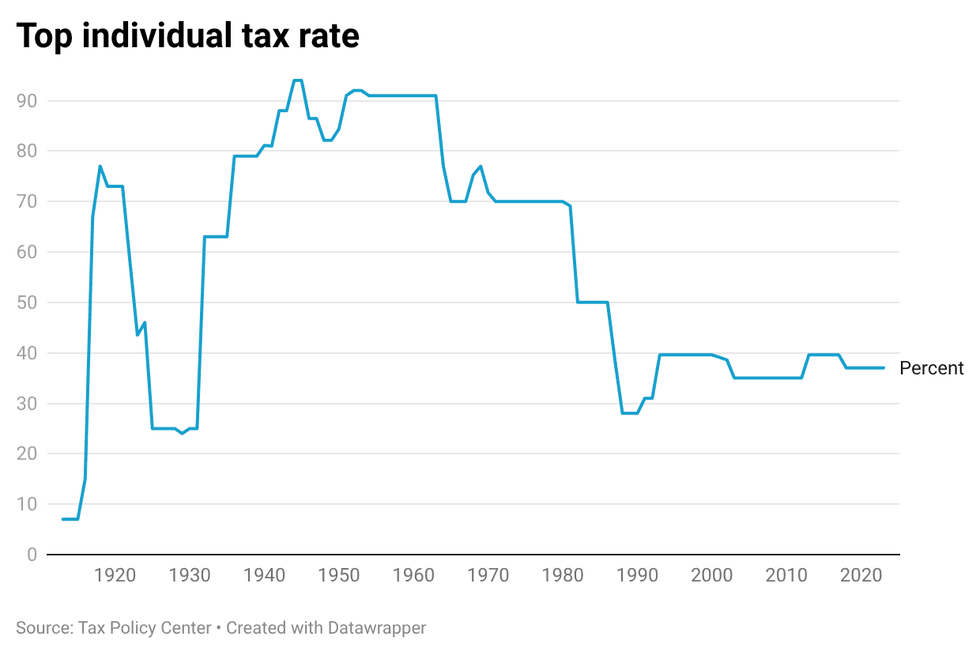
Progressive taxation has also been around for a very long time. In fact, taxes on high incomes were much higher in the 1950s than they are today:
At each stage of the expansion of U.S. social democracy, the right has screamed “socialism.” There was hysterical opposition to the creation of unemployment insurance in the 1930s; that opposition is the context for FDR’s famous 1936 Madison Square Garden speech, in which he declared of the forces of “organized money”,

They are unanimous in their hate for me—and I welcome their hatred.

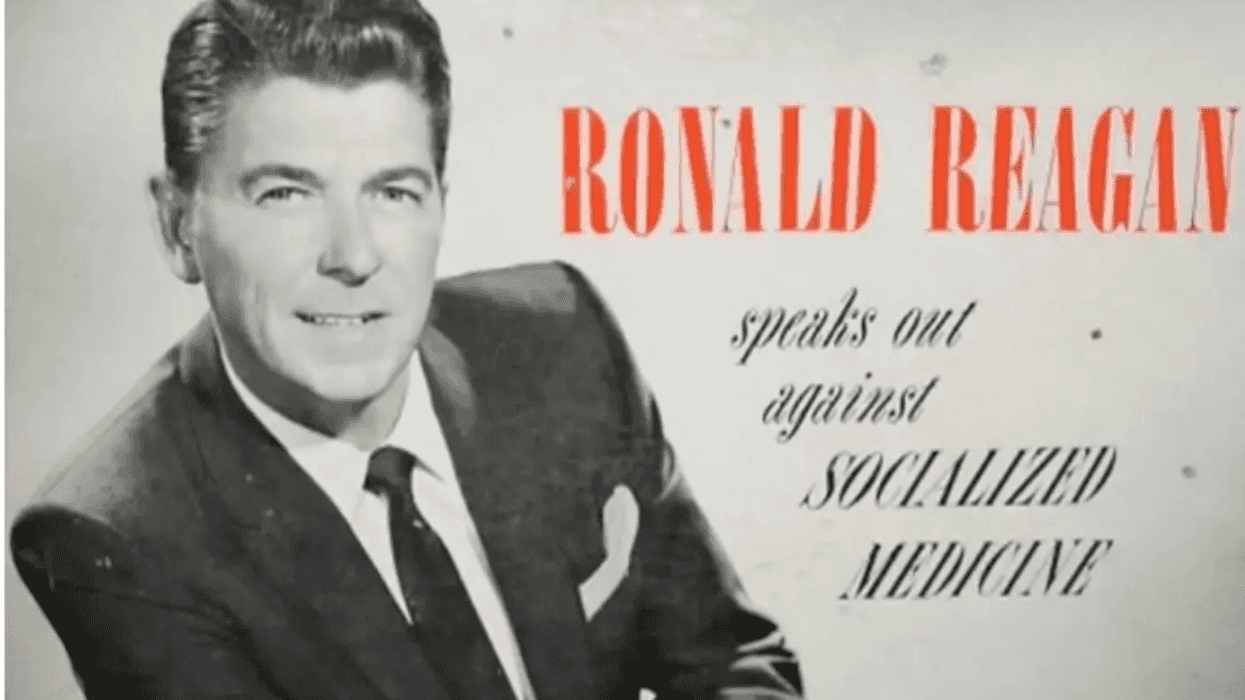
The picture at the top of this post comes from Operation Coffee Cup, a 1961 effort to head off what would soon become Medicare by getting doctors’ wives to invite their friends over to drink coffee and listen to a recording of Ronald Reagan explaining that government health insurance would destroy American freedom.

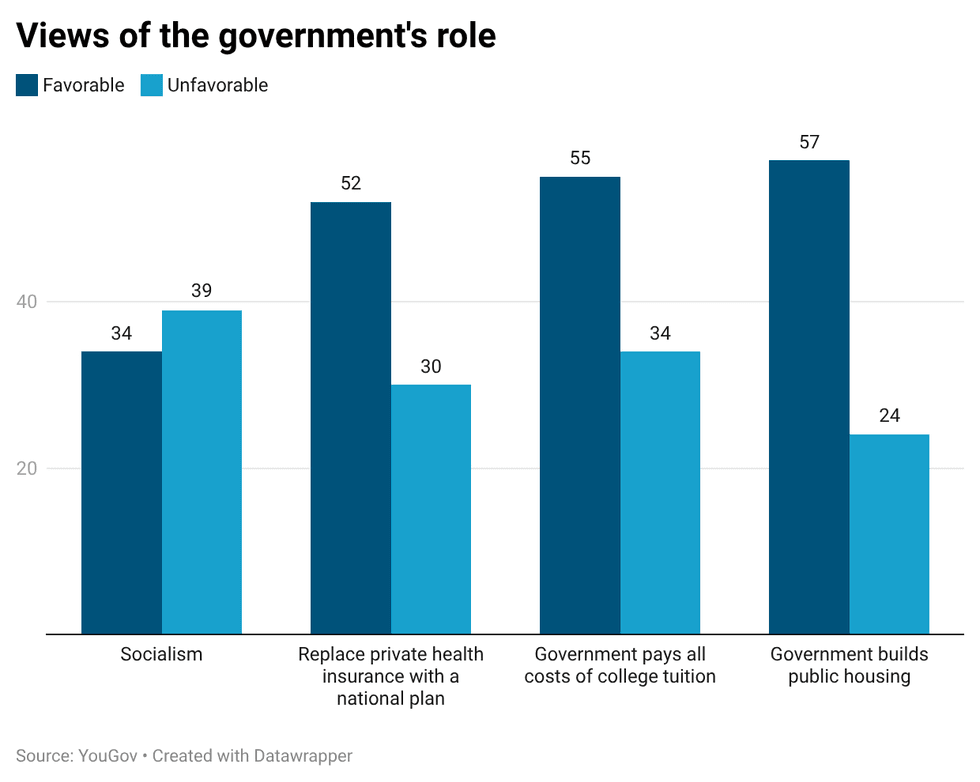
Yet Social Security and Medicare exist and are immensely popular. Indeed, while Americans continue to have a generally unfavorable view of socialism, they are strongly supportive not just of existing social democratic programs but of proposed expansions of the government’s role. From the latest YouGov poll:
Which brings me back to polls showing a rise in acceptance of “socialism.” What do they mean?

It’s safe to say that they don’t represent a groundswell of public support for actual socialism. Even politicians who call themselves socialists really aren’t.

It’s misleading even to call this a lurch to the left. As analysts like G. Elliott Morris have shown at length, most voters don’t think about politics in terms of left versus right. For the most part they think about kitchen-table issues, without strong ideological frameworks.

There is, however, a real groundswell of dismay over an economy that increasingly favors a tiny group of billionaires, and a political system that all too often works on these oligarchs’ behalf. When people say that they favor socialism, surely what they are often really saying is that they are angry about the rise of oligarchy. They are not demanding a dictatorship of the proletariat.

And while there are, of course, left-wing radicals in America, they have no realistic prospect of getting their way. So it’s important to understand what the current uproar over socialism is really about. For the most part, it’s an attempt to distract from the danger posed by the important radical movement in America — that of right-wing radicals who want to dismantle both social democracy and democracy itself.

Paul Krugman is a Nobel Prize-winning economist and former professor at MIT and Princeton who now teaches at the City University of New York's Graduate Center. From 2000 to 2024, he wrote a column for The New York Times. Please consider subscribing to his Substack.

Reprinted with permission from Paul Krugman.

Pragmatic Olaf Scholz Revives Social Democrats In Germany

Pragmatic Olaf Scholz Revives Social Democrats In Germany

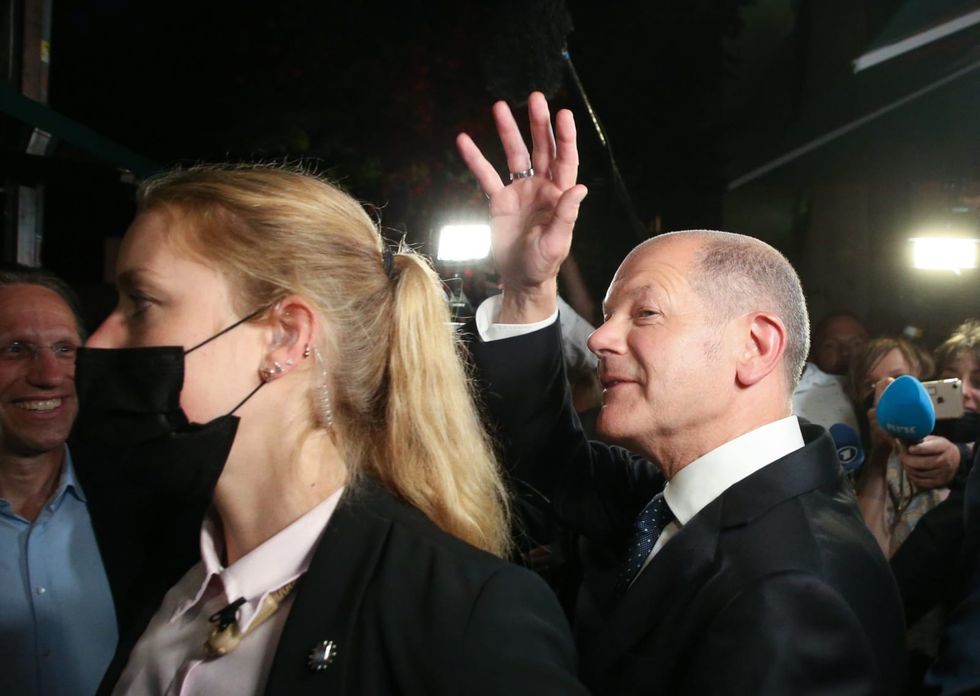
Olaf Scholz, Germany's finance minister and deputy to outoing Chancellor Angela Merkel, has arguably the best chance to be the country's first leader of the post-Merkel era. Back at the start of his campaign for the chancellorship, winning an election seemed like a long shot: His Social Democratic Party (SPD) suffered the worst electoral result in its history in 2017 with 20.5 per cent of the vote, and its numbers had slid further as junior coalition partner to Merkel's conservatives. Yet during an SPD campaign that focussed on Scholz's personal popularity with the electorate, there was a rema...

Bernie Should Own The ’Socialism’ Label

Bernie Should Own The ’Socialism’ Label

Bernie Sanders is currently the front-runner for the Democratic presidential nomination. He and everyone else knows exactly how the Republicans will attack him if and when he becomes the nominee: old-fashioned redbaiting.

China became communist in name only during the 1980s; the Soviet Union shut its doors in 1991; the Cold War is dead; and 64% of Americans under age 50 have no memory of a socialist regime actually existing. Yet Trump and the GOP have already broadcast their plans to hang the “democratic socialist” label around Bernie Sanders’ neck.

Whether such archaic fearmongering — against long-dead adversaries — will be effective even with elderly voters is anyone’s guess. Considering the fact that 40% of Americans consistently tell pollsters they prefer socialism or communism to capitalism, branding Sanders as a nefarious democratic socialist might have the unintended effect of bringing out people who don’t normally vote to support an ideology they’ve never had the chance to get behind.

On the other hand, only 76% of Democrats say they would vote for a socialist.

One thing is for sure: The socialism thing will be Sanders’ biggest challenge. And so what? Every candidate enters the game with a handicap of some sort.

Elizabeth Warren has acquired a reputation for deception and opportunism. Amy Klobuchar plays a mean girl behind closed doors. Pete Buttigieg is gay; only 78% of voters say they’d consider a gay candidate. He’s also inexperienced. Joe Biden appears to have been suffering from dementia for years.

Political weaknesses are inevitable; what makes or breaks a candidacy is how his or her campaign chooses to address it. History’s answer is clear: Take it on honestly, directly and credibly.

Own your crap. American voters hate sneakiness and avoidance.

Bernie has no one but himself to blame for this potential electoral albatross. As Paul Krugman of The New York Times points out, the independent senator from Vermont is not really a socialist: “He doesn’t want to nationalize our major industries and replace markets with central planning.” He is a New Deal Democrat indistinguishable from old liberal figures like Hubert Humphrey and George McGovern. The economic model Sanders wants to establish isn’t the USSR, or even Yugoslavia, but the Scandinavian countries with their superior safety nets and enlightened penal systems. Capitalism as we know it would continue, albeit with reduced overall cruelty.

Bernie is a social democrat, not a democratic socialist. For some unknown reason, however, he chose to label himself as a democratic socialist. “It’s mainly about personal branding,” Krugman speculates, “with a dash of glee at shocking the bourgeoisie. And this self-indulgence did no harm as long as he was just a senator from a very liberal state.”

Now he’s going to have to explain himself and his beliefs to American voters who have been propagandized through education and the media to believe that socialism equals communism equals totalitarian dystopia.

If he’s smart — and there’s no reason to believe that he and his staff are anything but — he will own the phrase and address those concerns head on.

During the 1960 campaign, John F. Kennedy responded to worries about his being Roman Catholic and potentially taking orders from the pope. The speech allowed anti-Catholic voters to take a chance on him. “I believe in an America where the separation of church and state is absolute, where no Catholic prelate would tell the president (should he be Catholic) how to act,” Kennedy said.

Aware that he was going to run for president in a few years, Barack Obama discussed his drug use as a young man, specifically the fact that he had tried cocaine, in his memoir and in an interview published ahead of the race. By the time he ran in 2008, the coke thing was old news baked into the politics of the time.

“Democratic socialism” is a pretty meaningless term. Which is not necessarily bad. Because it doesn’t define an existing party or ideology in the real world, Sanders can imprint his own definition upon his awkward tabula rasa.

Like every crisis, this is an opportunity. Voters want to know what Sanders stands for. Their confusion about democratic socialism (confusion caused by Sanders’ weird word choices) is his chance to explain himself and his policies.

The one thing he should not and cannot do is to shy away from the S-word. No matter how much he protests, Republicans are going to call him a Marxist, a communist, a socialist, and worse. So there’s no point in protesting. “Yes,” he could say, “I am a socialist — a democratic socialist. A democratic socialist is a person who cares more about you as an ordinary American than about greedy billionaires and corporations who pollute your water and lay you off at the drop of a hat.”

Nothing neutralizes an attack more effectively than to cop to it.

If nothing else, even if he loses, Bernie could rehabilitate socialism as an acceptable economic alternative. In the long run, that would be a greater accomplishment than anything he could accomplish in eight years as president.

Ted Rall, the political cartoonist, columnist and graphic novelist, is the author of Francis: The People’s Pope. He is on Twitter @TedRall. You can support Ted’s hard-hitting political cartoons and columns and see his work first by sponsoring his work on Patreon.

Photo Credit: Gage Skidmore
What Kind Of ‘Socialism’ Is This? Sanders Claims Mantle Of New Deal

What Kind Of ‘Socialism’ Is This? Sanders Claims Mantle Of New Deal

Reprinted with permission from The American Prospect.

In 1916, amid the carnage of World War I, the great German-Polish socialist Rosa Luxemburg wrote that humanity was facing a choice between socialism and barbarism.

Earlier today, speaking at the George Washington University, Bernie Sanders noted that we live in a time of rising authoritarianism, citing the regimes of Putin, Xi, Orban, Duterte and Trump as indices of the growing threat. His speech was billed as offering his definition of socialism, which, a la Rosa, was said to be the alternative to oligarchy and authoritarianism.

Socialism as Sanders proceeded to define it is indeed an alternative to oligarchy and authoritarianism. What his speech left hanging was whether his socialism was in fact socialism.

In 2015, as his campaign was just taking off, Sanders came to a different D.C. university—Georgetown—to deliver what was also then billed as his definition of socialism. Before a crowd of wildly cheering college students, he reeled off a series of social democratic proposals—the universal right to health care, to college education and the like – with constant reference to the great American leader who did indeed lead the successful war against barbarism in the 1940s: Franklin Roosevelt. His speech was so FDR-centric that I wrote at the time:

Throughout the 1930s, Republicans claimed that Franklin Roosevelt was really a socialist. Today, Bernie Sanders said they were right.

Then, as today, Sanders referenced Roosevelt’s 1944 State of the Union speech – FDR’s last great speech—in which Roosevelt proposed an Economic Bill of Rights. Today, Sanders formally proposed “a 21st Century Economic Bill of Rights,” which included a right to a living-wage job, to “quality health care,” to “a complete education,” to “affordable housing,” to “a clean environment” and to “a secure retirement.”

As if citing Roosevelt were not enough, Sanders also cited Harry Truman, whose efforts to create a Medicare for All program in the 1940s were thwarted by conservatives and the medical profession. He quoted Truman, talking about his critics, at length:

Socialism [Truman said] is the epithet they have hurled at every advance the people have made in the last 20 years. Socialism is what they called Social Security. Socialism is what they called farm price supports. Socialism is what they called bank deposit insurance. Socialism is what they called the growth of free and independent labor organizations. Socialism is their name for almost anything that helps all the people.

Nor did Sanders’s talk simply identify socialism with the social democratic reforms of Roosevelt’s New Deal and Truman’s Fair Deal. It also contained two crucial omissions.

First, even as Sanders cited Roosevelt and Truman, but he also did not cite any avowed American democratic socialists, save, in passing, Martin Luther King Jr. He made no mention of his great hero, Eugene V. Debs. Nothing on Norman Thomas, the Socialist Party’s candidate for president in each of FDR’s four elections. Nothing on A. Philip Randolph or Bayard Rustin or Michael Harrington. No reference to Thomas’ line when asked if Roosevelt had actually carried out the Socialist Party’s program. “He carried it out,” Thomas said, “on a stretcher.”

Second, Sanders also omitted his own more socialistic proposals. His speech skipped over some groundbreaking social democratic reforms that Sanders and Elizabeth Warren have both advocated in the course of the campaign, including dividing corporate boards between shareholder and worker representatives. He made no mention of an American version of the Meidner Plan – a 1970s proposal never quite implemented in Sweden that would gradually transfer the ownership of corporations, through the yearly payment of profits in the form of stock to their employees’ organizations, to their workers.

In short, Sanders’s socialism, as he defined it, is an expansion of America’s semi-demi-welfare state to include more economic rights. It’s an effort to make us a more functional social democracy—which, of course, is no small proposal and by American standards, a great leap forward. But he could have made the same proposals and labeled them neo-Rooseveltian liberalism without straining historical accuracy.

How, then, did his speech depart from his 2015 Georgetown outing? Chiefly, in noting that the world had grown more dangerously authoritarian and xenophobic in the intervening years—a discussion that Sanders also cast in a neo-Rooseveltian light. Twice in his talk, he cited Depression-era rallies at Madison Square Garden: the first, the infamous pro-Nazi rally of 1939; the second, FDR’s election eve speech of 1936—surely, Roosevelt’s most radical oration—in which FDR sounded the anti-oligarchic and anti-authoritarian themes that Sanders is sounding today. This speech, too, Sanders quoted at length:

We had to struggle [Roosevelt said] with the old enemies of peace—business and financial monopoly, speculation, reckless banking, class antagonism, sectionalism, war profiteering.

They had begun to consider the Government of the United States as a mere appendage to their own affairs. We know now that Government by organized money is just as dangerous as Government by organized mob.

Never before in all our history have these forces been so united against one candidate as they stand today. They are unanimous in their hate for me—and I welcome their hatred.

No line in Sanders’ speech drew a louder spontaneous standing ovation than that one—the one about welcoming their hatred. And it wasn’t Bernie’s line; it was FDR’s.

Sanders’ conflation of democratic socialism with the progressive reforms of an FDR is at some level eminently understandable. Social Security is indeed a social democratic program, as is Medicare; their shortcomings, as Sanders surely realizes in seeking to bolster the first and universalize the second, is that they’re not social democratic enough. In running as a democratic socialist who seeks to complete and update FDR’s agenda, Sanders straddles the very fuzzy border between social democracy and American left liberalism. There, coming from the socialist side, he meets Warren, coming from the liberal side, and a growing number of their fellow Americans.

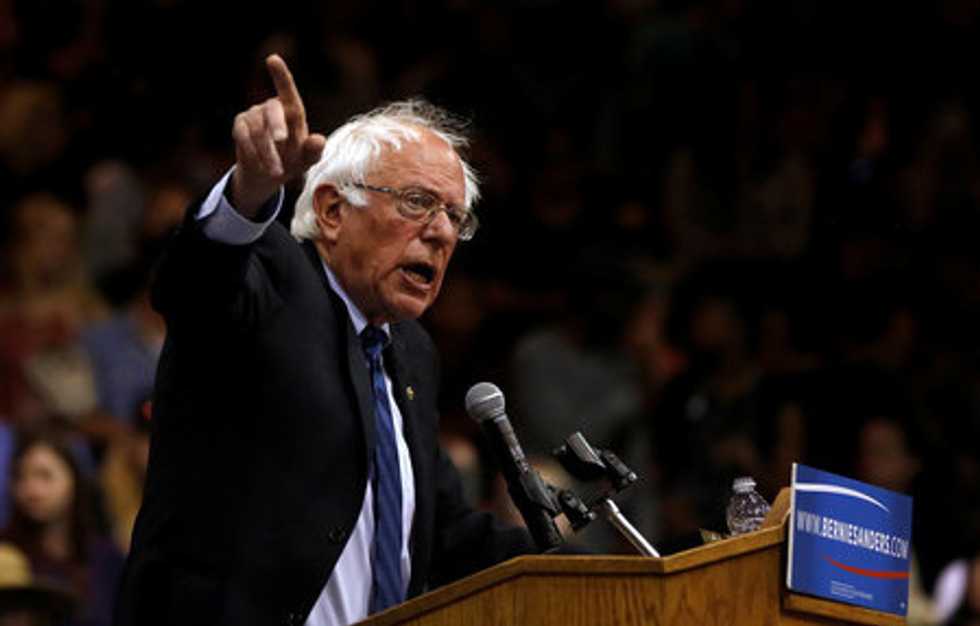
Democratic presidential candidate Bernie Sanders speaks at a campaign rally in Salem, Oregon, May 10, 2016. REUTERS/Jim Urquhart

Shop our Store

Headlines

Editor's Blog

Trending

World