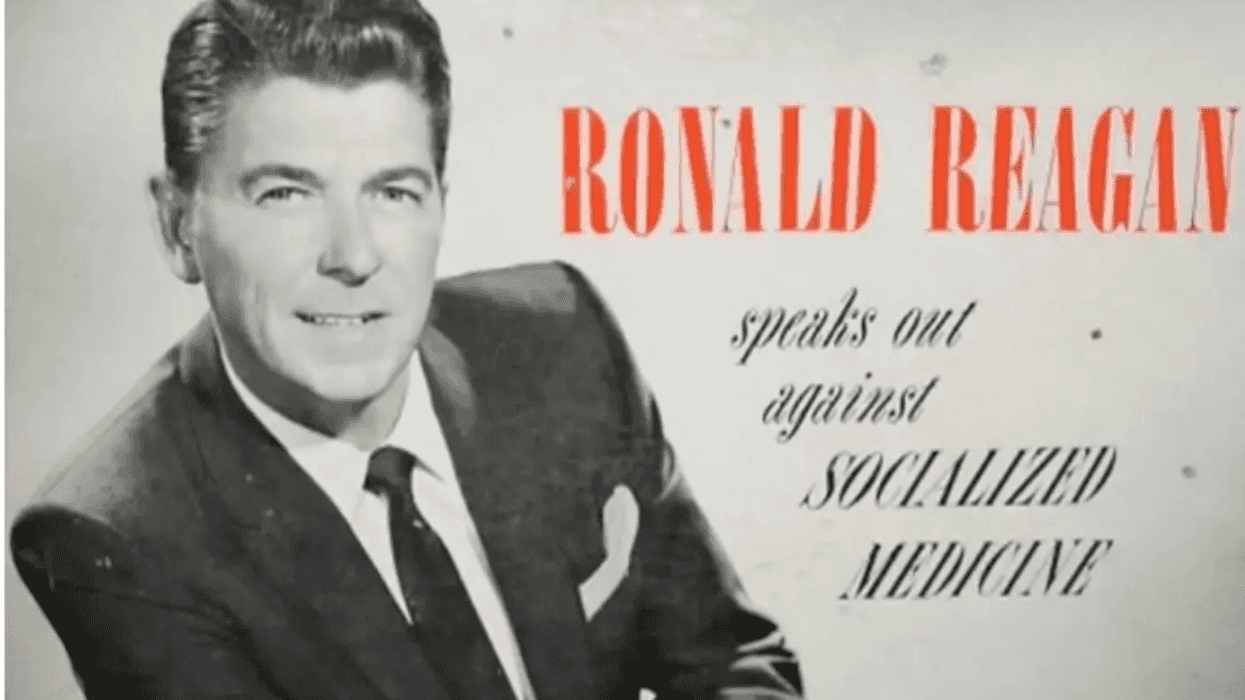
Ronald Reagan recorded a 1961 speech rying to stop passage of Medicare in 1965
Fox News has a poll supposedly showing “socialism gaining ground with young voters.” But I don’t believe it. Young people may be more receptive to the word socialism, but that’s only because right-wingers constantly use that word to smear policies that have nothing to do with real socialism — i.e., government ownership of the means of production.
The fact is that very few Americans — even among politicians who call themselves “democratic socialists” — are really socialists. What many, I’d say a majority, of Americans support is what Europeans call social democracy — an ideology that is OK with living in a mostly market-driven economic system in which some people make much more money than others, but one that advocates policies to tame markets and inequality with progressive taxation, safety net programs, and regulations.
America already has an extensive range of social-democratic policies, although they are weaker than those in most other rich countries. And sustaining social democracy — indeed, making U.S. social democracy stronger — has very broad support, even among Republicans. Actual socialism, by contrast, has little public appeal.
Why, then, does it look as if socialism is on the rise? Mainly because right-wing propagandists continually smear social democratic policies as socialist, trying to make popular, mainstream policy ideas sound extreme. And some Americans who are basically social democrats in effect respond by saying, “Well, if that’s socialism, I guess I’m OK with socialism.”
Right-wingers often try to portray social democratic policies as somehow un-American. But social democracy is as American as sliced bread, invented in 1928. The Social Security Act, which created a safety net for the disabled and the unemployed as well as retirees, was passed just a few years later, in 1935. A national minimum wage was established in 1938. The big healthcare programs, Medicare and Medicaid, weren’t established until 1965 — but even that was 60 years ago.
So very few Americans even remember a nation that didn’t have a large, expensive social safety net — albeit one with some big holes in it. (In Texas, 19 percent of the population under 65 and 14 percent of children lack health insurance.)
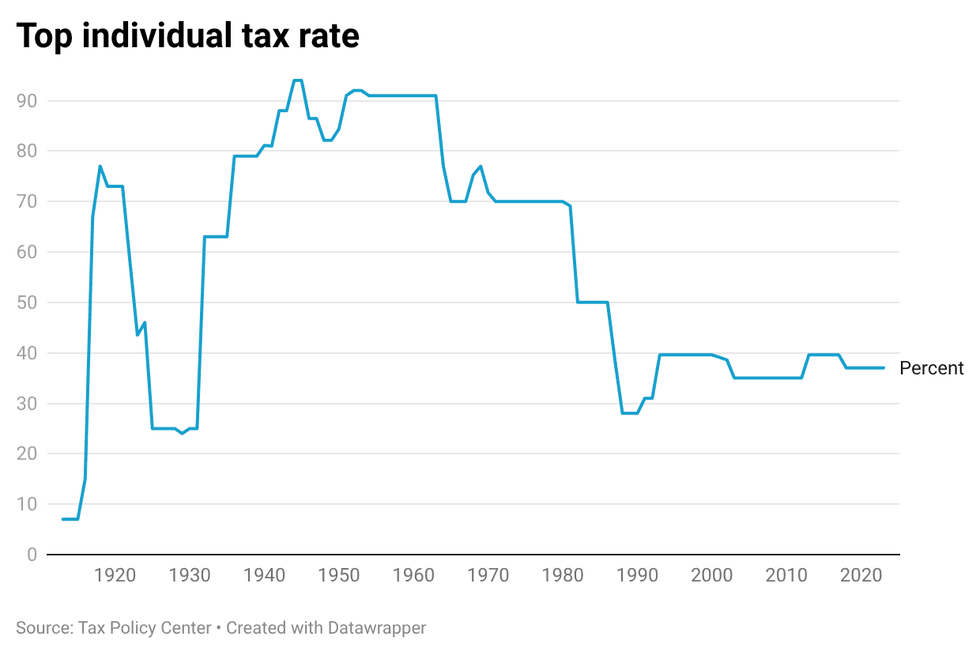
Progressive taxation has also been around for a very long time. In fact, taxes on high incomes were much higher in the 1950s than they are today:
At each stage of the expansion of U.S. social democracy, the right has screamed “socialism.” There was hysterical opposition to the creation of unemployment insurance in the 1930s; that opposition is the context for FDR’s famous 1936 Madison Square Garden speech, in which he declared of the forces of “organized money”,
They are unanimous in their hate for me—and I welcome their hatred.
The picture at the top of this post comes from Operation Coffee Cup, a 1961 effort to head off what would soon become Medicare by getting doctors’ wives to invite their friends over to drink coffee and listen to a recording of Ronald Reagan explaining that government health insurance would destroy American freedom.
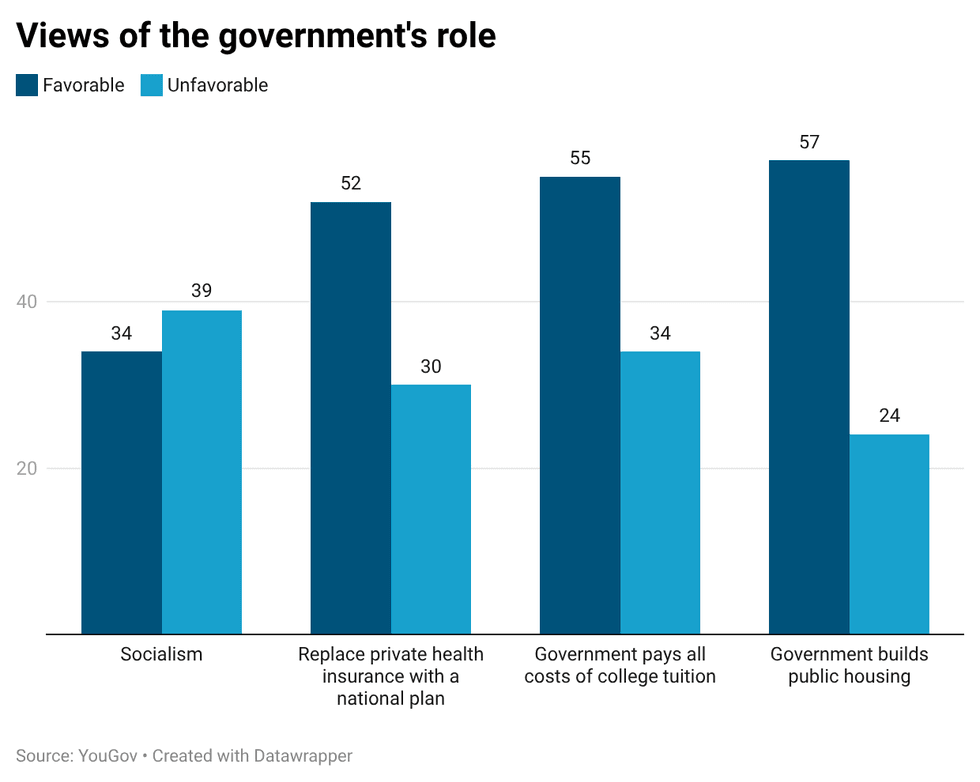
Yet Social Security and Medicare exist and are immensely popular. Indeed, while Americans continue to have a generally unfavorable view of socialism, they are strongly supportive not just of existing social democratic programs but of proposed expansions of the government’s role. From the latest YouGov poll:
Which brings me back to polls showing a rise in acceptance of “socialism.” What do they mean?
It’s safe to say that they don’t represent a groundswell of public support for actual socialism. Even politicians who call themselves socialists really aren’t.
It’s misleading even to call this a lurch to the left. As analysts like G. Elliott Morris have shown at length, most voters don’t think about politics in terms of left versus right. For the most part they think about kitchen-table issues, without strong ideological frameworks.
There is, however, a real groundswell of dismay over an economy that increasingly favors a tiny group of billionaires, and a political system that all too often works on these oligarchs’ behalf. When people say that they favor socialism, surely what they are often really saying is that they are angry about the rise of oligarchy. They are not demanding a dictatorship of the proletariat.
And while there are, of course, left-wing radicals in America, they have no realistic prospect of getting their way. So it’s important to understand what the current uproar over socialism is really about. For the most part, it’s an attempt to distract from the danger posed by the important radical movement in America — that of right-wing radicals who want to dismantle both social democracy and democracy itself.
Paul Krugman is a Nobel Prize-winning economist and former professor at MIT and Princeton who now teaches at the City University of New York's Graduate Center. From 2000 to 2024, he wrote a column for The New York Times. Please consider subscribing to his Substack.
Reprinted with permission from Paul Krugman.
- Interview: Labor Historian Nick Salvatore on Eugene Debs, Bernie Sanders, and Socialism in Modern American Politics - The National Memo - Smart. Sharp. Funny. Fearless. ›
- Everything Republicans Oppose, They Now Call ’Socialist’ ›
- How To Stop Worrying About “Socialism” ›
- What Kind Of ‘Socialism’ Is This? Sanders Claims Mantle Of New Deal ›
- Mamdani's Big Night In New York Primary Stokes Conservative Political Fantasies ›
- Is The DSA Actually Democratic? Or Are Its Candidates An Extremist Gift To MAGA? - National Memo ›
- Danziger Draws - National Memo ›
- Socialist? Capitalist? Americans Live In A Mixed Economy, Without Labels - National Memo ›
- Are Mainstream Democrats Taking Back Their Party From The DSA Fringe? - National Memo ›
- Does 'Democratic Socialism' Help Candidates To Win Elections? Numbers Say No - National Memo ›