Francesca Hong
Democratic socialism appears to be ascendant in the Democratic Party, but when it comes to winning elections, is that a good thing?
There is perhaps no more fraught intraparty discussion at the moment. Democratic socialists have notched some impressive primary victories, dethroning an incumbent or two along the way. But most of these have been in dark blue areas, like New York City, or in states like Florida, where Angie Nixon, a democratic socialist who won a Democratic Senate primary this past Tuesday, has very little chance of being elected in November.
In other words, democratic socialists’ victories have typically been in primaries that are not expected to lead to a competitive general election. In contrast, the movement’s most visible recent loss—Francesca Hong in Wisconsin’s Democratic gubernatorial primary—came in a swing state that will be competitive.
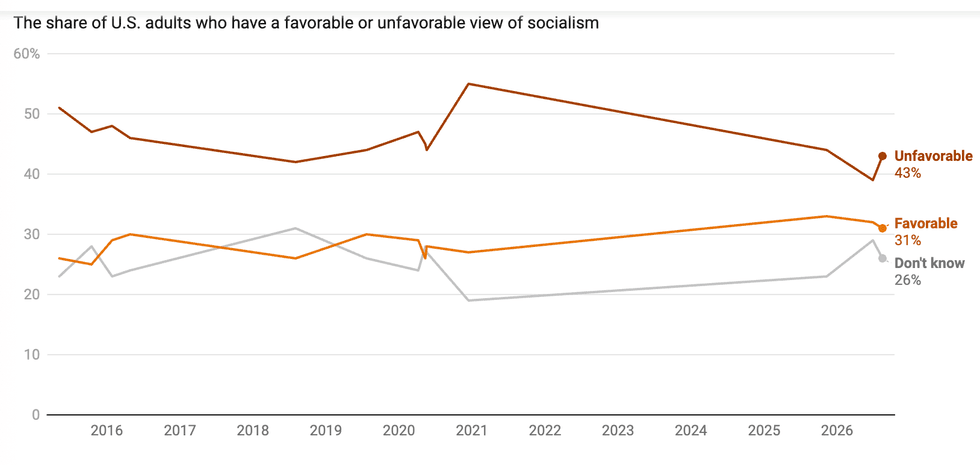
In high-stakes races, Democratic primary voters seem aware of jeopardy posed by the public’s largely negative view of socialism. Across 13 polls conducted by YouGov since 2015, the share of Americans who have a favorable view of socialism has never risen above 33 percent. Across every survey, more Americans have held a negative view of it than a positive one.
Americans Generally Don't Like Socialism
As a result, 45 percent of Americans say they would never vote for a self-identified socialist, according to a new YouGov survey. That includes 42 percent of independents and 11 percent of Americans who plan to vote for a Democratic House candidate this year. (For what it’s worth, the numbers don’t change much if pollsters ask about a “democratic socialist” candidate or a “socialist” one.)
Of course, Republicans indiscriminately brand even moderate Democrats as socialists. But does a political candidate embracing the term defuse that line of attack—Yeah, I’m a socialist, so what?—or does it hurt them to pick up a label much of the electorate deems toxic?
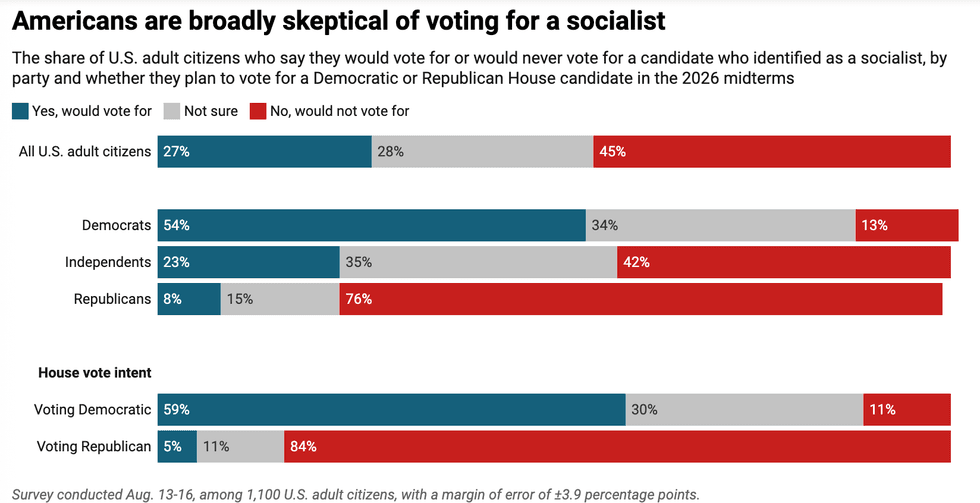 Chart by Andrew Mangan, created with DatawrapperSource: YouGov
:
The thing is, Americans aren’t always aware a politician is a socialist—even when they call themselves one. Relatively small majorities of Americans correctly identify Vermont Sen. Bernie Sanders (61 percent), New York City Mayor Zohran Mamdani (54 percent), and New York Rep. Alexandria Ocasio-Cortez (51 percent) as democratic socialists, per the new YouGov poll. And roughly a third incorrectly deem former Vice President Kamala Harris (37 percent) and former President Barack Obama (34 percent) to be socialists.
We shouldn’t take too much away from any one race, but Hong’s surprising loss in Wisconsin suggests the “democratic socialist” label weighed her down more than lifted her up. Democratic voters there were indeed worried that a socialist nominee—especially one with deeply unpopular views on Thanksgiving and the police—would help Republicans win the governor’s mansion this fall.
Likewise, William Lawrence, the Democratic nominee in Michigan’s Seventh District, left the Democratic Socialists of America days ahead of his August 4 primary, clearly aware that the affiliation would not help him in a district that President Donald Trump won by one percentage point in 2024. As Lawerence told CNN after winning the primary, he let his membership lapse “because I want to make clear my constituents that I’m here to represent them.”
Clearly, the label poses some jeopardy to the party in competitive races. And in this way, it’s possible that the rise of democratic socialists may slightly worsen the public’s already negative view of the Democratic Party, but there’s also reason to believe their ascendence doesn’t hurt other, non-socialist Democratic candidates all that much. A recent New York Times/Siena University poll found that while 53 percent of voters in battleground Senate races saw the national Democratic Party as “too far to the left,” only 35 percent saw the Democratic Senate candidate in their state the same way.
Of course, both shares might be smaller if democratic socialism were a lower-profile element of the Democratic Party. But that’s hard, if not impossible, to sort out at the moment.There is also a twist to all of this: Voters may be averse to self-branded socialists and “socialism” as a concept, but they often don’t feel the same way about socialist policies.
Sixty-five percent of Americans consider free universal healthcare to be a socialist policy, according to the new YouGov poll. And roughly the same share (64%) also support the concept of Medicare for All, per a recent YouGov/Economist poll.
The same is true for tuition-free college. Sixty-one percent of Americans see it as socialist—and yet 55% support the idea of the government covering the cost of tuition for all college students, according to a YouGov/Economist poll from earlier this summer.Other policies that Americans consider socialist also enjoy broad public support: 69% of Americans support providing more government subsidies for housing, 62% support rent control, and 68% support having publicly owned utility companies.
It seems that even when Americans peg a policy as socialist, that doesn’t stop them from wanting it.
The bigger question is, will the public eventually embrace socialist politicians like it’s embracing many of their policies? We may find out in two short years.
- Mamdani's Big Night In New York Primary Stokes Conservative Political Fantasies ›
- Michigan Democrats Urging Unity After El-Sayed Wins Close And Costly Primary ›
- Are Mainstream Democrats Taking Back Their Party From The DSA Fringe? ›
- Red Scare: Almost None Of Us Are 'Socialists,' But Most Are Social Democrats ›
- Centrist Democrats Versus Insurgent Socialists Is A Fight Not Worth Having ›
- Socialist? Capitalist? Americans Live In A Mixed Economy, Without Labels ›
- Mamdani's 2028 Bombast Doesn't Bode Well For National Democrats ›
- Is The DSA Actually Democratic? Or Are Its Candidates An Extremist Gift To MAGA? ›
- Pause From Doomscrolling -- And Be Hopeful As MAGA And Trump Swirl The Toilet ›
- DSA Should Drop The Blue-Collar Cosplay That Working Voters Reject - National Memo ›
- Rise of Democratic socialism highlights party's divisions on Israel : NPR ›
- Democratic Socialists and what they mean for midterms - YouTube ›
- Are Democrats having a Tea Party moment? I'm not buying it. | Opinion ›
- Democratic socialists are strategizing for their biggest moment yet | CNN Politics ›
- Opinion | Is It Really True That Socialism Is a Threat to the Democrats? - The New York Times ›
- How Democratic Socialists Are Wrestling With Their Next Moves - The New York Times ›