Tag: democratic socialism
Does 'Democratic Socialism' Help Candidates To Win Elections? Numbers Say No

Does 'Democratic Socialism' Help Candidates To Win Elections? Numbers Say No

Democratic socialism appears to be ascendant in the Democratic Party, but when it comes to winning elections, is that a good thing?

There is perhaps no more fraught intraparty discussion at the moment. Democratic socialists have notched some impressive primary victories, dethroning an incumbent or two along the way. But most of these have been in dark blue areas, like New York City, or in states like Florida, where Angie Nixon, a democratic socialist who won a Democratic Senate primary this past Tuesday, has very little chance of being elected in November.

In other words, democratic socialists’ victories have typically been in primaries that are not expected to lead to a competitive general election. In contrast, the movement’s most visible recent loss—Francesca Hong in Wisconsin’s Democratic gubernatorial primary—came in a swing state that will be competitive.

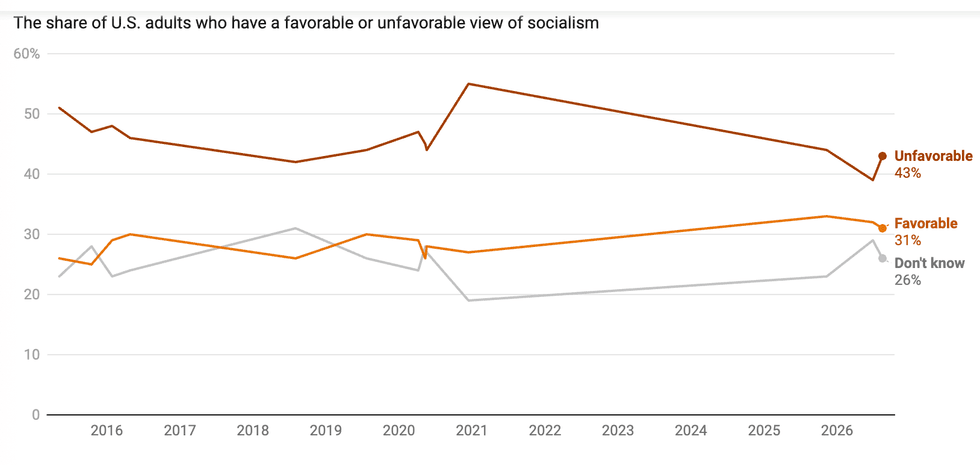
In high-stakes races, Democratic primary voters seem aware of jeopardy posed by the public’s largely negative view of socialism. Across 13 polls conducted by YouGov since 2015, the share of Americans who have a favorable view of socialism has never risen above 33 percent. Across every survey, more Americans have held a negative view of it than a positive one.

Americans Generally Don't Like Socialism
As a result, 45 percent of Americans say they would never vote for a self-identified socialist, according to a new YouGov survey. That includes 42 percent of independents and 11 percent of Americans who plan to vote for a Democratic House candidate this year. (For what it’s worth, the numbers don’t change much if pollsters ask about a “democratic socialist” candidate or a “socialist” one.)

Of course, Republicans indiscriminately brand even moderate Democrats as socialists. But does a political candidate embracing the term defuse that line of attack—Yeah, I’m a socialist, so what?—or does it hurt them to pick up a label much of the electorate deems toxic?
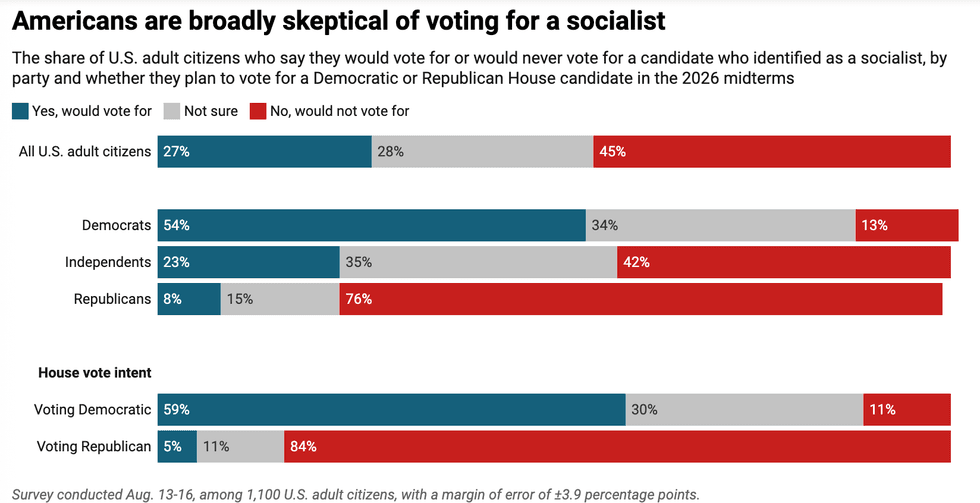
Chart by Andrew Mangan, created with DatawrapperSource: YouGov

:

The thing is, Americans aren’t always aware a politician is a socialist—even when they call themselves one. Relatively small majorities of Americans correctly identify Vermont Sen. Bernie Sanders (61 percent), New York City Mayor Zohran Mamdani (54 percent), and New York Rep. Alexandria Ocasio-Cortez (51 percent) as democratic socialists, per the new YouGov poll. And roughly a third incorrectly deem former Vice President Kamala Harris (37 percent) and former President Barack Obama (34 percent) to be socialists.

We shouldn’t take too much away from any one race, but Hong’s surprising loss in Wisconsin suggests the “democratic socialist” label weighed her down more than lifted her up. Democratic voters there were indeed worried that a socialist nominee—especially one with deeply unpopular views on Thanksgiving and the police—would help Republicans win the governor’s mansion this fall.

Likewise, William Lawrence, the Democratic nominee in Michigan’s Seventh District, left the Democratic Socialists of America days ahead of his August 4 primary, clearly aware that the affiliation would not help him in a district that President Donald Trump won by one percentage point in 2024. As Lawerence told CNN after winning the primary, he let his membership lapse “because I want to make clear my constituents that I’m here to represent them.”

Clearly, the label poses some jeopardy to the party in competitive races. And in this way, it’s possible that the rise of democratic socialists may slightly worsen the public’s already negative view of the Democratic Party, but there’s also reason to believe their ascendence doesn’t hurt other, non-socialist Democratic candidates all that much. A recent New York Times/Siena University poll found that while 53 percent of voters in battleground Senate races saw the national Democratic Party as “too far to the left,” only 35 percent saw the Democratic Senate candidate in their state the same way.

Of course, both shares might be smaller if democratic socialism were a lower-profile element of the Democratic Party. But that’s hard, if not impossible, to sort out at the moment.There is also a twist to all of this: Voters may be averse to self-branded socialists and “socialism” as a concept, but they often don’t feel the same way about socialist policies.

Sixty-five percent of Americans consider free universal healthcare to be a socialist policy, according to the new YouGov poll. And roughly the same share (64%) also support the concept of Medicare for All, per a recent YouGov/Economist poll.

The same is true for tuition-free college. Sixty-one percent of Americans see it as socialist—and yet 55% support the idea of the government covering the cost of tuition for all college students, according to a YouGov/Economist poll from earlier this summer.Other policies that Americans consider socialist also enjoy broad public support: 69% of Americans support providing more government subsidies for housing, 62% support rent control, and 68% support having publicly owned utility companies.

It seems that even when Americans peg a policy as socialist, that doesn’t stop them from wanting it.

The bigger question is, will the public eventually embrace socialist politicians like it’s embracing many of their policies? We may find out in two short years.
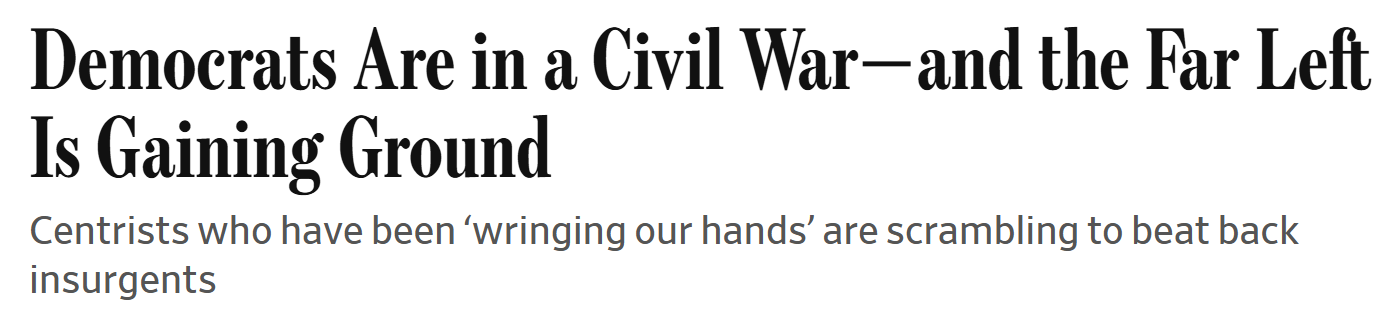
Centrist Democrats Versus Insurgent Socialists Is A Fight Not Worth Having

Centrist Democrats Versus Insurgent Socialists Is A Fight Not Worth Having

Whenever I encounter a person, media report, or podcast that’s wound up about socialists taking over the Democratic party and thereby winding down capitalism as we know it, I find myself somewhere between puzzled and eye-rolly.

The main reason for my response is that our economy has always existed on a continuum between pure free markets and deep market interventions by the public sector. There’s Social Security, an intergenerational transfer program that is highly valued by those who identify as die-hard capitalists. Those same capitalists are generally comfortable with Medicare, public infrastructure, laws that protect their property, health, and safety, rules that structure markets, and so on. Taken together, expenditures on Social Security and Medicare amount to about nine percent of GDP. When it comes to such “socialism,” we’re more than a little bit pregnant.

Where we locate on that continuum is a dynamic process driven by the general degree of comfort with the status quo. And today, there is—as there should be—great discomfort among the vast majority with the status quo, in which case we should expect movements along the continuum.

But why move left vs. right? Surely, because of the obvious failure of Trump’s right-wing, faux populism. He ran on making life more affordable than under Biden but to the extent that he’s done anything in the affordability space, he’s pushed hard in the wrong direction. He’s exacerbated inflation, leading to higher interest and mortgage rates than would otherwise prevail, cut taxes for the rich, and partially offset the resulting debt costs by cutting health coverage and nutritional supports for economically vulnerable families. Last week he refused to sign a bill to help, at the margin, increase the supply of affordable housing, because his Republican allies have been unable to pass a vote to rig forthcoming elections (not that they didn’t want to, to be clear, but that they couldn’t get the votes to override a filibuster).

So I don’t think anyone should be surprised that the move along the continuum away from the status quo has been to the left. At the same time, I see no reason for Ds to overreact to this. Mamdani, to take exhibit A in this faux war, didn’t run on socializing the means of production or getting rid of market-based pricing. He ran (in part) on more affordable child care and housing, paid for by higher taxes on the rich.

The Wall Street Journal teed the issue up thusly:

They described the “insurgents” as “[r]unning on a tax-the-rich platform that would provide more services to working Americans, as well as on calls to separate the U.S. from Israel and “abolish ICE.”

First, I challenge you to find a Democrat of any stripe who doesn’t want to provide “more services to working Americans,” and the majority, left and center-left, would raise taxes on the wealthy to offset the costs. Mainstream, centrist Democrats complained bitterly, and justly so, when Trump and the Republicans extended their tilted, regressive tax cuts. Given the actions of the Netanyahu government, that part of our historical status quo must also change, something we’re hearing a lot more from moderate Democrats (and moderate Republicans).

The ICE call is trickier because for many voters, it suggests opening the borders to undocumented immigration in ways to which most Americans, and most Democrats, object. But it is clear to me and anyone else paying attention that we must abolish the unchecked, murderous power of this corrupted agency. I doubt there are many Americans (to be clear, I know there are some; in fact, a nontrivial minority) who are comfortable with the fact that the killers of Alex Pretti and Renée Good—and the killers’ enablers—have come nowhere close to being held to account.

I don’t mean to downplay the socialism label, which is surely notable. And I do think it expresses a frustration with current day, U.S.-style capitalism, a system that is currently and massively rewarding tech oligopolists who blithely pronounce that their latest and greatest invention is going to dis-employ large swaths of the workforce. Would you expect a regular, not-particularly-ideological person, struggling to make ends meet, whose grown kids can’t afford a home, while the deeply corrupt president takes equity shares in private companies, to stand up and applaud today’s capitalism? Or might you expect them to be open to a different offer?

So, let’s talk about that offer. Because this, not the label, is what will ultimately matter. If Mamdani and the other new-wave Democratic Socialists can deliver on the affordability and social justice agenda where status-quo purveyors—in both parties—have come up short, then they should and will win. If they fail, they’ll be kicked to the curb like every other incumbent these days.

In this regard, there is solid logic to the idea of collecting more tax revenues from those who’ve benefitted most not just from market forces (often juiced by regulatory protections—see Baker’s work on patents and monopoly power) but from decades of high-end tax cuts, and use some of those resources to offset the affordability crisis facing middle and low-income families.1

Rent control, on the other hand, sounds good to stretched renters and is a rare housing policy that helps people today vs. years in the future when affordability policies (like those in the ROAD Act) finally lead to added housing supply. But it has a track record of doing more harm than good. A lot of landlords are also stretched, and the rent freeze will make it harder for them to maintain upkeep. Worse, evidence shows rent control to lead owners of rental units to get out from under the freeze by converting to condos.

Still, good for Hizzoner for delivering on his campaign promises, in this case a two-year rent freeze on 40 percent of New York City apartments. I worry this one will have unintended consequences, and if I’m right, his administration should unwind it early.

That last part seems important to me. Again, forget about the names and labels. The future of democracy and the potential for getting back to functional governance requires a lasting political coalition, and that can only be built by delivering help to the people who need it the most. If you ran on a rent freeze, that go ahead and try a rent freeze. But if it backfires, quickly explain to your constituents that it isn’t working, you’re ending it, and you’re moving on to plan B, followed by, if necessary, plan C (see CAP’s plan for direct rent relief; it’s a federal plan, but aside from Trump, there’s actually bipartisan interest in addressing the shortfall in affordable housing).

Remember what Roosevelt said in 1932, another period when capitalism’s flaws were blatantly transparent: “The country needs and, unless I mistake its temper, the country demands bold, persistent experimentation. It is common sense to take a method and try it: If it fails, admit it frankly and try another. But above all, try something."

One last point about this alleged internal attack by socialist insurgents. As I’ve said, I see no such thing but instead see earnest politicians, and in Mamdani’s case, a highly skilled politician, recognizing that the status quo is broken and reaching for alternatives.

But we do not live in a political vacuum and the right will use the socialists’ wins to try to scare the broad electorate. Their leader posted this on social media:

The Communists are finally making their move. I’ve been waiting and preparing for this for a long time. It’s easy to be a Communist—All you have to do is say, ‘I’ll give you everything,’ but that means you’re taking it away from others that have earned it.

I’m not a political advisor, so take what follows with a shaker of salt. But there is, I believe, a way to break this attack. It starts by recognizing the obvious point that what works in New York City won’t work in most other places. But if it stops there, we’re sitting ducks. Remember, the fact about contemporary Republicans is that they’re awful at governing but a lot better than Democrats at getting elected, largely through fear tactics and pitting people against each other, a strategy as old as politics itself.

The key to winning in this period of unaffordability, chaos, fear, and heightened inequalities is not for Democrats to fight over the socialist, capitalist, centrist or leftist labels, but to connect with voters on how we’re going to help them and equally importantly, on how the other side has failed to do so and still has no idea what to do other than to try to scare people away from new, younger faces with bold, new ideas.

Trump and his reckless, corrupt, and inept enablers promised they’d help people, but clearly they lied, and now, when they’re not engaging in self-enriching grift and graft, they’re name-calling to try to distract us from their blatant failures.

But we know who the enemy is. It is the status quo. The polling, both electoral and consumer sentiment, couldn’t be clearer on this. And to shout “commie!” or “socialist!” at someone with potentially credible ideas on how to wield public policy to help solve real problems is to defend the status quo. Full stop.

Jared Bernstein is a former chair of the White House Council of Economic Advisers under President Joe Biden. He is a senior fellow at the Council on Budget and Policy Priorities. Please subscribe to his Substack, from which this is reprinted with permission.


1
Why Centrist Democrats Disdain Bernie Sanders — And Prefer Elizabeth Warren

Why Centrist Democrats Disdain Bernie Sanders — And Prefer Elizabeth Warren

Reprinted with permission from Alternet.

While former Vice President Joe Biden remains the frontrunner in many polls on the 2020 Democratic presidential primary, Sen. Bernie Sanders of Vermont can often be found in second place — and the Vermont senator and self-described “democratic socialist” raised an impressive $18 million during the first quarter of his campaign. If Sanders were to win the Democratic nomination and defeat President Donald Trump in the general election, he would be the most liberal/progressive president the U.S. has had since Lyndon B. Johnson in the 1960s. But some centrist Democrats fear that Sanders is unelectable, as a new report in The Guardian details with a review of the “anyone-but-Bernie” movement.

The Guardian’s Lauren Gambino reports that on June 18, the centrist think tank Third Way held an event in South Carolina — where about 250 people were in attendance and Third Way members expressed fears that Sanders would win the primary but lose to Trump in the general election.

Jon Cowan, president of Third Way, told the crowd, “I believe a gay midwestern mayor can beat Trump. I believe an African-American senator can beat Trump. I believe a western governor, a female senator, a member of Congress, a Latino Texan or a former vice-president can beat Trump. But I don’t believe a self-described democratic socialist can win.”

Cowan, in an interview with the Guardian, expressed his worries about Sanders’ influence on the Democratic Party, asserting, “He has made it his mission to either get the nomination or to remake the party in his image as a democratic socialist. That is an existential threat to the future of the Democratic Party for the next generation.”

Sanders was quick to respond to the June 18 event. The following day on Twitter, he denounced the anyone-but-Bernie movement as the work of “the corporate wing of the Democratic Party.”

The anyone-but-Bernie movement raises an interesting question: what about Sen. Elizabeth Warren, a Democratic presidential candidate who shares many of Sanders’ liberal/progressive views and has been surging in recent polls? Why would Third Way be so hostile to Sanders but not to Warren? Arguably, it comes down to messaging.

Warren, unlike Sanders, has rejected the term “democratic socialist.” The Massachusetts senator has declared that she favors “markets” and is a “capitalist to my bones”; Warren has positioned herself as a blistering critic of crony capitalism but not of capitalism itself. If anything, Warren is — not unlike President Franklin Delano Roosevelt in the 1930s — promoting herself as a savior of capitalism, not an opponent.

On Twitter, Sanders shared a June 19 Politico report on Warren’s relationship with Third Way, which was highly critical of her in the past but in 2019, likes the fact that she stresses her capitalist credentials. At the Third Way event in South Carolina, Matt Bennett (the group’s co-founder) compared Sanders and Warren and stressed, “One is a Democratic capitalist narrative. The other is a socialist narrative.”

Truth be told, Sanders is really a capitalist — and the “socialism” that he favors draws its inspiration from FDR’s New Deal, President Lyndon B. Johnson’s Great Society and the modern-day governments of Sweden, Denmark and Norway rather than Che Guevara or Mao Tse Tung. But in a soundbite culture like the United States, some people can’t get past the fact that Sanders is using the word “socialist” at all. And Trump is certainly using the word to bash Democrats and terrorize voters, claiming that only Republicans can save the U.S. from the type of severe economic problems Venezuela has been suffering under President Nicolas Maduro.

Despite all the Sanders-bashing at the South Carolina event, Cowan also warned the crowd against Democrats promoting a message of “warmed-over 1990s centrism” —declaring, “Voters do not want mushy, bland, empty Democratic centrism.”

Whether the Democratic Party will ultimately nominate Biden or another centrist for the 2020 election or go with someone more liberal/progressive remains to be seen. Sanders might win the nomination regardless of what Third Way thinks. But as the primary moves along, the anyone-but-Bernie voices in the Democratic Party will be no doubt be railing against him — and urging fellow Democrats to please refrain from calling themselves “socialists.”

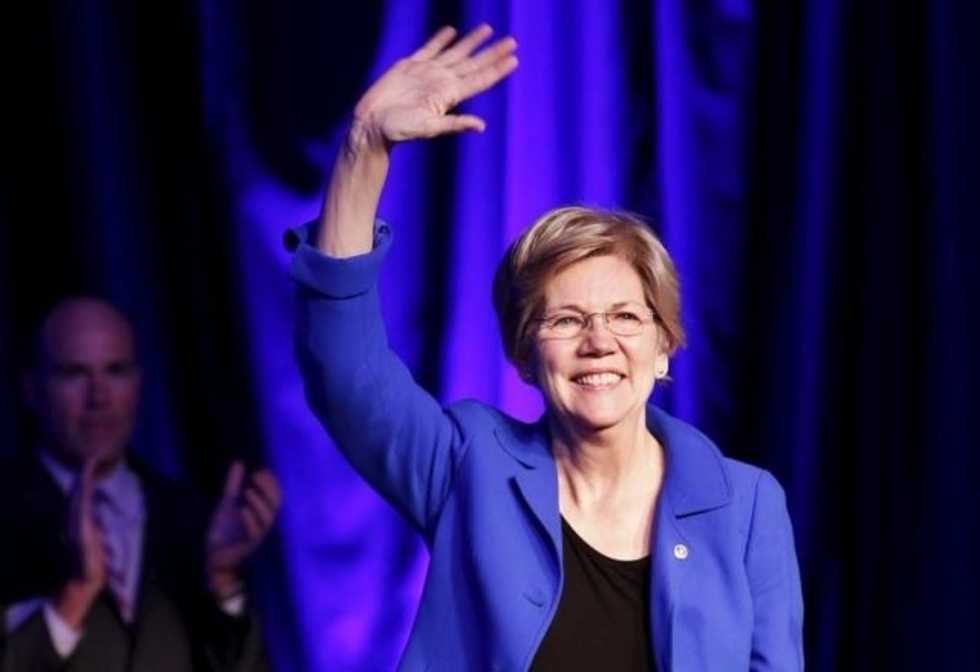
Senator Elizabeth Warren (D-MA) waves at the BlueGreen Alliance Foundation’s Good Jobs, Green Jobs Conference in Washington. REUTERS/Yuri Gripas/File Photo

What Kind Of ‘Socialism’ Is This? Sanders Claims Mantle Of New Deal

What Kind Of ‘Socialism’ Is This? Sanders Claims Mantle Of New Deal

Reprinted with permission from The American Prospect.

In 1916, amid the carnage of World War I, the great German-Polish socialist Rosa Luxemburg wrote that humanity was facing a choice between socialism and barbarism.

Earlier today, speaking at the George Washington University, Bernie Sanders noted that we live in a time of rising authoritarianism, citing the regimes of Putin, Xi, Orban, Duterte and Trump as indices of the growing threat. His speech was billed as offering his definition of socialism, which, a la Rosa, was said to be the alternative to oligarchy and authoritarianism.

Socialism as Sanders proceeded to define it is indeed an alternative to oligarchy and authoritarianism. What his speech left hanging was whether his socialism was in fact socialism.

In 2015, as his campaign was just taking off, Sanders came to a different D.C. university—Georgetown—to deliver what was also then billed as his definition of socialism. Before a crowd of wildly cheering college students, he reeled off a series of social democratic proposals—the universal right to health care, to college education and the like – with constant reference to the great American leader who did indeed lead the successful war against barbarism in the 1940s: Franklin Roosevelt. His speech was so FDR-centric that I wrote at the time:

Throughout the 1930s, Republicans claimed that Franklin Roosevelt was really a socialist. Today, Bernie Sanders said they were right.

Then, as today, Sanders referenced Roosevelt’s 1944 State of the Union speech – FDR’s last great speech—in which Roosevelt proposed an Economic Bill of Rights. Today, Sanders formally proposed “a 21st Century Economic Bill of Rights,” which included a right to a living-wage job, to “quality health care,” to “a complete education,” to “affordable housing,” to “a clean environment” and to “a secure retirement.”

As if citing Roosevelt were not enough, Sanders also cited Harry Truman, whose efforts to create a Medicare for All program in the 1940s were thwarted by conservatives and the medical profession. He quoted Truman, talking about his critics, at length:

Socialism [Truman said] is the epithet they have hurled at every advance the people have made in the last 20 years. Socialism is what they called Social Security. Socialism is what they called farm price supports. Socialism is what they called bank deposit insurance. Socialism is what they called the growth of free and independent labor organizations. Socialism is their name for almost anything that helps all the people.

Nor did Sanders’s talk simply identify socialism with the social democratic reforms of Roosevelt’s New Deal and Truman’s Fair Deal. It also contained two crucial omissions.

First, even as Sanders cited Roosevelt and Truman, but he also did not cite any avowed American democratic socialists, save, in passing, Martin Luther King Jr. He made no mention of his great hero, Eugene V. Debs. Nothing on Norman Thomas, the Socialist Party’s candidate for president in each of FDR’s four elections. Nothing on A. Philip Randolph or Bayard Rustin or Michael Harrington. No reference to Thomas’ line when asked if Roosevelt had actually carried out the Socialist Party’s program. “He carried it out,” Thomas said, “on a stretcher.”

Second, Sanders also omitted his own more socialistic proposals. His speech skipped over some groundbreaking social democratic reforms that Sanders and Elizabeth Warren have both advocated in the course of the campaign, including dividing corporate boards between shareholder and worker representatives. He made no mention of an American version of the Meidner Plan – a 1970s proposal never quite implemented in Sweden that would gradually transfer the ownership of corporations, through the yearly payment of profits in the form of stock to their employees’ organizations, to their workers.

In short, Sanders’s socialism, as he defined it, is an expansion of America’s semi-demi-welfare state to include more economic rights. It’s an effort to make us a more functional social democracy—which, of course, is no small proposal and by American standards, a great leap forward. But he could have made the same proposals and labeled them neo-Rooseveltian liberalism without straining historical accuracy.

How, then, did his speech depart from his 2015 Georgetown outing? Chiefly, in noting that the world had grown more dangerously authoritarian and xenophobic in the intervening years—a discussion that Sanders also cast in a neo-Rooseveltian light. Twice in his talk, he cited Depression-era rallies at Madison Square Garden: the first, the infamous pro-Nazi rally of 1939; the second, FDR’s election eve speech of 1936—surely, Roosevelt’s most radical oration—in which FDR sounded the anti-oligarchic and anti-authoritarian themes that Sanders is sounding today. This speech, too, Sanders quoted at length:

We had to struggle [Roosevelt said] with the old enemies of peace—business and financial monopoly, speculation, reckless banking, class antagonism, sectionalism, war profiteering.

They had begun to consider the Government of the United States as a mere appendage to their own affairs. We know now that Government by organized money is just as dangerous as Government by organized mob.

Never before in all our history have these forces been so united against one candidate as they stand today. They are unanimous in their hate for me—and I welcome their hatred.

No line in Sanders’ speech drew a louder spontaneous standing ovation than that one—the one about welcoming their hatred. And it wasn’t Bernie’s line; it was FDR’s.

Sanders’ conflation of democratic socialism with the progressive reforms of an FDR is at some level eminently understandable. Social Security is indeed a social democratic program, as is Medicare; their shortcomings, as Sanders surely realizes in seeking to bolster the first and universalize the second, is that they’re not social democratic enough. In running as a democratic socialist who seeks to complete and update FDR’s agenda, Sanders straddles the very fuzzy border between social democracy and American left liberalism. There, coming from the socialist side, he meets Warren, coming from the liberal side, and a growing number of their fellow Americans.

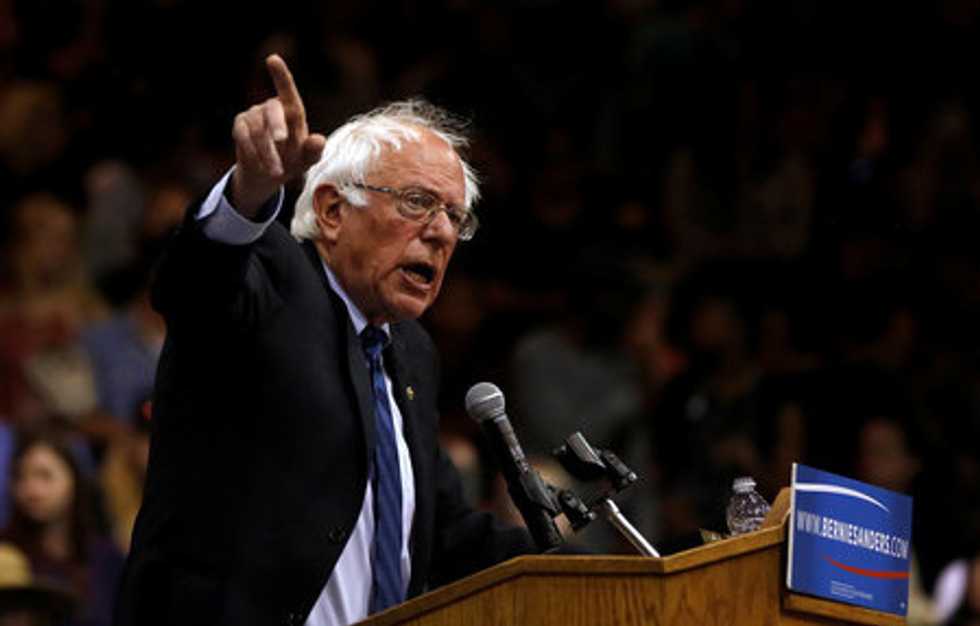
Democratic presidential candidate Bernie Sanders speaks at a campaign rally in Salem, Oregon, May 10, 2016. REUTERS/Jim Urquhart

Shop our Store

Headlines

Editor's Blog

Trending

World