Why The 'Democratic Socialists' Have Repelled So Many Black And Latino Voters
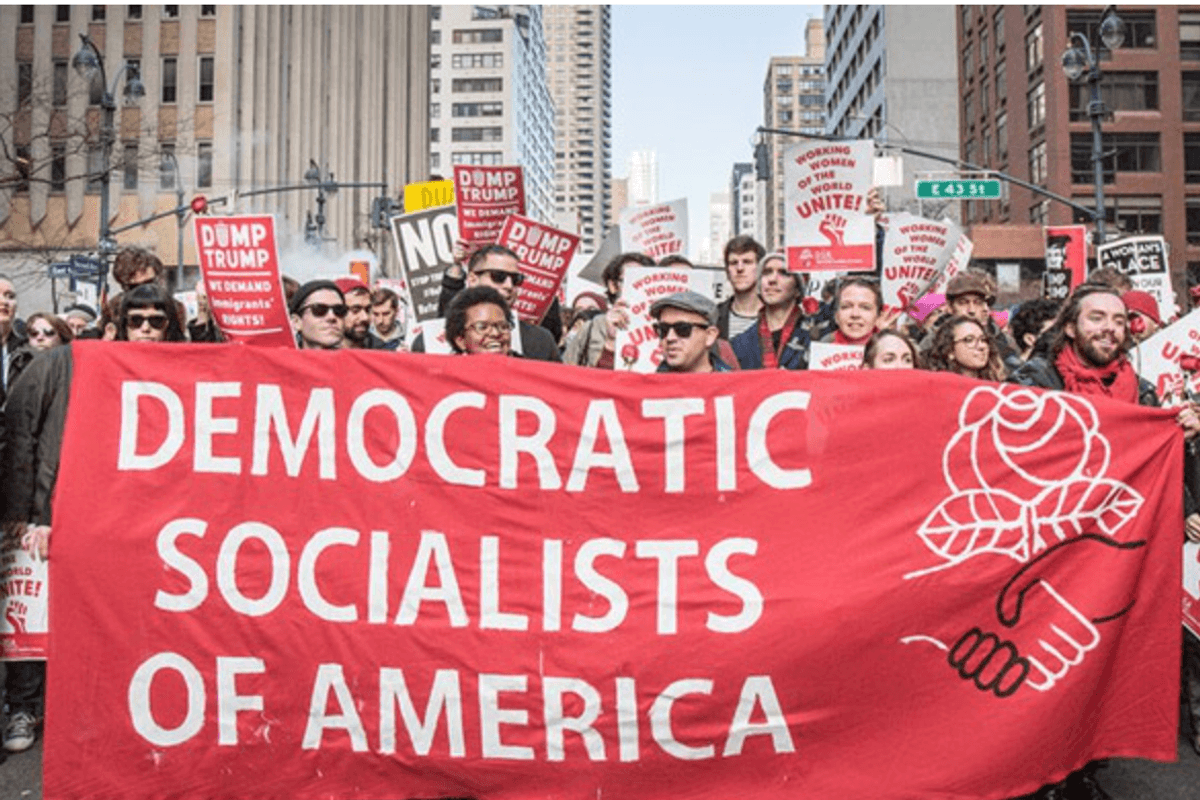
Democratic Socialists of America marching in Manhattan on January 21, 2017
The Democratic Socialists of America use people of color as fashion accessories. Sure, they put black or brown faces on ballots, and they talk a big game about racism. But black and brown voters are not choosing their candidates. The DSA national membership chooses, and it is 85% white.
Look at the crowds. In October 2019, Reps. Alexandria Ocasio-Cortez and Bernie Sanders staged a rally at the Queensbridge housing project, across from Manhattan. Its residents are 47% black, 34% Latino and 10% Asian. News photos showed a nearly unbroken sea of white enthusiasts.
The head of the Queensbridge Resident Association called the organizers "disrespectful." They didn't even bother to place flyers in the buildings.
During the 2020 presidential race, Bernie Sanders rode high in the early Democratic primaries, where voters are mainly comfy whites. But when the primaries moved south, where Democratic voters are overwhelmingly black, he got creamed. In South Carolina, he lost to Joe Biden by 29 percentage points.
Asked to respond to that massive comeuppance, Sanders waved off the importance of those black voters. They were "conservative," he said. "But you know what? We're out of the Deep South now. And we're moving up."
That rankled several prominent black officials. "I was very concerned with that comment," said New York Rep. Hakeem Jeffries. "Black voters in the South are not very conservative" and "essentially dismissing the South was a slight at African American voters."
A recent poll in the Michigan Democratic Senate primary has 67 percent of blacks supporting the white candidate, Rep. Haley Stevens. Only 21 percent back the DSA's Abdul El-Sayed. A prominent El-Sayed supporter, William Lawrence, is on record denouncing black political leaders as a "pillar" of the "capitalist, imperialist" American establishment. Their support of the Democratic leadership, Lawrence said, "defangs the white left."
He really said that.
Sanders has a spotty history on race. He had joined the white flight out of New York City in the 1960s, when a new generation of black activists didn't care to take orders from white liberals. Sanders repaired to Burlington, Vermont, then less than one percent black. There he built a white-dominated socialist movement, using people of color as window dressing from the very start.
In his 2020 presidential campaign, Sanders' chief black intellectual, Cornel West, called Barack Obama a "Rockefeller Republican in blackface." (Also, a "war criminal.")
New York Mayor Zohran Mamdani has followed the playbook. He has an odd character named Gustavo Gordillo defending his city-run grocery stores. Co-chair of DSA's New York chapter, Gordillo is an immigrant from Peru who studied "radical Latin American cinema" in college. He tried to move up in the art world, but after apparently not succeeding, decided to try his hand as a DSA celebrity.
Gordillo is now on TV "explaining" Mamdani's plan for government groceries, one costing taxpayers an amazing $30 million. Asked whether it's OK for publicly owned stores to put nearby bodegas out of business, Gordillo chirped that if bringing down prices in the neighborhood "is enough to put someone out of business, then maybe they shouldn't have been in that business in the first place."
The bodega owners are largely Dominican, Yemeni or from other recent immigrant groups. Their little stores are entrepreneurial ventures that put families on the path of economic advancement. The owners work their tails off long into the night, often confronting criminals bent on everything from shameless shoplifting to armed robbery.
And now Gordillo is on TV arguing that bodega owners who can't compete with stores built with taxpayer dollars — and that don't have to pay rent or property taxes — are somehow deficient businesspeople.
None of the above is made up, I swear.
Froma Harrop is an award winning journalist who covers politics, economics and culture. She has worked on the Reuters business desk, edited economics reports for The New York Times News Service and served on the Providence Journal editorial board.
Reprinted with permission from Creators.
- Insulting Trump Bombs At Redo Of White House Correspondents' Dinner ›
- Was JFK A Conservative — Or A Socialist? Let’s Ask The Right-Wingers Of 1963 ›
- The Wealthy Sponsors Of Tucker Carlson’s Phony ‘Class Warfare’ ›
- Is The DSA Actually Democratic? Or Are Its Candidates An Extremist Gift To MAGA? ›
- Danziger Draws - National Memo ›
- Michigan Democrats Urging Unity After El-Sayed Narrowly Wins Costly Primary - National Memo ›
- Michigan Delivers A Hard Lesson For AIPAC, But Will They Ever Learn? - National Memo ›
- Socialist? Capitalist? Americans Live In A Mixed Economy, Without Labels - National Memo ›
- DSA Should Drop The Blue-Collar Cosplay That Working Voters Reject - National Memo ›
- The cancellation of professor Adolph Reed, Jr.’s speech and the DSA’s promotion of race politics - World Socialist Web Site ›
- Fathom – The Democratic Socialists of America just endorsed ethnic murder ›
- r/dsa on Reddit: I know the DSA has a lot of work to do when it comes to diversity. But is this number accurate? ›
- Do America’s Socialists Have a Race Problem? | The New Republic ›
- The DSA Is the Most Racist Faction of the Democrat Party Since the Dixiecrats Fought Against Civil Rights ›
- Is DSA Racist? - Political Currents by Ross Barkan ›