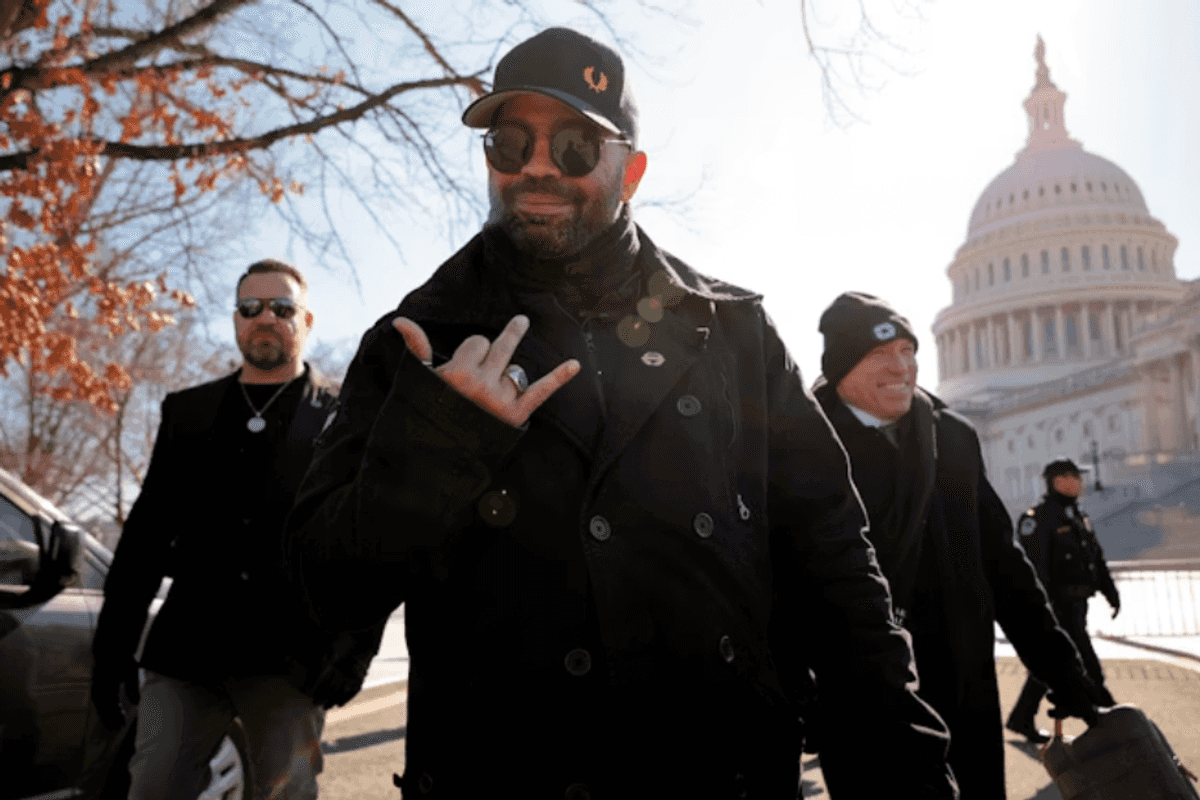
Enrique Tarrio outside the Capitol in September 2023
As of this afternoon, President Trump is retreating from the $1.8 billion Anti-Weaponization Fund, according to The New York Times and multiple other reports. The White House communicated the decision to Republican leaders on Capitol Hill today. The decisive moment came earlier Monday, when Speaker Mike Johnson met with Trump and told him bluntly that the fund was torpedoing the $70 billion immigration enforcement bill—the centerpiece of the administration’s legislative agenda.
That conversation, a source says, is what finally convinced the president to drop it. Senate Majority Leader Thune had already told reporters that changes were a “safe bet” and that “the best way to handle it is if the administration decides to shut it down themselves.” House Republicans had been actively looking for ways to kill the fund, and the Senate was already in open revolt—with more than a dozen Republican senators, including Lindsey Graham, privately urging Trump to pull the plug.
Trump and the DOJ waged a similar, strategic retreat a few weeks ago, when his lawyers filed a panicked voluntary dismissal two days before they would have had to walk into Judge Williams’s courtroom and explain, under the solemnity of federal proceedings, how Donald Trump suing an agency he controls, defended by his own former personal criminal defense lawyer, constituted a genuine adversarial lawsuit. Pinned between a rock and a hard place, he bolted.
So Trump blinked. Again. And on an ill-advised move—bogus and illegal on multiple fronts—on which he nevertheless had fully staked his diminishing political capital.
DOJ issued a statement today that it would “abide by the Court’s ruling”—meaning Judge Leonie Brinkema’s temporary restraining order out of Virginia, which froze the fund Friday, not Judge Kathleen Williams’s order reopening the settlement, about which more below.
The DOJ statement defended the fund, said nothing about it being permanently dead, and left conspicuously open the question of whether it could be revived.
So the parameters of the retreat remain unclear as of this writing. It may be a full capitulation. It may be a tactical pause dressed up as a concession. Either way, as a matter of political reality, it is a humiliation—the administration’s biggest self-inflicted wound of Trump 2.0, now compounded by a very public retreat.
In my dispatches on this scandal going back to February, and in my conversations with Representative Jamie Raskin and others, I argued that while the legal avenues for challenging the fund were real but difficult—standing problems, appropriations law hurdles, the fund’s architecture designed specifically to be unreachable—the political blowback would ultimately be too powerful to ignore.
That was because the emotional and political core of the entire scheme was the proposition that the January 6 rioters were victims—“patriots” at a “love-in,” not insurrectionists at a riot designed to hijack the Constitution—entitled to taxpayer-funded compensation. That core was part and parcel of Trump’s relentless and corrupt effort to whitewash history and his own role in trying to steal the 2020 election.
And the political winds, in fact, proved too strong to ignore. The moment Republican Senators and House members had to confront the question—do you support giving money to the people who beat police officers on January 6?—the fund became politically radioactive. Ted Cruz called a meeting with Blanche and Senate Republicans last week one of the roughest he had seen in his Senate career. Another attendee called it the toughest grilling of any administration official they had ever witnessed. Lindsey Graham, of all people, privately urged Trump to drop it.
Thune told reporters that “the best way to handle it is if the administration decides to shut it down themselves.” And Johnson, in his Monday meeting with Trump, delivered the message that finally landed: The fund was killing the immigration bill, and House Republicans were looking for ways to stop it with or without the White House.
Senate Democrats twisted the knife further today, with Schumer releasing a “Dear Colleague” letter vowing a coordinated multi-front assault—floor votes, oversight, appropriations fights—and Senators Schiff, Kelly, and Slotkin introducing the Drain the Slush Fund Act to bar any payouts to those convicted of crimes or connected to January 6. They might not have been positioned to stop the arrangement legally, but they were able, with the foreseeable aid of Republican defectors, to keep the spotlight turned up high enough to make it impossible to look away, as the White House plainly was hoping.
Trump will now take serious lumps from the MAGA base—far more than if he had never embarked on this asinine detour in the first place. The pardoned rioters who were salivating over their anticipated windfalls are going to be furious. Brandon Fellows, who spent three years in prison for his January 6 conduct, had already sought $30 million from DOJ before the fund was even announced and told CNN he was “feeling confident.” The Proud Boys leader expected a $2 to $5 million personal payout. Robert Gieswein—who marched with the Proud Boys, sprayed aerosol irritant at Capitol Police officers, threw a punch at another officer, and served four years in prison—told The Free Press he wants up to $10 million, though he’d be willing to settle for less.
It looks as if all of them, and the roughly 1,600 other January 6 defendants, are going to be left empty-handed and enraged. More, Trump is backing down precisely because the politics of supporting them became untenable—it is they whom Trump is plainly abandoning. All of that amounts to a richly deserved comeuppance for Trump’s staggering audacity in trying to make the American people not just pardon but financially reward the most serious assault on American democracy since the Civil War.
But if Trump, Blanche, and the attorneys involved in the original scheme—including Associate Attorney General Stanley Woodward and Trump private attorney Boris Epshteyn—think that retreat puts an end to the prior misconduct, they may be in for a rude surprise.
Whereas Brinkema’s order froze the fund’s operation going forward, Williams is asking a fundamentally different question: What already happened in her court? She is not interested in where the fund goes from here. She is interested in whether she was deceived, whether her court served as an instrument of fraud, and whether the lawyers who were involved in the bogus settlement violated their most basic obligations to the tribunal.
Last week, a bipartisan group of 35 former federal judges filed a motion urging Williams to reopen the case under Federal Rule of Civil Procedure 60(b)(4). Their filing was blunt: “The Court was deceived.” They argued that Trump and his co-plaintiffs deliberately withheld any mention of the settlement from their dismissal notice—timing the withdrawal to outrun Williams’s scrutiny—and that the resulting arrangement “is a product of collusion and is itself a fraud on the Court.”
Williams did not hesitate to act on the suggestion. On Friday, she issued an order reopening the case, invoking Rule 11—which requires attorneys to certify that any filing serves a legitimate purpose—and citing extensive case law for the proposition that a court may raise Rule 11 violations on its own initiative and that a party cannot avoid sanctions simply by voluntarily dismissing the case.
I expect the administration to try the same move with Williams that it just tried with the fund itself: a strategic retreat dressed up as compliance. He and Epstheyn may try to elude her order altogether, or failing that, to submit on June 12 a filing that treats the whole reckoning as moot: the case is closed, the voluntary dismissal is self-executing under Eleventh Circuit precedent, there is nothing left for her to adjudicate. It is the legal equivalent of a stiff arm: not quite refusing to respond, but responding with nothing of substance.
Williams is unlikely to find that satisfying. We have seen this movie before—most vividly in the Boasberg-Bove-Rao confrontation over deportation flights, where the administration’s combination of contempt and foot-dragging met a judge who simply would not stand down. I don’t think that a dismissive June 12 filing will cause her to close up shop. Nor should it: the retreat from the fund is completely separate from the past potential abuse of the court.
If Williams insists on getting to the bottom of what happened, the various lawyers and participants will look like flies on flypaper, trying to wriggle away from the consequences of their conduct. That would presumably include Trump and the administration’s tried-and-true technique of seeking emergency review in the Eleventh Circuit, and if that fails, the Supreme Court (where the circuit justice for the Eleventh Circuit is Clarence Thomas). But in effect, they’d be doubling down on the whole dubious wager, and risking even greater humiliation.
Williams is not done. She has the record, the legal tools, and clearly the will to press forward, and the 35 former judges have handed her both the doctrinal roadmap and the judicial mandate to act. Political retreat does not erase a fraud on the court. The lawyers who engineered this heist still have a June 12 deadline, and a federal judge waiting for their answer.
The fund may be withering. But the investigation and accountability of the overall constitutional swindle may just be getting started.
Harry Litman is a former United States Attorney and the executive producer and host of the Talking Feds podcast. He has taught law at UCLA, Berkeley, and Georgetown and served as a deputy assistant attorney general in the Clinton Administration. Please consider subscribing to Talking Feds on Substack.
Reprinted with permission from Talking Feds.
- Perps, Not Victims: The Big Lie At The Heart Of Trump's Slush Fund ›
- GOP Representative Targeted By Trump For Opposing January 6 Slush Fund ›
- Right-Wing Lawyers Are Already Squabbling Over January 6 'Slush Fund' Spoils ›
- With Slush Fund, Trump And Blanche Conjured A Metastasizing Scandal ›
- Looting America: Trump's Corruption At The Point Of No Return ›
- Trump Built His Slush Fund 'Settlement' On A Lie -- And An Impeachable Offense ›
- Federal Judge Halts Justice Department From Enacting January 6 Slush Fund ›
- Graham's Sudden Death Throws Blanche Confirmation Into Doubt - National Memo ›
- Danziger Draws - National Memo ›
- Parachuting Into The Slush Fund Case, Blanche Proves DOJ Colluded With Trump - National Memo ›
- DOJ Trumpets That It Will ‘Abide by’ Slush Fund Court Order After GOP Balks At Funding ICE, Ballroom ›
- Democrats Are Starting to Fight Back Against Trump’s MAGA Slush Fund | The New Republic ›
- Trump drops his $1.8B ‘slush fund’ after outrage over paying his allies | The Independent ›
- Trump Abandons $1.8B Political Slush Fund—For Now ›
- Trump administration appears to back off $1.8 billion ‘anti-weaponization’ fund after rare GOP backlash ›