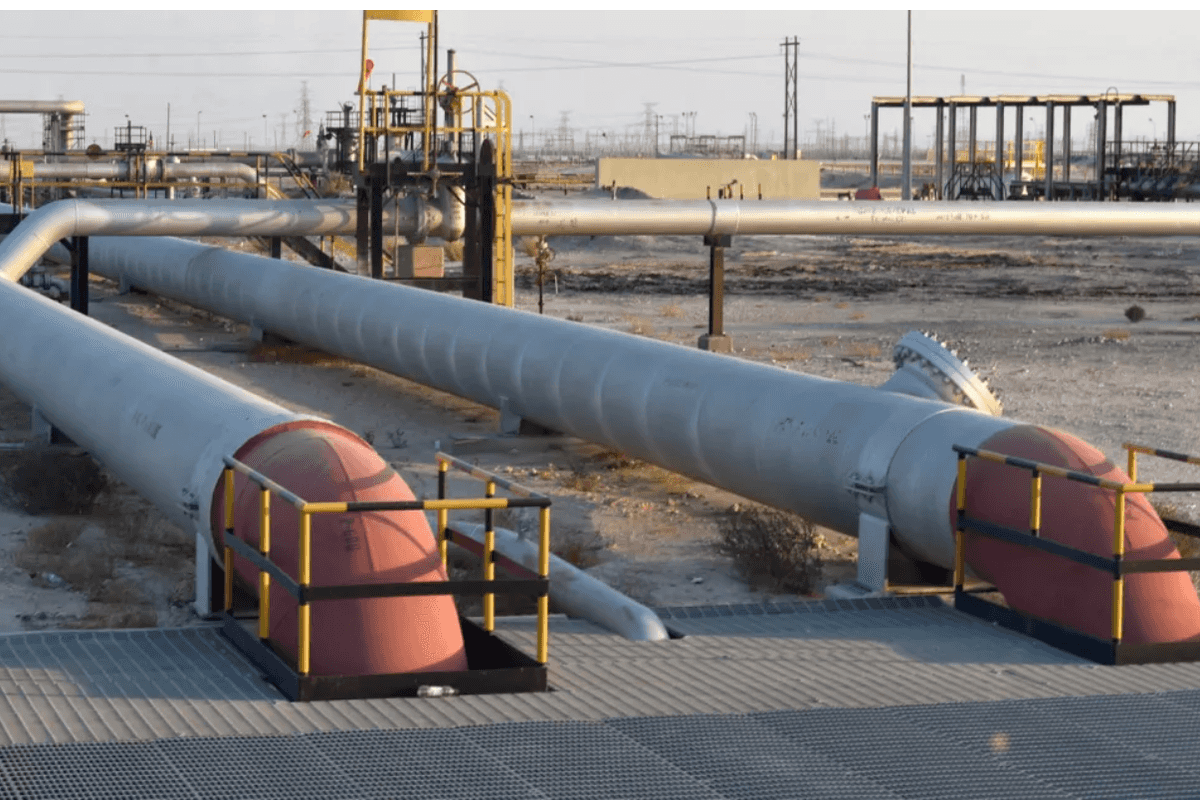
Oil pipelines in Saudi Arabia
In a recent episode of the New York Times podcast, The Daily, journalist David Sanger spoke of Iran’s two leverage points against the United States: one is the nuclear threat, and the other is the Strait of Hormuz:
The second piece of leverage they have is the ability to cause havoc in the world economy and world energy markets…that is not necessarily a lasting power for the Iranians. You’re already seeing countries figure out how to get energy elsewhere. Over time, you’re going to see more pipelines built to avoid having to send oil across the Strait. The Saudis have already reactivated an unused pipeline they had to route around the Strait.
So the Iranians know that this is not going to be a forever weapon. But it’s pretty good for right now.
In what should go down as the more egregious missteps in the history of foreign policy, this leverage point was a gift from the Trump administration, whose unwarranted self-confidence and ignorance of the region taught the Iranian regime that they had this weapon.
But I agree with Sanger that it is not a “forever weapon.” Just like you’d learn to avoid the route to school where bullies take your lunch money, the energy exporters of the Gulf are starting to make other plans. Let’s take a brief look at what alternatives exist and when they might come into play.
BLUF: GS Research estimates “that enough pipeline capacity will likely be added in the Mideast region to insulate over 45% of the pre-war level of Persian Gulf producers’ exports by end-2027 and more than 60% by end-2028 from any potential future Hormuz shocks.”
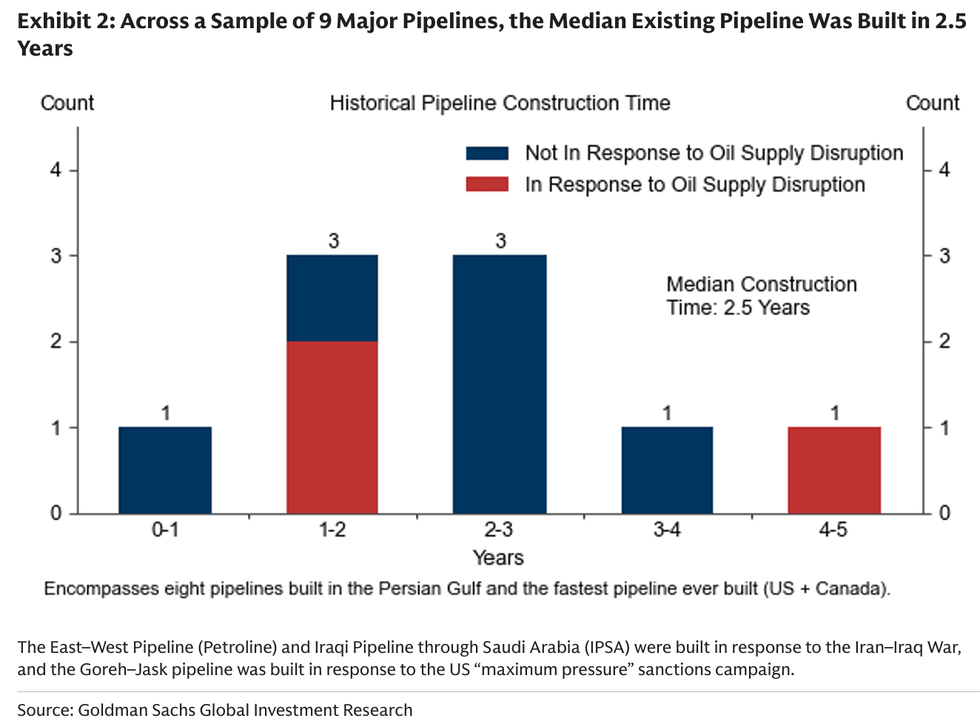
How long does it take to build a pipeline? GS doesn’t have that large a sample, but the median construction time is 2.5 years.
The researchers estimate an “accelerated scenario,” where regional producers, motivated the fact that both sides are dug in and any agreement is likely to be as shaky as the last one, step on the gas to speed up pipeline production.
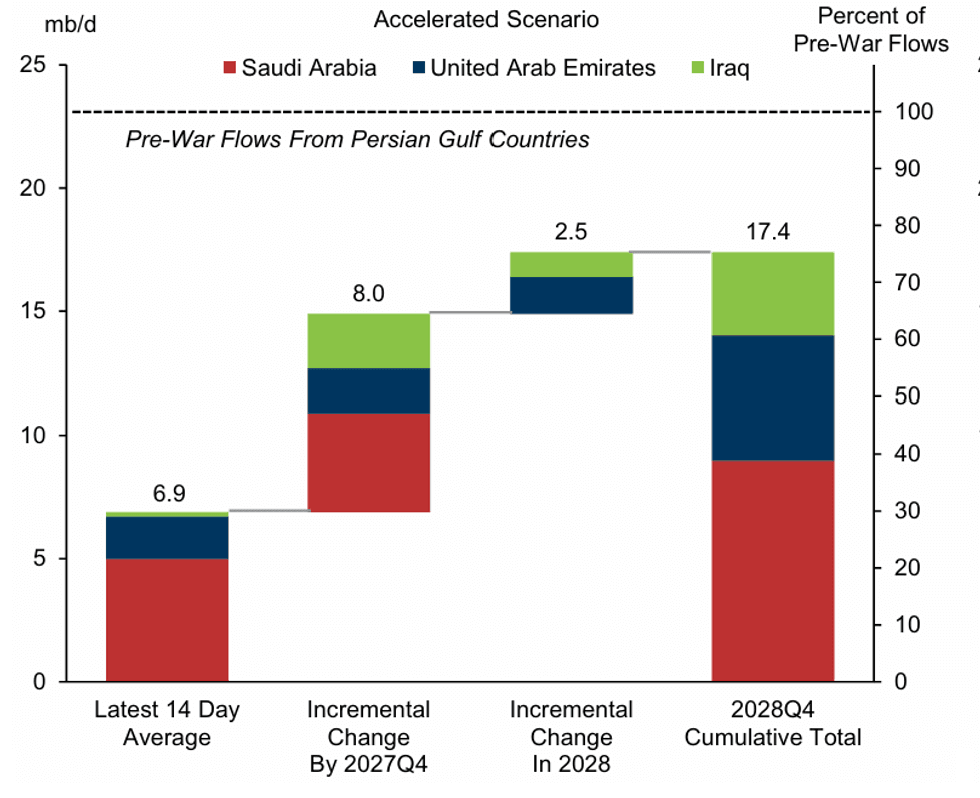
The Saudis and the UAE already are already rerouting about a third of the pre-war supply, and under this scenario, 75 percent of the flows are rerouted by the end of ‘28. Under GS’s conservative scenario, that flow share falls to 45 percent.
If you’re thinking ‘28Q4 feels far away and a lot can happen between now and then, I agree. And I’ve got another idea to help reduce Iranian leverage: shift to renewable energy sources. Every time someone presses start on their electric vehicle, it’s a blow for the oil producers and a ding to Iranian leverage in the Strait, especially, of course, if the electricity is derived from clean sources, which is fast becoming a highly viable option in terms of price-points.
But one thing I’ve learned in many years of tracking global flows is that supply chains will adapt. Now right away, and price effects arrive much sooner; in fact, they’re the motivator for the alt routs. But it’s a good example of the kind of ripple effects you get when you throw a big, dumb boulder in the water, as the Trump admin has done with this war.
Jared Bernstein is a former chair of the White House Council of Economic Advisers under President Joe Biden. He is a senior fellow at the Council on Budget and Policy Priorities. Please subscribe to his Substack, from which this is reprinted with permission.
- Will Bond Market Yields Force Trump To End His Blundering Iran War? ›
- As Trump Ends Ceasefire, Hawks Demand Iran Invasion -- And Nuclear Strike? ›
- Did We Lose Yet? Trump's Ego-Driven Iran 'Excursion' Crashes Into Reality ›
- Iran Hawks Confidently Predict Trump Will Resume War After Midterm Elections ›
- Trump's Fox News Cabinet Fractures Over How (Or Whether) To End War ›
- Will Surrendering To Iran Relieve Trump's Gas Pains? Alas, Probably Not! ›