Tag: 2026 senate races
Senate Turnover May Be Within Reach As Democratic Candidates Surge

Senate Turnover May Be Within Reach As Democratic Candidates Surge

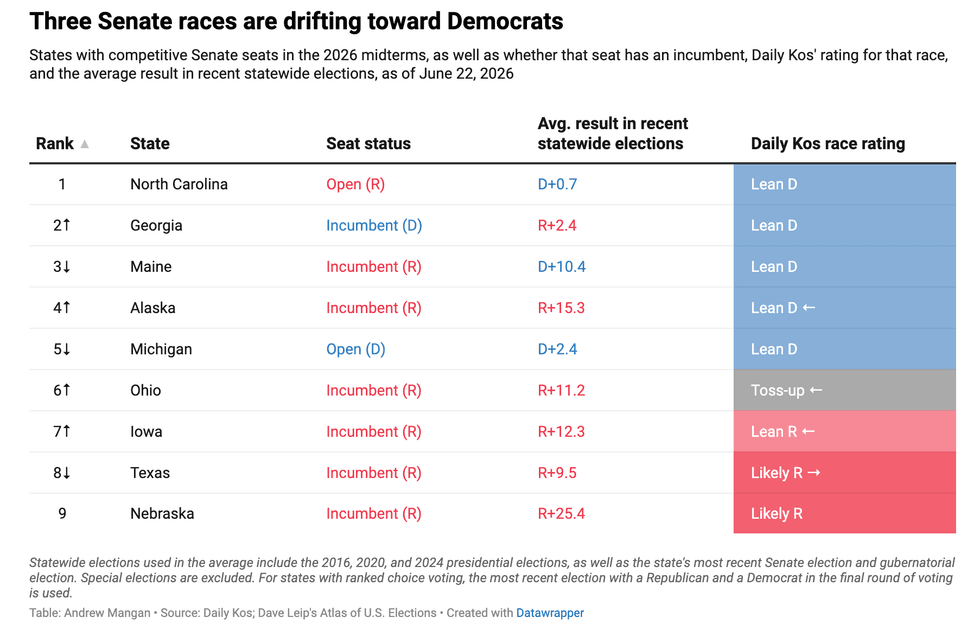
As the political climate gets increasingly noxious for President Donald Trump and his captured Republican Party, it’s becoming clearer that Democrats are favored to retake the House this November. The Senate is a tougher lift, but it’s no longer just in play. Democrats may now be the slightest of favorites to win it.

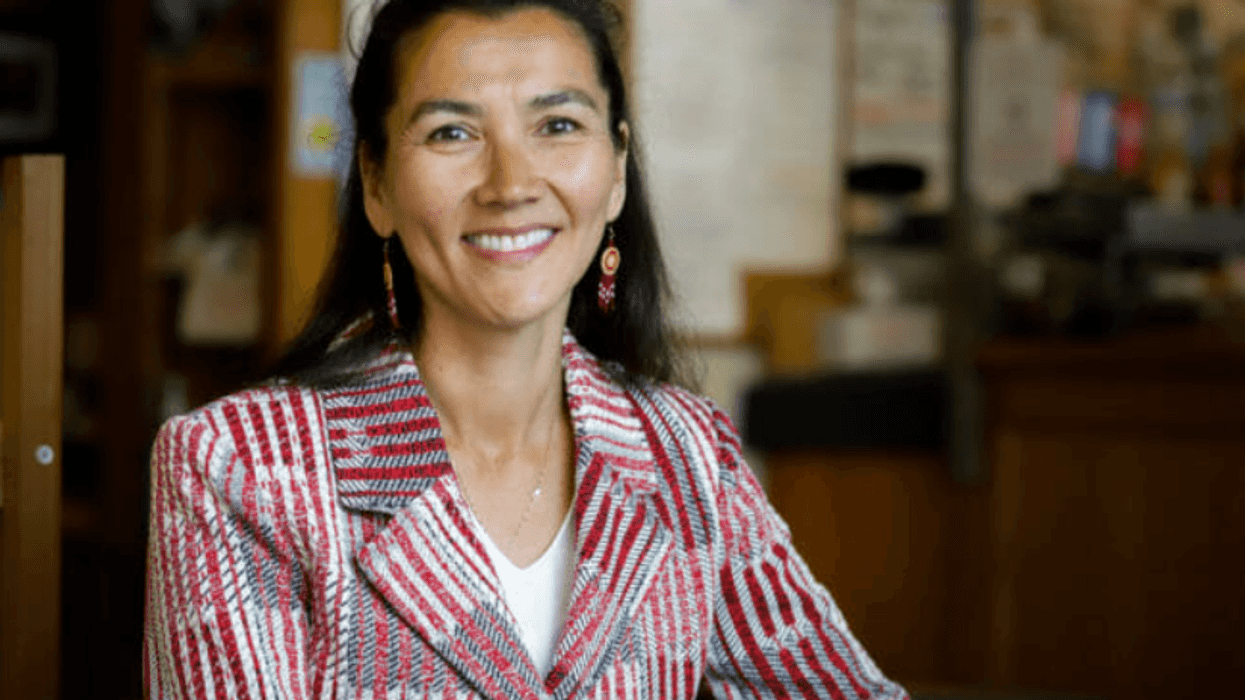
That is a remarkable state of affairs. Democrats are operating on largely hostile terrain, while Republicans hold a 53-seat majority in the chamber. Democrats need a net gain of four seats to secure a majority. (If you’re interested, you can look back at our March 29 and May 10 rating updates.)

1. North Carolina (R-open, Lean D)

Former Democratic Gov. Roy Cooper has enjoyed big leads in just about every poll so far as he faces former Republican National Committee Chair Michael Whatley in this open-seat race. On June 11, Sabato’s Crystal Ball moved the race to “Leans Democratic,” catching up with Cook Political Report, which shifted the race to “Lean D” in April.

Scandal has screwed Democrats here before, so nothing can be taken for granted. But as for now, this is the Democrats’ most surefire pickup of the cycle.

2. Georgia (D-incumbent, Lean D)

Sen. Jon Ossoff is the most vulnerable Democratic incumbent on the map. Oddly, the most recent poll of the general election was fielded in early April, when Ossoff held a high-single-digit lead. We now have an official Republican challenger in Rep. Mike Collins, so new polling should arrive soon in this reddish-purple state.

I’m moving Georgia ahead of Maine for now. Ossoff’s campaign is firing on all cylinders, without the self-inflicted drama that has engulfed Democrats in the Pine Tree State. Both Cook and Sabato rate the race “Lean D.”

3. Maine (R-incumbent, Lean D)

Democratic nominee Graham Platner is, to put it mildly, controversial. Yet he seems to have entered the kind of political space Trump occupies, where scandal doesn’t just bounce off him but even sometimes seems to strengthen him. Platner is charismatic, with a fiery anti-establishment message tailor-made for the moment. Maine has always had a soft spot for unconventional politicians, and that appears to be helping him.

Unlike Trump, Platner has apologized for his worst excesses. We’re long past the era when candidates were expected to be paragons of purity. At minimum, voters seem willing to reward politicians who show some capacity for growth.

In polling, the race is tight. Platner holds a narrow lead over incumbent Republican Sen. Susan Collins, who has repeatedly survived in this Democratic-leaning state. If you’re looking for evidence that his latest controversies are taking a toll, the data is mixed. In Quantus Insights polling, the race moved from Platner+7 in early March to Platner+1 this month. Meanwhile, Republican pollster Fabrizio, Lee & Associates went from Collins +1 in January to a tie more recently.

My instinct says that Platner ultimately reestablishes a mid-single-digit lead and wins comfortably in a high-turnout Democratic environment. But that’s speculation. For now, “Lean D” remains the appropriate rating. Cook and Sabato both rate the race a Toss-up.

4. Alaska (R-incumbent, Lean D)

In May, this was a toss-up race, which, in itself, seemed ridiculous. We’re talking about Alaska, a state Trump carried in 2024 by 13 percentage points, with an incumbent Republican senator, Dan Sullivan, who isn’t plagued by scandal, though he is somewhat unpopular.

Yet here we are in June, upgrading the race to “Lean D.”

Driving the change is former Democratic Rep. Mary Peltola’s consistent strength in polling. Alaska Survey Research, the state’s gold-standard pollster, has shown Peltola with 5-point leads in its past two surveys, while Sullivan hasn’t scored above 44% support. In April, ranked-choice simulations failed to give Sullivan the boost he needed to clear 50%, while Peltola reached that threshold comfortably in round two. The June results tell essentially the same story.

Cook still has the race at “Lean R,” while Sabato rates it a “Toss-up.”

5. Michigan (D-open, Lean D)

Democratic Sen. Gary Peters’ retirement scrambled the race in one of the country’s premier battleground states. Both Cook and Sabato rate it a Toss-up, which is understandable on paper. But with the primary still ahead on Aug. 4, there remains considerable uncertainty.

On the Democratic side, progressive physician and former Wayne County health director Abdul El-Sayed, backed by Bernie Sanders, Alexandria Ocasio-Cortez, and Justice Democrats, has led most recent polling against Rep. Haley Stevens and state Sen. Mallory McMorrow.

El-Sayed’s strength has predictably unnerved some Democrats, who worry both about his progressive politics and whether his Arab surname could become a liability in a state Trump carried in 2024.

Polling offers little clarity. In some surveys El-Sayed performs better than his rivals in hypothetical general-election matchups; in others he performs worse. While Cook and Sabato’s Toss-up ratings are defensible, I still lean Democratic because of the national environment. In a neutral climate, I would be considerably more pessimistic.

If all of the above races break as I project, Democrats would reach a 50-50 Senate, with Vice President JD Vance holding the tie-breaking vote. To secure a majority, Democrats would need to flip one of the following four seats.

6. Ohio (R-incumbent, Toss-up)

Former Sen. Sherrod Brown of Ohio, shown earlier this year.AP

I love Sherrod Brown. The former senator spent decades outperforming the partisan lean of his increasingly conservative state. His luck finally ran out in 2024, when he lost to now-Sen. Bernie Moreno. Even so, while Trump won Ohio by 11 points, Brown lost by less than 4 points.

Early polling in Brown’s comeback bid was uninspiring, with appointed Republican Sen. Jon Husted either narrowly trailing or narrowly leading Brown. As I often note, undecided voters usually break toward their state’s partisan baseline. A Democrat sitting at 45% in Ohio is rarely in a strong position.

That picture may be changing. The two most recent polls show meaningful movement toward Brown. Fox News’ poll, conducted by Beacon Research and Shaw & Company Research, had Brown up by 8 points, 53% to 45%. That’s difficult to take at face value, but it does reinforce the broader trend.

Do I believe Brown is really up by 8 points? No. Do I believe the national environment is shifting in his favor? Absolutely. Given that both Cook and Sabato also rate the race a “Toss-up,” an upgrade feels warranted.

Winning the above six races is Democrats’ clearest path to a Senate majority. And it bears repeating: That would require Democrats to win two states Trump carried by double digits.

7. Iowa (R-open, Lean R)

Welcome to the list, Iowa! And what a promotion it is, going from “other states to watch,” all the way up to “Lean R.”

Democrats have their nominee in Iowa state Sen. Josh Turek, and he will face Republican U.S. Rep. Ashley Hinson in the general election. The past three polls of the race have had these candidates neck and neck in the mid-40s. Trump carried the state by more than 13 points in 2024, so I still expect those undecideds to lean Republican, but his approval rating is 12 points underwater in the state, according to Civiqs, and Iowa’s agricultural economy has been particularly hard hit by Trump’s tariffs and worker deportations.

8. Texas (R-incumbent, Likely R)

How about that Republican primary between corrupt Texas Attorney General Ken Paxton and incumbent Sen. John Cornyn? By big-footing his way into the race with a Paxton endorsement, Trump guaranteed that Republicans will have to spend tens of millions in the battle for this seat.

Democrats have an outside shot with state Sen. James Talarico. Out of the gate, Republicans seem uncertain how to attack him. First came strained attempts to portray him as gay, complete with insults like “Tofu Talarico” and “low-T Talarico.” Fox News host Jesse Watters called him a “gay vegan.” White House aide Stephen Miller claimed Democrats had nominated “their first transgender senate candidate.”

Weird, but it gels with their hateful brand.

But a week later, Republicans were attacking Talarico for having dated multiple women. Of course, all of the relationships were consensual, public, and unremarkable. Yet Republicans treated the revelation as a major scandal.

Perhaps the strategy is to just scream random nonsense that leaves people so confused they forget that Paxton was impeached by Texas’ overwhelmingly Republican House.

Reprinted with permission from Daily Kos


​'Sabato's Crystal Ball​': Odds Of Flipping Senate Blue Keep Getting Better

​'Sabato's Crystal Ball​': Odds Of Flipping Senate Blue Keep Getting Better

Democrats’ odds of taking control of the Senate just got even better, with The University of Virginia Center for Politics Sabato’s Crystal Ball flipping three races blue.

According to the new ratings, North Carolina’s open Senate race is now projected to flip into Democrats’ hands, with the contest now rated “Lean Democratic.”

And the Senate contests in Alaska and Ohio—states that President Donald Trump carried by 13 points and 11 points, respectively—are now rated “toss-ups.”

“As we reassess the Senate playing field with a little less than five months to go until the November election, three Senate ratings move in Democrats’ favor today, and there are now enough toss-up races to give Democrats a clearer path to winning the Senate majority,” Sabato’s Crystal Ball declared.

Republicans are on shaky ground in all three of those states because Democrats not only nominated strong challengers who have won statewide races before, but Trump’s popularity is now underwater—even in states that he carried in 2016, 2020, and 2024.

Apparently, even die-hard Republicans in red states aren’t fans of Trump saying that “I love the inflation” and that he doesn’t care about Americans’ financial situations.

“If both [Alaska’s former Rep. Mary] Peltola and [Ohio’s former Sen. Sherrod] Brown could come reasonably close in 2024 as Trump was carrying their states by double digits, doesn’t it seem plausible that both have a reasonable chance to win in what should be a much better political environment than 2024 was?” wrote Sabato’s Crystal Ball.

It continued, “Meanwhile, [Alaska’s GOP Sen. Dan] Sullivan and [Ohio’s GOP Sen. Jon] Husted would probably be fine in most years against most opponents, but this may not be most years, and Peltola and Brown are not most opponents.”

The changes came the same day as a new poll from Emerson College, showing Democrats growing their lead on the generic ballot—which asks voters what party they want to see in control of Congress after the next election—to a stunning ten points.

That double-digit margin is higher than the eight-point lead Emerson clocked Democrats at in October 2018—right before Democrats went on to regain control of the House by 8.4 points.

Republicans clearly know that they’re in trouble.

According to Politico, “People close to the president are concerned about Ohio and Sen. Jon Husted’s political team, and there is consternation about whether they’re up to the task.”

And Semafor’s Burgess Everett reported on Tuesday that Republican senators were shown polling that made the races look “bleak” and “challenging” for their party.

Meanwhile, Senate Minority Leader Chuck Schumer is confident in Democrats’ chances.

“We are poised to take back the Senate. We needed multiple paths. No one thought Iowa or Texas would be part of the path—but it is,” he told Punchbowl News Thursday, comparing this year’s midterms to 2006, when Democrats won control of Congress amid backlash to then-President George W. Bush’s unpopular wars.

Schumer added, “It’s almost as if Trump wants to deliberately sabotage the Senate Republicans.”

Reprinted with permission from Daily Kos


Republicans Collins And Whatley Booked Big Profits From Iran War Oil Spike

Republicans Collins And Whatley Booked Big Profits From Iran War Oil Spike

Two Republicans competing in marquee Senate races appear to be financially benefiting from the war in Iran.

Maine Sen. Susan Collins and North Carolina Republican Michael Whatley have both seen their stock portfolios soar since the war began on February 28, largely because of their investments in oil and gas.

American-produced oil shot up in value after the war disrupted the global oil trade. This has led to a surge in gas prices and increased profits for some oil and gas companies.

The U.S. and Iran entered a two week ceasefire agreement on March 7, but it is unclear if the plan will stabalize the oil market.

Leo Mariana, a research analyst at Roth Capital Partners, told The Guardian that the war has been a “windfall” for energy investors.

Among those investors are Collins and her husband, who reported owning up to $115,000 in natural gas stock on her campaign finance disclosures. This includes shares of ConocoPhillips, that hit a 52-week high on March 26.

Between the start of the war and April 1, Collins profited by up to $24,480 from these investments.

Whatley also owns shares of ConocoPhillips, along with Chevron, Exxon Mobil, Devon Energy, and Shell. His total oil and gas investments are worth up to $1.39 million.

With the help of the war, Whatley has profited by up to $219,660.

Both Whatley and Collins have expressed support for the war in Iran, a stance that risks putting them out of step with most voters. A Pew Research Center survey from March found that 61 percent of voters don’t support the conflict.

Whatley’s Democratic opponent, former North Carolina Gov. Roy Cooper, said on X that the war was “devastating” and unwise.

“Americans fear another costly, drawn-out war that puts our troops in harm’s way and removes focus and resources from needs here at home,” Cooper said. “Americans deserve to know all the long-term objectives of this war, its risks and the exit strategy.”

Collins’ Democratic opponent will be chosen in a June 9 primary.

Reprinted with permission from American Journal News

U.S. Senator Jon Ossoff (D-GA).

What Will It Take For Democrats To Flip The Senate? A State-By-State Cheat Sheet

The House of Representatives will be a Democratic-led institution after this November’s midterm elections. The big question is whether Democrats can also recapture the Senate—a chamber that, under any rational circumstances, shouldn’t be competitive.

It’s a brutal map for Democrats. Yet, thanks to President Donald Trump’s toxic incompetence and his obsequious party, it’s now in play. This is the first in a regular feature tracking the most competitive races throughout this election season.

Republicans hold 53 seats in the Senate, meaning Democrats need to net four to get past Vice President JD Vance’s tiebreaking vote.

1. North Carolina (R-open, Lean D)

Former Democratic Gov. Roy Cooper has led in every single poll so far as he faces former Republican National Committee Chair Michael Whatley in this open-seat race.

Time after time, Democrats have come close in recent Senate contests in the Tar Heel State. In 2020, the race appeared within reach until a late scandal derailed the Democratic nominee, who ultimately lost by less than two percentage points. In 2022, Republicans won again by about three points. Those margins mirror the state’s Republican lean at the presidential level, underscoring just how evenly divided North Carolina is.

Nothing can be taken for granted. But Democrats have shown they can win statewide, and Cooper remains a popular figure after two terms as governor. He also has a shockingly strong record, having run in six statewide races and won all of them.

2. Maine (R-incumbent, Lean D)

How tough is this cycle for Democrats? This is a Republican-held seat in a state won by Democratic presidential nominee Kamala Harris in 2024.

Once again, Republican Sen. Susan Collins is at the center of one of the most competitive races on the map as she seeks a sixth term in a state that consistently leans Democratic at the presidential level.

This is one of Democrats’ best pickup opportunities, but the path isn’t straightforward. Collins has survived tough races before—most notably in 2020, when she won reelection even as Joe Biden carried the state at the presidential level. Collins continues to benefit from a reputation as a moderate willing to break with her party. At the same time, she’s the only Republican senator representing a state that has largely rejected Trump in every election.

The Democratic primary is still taking shape, with Gov. Janet Mills and oyster farmer Graham Platner facing off in an establishment-vs.-insurgent battle. Emerson College’s latest poll of the race shows Platner dominating both the primary and general. But Collins is a survivor, and history says she can’t be counted out.

At this point, if Democrats can win their two best pickup opportunities, it lifts them to 49 seats in the Senate. For a majority, Democrats need to hold the next two seats, in Georgia and Michigan, and then flip two more.

3. Georgia (D-incumbent, Lean D)

Sen. Jon Ossoff is the most vulnerable Democratic incumbent on the map, defending a seat in a reddish-purple state.

Margins here are razor-thin. Ossoff won his 2021 runoff election by just over 1 point, while fellow Democratic Sen. Raphael Warnock won both his races in 2021 and 2022 by less than 3 points.

Republicans are coalescing around Rep. Mike Collins and will invest heavily. The only public poll released this year, from Emerson College, gives Ossoff a lead of 48 percent to Collins’ 43 percent. In this climate, that should be enough—but there’s little room for error.

4. Michigan (D-open, Lean D)

Democratic Sen. Gary Peters’ retirement has created an open-seat race in Michigan, one of the most important battlegrounds in the country.

The Great Lakes State has leaned Democratic in recent cycles, with the party scoring big wins in state-level races, like the governorship. But federal contests remain competitive. Trump carried the state in 2016, narrowly lost it in 2020, and won it back in 2024, the same year that Democrat Elissa Slotkin won her Senate race by 0.3 points.

Both parties have competitive primaries that won’t be settled until Aug. 4, unusually late in the cycle. Three Democrats—state Sen. Mallory McMorrow, U.S. Rep Haley Stevens, and progressive activist Abdul El-Sayed—are polling neck and neck right now. And without clarity on the candidates, this is currently Lean D, largely due to the broader political environment. It’s difficult to see a Republican fully escaping the drag of Trump’s tariffs, wars, and inflation.

If Democrats hold Georgia and Michigan, they remain at 49 seats in the Senate. But to win a majority, they need to pick up two more among Alaska, Iowa, Nebraska, Ohio, and Texas. See how tough this task is? Yet, thanks to Trump, it’s not out of arm’s reach.

5. Alaska (R-incumbent, Toss-up)

Republican Sen. Dan Sullivan is seeking reelection in Alaska, a state that defies easy categorization—solidly Republican on paper but with a strong independent streak. For example, the state legislature is run by a bipartisan coalition that sidelines MAGA hard-liners.

Alaska consistently votes Republican at the presidential level—a Democratic nominee has won it only once since it became a state—but its large independent electorate and political culture reward candidates who distance themselves from party orthodoxy. That’s helped figures like moderate Republican Sen. Lisa Murkowski repeatedly win. Ranked-choice voting also adds another layer of unpredictability.

Former Democratic Rep. Mary Peltola, who defeated former Gov. Sarah Palin in Alaska’s 2022 House race, is the Democrats’ dream candidate. Public polling shows a tight race, with recent surveys giving her a narrow edge. It’s always difficult to defeat an incumbent, especially one aligned with the state’s partisan lean. But Peltola is a strong candidate, and this is a favorable climate.

6. Ohio (R-incumbent, Lean R)

Ohio shouldn’t be in play. Trump has carried this onetime battleground by eight points or more in all three of his campaigns. It was remarkable that liberal Democratic Sen. Sherrod Brown survived as long as he did, holding office for eighteen years. And even in defeat in 2024, he lost by less than four points while Trump won in the state by 11 points.

Brown is thankfully back this year, running in the special election for the seat vacated by Vice President JD Vance. His opponent is appointed Republican Sen. Jon Husted.

Husted’s lack of true incumbency, combined with Brown’s crossover appeal, gives Democrats a real pickup opportunity. Polling shows a tight race, with both candidates in the mid-40s. That’s a dangerous place for Brown since undecided voters tend to break in favor of the state’s partisan lean. He may be strong enough to defy that, and the national environment helps. But for now, this remains the GOP’s race to lose.Republican

7. Texas (R-incumbent, Likely R)

Republican Sen. John Cornyn is seeking reelection in a longtime GOP stronghold. But MAGA has a habit of sabotaging themselves, and Texas Republicans are flirting with exactly that by rallying around Ken Paxton, the unbelievably corrupt state attorney general who was impeached by members of his own party. (The state Senate acquitted him, so he has remained in office.)

Polling shows a familiar pattern: Talarico in the mid-40s. That usually means undecideds will lean Republican. The question is whether the current climate disrupts that pattern. A Paxton nomination would make that more plausible. For now, though, this remains likely Republican.

8. Nebraska (R-incumbent, Likely R)

Dan Osborn, a political independent and former union leader, nearly pulled off a shocker in 2024, coming within 7 points of upsetting Republican Sen. Deb Fischer, even as Trump carried the state by over 20 points. That’s the value of running without a “D” beside your name in a state as red as Nebraska.

Running again, Osborn faces ultrarich Republican Sen. Pete Ricketts, who is an imperfect fit in a moment defined by economic anxiety. Trump’s tariffs, deportations, and cuts are hitting rural Nebraska especially hard.

The only recent poll comes from the Osborn campaign and shows a tight race, as you’d expect it to. In 2024, undecided voters did the thing and broke toward Republicans on Election Day. Osborn faces that same challenge this year. Still, if anyone can make this competitive, it’s Osborn—and this environment gives him a shot.

Other states to watch

Republicans believe they can make the Democratic open seat in New Hampshire competitive. And there’s a plausible scenario where Iowa joins this list as well.


Shop our Store

Headlines

Editor's Blog

Corona Virus

Trending

World