Has The Worm Finally Turned On Trump's Staggering Personal Corruption?
Did you catch the story about Trump trying to raid the Treasury to the tune of $10 billion? It's the latest in a string of grasping, grubby assaults on public integrity that have marked the Trump regime. This is not just the most corrupt presidency in American history; it is among the most corrupt regimes on earth.
Trigger warning: The thefts and abuses below are eye-watering. I cite them not to enrage readers, but to offer a theory that we may, at long last, be passing out of the "LOL nothing matters" phase of this travesty. There is good reason to believe that, finally, Trump's unprecedented corruption is going to bite him in the ass.
The IRS farce, which began in Trump's first term, goes like this: There was an actual offense committed against Trump. Between 2018 and 2020, Charles Edward Littlejohn, who worked for Booz Allen Hamilton under contract with the IRS, leaked confidential tax information about a number of wealthy individuals, including Trump, to ProPublica and The New York Times. (Recall that Trump, after repeatedly vowing to disclose his tax returns, never did.) The Times subsequently revealed that Trump, then a putative billionaire, paid only $750 in federal income taxes in 2016 and 2017.
Littlejohn was discovered, fired, and prosecuted by the Justice Department under Joe Biden. At the conclusion of the trial, Judge Ana Reyes handed down the maximum sentence of five years in prison.
Fast forward to 2026. In January, Treasury Secretary Scott Bessent, whose department oversees the IRS, announced that it was terminating all contracts with Booz Allen Hamilton, totaling $21 million, for failure to safeguard taxpayer information. Three days later, Trump and his sons sued the IRS for the aforesaid $10 billion, alleging that the leak had caused them "reputational and financial harm" and "public embarrassment."
Hmm. The financial harm claim is risible — is the Trump family really arguing that, if not for this leak, they would have accumulated money even faster than they have over the past six years? As for embarrassment, it seems the Trumps bear the burden of proving they've ever felt such a thing in their lives.
Beyond that, there is the preposterous sum of $10 billion for this piddling "injury." It would amount to two-thirds of the IRS's annual budget and be about 1,000 times more than the largest payout in the history of the Federal Tort Claims Act. But that isn't the most eye-popping aspect of the case. No, that honor goes to the fact, highlighted by Judge Kathleen Williams in her order requiring a new hearing, that there are not two contending parties here.
Courts only have jurisdiction when there is a bona fide "case or controversy." In this case, Judge Williams observes, Trump is sitting on both sides of the table. He is the plaintiff, but he is also the superior of all the respondents and can fire any at will. She quoted Trump himself, who admitted that "I'm supposed to work out a settlement with myself." So it's not a lawsuit, it's a gargantuan shakedown of American taxpayers.
There is so much more. Remember the thousands of hours of vitriol he devoted to Hunter Biden's corruption? I can't sum up the contrast better than National Review's Andrew McCarthy did, in a series about Trump's stupendous grifting. McCarthy carefully documented how Trump and Steve Witkoff founded their crypto business, World Liberty Financial, just before Trump returned to the White House.
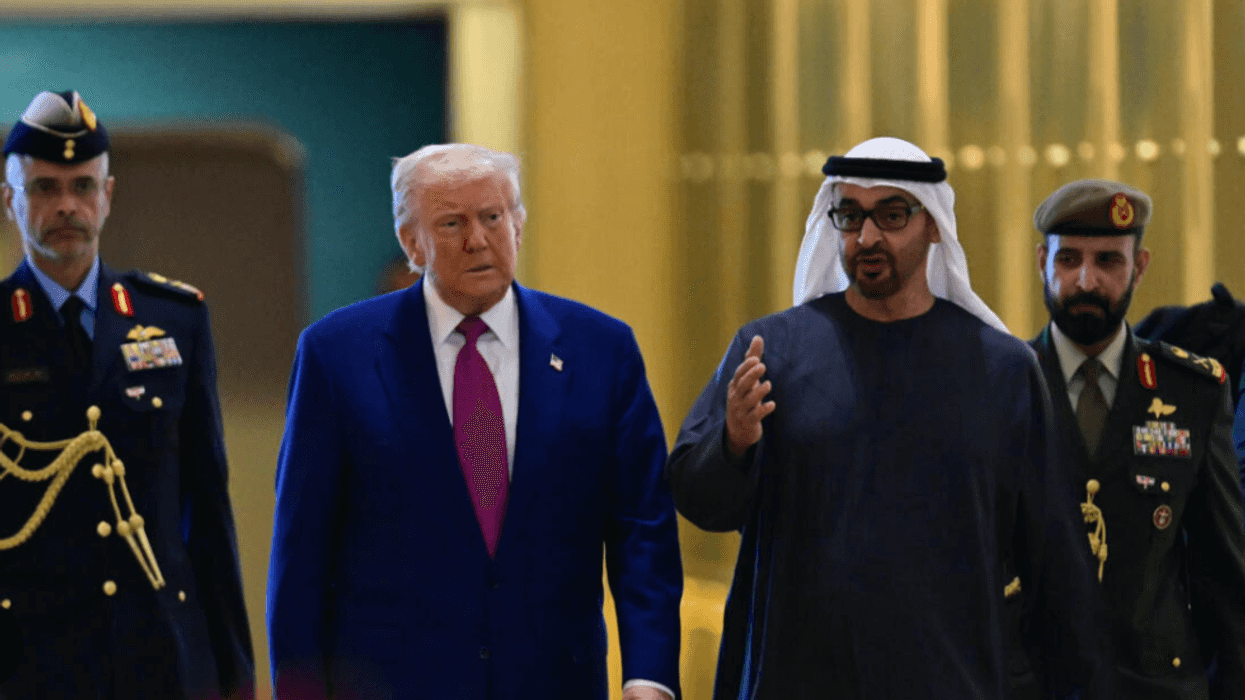
The Wall Street Journal reported that WLF then received, four days before the inauguration, a $500 million investment, amounting to a 49 percent share in the company, from Sheikh Tahnoon bin Zayed al Nahyan, aka the "spy Sheikh," the second-highest-ranking royal in Abu Dhabi and the Emirati national security advisor. Nothing remotely like this has happened before.
What did the UAE want in return for this largesse? During the Biden years, the UAE's ambitions to become an AI player had been thwarted. The administration declined to give the UAE access to high-end computer chips because the regime had close ties to the Chinese Communist Party. Hold that thought.
Speaking of China, one of the figures who helped midwife WLF with technical advice was the Chinese-born Binance founder Changpeng Zhao. Zhao had pleaded guilty to permitting his cryptocurrency exchange to be used by terrorists, cybercriminals, and child abusers. But he was very useful to WLF, helping to launch their first stablecoin, USD1. UAE-linked entities then purchased $2 billion of these. Trump pardoned Zhao in October 2025. He told 60 Minutes that "I don't know who he is," and then immediately contradicted himself by adding, "I know he got a four-month sentence or something like that. And I heard it was a Biden witch hunt."
Oh, and the UAE got the chips. So much for the supposedly "tough on China" Trump administration.
Andrew McCarthy, recalling the Republican outrage over Hunter Biden, put it this way: "You know what the difference is between the Biden family business and the Trump family business? You'd have to add two digits to the sum of Biden abuses of power, foreign entanglements, and [alleged] corruption ... to get near what Trump has raked in just from the UAE."
Qatar gave Trump a $400 million luxury jet. Just like that. No embarrassment, no extenuating circumstances, no nothing. Just the bottomless greed of an unleashed Midas (without the curse — for now).
To escape tariffs, Vietnam approved a $1.5 billion Trump Organization project to build a huge golf course near Hanoi. Mar-A-Lago increased its membership fee to $1 million, and the Bedminster club raised its initiation fee to $125,000. Paramount paid Trump $16 million in settlement of a suit over Kamala Harris' interview on 60 Minutes. ABC donated $15 million to the future Trump library in settlement of a case about George Stephanopoulos. Amazon put $28 million in Melania Trump's pocket for an unwatchable documentary. The Trump juniors have invested in drone companies and other firms that have received government contracts. Trump pals like Michael Flynn and Carter Page have received $1.25 million "restitution" payouts from the government, though Flynn pleaded guilty and Page's lawsuits have been dismissed twice.
The Trump family has increased its net worth by about $4 billion since January 2025, with the total now approaching $6.2 billion.
And this is just the financial corruption. The perversion of justice is perhaps even worse — prosecuting Trump's critics and pardoning his allies.
Why then do I say that we may be nearing a turning point? Any country that could passively accept the UAE gift, the Qatar plane and the January 6 pardons is beyond caring, no? We'll see. My theory is that two things must be present for people in a free republic to turn a blind eye to corruption: 1) Their personal bank accounts must be flush, and 2) they must believe that most of the corruption stories are just partisan attacks.
We have recent evidence from Hungary. Between 2010 and 2019, while the economy was (mostly) growing nicely, Hungarians were prepared to overlook Viktor Orban's subversion of the judiciary, capture of the media, and personal wealth aggrandizement. But when the economy went south in 2023, people became outraged about the corruption. Peter Magyar, especially because he had been a Fidez party insider at one time, was able to capitalize on that anger.
Alexei Navalny, though he could not win an election in Russia (because they're rigged), became a national sensation by documenting the palaces and other wealth that Putin and his cronies had obtained. Putin's trajectory was similar to Orban's. When he first gained power, the economy was strong due to high energy prices, allowing him to consolidate power. But when the economy soured, people became much more open to criticism about corruption, though sadly, they were in no position to remove Putin. Still, Navalny was enough of a threat that Putin had him consigned to a penal colony (where Putin's government later killed him).
The American economy was very strong in the 1990s, and though Bill Clinton behaved in an abominable fashion toward women, people were willing to overlook it. Similarly, voters in 2024 made a bargain: Though they knew Trump was corrupt, they bet that he would bring them the kind of economy they'd enjoyed in 2018. This isn't an admirable trait, but there is good reason to think it's the way many voters operate.
Trump has not delivered on the bargain. On the contrary, economic conditions are now worse than they were in 2024. Nor can Trump rely on partisanship to come to his rescue because it isn't the Democrats who are making the case about corruption, it's Trump himself and his allies.
It is Trump who attempted to use the attempted assassination at the White House Correspondents' Association dinner to make the case for his garish ballroom. It is Senate Republicans who are adding the insult of demanding taxpayers pay $1 billion for this monument to Trump's ego. It is Trump, not his opposition, who instructs voters that they should be happy with fewer dolls at Christmas. It is Trump who accepts gold bars from the Swiss delegation and adorns the Oval Office in a style that could be called neo-Saddam.
The corruption never mattered before, but when gas prices are near $5 a gallon, groceries have only gone up and the economy is skidding toward recession, the gold leaf becomes not an eccentricity but an indictment. The worm has turned.
Mona Charen is policy editor of The Bulwark and host of the "Beg to Differ" podcast. Her new book, Hard Right: The GOP's Drift Toward Extremism, is available now.
Reprinted with permission from Creators