Tag: iran ceasefire
Congratulations To All? Trump's Latest Deal Looks Like A Massive Gift To Iran

Congratulations To All? Trump's Latest Deal Looks Like A Massive Gift To Iran

The very first words announcing the Trump administration’s latest “deal” to conclude its war on Iran – which will reportedly be signed on Friday – were entirely false.

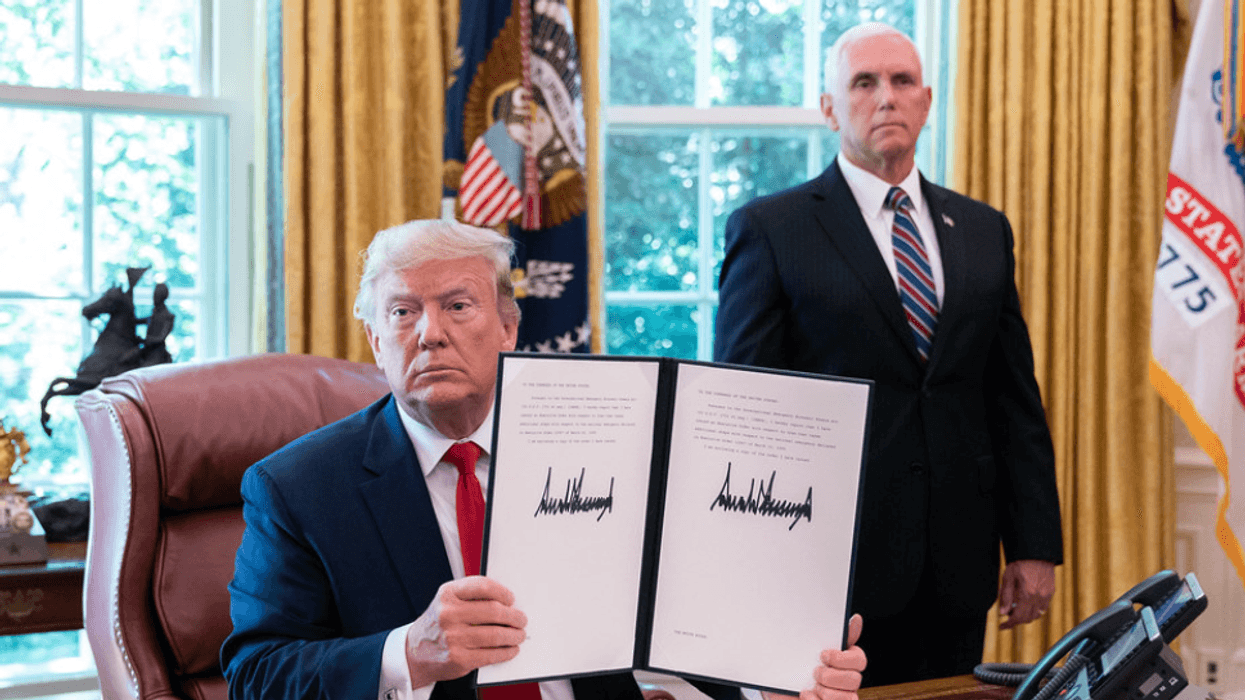
“The Deal with the Islamic Republic of Iran is now complete,” the president proclaimed on his Truth Social site on Sunday evening. “Congratulations to all!”

But the agreement, whose details remain entirely opaque and disputed by all parties, is far from complete – if “complete” is meant to indicate that Trump has achieved any of the objectives for which he expended hundreds of billions of dollars, at least 13 American lives, an untold number of Iranian civilian deaths, and severe damage to the world economy and this nation’s international standing.

Instead, what Iranian officials have called a “memorandum of understanding” merely extends the current ceasefire (which hasn’t actually curtailed kinetic hostilities) for two months, while the United States and Iran resume negotiations over Tehran’s nuclear programs, the alleged reason for war.

No honest analyst believes that Trump or his inept negotiators will achieve more restrictions on Iran than the multilateral agreement he discarded in 2018 merely because it was achieved by his predecessor President Barack Obama. In the leaks and comments about this renewed ceasefire, what can be detected is the strong suggestion that this is in fact a far worse deal from the American standpoint – and a far more lucrative outcome for the Iranians.

Unless the Iranian news agencies are lying just as brazenly as Trump always does, the Tehran dictatorship will collect at least $24 billion in previously frozen funds during the 60-day negotiation period. The Trump administration's response has come in the form of non-denial denials, and it now appears that those previously unavailable billions will be exchanged for the reopening of the Strait of Hormuz. That reopening is the only aspect of the mooted :"deal" that both sides agree will happen, and merely resolves a crisis that Trump and his Israeli partner Benjamin Netanyahu provoked when they initiated this conflict.

Of course the reopening of ship traffic in the Persian Gulf won't actually resolve anything, because the Iranians will still be able to close the strait whenever they choose -- a commercial and diplomatic superpower that they can now exercise entirely due to Trump's blundering.

Beyond that, we have no idea how or whether Trump's low-wattage diplomatic team will negotiate a credible agreement that restricts Iran's nuclear development with any force, as the JCPOA did. The likelihood of such an achievement within the next two months seems vanishingly small, since the JCPOA talks required many months and skills that the Trump gang simply doesn't possess,

But even now we can measure what Trump is doing against what Obama did: If the Iranians get $24 billion to reopen the strait, without any real restrictions on their nuclear program that will represent more than ten times the amount of money Tehran received after signing the JCPOA. In other words, Trump has sold out cheap to end this pointless war -- and the rest of us will pay the price.

Joe Conason is founder and editor-in-chief of The National Memo. He is also editor-at-large of Type Investigations, a nonprofit investigative reporting organization formerly known as The Investigative Fund. His latest book is The Longest Con: How Grifters, Swindlers and Frauds Hijacked American Conservatism (St. Martin's Press, 2024). The paperback version, with a new Afterword, is now available wherever books are sold.
Trump's Murky Iran Ceasefire Won't Instantly Restore Global Oil Supplies

Trump's Murky Iran Ceasefire Won't Instantly Restore Global Oil Supplies

Maybe this time’s a charm.

Given the dearth of reliable spokespersons and Trump’s endless claims that the war is over, it’s hard to know the durability of the current agreement to cease hostilities and negotiate an end to the Iranian conflict. There are many places to read about these developments so I won’t review them here. Trump will surely be claiming victory, regime change, etc. but the deal he’s accepting will be no better than what prevailed prewar, not to mention a key point of this post regarding what Iran has learned from this conflict.

Neither will I repeat my post from a few weeks ago, raising what I still believe is the critically important question of what was this war for.

If what we’re hearing about the negotiations to end the war is correct, then everyone from policymakers to pundits to voters—especially voters—must ask the questions “What was that for? What did thousands of people die for? Why did the global economy have to undergo a massive disruption, elevating prices and interest rates? Why did the US have to further lower its international stature by not only getting dragged into this war, but by not winning it in any recognizable way?”

Instead, let’s briefly discuss—with some good pictures—what we might expect re the recovery of energy and energy-adjacent markets if and when transit through the Strait of Hormuz resumes.

The bottom line is that it will likely be months before prewar traffic resumes. First, there are three timing issues: it takes time to clear the mines from the sea. Next, the insurers need to believe this time is for real. Then, there’s infrastructure rebuilding. Second, physical inventories are very low, such that any hiccups could lead to sharp price spikes. Third, after the human costs, the biggest fallout from the war was that Trump has done something no other president has: he taught the Iranian regime that it could shut down global commerce.

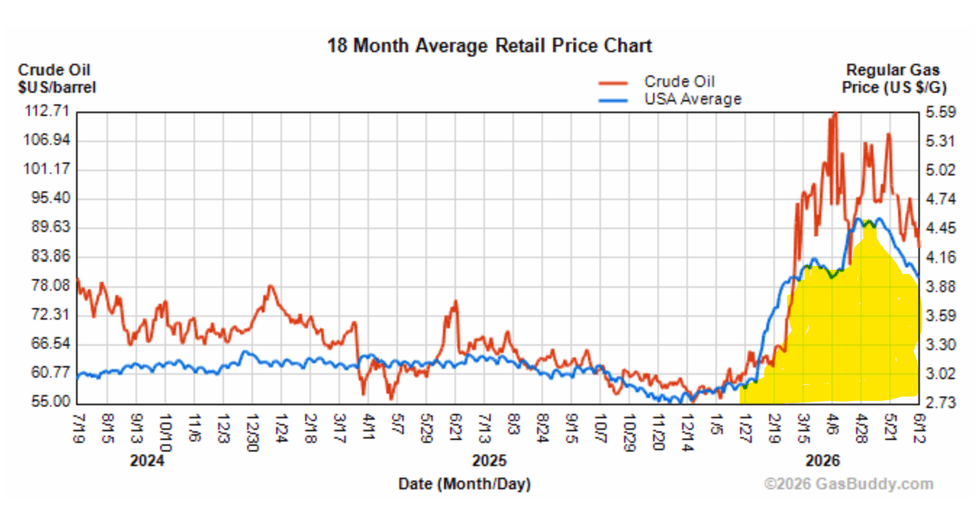
So, yes, I’m happy to see these recent declines re oil and gas prices, but let’s keep it real. These partial gains—I don’t expect we’ll see the pre-war gas price this year—are perfectly akin to how your headache would go away if you stop banging your head against the wall.

The fact that global physical inventories are just about to fall outside their historical range (see figure below) was surely a motivator for Trump relaxing his demands and ending the war, if that’s really where we are. The physics of oil inventory management, according to one expert, is that “Whenever you get to tank bottoms, the whole operation gets bogged down” (that’s because sludge collects at the bottom of storage tanks).

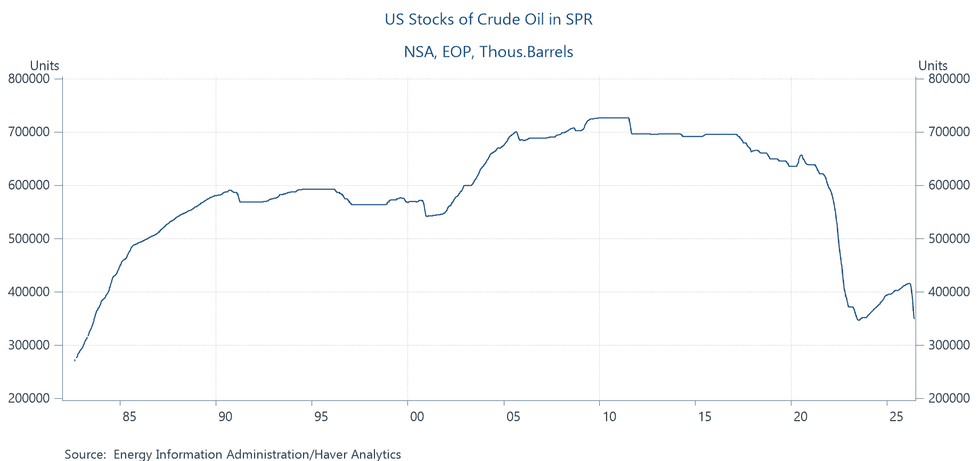
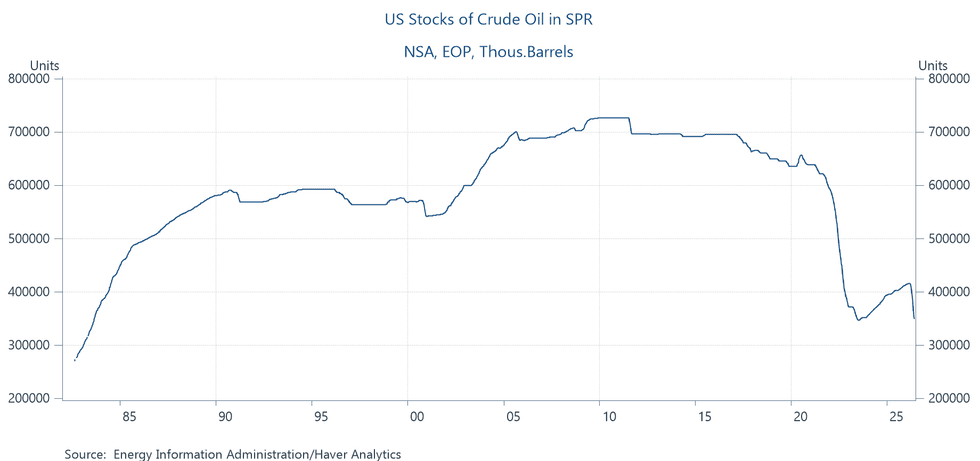
One related problem for the US is that war-related drawdowns have left us at the historical low end of our Strategic Petroleum Reserves. The figure below is through June 5, but the Wall Street Journal reports if the admin follows through on its current release plans, the inventory will fall to 243 million barrels which would be the lowest on record. Already, this reserve is in bad shape for hurricane season.

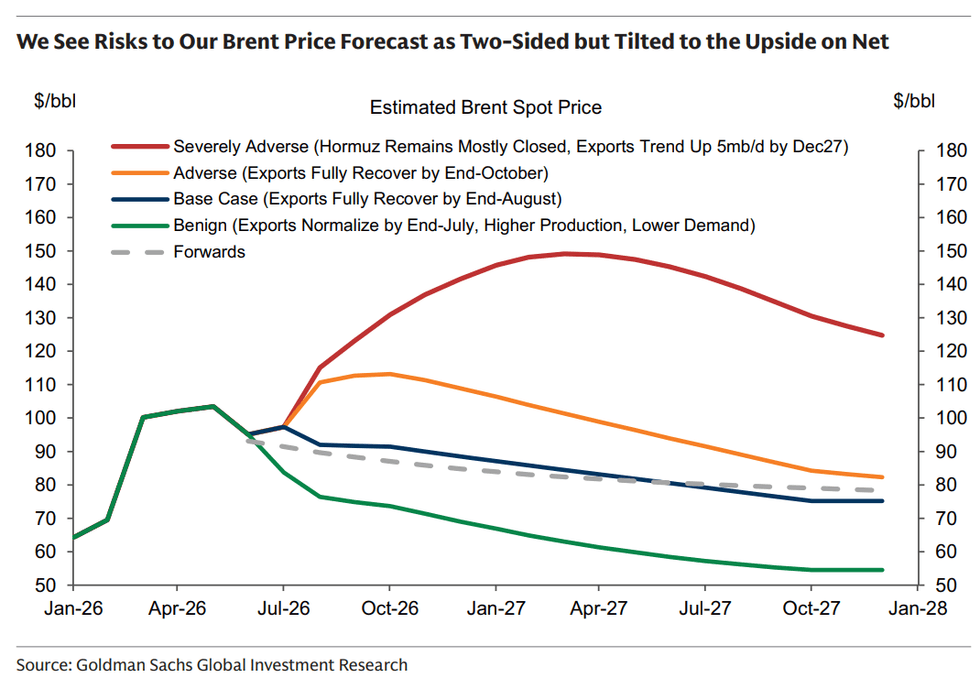
So, what should we expect? Here’s the GS energy-research team’s latest forecast, along with market expectations (“forwards”). The base case drifts down but remains elevated compared to prewar levels. The most benign case factors in a faster recovery than I’ve emphasized above, along with weaker demand.

There is a great deal of Trumpian damage that will persist once he’s gone, but a strong entry on that list is the fact that his actions have bequeathed this violent, authoritarian, theocratic Iranian regime with a global flex-point: he’s shown them that they can, at least for now, shut down a fifth of the world’s energy flow using missiles and cheap drones. It’s far from costless for them to do so, but that’s one of the problems with such regimes. They don’t suffer. Their people do, and they care little about that.

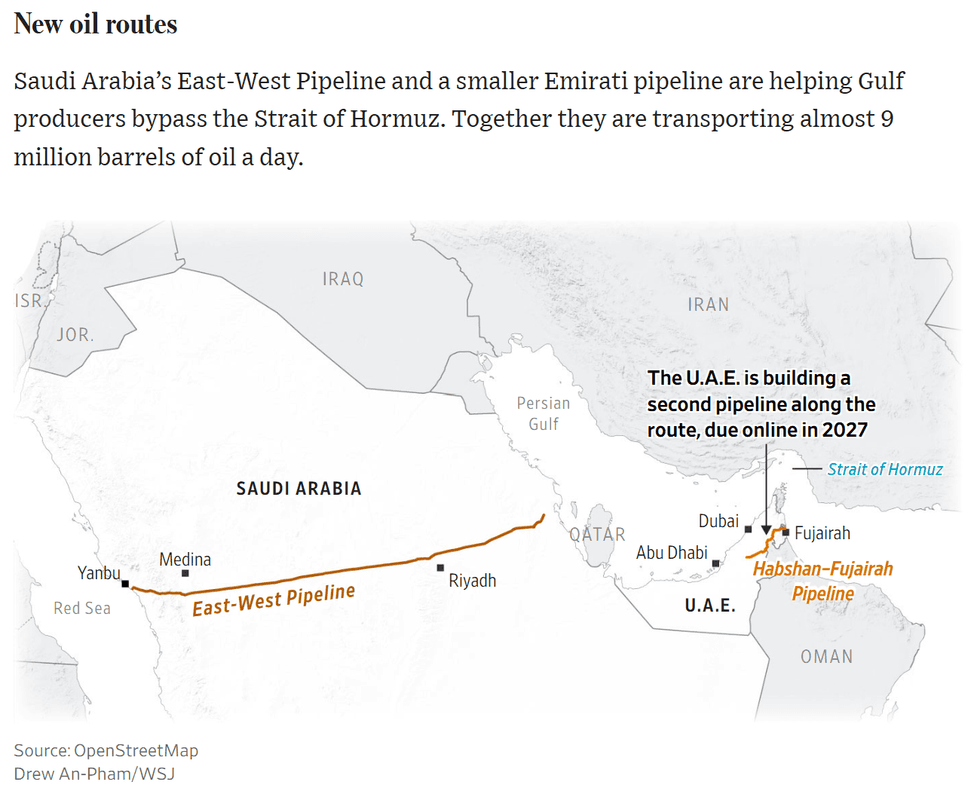
I said “at least for now,” and that’s important. Two useful developments have occurred due to the war. One, gulf suppliers have learned that they’d better develop alternative supply routes (see figure), and two, consumers have been reminded of the opportunity costs of owning gas-powered cars. If EVs were more affordable—see my letter to Trump on one way to make that come true—a lot more drivers could significantly insulate themselves from fossil-fuel geo-madness while improving the environment.

Jared Bernstein is a former chair of the White House Council of Economic Advisers under President Joe Biden. He is a senior fellow at the Council on Budget and Policy Priorities. Please consider subscribing to his Substack, from which this is reprinted with permission.

'Wall Street Journal' Warns Trump Against Ceasefire Bailout For Iranian Regime

'Wall Street Journal' Warns Trump Against Ceasefire Bailout For Iranian Regime

Amid reports that a new ceasefire deal is imminent, the conservative Wall Street Journal editorial board warned President Donald Trump to avoid a deal that functions as an economic bailout for Iran.

Over the weekend, Trump claimed that the U.S. and Iran were close to reaching a deal for a 60-day ceasefire in the conflict that has ravaged the world economy and sent oil prices skyrocketing. Iranian officials confirmed that talks were progressing, but stressed that major sticking points were still holding it back, adding that a deal was nowhere near as close as the president suggested. Nevertheless, news of an impending reprieve sent oil prices tumbling slightly.

In response to these reports, the Wall Street Journal board — which is commonly viewed as a major conservative voice on economic and political issues — published a new piece, warning Trump that one aspect of the supposed plan would amount to an economic bailout for Iran, and would leave the U.S. with only the most extreme leverage to get a final deal made, calling the notion a major potential "strategic setback."

In particular, the board took issue with the proposed portion of the deal that would end the U.S. blockade of Iran's port and allow them to resume selling oil to foreign markets.

"The preliminary deal, as mooted in the press, is for both sides to end their blockades, and perhaps for the U.S. to sweeten the pot financially, while talks on nuclear issues and further sanctions relief continue for 60 days or more," the board wrote. "A U.S. official says, but Iranian officials deny, that the regime gave assurances a final deal would include 'disposal' of its enriched uranium."

The end of the blockade, they warned, would destroy a key piece of U.S. leverage over Iran before its nuclear program is properly dealt with. The only remaining leverage — threatening to renew the fighting — will ring hollow after his previous backtracks.

"The basic problem lies with ending U.S. pressure before dismantling the nuclear program," the board added. "If the blockade ends and Iran can sell its oil, all that’s left to coerce it into nuclear concessions is the threat of renewed war."

It continued: "But Trump wasn’t willing to do that after Iran reneged on reopening the Strait of Hormuz and attacked U.S. forces and Gulf allies. How credible will the threat be 60 days closer to midterms, when it would trigger a new Iranian blockade of Hormuz? A pledge not to build a nuclear weapon means nothing because the regime has always said that while doing the opposite... Iran’s regime went into this war facing domestic political and economic crises. War has made these worse. Saving such a regime now with an economic bailout would be the real betrayal—of the U.S. interest even more than the Iranian people.”

Reprinted with permisson from Alternet


Amid Faltering Ceasefire, Fox News Personalities Push To Resume Bombing

Amid Faltering Ceasefire, Fox News Personalities Push To Resume Bombing

Some Fox News figures have continued to agitate for the Trump administration to resume bombing Iran amid continuing, if unclear, negotiations to maintain the tenuous ceasefire.

On April 8, the United States and Iran entered into a ceasefire agreement, though the countries have exchanged low-level attacks in recent days. On May 3, President Donald Trump announced a new phase of the campaign, dubbed Project Freedom, which would provide some U.S. support to ships stranded in the Strait of Hormuz, though the degree of its implementation has been difficult to discern. Separately, the Pentagon has reportedly drawn up strike plans that would likely include bombing Iranian infrastructure targets, acts which could constitute war crimes, should Trump decide to carry out new attacks.

Top Fox News figures have supported the war since even before Trump launched it on February 28 alongside Israel, a position largely unchanged across the network in the ensuing months. As recently as April 29, Fox personalities were calling for Trump to restart the war, a drumbeat that has only gotten louder since.

On May 8, Fox News senior security analyst Jack Keane, a longtime supporter of attacking Iran, called for Trump and Israel to escalate their offensive campaigns.

“In my judgment, I think we got to see reality for what it is,” Keane said. “We should go back and execute Project Freedom, take the Strait of Hormuz away from the Iranians, secure it and open it for navigation and also at some point get some assistance in doing that.”

“And then we have to unleash the Israelis," Keane continued. “They have a very comprehensive bombing campaign that they’re going to conduct that deals with leadership, it deals with energy, it deals with all the weapons systems we still have to go through.”

“We would be able to do some selective bombing in support of returning to combat operations, while the main effort for the United States would be to open up the Straits of Hormuz,” Keane added.

Fox News host Brian Kilmeade, a major Iran war hawk, also argued that the United States and Israel should resume bombing Iran in lieu of continued negotiations.

“It seems as though the Iranians feel like they survived and will emerge stronger currently,” Kilmeade said. “And the fact is they haven’t gotten back to us on the 14-point plan in two days.”

“I think they’re almost daring us to resume strikes,” he continued. “At which time, we understand that there’s a plan in place for Israelis to hit a lot of locations — they have more air power actually than us in the region. And I think we could handle the strait and maybe tell Iran who’s really in charge. Perhaps we need that."

Kilmeade’s co-host, Ainsley Earhardt, agreed.

“I like what Gen. Jack Keane said: Take it — take the strait, open it, and unleash the Israelis,” she said.

Reprinted with permission from Media Matters

Shop our Store

Headlines

Editor's Blog

Trending

World