Tag: job creation
Why Is Trump Still Boosting AI? Because He Has Nothing Except The Bubble

Why Is Trump Still Boosting AI? Because He Has Nothing Except The Bubble

Will AI transform the economy? The jury is still out on that one: So far there is little evidence for either the massive job losses or the soaring productivity growth industry leaders threatened/promised, but it’s still early days.

But AI does seem to be transforming U.S. politics. I can’t think of a technology that has inspired so much hate across such a wide political spectrum. Even the leading AI companies are warning about the dangers of their technology and pleading for government regulation to slow it down.

Which makes it more than puzzling that Donald Trump is going all in on AI, claiming that concerns about its dangers are a “hoax” and opposing any kind of regulation.

In so doing, he’s taking a wildly unpopular position. Here’s recent polling from UMass Amherst:
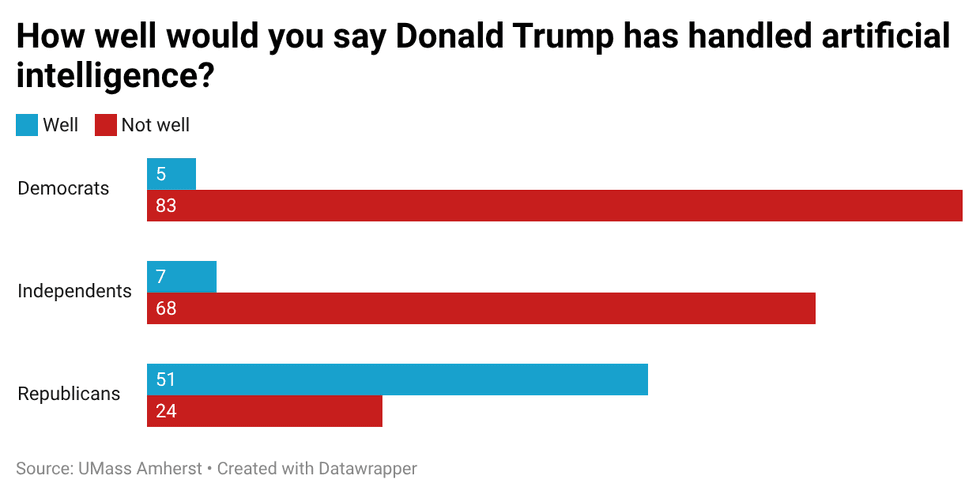
Notice that even a large part of Trump’s base is deserting him on this issue, with a quarter of Republicans disapproving.

So why is Trump posting stuff like this?
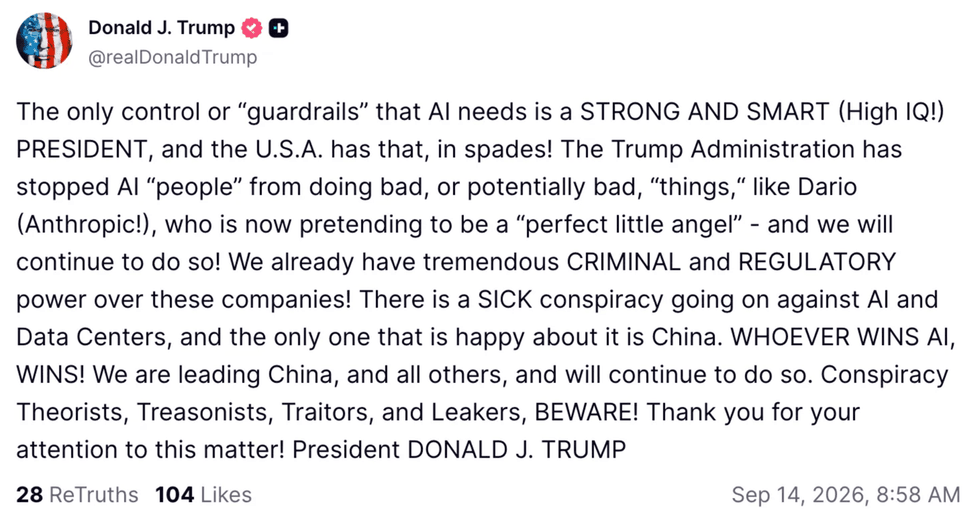
Robert Reich has a good post on the subject, urging us to follow the money: As he notes, members of the Trump family have personal financial stakes in the industry. And one motive one should never, ever dismiss in current U.S. affairs is Trump’s personal greed.

I would, however, add two more points.

First, I think Reich is too glib in dismissing the idea that Trump imagines that he knows what he’s doing. “It can’t be,” Reich writes, “that he knows very much about AI.” But does he know that he doesn’t know? That Truth Social post above, in which Trump declares himself perfectly able to manage this wild new technology because he is a “STRONG AND SMART (High IQ!) PRESIDENT”, is like a textbook illustration of the Dunning-Kruger effect, in which incompetent people are highly confident in their own judgment because they’re too incompetent to realize that they’re incompetent.

Second, it’s important to realize how much Trump needs an AI boom.

Trump came into office believing that his tariffs would produce a huge boom in “manly” jobs. In fact, job growth has been weak — and more than all the job gains have gone to women. Meanwhile, tariffs have driven up consumer prices.

And then there’s the Iran war, which has been an economic as well as a strategic disaster. Diesel prices are now well above $6 a gallon. Trump officials love to say that gasoline was over $5 a gallon under Biden, which was true — for one week.

Yet one thing did seem to be going right under Trump II. Enthusiasm for AI was generating a huge investment boom and supporting stock prices. Trump officials, notably Scott Bessent, the Treasury Secretary — who Edward Luce of the Financial Times now dubs “the Pete Hegseth of the Treasury” (ouch) — had taken to claiming that AI will solve all their problems, ending inflation by reducing costs and curing the budget deficit by generating huge economic growth.

The backlash against AI, then, is taking away the one thing the Trumpists thought they had going for them. So in a way it’s understandable that Trump is trying desperately to hold on to the magic (and possibly endangering the future of humanity, but he doesn’t care about that.)

But of course it won’t work. The AI boom, once Trump’s last remaining political asset, is now a huge liability.

Paul Krugman is a Nobel Prize-winning economist and former professor at MIT and Princeton who now teaches at the City University of New York's Graduate Center. From 2000 to 2024, he wrote a column for The New York Times. Please consider subscribing to his Substack.

Reprinted with permission from Paul Krugman.
Inherited Conditions: Biden Left Trump The Best Economy In Half A Century

Inherited Conditions: Biden Left Trump The Best Economy In Half A Century

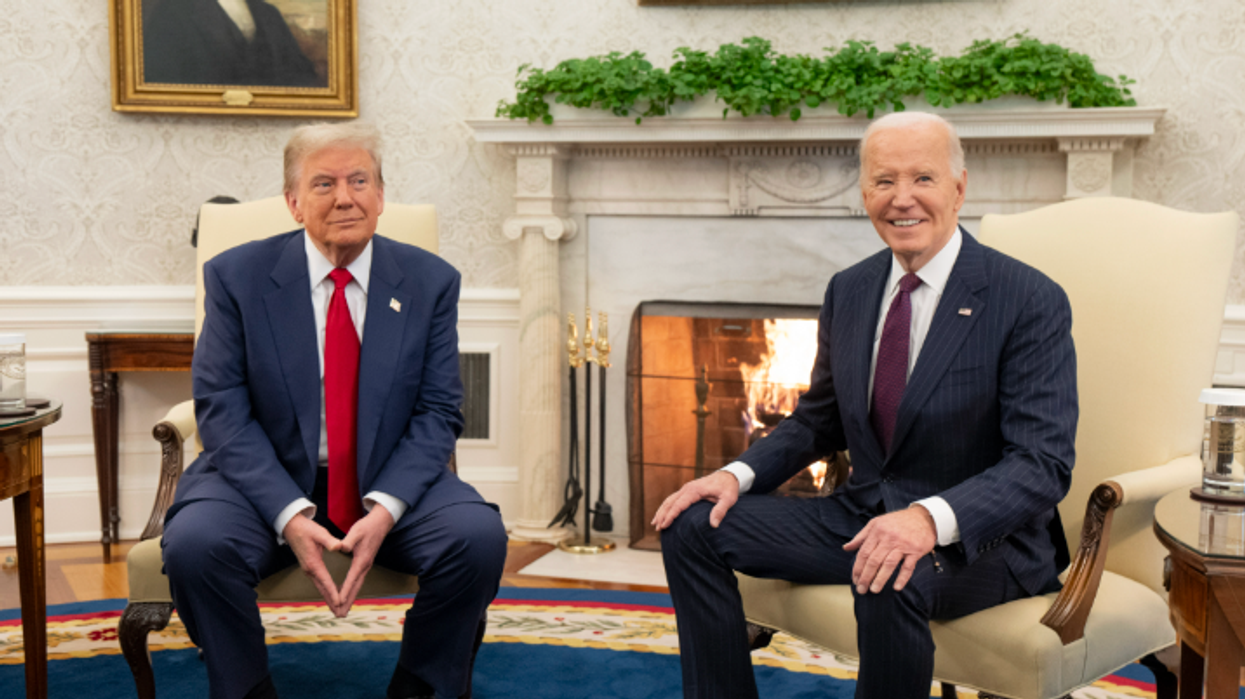
Donald Trump may not be able to remember what things were like five years ago, when he handed the economy and the country to Joe Biden, but it is important that the rest of us do. As in so many other areas where Trump tries to turn reality on its head, he pushes the story of Biden inheriting a great economy, which he then wrecked. The reality is the opposite, Biden turned around an economy in shambles due to the pandemic, and handed off an economy that was widely touted as the envy of the world.

The most important reversal was in the labor market. More than 19 million people were laid off in the pandemic shutdowns in the spring of 2020. Many quickly came back to work in the summer and fall, but the huge bounce back had stopped by the time Biden took office.

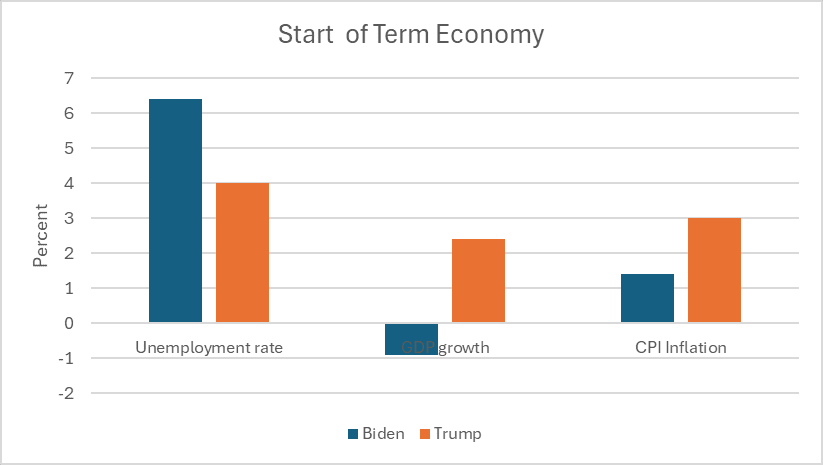
Job growth averaged just 150,000 in the last three months of the Trump administration. In fact, the economy actually lost jobs in December of 2020, so it is clearly wrong to imagine that there was a surge of rehiring at the time Biden took office. Employment was still 9.4 million below its pre-pandemic peak in January of 2021. The unemployment rate stood at 6.4 percent.

Biden’s recovery package quickly turned the economy around. Unemployment was down to 4.0 percent by the end of 2021. Employment levels regained the lost ground by June of 2022. It would have taken more than six years to get back to pre-pandemic employment levels at the rate of job growth in the last three months of the Trump administration.

One cost of Biden’s aggressive recovery package was a surge in inflation. The year-over-year inflation rate began to rise rapidly from pandemic lows, peaking at 9.0 percent in June of 2022. Clearly the recovery package contributed to this increase, but most of the story is the world-wide supply chain crisis stemming from the pandemic. (The surge in energy prices following Russia’s invasion of Ukraine was also a big factor pushing inflation higher.)

The story here is straightforward. As a result of the pandemic, people were not spending money on services like restaurants and travel. Instead, they spent it on goods, like appliances, television sets, and cars. The world could not meet this huge surge in demand, especially at a time when many production and shipping facilities were still crippled by the pandemic.

It is also important to recognize that this shift from services to goods was not the result of governmental restrictions. It was due to people not wanting to go into crowds and risk getting a potentially deadly disease that they could then transmit to friends and family members. Service spending did not return to its pre-pandemic share of consumption until early 2024.

However, the rate of inflation fell quickly. By the fall of 2024 the year-over-year rate was down to 2.5 percent, only slightly above the Fed’s 2.0 percent target. It’s also important to note that wages outpaced inflation over the Biden years, with the lowest paid workers seeing the largest real wage gains in more than half a century. It’s also important to note an increase of 20 million in the number of people who work from home, which is estimated as equivalent to a wage gain of 8 percent.

Finally, there is the question of overall economic growth. The economy had an unprecedented plunge in the spring of 2020 associated with pandemic shutdowns. It shot back in the summer and fall, but it had lost momentum by the end of the year. GDP in the fourth quarter was still 0.9 percent below its year ago level.

The recovery package quickly ramped up growth. The economy had some shaky times due to supply chains issues, two subsequent and unanticipated waves of covid in the summer of 2021 and winter of 2022, Russia’s invasion of Ukraine, and the sharp rate hikes by the Fed beginning in March of 2022. But it had settled down to a healthy pace of growth by 2024, with a year-over-year rate of 2.4 percent in the fourth quarter. That is the economy Joe Biden handed off to Donald Trump.

Source: BLS and BEA

It would be foolish to say everything was great when Biden left office. The United States has a badly undeveloped system of social supports. Tens of millions of people struggle to put food on the table, pay the rent, and cover medical bills. But by almost every measure most of the country was doing better in 2024 than they had been doing in 2020 or even before the pandemic in 2019.

Donald Trump might want people to forget this fact, but just because he has memory problems, it doesn’t mean the rest of us should.

Dean Baker is a senior economist at the Center for Economic and Policy Research and the author of the 2016 book Rigged: How Globalization and the Rules of the Modern Economy Were Structured to Make the Rich Richer. Please consider subscribing to his Substack.

Reprinted with permission from Dean Baker.

Does Trump Know Where Jobs Really Come From?

Does Trump Know Where Jobs Really Come From?

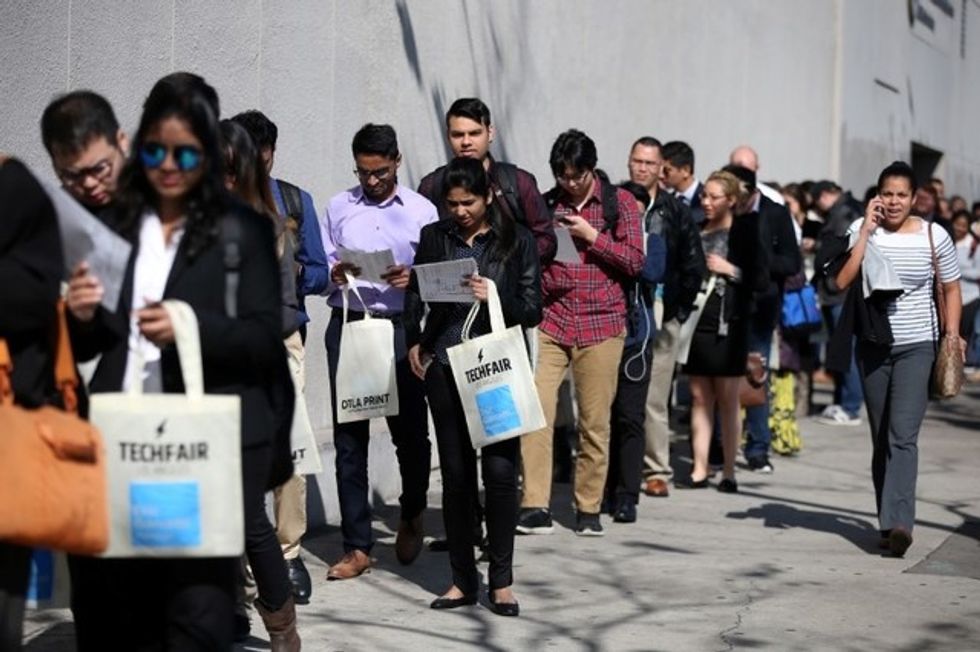
IMAGE: People wait in line to attend TechFair LA, a technology job fair, in Los Angeles, California, U.S., January 26, 2017. REUTERS/Lucy Nicholson

5 Best Things That Happened In 2015

5 Best Things That Happened In 2015

Here’s a prediction that follows a year when almost every prediction was flat wrong: 2015’s reputation will age well.

It could well even be remembered as the turning point in the greatest global crisis of our time.

That’s not to say the world-tilting hangover you’re feeling from the worst of the last 365 days isn’t real. The barbarism of ISIS and other horrendous acts committed in the name of religious extremism are indelible. As is all the continued horror in Syria. But amidst the domestic sturm und dang of overly hyped fears and hysterical pandering to our worst instincts, continued progress around the world made us safer, healthier and potentially even smarter.

Conservatives have a vested interest in scaring the Rice Krispies out of you. As we approach the election, that remains their best hope to dull the fact that Democratic presidents outperform Republican ones in every way that matters. Diminishing or hiding Obama’s accomplishments underneath a veil of fear is a necessity. Even Democratic candidates for president have to make arguments about how they’d improve America that often come across as minimizing the progress made during the last seven years. The media’s bias toward sensationalism also helps to explain why good news is often ignored or skimmed over.

So as a public service and a tribute to the truth, let’s dwell on the positive developments of the past year for a moment.

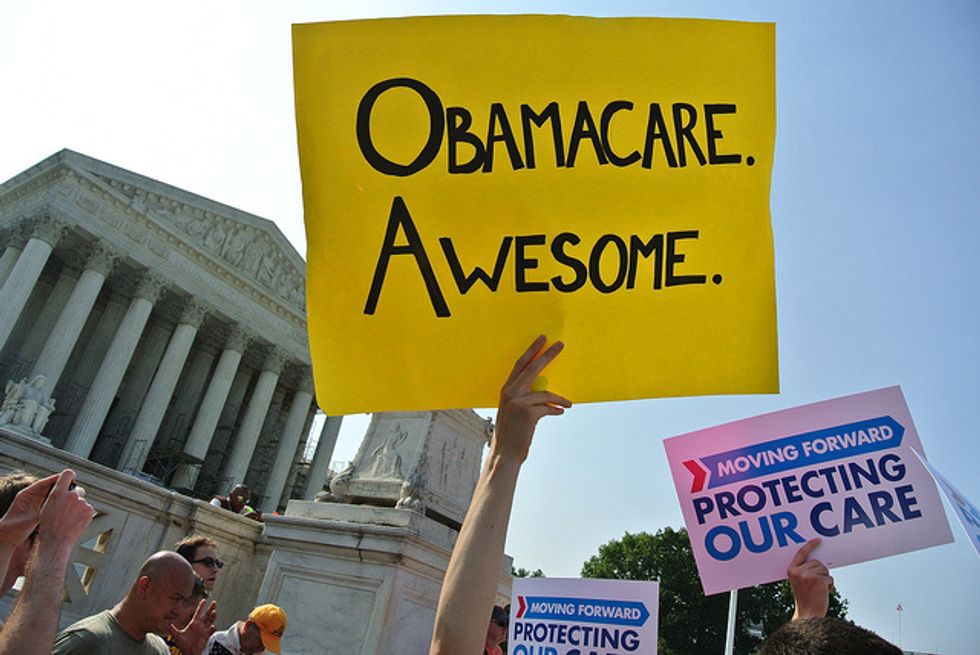
5. Obamacare kept saving lives.
It’s rarely mentioned, but the point of the Affordable Care Act is to keep Americans from dying. Positive enrollment news hasn’t been enough to overshadow the fact that the president’s health reforms have suffered some bad setbacks at the hands of Republican saboteurs this year. Even though the increases in prices of health care services is lower now than they have been since 1961, premiums also did not continue their trend of coming in below expectations for a pretty simple reason — the newly insured were sicker than expected. They’re getting health care and lives are being saved. How many lives? A study done on Massachusetts after Romneycare found 1 life saved for every 830 people gaining coverage. Given that about 17 million Americans have gained coverage, we can project that about 20,000 lives will be saved each year. You don’t hear that on the news. We hear about how Kentucky’s new governor wants to break his system’s excellent Kynect health care system, while headlines about how hard it will be for him to actually unwind Obamacare and stories about the drive to expand Medicaid in Republican states slip below the fold somewhere into the Phantom Zone deep beneath the comments section.

4. We had the second-best year of job creation this century.
Remember how Republicans said Obamacare would destroy the economy? “Even with weakness seen during the summer, job gains in 2015 will top 2.5 million, making it the second-best calendar year for U.S. job growth in this millennium, after last year’s 3.1 million,” MarketWatch reports. “The last time more jobs were created in a two-year period was at the height of the dot-com boom, in 1998-1999.” Weird. The first two full years of Obamacare led to the best job creation of the century. Surely, Republicans will be called out on that.

3. The GOP stopped hiding the antipathy that’s dividing the party.
In 2014, Republicans proved that they had the skills and discipline to run sober candidates who could exploit a very favorable electoral map. In 2015, we saw the party begin to reap the burden of letting bipartisan immigration reform die without ever even getting a vote in the House. The urge to continually demand deportations instead of reform reflected an animated base that represents about half of the party. The other half of the party recognizes either the advantages of immigration or the costs of appearing intolerant in a changing America and generally supports reform. From this morass emerges Donald Trump pitching a ridiculous wall, slurring Mexican-Americans, determined — it seems — to drive Latino voters to reject the Republican party the way African-Americans have for decades. And even if that doesn’t happen, this could be the year that the long fantasized split in the GOP will come to fruition.

2. We gave diplomacy a chance.
Making predictions about the Middle East was already a fool’s errand before our war of choice in Iraq decimated the region, empowered Iran and exacerbated tensions between ethnic groups while awakening latent rage that has been built up over generations of oppression. As 2016 ended, good news — Iran ridding itself of the uranium needed to build a nuclear weapon — was paired with a disturbing revelation — more Iranian ballistic missile tests. Just as parties in the U.S. are torn over attempting peace with a sworn enemy, nationalistic forces in Iran continually hanker for war. Hopes of this deal proceeding successfully and denying Iran nuclear weapons, eliminating the existential threat to Israel, hinge on so many variables that hope seems foolish. But President Obama’s administration has proven that engagement with Iran as with Cuba is a worthy goal, regardless of our ability to control every possible outcome.

1. We may have put the world on the path to avoiding the worst of the climate crisis.
It was a bad year for people hoping to prove that 97 percent of climate scientists are wrong. The world greatly improved its chances of avoiding the worst of drought, floods and famine carbon polluters hoped we’d eagerly embrace. The Paris agreement is imperfect, no doubt, with enforcement replaced with financial encouragement, global cooperation and public shaming. But it’s also the most the world has ever done to collectively fight climate change — and it comes on the heels of an Obama-sparked green energy revolution that has helped the world see the first year where the economy expanded and carbon emissions decreased for the first time in 40 years. If this is the beginning of the world’s commitment to avoiding leaving our descendants a purposely wrecked climate, history will remember 2015 as the moment when humans took responsibility for our actions. If not, we’re doomed. Ben Adler at Grist summed it up best: “For activists all over the world, the Paris Agreement shows there is still hope for maintaining a livable climate, but there’s a lot more work to be done pushing world governments to meet the challenge.”

Photo via

Shop our Store

Headlines

Editor's Blog

Trending

World