Foul Smell Arises From ICE Killing Of Longtime Houston Resident
There was a time when the federal government’s record justified withholding judgment, when, in the wake of another gut-wrenching killing by ICE agents, a fair-minded person could count on the Department of Justice to investigate its own officers and bring charges if the facts warranted them.
That time is long past. ICE is now a rogue agency. It has lied about and obstructed the investigation of previous killings, and it has been regularly contemptuous of court orders. As the chief judge of the federal district of Minnesota wrote, “ICE has likely violated more court orders in January 2026 than some federal agencies have violated in their entire existence.” The presumption of regularity—the baseline courtesy we once extended to the government’s account of what its agents did—has been put through a wood chipper.
So when word emerged of another ICE killing—this one in Houston, of a longtime resident named Lorenzo Salgado Araujo—and ICE immediately claimed that the victim had “weaponized his vehicle” to run down an officer who fired only in self-defense, there was every reason to expect the worst.
And the worst is just what we’ve gotten—not just in the facts of the killing itself, but in the federal government’s apparent determination to circle the wagons and smother any effort to achieve justice.
It is a fetid, still-unfolding scandal, and it has come in four stages: the killing; the official excuse; the evidence that gives that excuse the lie; and the wagon-circling to foreclose any accountability.
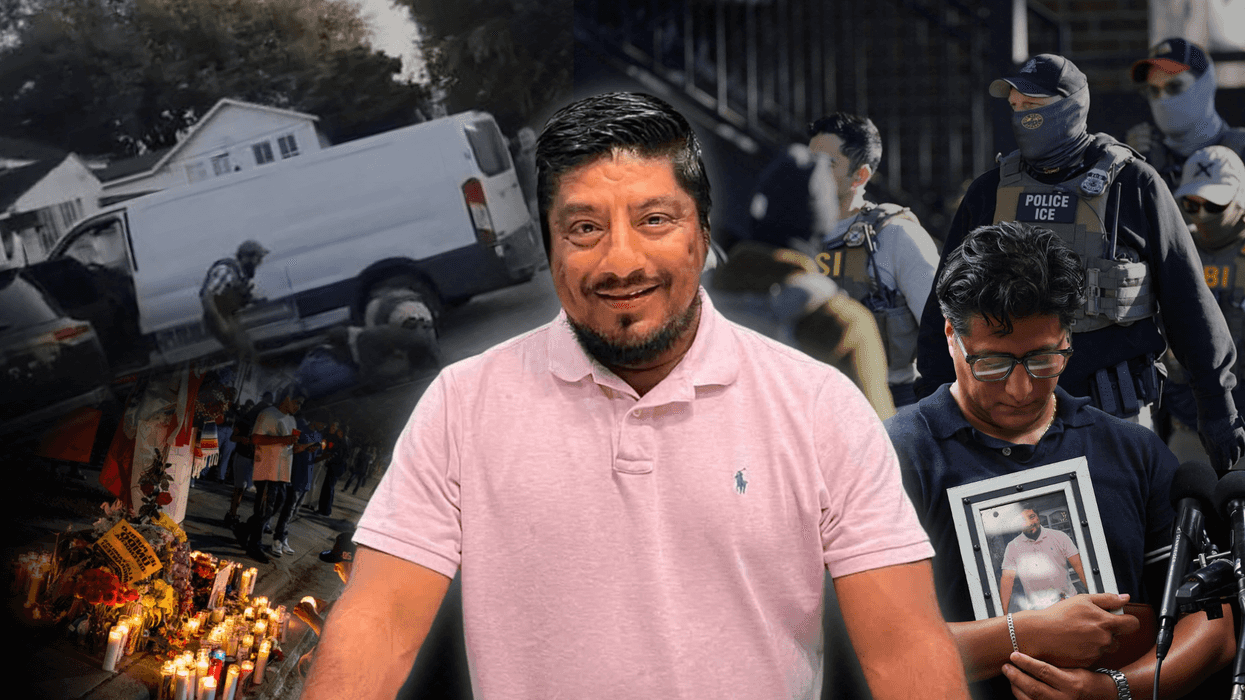
Lorenzo Salgado Araujo was, by every measure, what our political leaders all claim to prize. 52 years old, he had lived in the country for 35 years, raising 3 sons—all U.S. citizens—whom he sent to college while running a construction business that gave dozens of other people jobs. He was diligently in the process of legalizing his immigration status.
As Bill Kristol put it, Salgado Araujo was a better American than the people leading our country.
Last Tuesday, July 7, Salgado Araujo woke up at his normal five a.m., got in his work van, and picked up his crew, comprising 3 other men, including his younger brother, Victor.
As he was on his way to work, at around 6:50 a.m., ICE agents confronted the van and delivered the fatal shots. The details remain murky but are coming into focus.
One particular heart-rending detail: That morning, Salgado Araujo’s wife, worried that something had gone wrong, called their eldest son, Ronaldo. Ronaldo drove to the site, found his father’s white van, but no sign of him. Then a video surfaced on his social-media feed: a man on the ground, shot, struggling. Ronaldo recognized his father instantly: not by his face, he said, but by his voice, crying for help as he lay bleeding out in the street.
Salgado Araujo arrived at Ben Taub Hospital, where all three of his sons had been born, carrying no identification. At the family press conference, a community leader asserted ICE agents removed all his personal identification. He therefore was logged in as a John Doe. He died hours later.
As we were learning about the killing, the Department of Homeland Security (DHS) issued an official statement. It cited no actual sources other than “information we are receiving.” People familiar with the ICE playbook could probably recite the account with their eyes closed.
DHS reported that Salgado Araujo had refused commands and “weaponized his vehicle in an attempt to run over an ICE law enforcement officer,” who fired “in self-defense.”
That’s more or less the identical account, down to the use of the word “weaponized,” that they proffered after the killing of Renée Good. But video evidence showed that the shot that killed Good was fired through her open driver’s side window, with the agent standing out of the vehicle’s path—severely undermining the claim that the shooter was defending himself from Good’s car plowing into him.
So Salgado Araujo’s killing and the official defense repeated the same rotten pattern as in the Good case. The third stage, as with Good, was the revelation of facts that make the official claims of self-defense look like a bald lie.
Good’s killing arose in the context of a robust, lawful demonstration. Consequently, there was a lot of video that rolled in. The 6:50 a.m. shooting on their way to a construction site is harder to piece together. Moreover, the ICE agents were not wearing body cameras, notwithstanding the promise in February in the wake of the Minnesota tragedies that DHS would “rapidly acquire and deploy body cameras to DHS law enforcement across the country.”
But there were three eyewitnesses: the three workers in the van with Salgado Araujo. Their accounts would be central to any bona fide investigation.
That makes ICE’s treatment of them particularly reprehensible. Instead of trying to elicit the facts from them, ICE put all three in immigration detention, apparently facing removal. The agency reportedly has imposed pressure on them to self-deport.
Fortunately, an attorney for the surviving passengers, Hugo Balderas-Ibarra, was able to speak to all of them, separately, in detention. Each of them flatly contradicts ICE’s self-defense scenario.
According to the lawyer’s account, all three passengers report that they were heading to work around 6:30 a.m. when an unmarked car pulled up behind them at a stoplight. When the light turned green, the unmarked car swung onto the shoulder, cut in front of them, and tapped its brakes. At that point, Salgado Araujo made a U-turn, and then the officers switched on their lights. According to the passengers, Salgado Araujo was on a road with heavy construction and crawling along at about five miles per hour.
One of the three, Jose Trinidad Rojas, wrote out his denunciation of ICE’s version by hand. “That is a lie,” Rojas wrote. “It is impossible for them to say that they were going to get run over … there were no officers in front of or behind the vehicle. They were on the sides.”
The ICE car rammed the van, not the other way around. Another ICE vehicle then pulled up on the other side, hemming them in.
An ICE officer proceeded to jump out of the unmarked car and ran at the van from the side, yelling “stop.” He began firing through the front passenger window. A shot hit Salgado Araujo in the abdomen. Victor, the brother, was in the passenger seat and said that when the officer fired the fatal shot, “the gun was in front of my face.”
If the witnesses’ unanimous and separate accounts are accurate, the ICE “weaponized vehicle” yarn fails outright. Salgado Araujo was not bearing down on the shooter, who shot through the front passenger window, so obviously was not in danger from the car.
One final wrenching detail. ICE was not even looking for Salgado Araujo or any of his passengers. Their target was a Guatemalan national who had nothing to do with Salgado Araujo, and who was nowhere in the vicinity. But supposedly someone in the van “resembled the target,” at least to the ICE agents.
Not so the aftermath. The feds appear to be waist-deep, and getting deeper, in a conspiracy to prevent the investigation of Salgado Araujo’s killing and stonewall any efforts to determine if a crime occurred.
A straight-shooting Department of Justice would initiate an investigation in the Civil Rights Division into whether the agents deprived Salgado Araujo of his civil rights in violation of 18 U.S.C. § 242. It’s the same charge that the officers who killed George Floyd were convicted of. The Department has employed it against law enforcement officers.
If the feds chose not to move forward, the assumption would be that the state authorities, who have a strong interest in possible homicide charges under state law, would get the baton, and that the feds would cooperate with their efforts, starting with the sharing of evidence.
With Todd Blanche’s DOJ, this normal approach is a pipedream.
First, the federal authorities appear to be undertaking efforts to prevent the most important evidence we now have, the eyewitness accounts, from ever seeing the light of day. All three witnesses were immediately taken into immigration detention and are now facing removal. If they are deported, the evidence walks out of the country with them.
As for the state of Texas’s efforts to look into the killing, the feds are actively trying to squelch it. Harris County DA Sean Teare revealed that “federal authorities continue exclusively handling all aspects in this case,” and that “access to key evidence remains under federal control.” The Houston Police Department issued a carefully worded statement: local law enforcement has “no independent jurisdiction to investigate federal agencies or federal law enforcement personnel who are acting in the course and scope of their official duties.”
That hedged account significantly understates Houston PD’s independent role. It incorporates the legal standard for federal immunity, roughly whether the federal agents’ conduct was necessary and proper. If a court were to determine that was the case, Houston law enforcement would be stymied; but that’s the whole issue that a state prosecution would take on. There is no law that strips a state of the power to investigate a killing within its borders simply because the killer wore a federal badge.
And most gallingly, the feds are not even pretending to undertake an investigation of the killing. They have announced a two-part inquiry. The DHS Inspector General—Joseph Cuffari’s office, currently sitting on more than six hundred open misconduct complaints against DHS employees—will “lead” the inquiry. But the Inspector General has no criminal jurisdiction over a homicide; at most, it can find that some internal deadly-force protocol was broken.
But never fear, the FBI is also on the case. Actually, never mind and start fearing: the FBI’s Houston office has announced that its inquiry will focus on whether Salgado Araujo assaulted a federal officer. They have opened a file on the victim and aren’t even looking into the killing. It’s akin to a kick to the dead victim’s stomach.
Even the most benign reading of the facts of Salgado Araujo’s killing screams out for a thorough investigation. The more sinister versions—fully warranted by ICE’s recent track record—present a litmus test for any Department of Justice.
A government that violates the Constitution, then lies about it, then circles the wagons to keep the lies from coming out, is failing that test in real time; worse, it gives every indication of indifference to, if not pride in, its derelictions. The deeply bitter irony is that the victim’s humility and dedication to the American dream were matched, point for point, by the government’s hubris and indifference to the rule of law.
It all doesn’t pass the smell test, meaning, in this case, it stinks to high heaven.
Harry Litman is a former United States Attorney and the executive producer and host of the Talking Feds podcast. He has taught law at UCLA, Berkeley, and Georgetown and served as a deputy assistant attorney general in the Clinton Administration. Please consider subscribing to Talking Feds on Substack.
Reprinted with permission from Talking Feds.