Tag: pro publica
Trump Officials Direct Funding To White South Africans and Europe's Far Right

Trump Officials Direct Funding To White South Africans and Europe's Far Right

Reprinted with permission from ProPublica

For decades, the U.S. Department of State gave money to groups protecting free speech, human rights and persecuted minorities in poor and authoritarian countries.

To decide what to fund, staffers with deep expertise typically pored over reams of information on abuses under the most repressive regimes and held an open competition to fund groups to work in those countries.

This year, Trump administration officials presented State Department workers with their own list of organizations that should be funded. To the shock of many staffers and lawmakers, they proposed at least a dozen grants that would bypass the normal open bidding process. They also sought to give taxpayer dollars to groups aligned with conservative and anti-immigration movements in Europe as well as advocates for white South Africans, according to interviews and documents reviewed by ProPublica.

Among the organizations appointees have considered funding in recent months are a British free-speech organization that has fought against bans on “gay conversion therapy” and an Afrikaner group run by a controversial figure who has called for self-governance of the white ethnic minority within South Africa.

This type of giving would mark a stark departure from the traditional aid that helped torture victims and documented rapes, political violence and other abuses in some of the most oppressive countries in the world, according to more than a dozen former State Department employees. One new program with $4.9 million of competitive funding available to groups to develop “civilizational self-confidence in Europe” is slated for “research, conferences, cultural engagements, and support for civil society” in wealthy democracies. The call for proposals says recipients should “not attempt to reform the legislative processes,” but experts and lawmakers have expressed concern that the U.S. is seeking to influence politics in allied countries.

That emphasis on Western nations was evident in a grant the State Department has been working on for months to a fledgling British American think tank dedicated to “renewing our Judeo-Christian culture and civilisational mission.” After pushback from Congress, the State Department abandoned those plans in recent days.

“I’ve never before seen U.S. government funding for such groups,” said William Allchorn, a senior research fellow at Anglia Ruskin University and an expert on radical-right extremism in the United Kingdom. “It’s crossing the Rubicon, isn’t it?”

A review of proposed grants shows several are being directed to more traditional human rights purposes, but even some of those have raised concerns in and outside the State Department.

Strict agency rules have long required an open bidding process whenever possible to guard against waste, fraud and abuse. Generally, the State Department is allowed to offer awards directly to a single entity or to a small group of potential grantees in rare instances, such as when only one organization is capable of the work or an emergency necessitates providing money so quickly that open competition is impossible. It has also used such “sole-source” and “limited-source” awards, which are not publicly announced, in highly sensitive countries where openly working on human rights can be dangerous.

None of those justifications appear to apply here, according to contracting experts and former staffers consulted by ProPublica. The situation is all the more concerning, they said, because Trump officials handpicked the potential recipients, decisions previously made by a panel of government experts who evaluated applicants based on the organizations’ experience and qualifications.

“It’s not good governance to have political appointees give grants to individuals for unknown reasons,” one former bureau staffer said.

Directing awards to organizations in high-income countries further complicates the funding. The practice is so unusual that an internal waiver justifying the choice is typically required.

The State Department did not answer when asked whether it had sought waivers for the grants to high-income countries.

During private briefings this month, members of Congress expressed concern over both the list of potential recipients and the plan to award no-bid or limited-bid grants, according to officials familiar with the closed-door meetings who weren’t authorized to publicly discuss them.

In response to a detailed list of questions about this story, the State Department sent a short written response, noting that “programs are still in active deliberation and receipt of a grant is not guaranteed to any organization that does not meet all requirement and standards for federal grants.” A State Department official who declined to be named stressed that the process for awarding grants was ongoing and that multiple offices provide input. They also said the administration has serious concerns about the human rights situation in South Africa that need to be addressed.

Asked about the potential grants, Sen. Jeanne Shaheen, a Democrat from New Hampshire and the ranking member of the Senate Committee on Foreign Relations, said Congress expects the State Department “to invest resources to advance human rights, democratic institutions, civil society, freedom of expression and worker rights” and that the proposals are “an appalling departure from that practice and an affront to our democratic allies.”

“These awards suggest that the Department intends to select awardees for federal funding based on their political ideology,” Shaheen said, “not in the interest of American taxpayers or national security.”

Read NowShow less
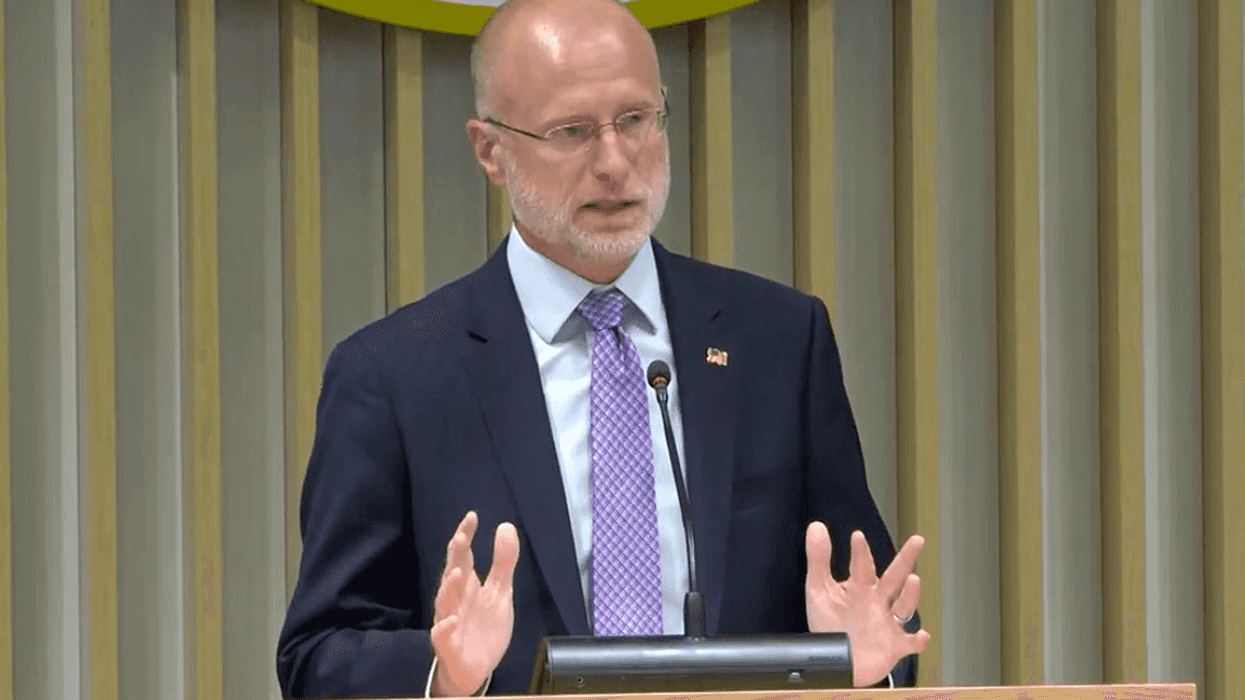
Brendan Carr

FCC Officials Took Paramount's Pricey Gifts While Company Sought Deal Approval

Reprinted with permission from ProPublica

The rich and famous who filed into the Kennedy Center’s opera house in December were there to enjoy one of the nation’s most exclusive celebrations of the performing arts: the center’s annual honors gala.

The black-tie event, hosted by President Donald Trump, prioritized tickets to people who donated more than $75,000 to the center. This year, it feted Hollywood icon Sylvester Stallone, the legendary glam rock band Kiss and the Grammy Award-winning disco pioneer Gloria Gaynor.

Among the attendees that evening were two lower-profile government officials whose regulatory decisions had been crucial to the future of the gala’s broadcast sponsor, CBS, and its parent company, Paramount.

Five months earlier, Federal Communications Commissioner Olivia Trusty cast a decisive vote approving Paramount’s historic $8 billion merger with Skydance Media. Now, the commissioner and a guest enjoyed the star-studded celebration thanks to tickets gifted to her by Paramount worth more than $12,000, according to ethics disclosure records obtained by ProPublica.

The other commissioner who approved the merger watched from a prized perch. FCC Chair Brendan Carr and his wife sat in a private skybox with Paramount CEO David Ellison and other executives from Paramount and CBS. Such seats sold for $125,000 a ticket, according to Kennedy Center guidelines.

It’s unclear if Paramount gifted Carr the premium seats because the FCC has yet to make public his financial disclosure for last year.

However, past disclosures show Carr and Trusty are among seven FCC commissioners who have accepted Kennedy gala tickets from CBS or its parent company over the last decade. Ethics experts told ProPublica this poses a blatant conflict of interest since the commission regulates the network. Carr’s previous financial statements show he has accepted tickets at least seven times since his 2017 appointment, totaling over $63,000 in gifts.

Last December’s ceremony attended by Trusty and Carr took place as Paramount was launching a hostile takeover bid for Warner Bros. Discovery, a move that would later result in a merger agreement that requires FCC approval.

Federal ethics rules ban employees from taking gifts from any entity that does business with, is regulated by or seeks official action from their agency.

Four ethics experts told ProPublica that by accepting the premium tickets Trusty and Carr compromised the FCC’s impartiality and should not take part in any upcoming decision on the merger.

“There’s no way that any top federal regulator should ever, ever accept a gift from a regulated company with interests their work will foreseeably affect,” said Walter Shaub, who led the federal Office of Government Ethics from 2013 to 2017. “The appearance of taking gifts like that is terrible. What’s at stake is nothing less than the public’s trust in government.”

Virginia Canter, who served as an ethics lawyer at the White House, Treasury Department, and Securities and Exchange Commission during the presidencies of George H.W. Bush, Bill Clinton, George W. Bush and Barack Obama, said the commissioners who accepted tickets cannot participate in this matter without damaging the integrity of the government’s decision-making process.

“This is shocking. Pretty disturbing, that’s what I would say. I just don’t understand what they were thinking,” said Canter, who now works as chief counsel for ethics and corruption at the nonpartisan government watchdog group Democracy Defenders Fund.

The FCC’s review of the merger is one of the final hurdles facing a historic $110 billion consolidation of two of the five largest film studios in Hollywood. The deal would unite Paramount Skydance with Warner Bros., bringing under the control of one company Paramount+ and HBO Max streaming services; CBS and CNN; and scores of other major broadcast channels, cable networks, and digital platforms.

The new megacorporation, which could reshape how millions will access news, movies, sports and video games, faces fierce opposition from inside and outside Hollywood. More than 5,000 actors, producers and entertainment workers — including stars such as Robert De Niro, Javier Bardem, Joaquin Phoenix and Glenn Close — signed an open letter decrying how the consolidation would eliminate jobs and compromise “the integrity, independence, and diversity of our industry.”

On Monday, California, New York and 10 other Democratic states filed a lawsuit seeking to block the merger under federal and state anti-monopoly laws.

American and international regulators are evaluating the deal for its potential national security implications and impacts to consumers worldwide. Last week, the British government signaled it planned to investigate whether the new entertainment titan that would emerge from the union would unfairly stifle competition. The FCC’s ongoing review includes examining the Middle Eastern sovereign wealth funds backing the deal, including from Saudi Arabia, Qatar and Abu Dhabi.

The FCC usually has five commissioners — all appointed by the president and confirmed by the Senate to serve five-year terms — but the agency currently has only three. Any vote by the full commission would likely be decided by Republicans Carr and Trusty over Democrat Anna Gomez. Gomez was not at the December 2025 show but has accepted tickets from Paramount in the past. Because the FCC requires a three-commissioner quorum for a vote, any recusal could leave the panel unable to decide on the merger. Carr could decide to ask staff to approve the deal rather than bring it to a commission vote, but the ethics experts said he should recuse himself from any decisions affecting the Paramount merger.

The experts warned the commissioners’ gifts might become central in legal challenges and said the Justice Department should investigate potential violations of federal rules or laws.

Neither Carr nor Trusty responded to ProPublica’s requests for comment. Gomez said in a statement that she followed agency advice when she attended the event in 2023 and 2024. Her statement did not elaborate or otherwise address why taking gifts from Paramount did not pose a conflict of interest.

An FCC spokesperson said agency ethics officers have for years cleared commissioner appearances, finding it consistent with ethics law.

“FCC Chairs and officials have attended the same event, in the same ways, consistently from the Trump Administration to the Biden Administration to the Obama Administration,” the FCC said in a statement. “There has been no change in recent years.”

Shaub called the justification outrageous.

“It’s no excuse to say that you took the gift because everyone else was doing it or that your agency has had a bad habit of indulging in gift taking for a long time,” Shaub said. “That kind of explanation doesn’t work for school children, and it sure as hell doesn’t work for government officials who are supposed to have better judgment than a fifth grader.”

Read NowShow less
Vowing To Crack Down On 'Illegal Voting,' Paxton May Have Violated Texas Election Law

Vowing To Crack Down On 'Illegal Voting,' Paxton May Have Violated Texas Election Law

"This story was originally published by ProPublica.

Two weeks before this year’s primary elections, Texas Attorney General Ken Paxton announced the creation of a tip line for the public to report people or groups suspected of voter fraud.

“Free and fair elections are a cornerstone of a thriving republic, and with the authority granted to my office by the Legislature, we will stop at nothing to uncover and stop any illegal voting activity,” Paxton said in a February news release announcing the tip line.

The announcement linked to guidance from his office about election laws in Texas, which included a requirement to be a U.S. citizen, a prohibition on collecting mail ballots on behalf of others and a warning that “it is illegal to misrepresent your residence on election records or to establish a residence for the purpose of influencing the outcome of an election.”

“You must register to vote using the address where you reside,” the attorney general’s guidance stated.

Despite his own warnings, Paxton appears to have used an address where he did not live while voting in six elections in the past two years, including in May’s runoff that made him the Republican nominee for U.S. senator, according to records obtained by ProPublica and The Texas Tribune.

State Sen. Angela Paxton said in a 2025 divorce filing that Paxton, whom she accused of adultery, moved out of their Collin County home a year earlier. But Paxton continues to list the home’s address in the northern Dallas suburb on his voter registration. Angela Paxton declined to be interviewed. A source close to the Paxtons said the attorney general has not moved back into the home since leaving.

It is unclear where Paxton has lived for the past two years, but reporting by ProPublica and the Tribune has linked him to a home in neighboring Denton County since February.

Three election lawyers told the news organizations that Paxton may have violated the same Texas laws his office cautioned about in its news release.

ProPublica and the Tribune reached out to Paxton’s campaign on June 3, 15 and 25, asking why he remained registered to vote in Collin County when he appeared to no longer live there and about his connection to the Denton County property. A reporter also left a voicemail on his personal cellphone on June 25. The news organizations sent his government office and campaign staff an email on Monday with a detailed list of questions, including a request for Paxton’s response to election lawyers’ belief that he may be violating the law.

Paxton and his office did not reply until Monday’s email. Campaign spokesperson Madison Cercy did not answer the questions from the news organizations. Instead, she issued a statement saying that the attorney general has been “a national leader on election integrity, with a long record of defending Texas elections.” Cercy said that “attempting to insinuate otherwise and tear him down with a baseless, lie-filled tabloid story is not real reporting.”

Asked twice to provide specifics about what they believed was inaccurate, the campaign did not respond.

Voting in an election when the voter is ineligible is a second-degree felony under Texas law and is punishable by up to 20 years in prison and a fine of up to $10,000. But prosecutors rarely bring cases challenging individual voters’ residency claims because they are hard to prove, the election lawyers said.

State courts have repeatedly ruled that there is no single way to determine where someone lives, and judges must consider multiple factors, such as where a voter sleeps or stores personal belongings. Prosecuting such cases also requires proof that a voter “knowingly” or “intentionally” broke the law.

Even if it’s clear that someone doesn’t live at the address where they are registered to vote, state law allows them to remain registered if their absence is temporary and they intend to return. The provision is commonly used by college students and military service members.

“So long as you truly intend to return, I think you’re fine,” said Beth Stevens, an election lawyer who worked for the Harris County clerk and the Texas Civil Rights Project. “When you start doing things that suggest, ‘Oh, I’ve fully moved. I’m just wink-wink saying I intend to return,’ that’s when you get into questionable territory.”

Paxton’s public and contentious split from his wife could make it difficult to argue that he intended to return to the home they own and where she continues to reside, said David Becker, a former voting rights lawyer for the Justice Department.

“I think there would be questions raised about a residence where someone does not live, does not spend the night and can in no way have the intent to continue to reside. Those would probably raise red flags in any state,” Becker said.

Becker, who is now the director of the Center for Election Innovation and Research, a Washington, D.C.-based nonprofit that works to build public trust in elections, added that the situation is particularly problematic because Paxton’s job is to enforce election laws.

“Certainly, the chief law enforcement officer of the state of Texas, someone who has made claims about election integrity and made it a priority of his office, should be charged with knowing the laws of residencies of the state of Texas with regard to voting,” Becker said.

Paxton has advocated for strict enforcement of the state’s election fraud law, including in cases against voters his office alleged had falsified records about where they lived. In 2018, the attorney general’s voter fraud unit arrested nine people on suspicion of using residential addresses where they did not live to vote in a municipal election in Edinburg, in the state’s Rio Grande Valley. County prosecutors, acting on behalf of Paxton, later dismissed the charges after failing to secure a conviction against the mayoral candidate they alleged had encouraged those voters to register at false addresses. The candidate, Richard Molina, said he was innocent and said the prosecution was politically motivated.

Clark Birdsall was not the attorney on those cases but defended another resident whom Paxton prosecuted for illegal voting. Birdsall was stunned that the attorney general appears to have voted under an address where he does not live.

He called it “especially egregious that someone such as Ken Paxton appears he’s not conforming to the law.”

State privacy laws allow some politicians and law enforcement officials to shield their voter registration information from public view. Paxton does not do so. His opponent in the Senate race, Democratic State Rep. James Talarico, does. Talarico’s campaign said he lives and is registered at the north Austin home he purchased in 2022. ProPublica and the Tribune were not able to independently confirm this.

Paxton’s campaign did not raise any issues with Talarico’s voter registration. In her statement to ProPublica and the Tribune, however, Cercy said, “Talarico has actively campaigned against voter security measures” and has said he opposes voter identification requirements. She pointed to a 2021 Fox News interview in which the state representative said he opposed voter identification rules that would require Texans to provide their driver’s license number or partial Social Security number for mail ballots. Talarico said hundreds of thousands of Texans, who don’t drive, lack a driver’s license. He did not directly answer a question about Social Security numbers during the interview.

The Talarico campaign did not respond to a request for comment.

Paxton’s living arrangements since he separated from his wife are not public, but information obtained by ProPublica and the Tribune offers some indication of where he may have been residing since February.

In mid-February, a trust bought a 5,000-square-foot home listed for $2.4 million in a gated community in Denton County, according to the appraisal district and the seller’s real estate agent. The trust did not disclose its ownership to Denton County officials. Trusts are not required to by law, a spokesperson for Travis County’s appraisal district said.

Paxton shares a separate blind trust with his wife, Angela, that they have used to purchase property and other assets. For years, the address listed for that blind trust had been an office building in Collin County. But that address was changed to the Denton County home a week after the property was purchased.

Angela Paxton said through a spokesperson that she has no connection to the Denton County home or the trust that purchased it. The trustee of the Paxtons’ trust, family friend Chip Loper, did not respond to questions about the address change.

In June, a reporter knocked on the door of the Denton County home. No one answered. When the reporter placed a letter for Paxton in the mailbox, an envelope addressed to Warren Paxton, the attorney general’s given name, was visible.

Later that week, Paxton appeared on a podcast with Texas Lt. Gov. Dan Patrick. Video from the podcast showed Paxton seated in front of a fireplace and mantle that were nearly identical to those depicted in the home’s online real estate listing. One resident also told the newsrooms that they spotted Paxton in the gated community.

Separately, the Daily Mail reported in May that Paxton had moved into the Denton County home with Tracy Duhon, whose extramarital affair with Paxton, the news outlet said, prompted his wife’s divorce filing. The Daily Mail also published a video of Paxton and Duhon that it reported was taken at an airport in Iceland in late June. The video was quickly seized upon by Talarico, who depicted Paxton as out of touch with Texans. Duhon did not respond to questions about her connection to the Denton County property or about the Daily Mail reporting.

Paxton is not registered to vote in Denton County, voter rolls show. Instead, since February, he has voted in Collin County twice: once in the March Republican primary and once in the May runoff. Each Texas county elects its own slate of local officials, which is why state law requires voters to register where they live.

Ekow Yankah, a law professor at the University of Michigan whose expertise includes election law, said Paxton’s voter registration situation should remind the attorney general of what studies have consistently shown: that intentional illegal voting is rare.

“You would think that somebody who’s going through this would learn a little bit of humility that lots of things which look on their face, like technical violations of the law, are usually explained by totally ordinary things,” Yankah said. “It’s only if you’re utterly cynical and ignore all the evidence that you make a claim that, in fact, these cases are attributable to nefarious criminal intent.”

Paxton cannot claim ignorance of the law because he enforces it, said Joshua Blank, research director of the Texas Politics Project at the University of Texas at Austin. In fact, as attorney general, Paxton should avoid even the appearance that he is not following the law, Blank said.

“We expect these laws to be understandable by ordinary citizens,” Blank said. “When our elected officials who are tasked with passing and enforcing these laws exhibit troubles in engaging with the voting process themselves, that raises serious questions.”

mike johnson and jim jordan

Big Oil Funds Project Teaching Judges 'Healthy Skepticism' of Climate Science

This story was originally published by Pro Publica

For many months, conservative lawmakers and political operatives have been targeting the scientists and lawyers behind the Climate Judiciary Project, a program meant to educate the courts about climate science, alleging that their effort constitutes a conspiracy to influence federal judges and persuade them to rule against the oil industry.

Now, just as congressional investigators are escalating a formal inquiry into the project, a separate program closely aligned with the fossil fuel industry and free-market conservatives is hosting a symposium for 150 judges in Nashville, Tennessee. The program, run by the Antonin Scalia Law School at George Mason University, also aims to educate judges, but in a way that prioritizes American business interests and questions climate science.

The dueling efforts come as a number of significant lawsuits seeking to hold fossil fuel companies accountable for climate damages are making their way through the courts and as oil-industry-aligned attacks on climate policies, and the legal arguments supporting them, have been sharply increasing.

ProPublica reported in April that political operatives connected to the conservative activist Leonard Leo were coordinating an effort across 11 states to pass laws shielding fossil fuel companies from liability for climate harm. In the past three weeks, similar liability waiver bills have been introduced federally in both the House and the Senate. Last week the Florida attorney general’s office launched an investigation into alleged judicial influence by the organization that oversees the Climate Judiciary Project, the Environmental Law Institute, a nonpartisan legal scholarship group funded until recently by the Environmental Protection Agency.

These developments come on the heels of a campaign last winter to get the Federal Judicial Center, the publishing body for the federal court system, to retract a roughly 90-page chapter devoted to climate science from the latest volume of its technical manual for judges. Twenty-two Republican attorneys general wrote to Rep. Jim Jordan of Ohio, the Republican chair of the House Judiciary Committee, demanding that the committee investigate the center’s publication of material about how to weigh scientific evidence about climate and the weather because the chapter’s authors appeared to be biased.

In their letter, they noted the authors work for Columbia University’s Sabin Center for Climate Change Law and alleged the chapter was influenced by Michael Burger, the executive director of the center who works closely with the law firm Sher Edling, which represents several climate plaintiffs. The Republican attorneys general also noted that some staff at the Sabin Center work with the Environmental Law Institute and the Climate Judiciary Project. Although the chapter had been peer reviewed and approved by the Federal Judicial Center, as well as by the National Academies of Sciences, Engineering and Medicine, the center retracted the climate chapter in February.

On April 28, Jordan went a step further, issuing letters accusing Burger, the Environmental Law Institute and Sher Edling of bias, conspiracy and collusion. Jordan demanded that the three parties produce private communications, receipts and records of funding sources, and that the recipients sit for interviews before the committee.

The Sabin Center, Jordan wrote, is “producing materials to be used to bias federal judges about novel climate-related legal theories” and coordinating to bring climate-related litigation to court. The activity raises questions about “the integrity and independence of the judicial process” and “ex parte contact with courts,” Jordan wrote, referring to the improper conduct of contacting a judge without opposing counsel present to argue issues related to a pending case.

Neither Sher Edling, the Sabin Center nor Burger responded to a request for comment. A representative for the Environmental Law Institute stated in an email that the Climate Judiciary Project “does not participate in litigation, coordinate with any parties related to any litigation, or advise judges on how they should rule on any issue or in any case. The goal of CJP is to provide judges with the tools they need to understand climate science and how it arises in the law.”

Jordan’s office replied to a request for comment by reasserting the statements in the letters it sent, and it did not respond to a detailed list of questions.

Amid the allegations of impropriety and conflicts of interest though, the program at George Mason University has scarcely been noticed.

The George Mason conference, called the “Judicial Symposium on Scientific Methodology, Expert Testimony, and the Judicial Role,” opened the day after Jordan sent out his letters and will continue through Saturday, May 2. It is run by the university’s Law and Economics Center, which oversees a project called the Judicial Education Program. The center is funded in part by ExxonMobil, which is a defendant in several of the climate lawsuits. ExxonMobil did not respond to a request for comment.

The conference includes speakers who have filed amicus briefs — filings by people who aren’t part of the case but have a strong interest in its outcome — in favor of the oil industry in several of those cases, as well as at least one lawyer who has represented fossil fuel companies in court. The reading assignments prepared for the judges include a Substack post by a notable climate contrarian accusing the authors of the retracted climate chapter in the federal court’s reference manual of including material by Burger and hiding his authorship. They also include a law journal argument that a key tenet of climate science used to identify the cause of disasters should be inadmissible in their courtrooms. One session, titled “Debates on the trustworthiness of tools to evaluate science in the courtroom,” focuses entirely on the federal courts’ reference manual.

In an emailed response to ProPublica, Donald Kochan, the executive director of George Mason’s Law and Economics Center, which organized the event, presented the symposium as a robust and objective discussion. The program’s advisory board, he wrote, is a politically and jurisprudentially diverse group including “some of the most progressive jurists in the country, including on climate issues.” Kochan, who did not respond to a list of specific questions, added that lectures are by leading academics on science and law and that he invited the authors of the judicial reference manual to speak but they declined, as did several others who he suggested would have represented more centrist viewpoints on the climate issue.

The conference is one of dozens of meetings, retreats and “intimate weeklong gatherings” that are regularly hosted by the Law and Economics Center as part of an initiative to instill free-market values and greater knowledge of the economic consequences of policy in judicial decision-making. In 2016 the law school renamed itself after the former Supreme Court Justice Antonin Scalia and the center expanded with $30 million in gifts, adding faculty and scholarships and launching additional “colloquia.” The center today runs several parallel initiatives under the umbrella of the Judicial Education Program, each aimed at gathering judges together and educating them. The symposium on science and evidence is one of these events.

According to an internal fundraising document from 2020 obtained by ProPublica, the gatherings are often luxurious all-expenses-paid affairs, created to foster lasting relationships and opportunities to network with judges. The document included a solicitation for more than $930,000 sent by the center to the Charles Koch Foundation, a libertarian organization that provides grants to universities and scholars. At the time of the proposal, more than 5,000 judges representing all 50 states had attended at least one of the organization’s programs, the document stated.

The goal of the symposium, according to the document, is to sway judges toward a libertarian economic viewpoint in their rulings — the very sort of “biasing” that Jordan accused the Sabin Center and the Climate Judiciary Project of.

“The goal of this project is to expose judges to the intellectual history of the role of capitalism, economic freedom, and a constitutionally limited government as fundamental features of a liberal society,” the document says. It is also to establish a community of like-minded justices “with synergistic effects on the judiciary as a whole” and to influence the outcome of cases that come before the courts. Judges, the fundraising proposal continues, “urgently need to cultivate an understanding” of economic analysis and its relevance to the legal system if they “are to issue decisions that advance the rule of law and America’s free enterprise system.”

According to the George Mason University website, the Law and Economics Center’s 2025 funders include DonorsTrust, a dark money pass-through organization meant to shield the identity of contributors. DonorsTrust is often used by organizations tied to Leo, who brought George Mason a $20 million gift, in addition to $10 million from the Charles Koch Foundation, that made expansion of the law school’s program possible.

This weekend’s symposium in Nashville is one of the most significant parts of the center’s outreach to justices. According to the 2020 fundraising letter, the goal of such gatherings is to challenge the status quo on science. The conference “will give judges a rounded understanding and healthy skepticism of the invocations of ‘science’ that lurk in the background of lawsuits they are hearing,” the center’s then-director wrote, and it will help judges understand that “so much of what passes as ‘science’ for leverage purposes never has to face tests for rigor, reliability and quality in front of a neutral arbiter.”

One of the symposium’s events prominently features Philip Goldberg, a managing partner at the law firm Shook, Hardy & Bacon and the special counsel to the National Association of Manufacturers’ policy lobbying arm, the Manufacturers’ Accountability Project, which the group describes as “the leading voice of manufacturers in the courts.” MAP, as it is called, has publicly rejected the claims in a landmark case that the city of Honolulu brought against Shell, ExxonMobil and other oil companies alleging they misrepresented the risks of using their fuels and are responsible for the damages they have caused. Goldberg authored a brief for the group that was submitted to the Supreme Court on the case in 2024.

Goldberg, who did not respond to a request for comment, has also authored briefs in climate liability cases brought by the city of Baltimore against BP and other fossil fuel companies — a case won by the defendants in March — as well as a case brought by Boulder County in Colorado against Suncor Energy and ExxonMobil, which alleges the companies misrepresented the risks of using fossil fuels. Lawyers from Shook, Hardy & Bacon are also present at the conference. Other lawyers at the firm wrote a brief in favor of Chevron in a case brought by Plaquemines Parish, Louisiana. (The oil companies dispute the allegations and each of these cases is ongoing.)

For its assigned reading for a session on the judicial manual, the symposium offered an article by the political scientist Roger Pielke Jr., a senior fellow at the conservative American Enterprise Institute. Pielke wrote that he found evidence that the true authorship of a significant part of the climate chapter in the reference manual was obscured. He used the Claude artificial intelligence program to run an analysis comparing the chapter’s text to a paper co-authored by Sabin’s Burger and said he found a correlation.

“Michael Burger did not write any of the text in the climate science chapter nor did he have any control over the content and scope,” one of the chapter’s two authors, Jessica Wentz, who has denied the chapter was biased, wrote to ProPublica. The other author did not respond, and Burger declined to comment.

The conference did not offer readings from the climate chapter of the manual itself, which is still available on the website of the National Academies of Sciences, Engineering and Medicine. Nor did it offer readings from the United Nations climate science authorities or climate-related readings from any other peer-reviewed scientific journal.

In its final session, the symposium features attorney Matthew Wickersham of the firm Alston & Bird, which has served as counsel for Chevron in several lawsuits. Wickersham did not respond to a request for comment. The only reading assigned to justices for that session is a paper Wickersham wrote in the Rutgers Law Record in 2025 about why attribution science — the field of study that makes it possible to link climate disasters to specific amounts of pollution and their sources — should never be admitted in court.

Shop our Store

Headlines

Editor's Blog

Trending

World