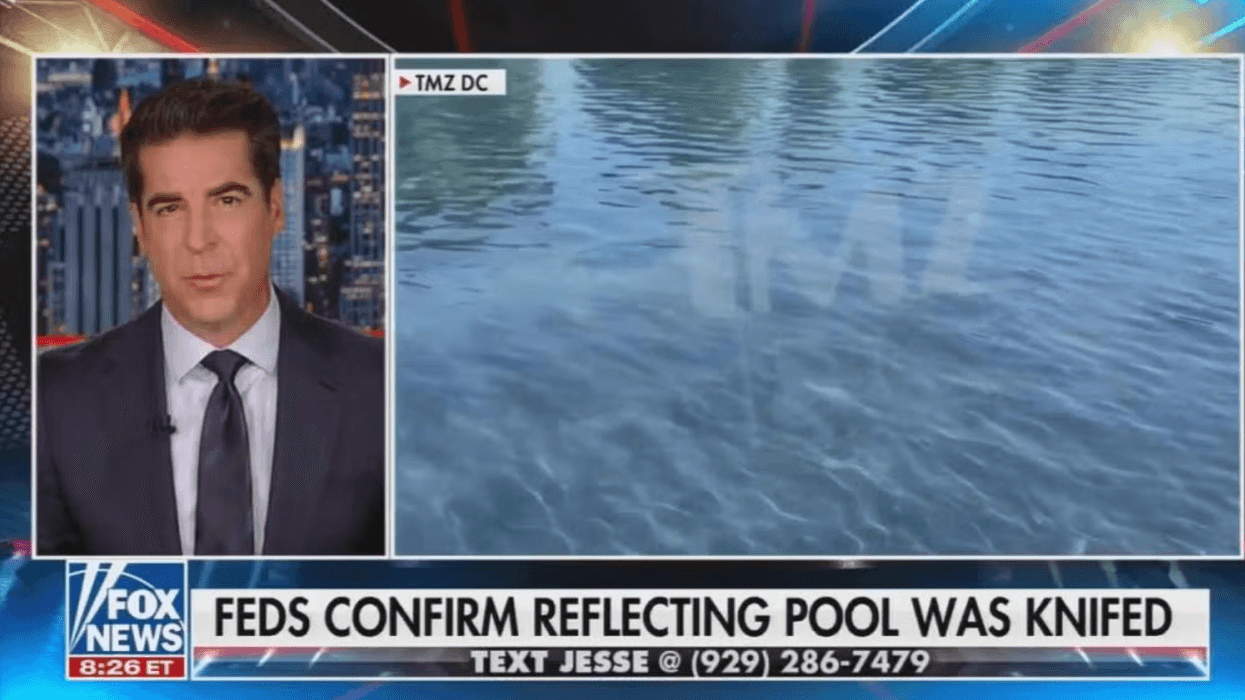
It’s hard to imagine a more consummate and humiliating debacle than the complete retreat that the Department of Justice was forced to execute in the Reflecting Pool case.
It would loom even larger if the Department’s reputation were not already in tatters. Having staked a large portion of its remaining credibility on the charges against David Hearn, the 67-year-old former Olympic canoeist whom her office had accused of vandalizing the Reflecting Pool, U.S. Attorney Jeanine Pirro was reduced on Friday evening to confessing, in a twenty-page filing, that its whole theory was false: the Lincoln Memorial Reflecting Pool had been ruined not by vandals but by the administration’s own botched, rushed renovation.
Some observers gave the DOJ credit for belatedly doing the right thing, taking Pirro at her word: diligent prosecutors misled by a careless sister agency, who moved to dismiss the moment they learned the truth. In fact, Pirro had zero choice. A grenade had been hurled into her office, and she was forced to fall on it. No points here for virtue.
Pirro’s motion did not just fold quietly. It took the Interior Department to task for withholding what it knew, insisting that had the agency “been forthcoming with the information clearly in its possession, the government would not have sought a grand jury indictment.” And it repudiated the prosecution’s own theory, conceding that the damage “was the result of a botched installation and not vandalism,” and that “it is difficult to attribute the widespread damage to the Reflecting Pool to vandalism, let alone to establish that fact beyond a reasonable doubt.”
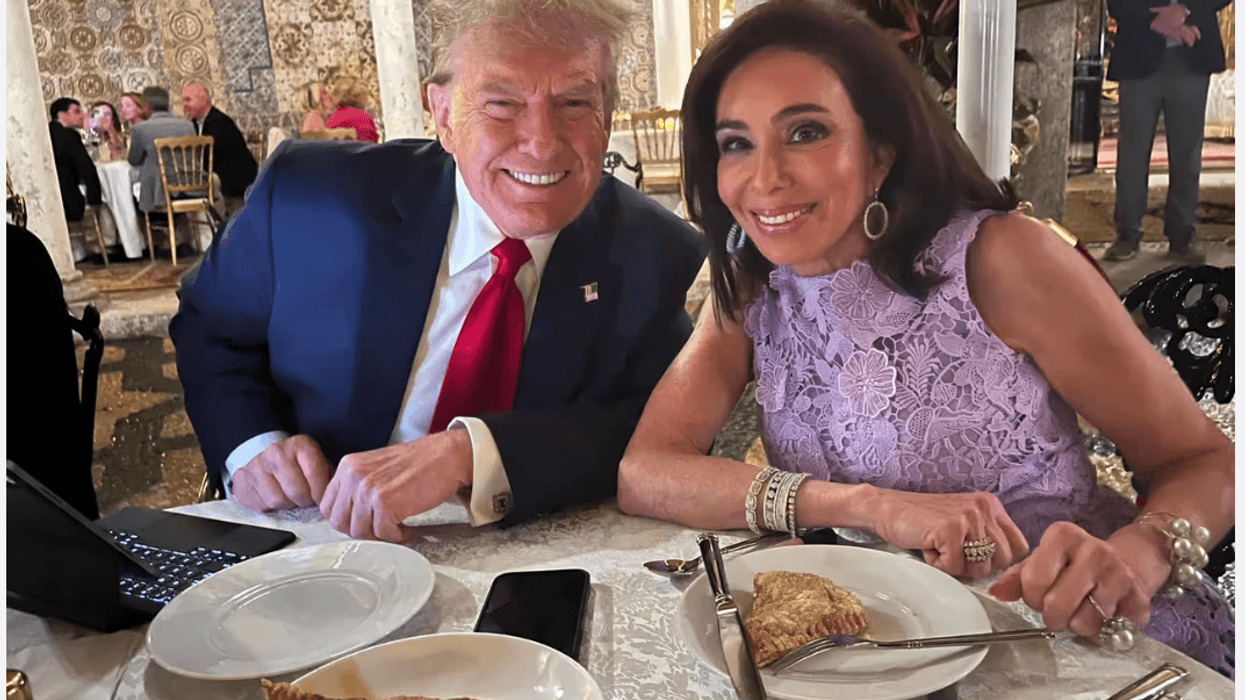
Pirro even put herself crosswise with the president, a friend and ally since the 1980s, who to this hour insists the pool was slashed with knives and box cutters and wants the case pressed. “I disagree 100% with Jeanine Pirro,” Trump fumed on Truth Social. “I don’t know what she was thinking?” For a prosecutor who has spent this administration as one of Donald Trump’s most reliable instruments, dismissing his pet case and blaming his renovation looks like a rare act of conscience.
The move that forced Pirro’s hand was the receipt of documents from the Department of the Interior demonstrating that the pool’s lining was peeling because of a rushed, failed installation—in other words, not because David Hearn tugged at a flap of it. That revelation is classic Brady material: evidence that supports the defendant’s innocence. Such material has to be turned over to the defense right away. Pirro’s own motion piously recites the point, reminding the court that “prosecutors have an affirmative obligation pursuant to Brady v. Maryland“ to produce such evidence to the defense—which takes some nerve, given that the reason she was writing was that the Brady bomb had just gone off in her hands.
So once those documents surfaced, Pirro found herself, like Odysseus, between Scylla and Charybdis. She could dismiss on her own terms, spinning the story as diligent prosecutors misled by a careless agency. Or she could turn the material over to Hearn’s lawyers and let them present it to Judge Todd Edelman—a former career public defender who, a week earlier, had already warned the government it was “operating at its own peril” in the case. Handed the Interior documents, he would have blown his top and dismissed the indictment himself, and potentially referred Pirro for disciplinary proceedings to her state bar.
Pirro’s hand was forced. The dismissal was not an unlikely visitation of virtue. It was damage control and cutting her losses. Her motion nonetheless drapes the retreat in principle, reciting that under “the Department of Justice’s Principles of Federal Prosecution, a criminal prosecution should only be maintained if the defendant ‘will more likely than not be found guilty beyond a reasonable doubt by an unbiased trier of fact and that the conviction will be upheld on appeal.’” She invokes the Department’s high charging standard as though walking away were an act of conscience rather than the only move left on the board.
Pirro’s immediate surrender served other, self-interested purposes. The prosecution was already so slapdash and improper that it raised the prospect of two looming train wrecks. The hasty dismissal is designed to avoid them both. We should hope some reckoning is still ahead.
The first is the distinct prospect of yet another gross impropriety in the grand jury. Hearn filed a motion on July 27, alleging that the government failed to present the grand jury with any evidence of damages. The administration had elevated what elsewhere were misdemeanor charges to a felony on the strength of a single statutory element: $1,000 or more in damage. Yet it apparently had no proof to offer of that amount of damages, or any amount. It is no different from charging a felon in possession and never introducing evidence of the gun.
And the hole was not incidental; the grand jurors saw it themselves. They questioned the government’s witness about the cost of the damage, and he could not quantify it. He testified, moreover, that the repairs would have been necessary regardless of anything Hearn did—the pool was already leaking more than a million gallons of water a week, its expansion joints past their service life, the liner already torn.
On that record, the grand jury somehow returned a felony indictment. Hearn accordingly moved for the full transcript and the instructions the jurors were given—a motion that, if granted, would have exposed how the prosecution steered a grand jury to a felony it had no evidence to support, and whether DOJ had once again committed misconduct behind those closed doors. Dismissing the case makes the question go away. For now.
The second glaring problem Pirro may hope to circumvent is her own flagrantly unethical conduct. When the indictment came down on July 2, Pirro did not let the charging document speak for itself, as DOJ norms require. She called a news conference and went well outside the record. “This is not only a priority for the president, but for myself,” she announced—publicly welding her office to Trump’s political grievance—and vowed, “We will prove beyond a reasonable doubt that Hearn willfully destroyed property at the Lincoln Memorial Reflecting Pool.” For good measure, she added that she had witnesses who saw him pull the lining up and destroy it, and that he faced up to ten years.
Making prejudicial, extrajudicial statements about a defendant is improper in itself, because it can taint the jury pool. It violates both DOJ policy and the state ethics rules that bind prosecutors. But it is far worse when the out-of-school statements are, as these sure now seem to be, whopping lies. A bar complaint over her handling of the Hearn case has already been filed in New York. Pirro can hope the spotlight on her conduct dims now that she has dismissed the case behind a skein of bromides about the Department’s high standards and the diligence of her prosecutors. She should not get that reprieve.
Which brings us to the telling gaps in Pirro’s own motion. Her defense, in essence, is that Interior misled her—that had she known the truth, she never would have charged. The first question that provokes is how the hell she rushed through a felony indictment without first checking with the responsible agency about the actual evidence.
And Interior does not concede that it left her in the dark. Interior Secretary Doug Burgum took to social media to contradict her outright, insisting his department “provided the U.S. Attorney’s office expert and eyewitness testimony to the damage done by vandals and provided every piece of evidence they asked for.” So the two arms of the government are now blaming each other in public—Pirro says Interior stiffed her; Interior says it handed her everything. It hardly matters which is lying: either way, Pirro charged a man with a felony she could not support.
And what about the witnesses she assured the public had seen Hearn tear up the pool? If they existed and were prepared to say he caused the widespread damage, they were prepared to perjure themselves—the government’s own records show that damage predated Hearn by weeks. So is the Department pursuing them? Were they friendly partisans, massaged into saying what the case required? Or did they never exist at all? The dismissal aims to bury those inconvenient, glaring questions.
A pedantic aside that I can’t resist. Pirro’s motion complains that Interior gave her office “less than fulsome” information—using “fulsome” to mean abundant. That usage has become common enough that the dictionaries now grudgingly allow it, but the older and better meaning is nearly the opposite: excessive to the point of being offensive or insincere, as in fulsome praise or fulsome flattery (more on the etymology of the word here). And that sense is almost too perfect here, because it was precisely the fulsome reinforcement of Trump’s false talking point—the swaggering, the boasts of tremendous evidence, the ten years—that produced this injustice in the first place.
All of this bluster and sloppiness gives the episode an element of farce. There is a Keystone Cops quality to the whole affair: Burgum insisting he could “absolutely” prove vandalism from the drained pool’s photographs, a president raving about a 300-foot slit cut with a box cutter, a U.S. Attorney promising tremendous evidence—all of it collapsing into a filing that concedes the pool fell apart due to the administration’s own botched renovation.
But the farce shouldn’t obscure the gravity—perhaps the purest instance of totalitarian abuse of the Trump years: the government cast a private citizen with no quarrel with Trump and no connection to the pool as the villain of a fiction, and moved to put him in prison for years.
The leader tells a lie everyone knows is a lie, and the machinery of the state sets about forcing the rest of us to repeat it, all the way to felony prosecution of a totally innocent bystander. That is what makes it the most perfectly Kafkaesque prosecution I can remember outside of the annals of fiction.
David Hearn went for a bike ride, stopped to touch a flap of coating that was already peeling, and put it back when a park employee asked him to. For that, the government of the United States tried to take ten years of his life. He is owed more than a dismissal. He is owed an apology—and the rest of us are owed an accounting of how the Justice Department came to be a willing and corrupt instrument of the president’s vanity.
Harry Litman is a former United States Attorney and the executive producer and host of the Talking Feds podcast. He has taught law at UCLA, Berkeley, and Georgetown and served as a deputy assistant attorney general in the Clinton Administration. Please consider subscribing to Talking Feds on Substack.
Reprinted with permission from Talking Feds.